










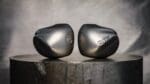

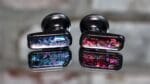



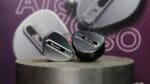
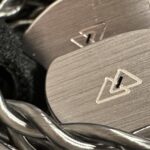
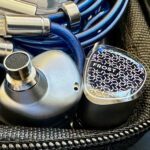
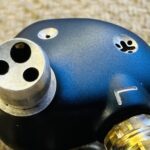





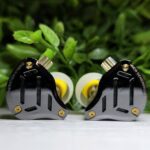









Hidizs MK12 X DucBloke Review
Intro
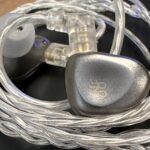
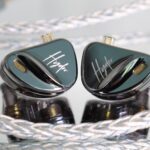
Hello everyone, today I have with me a brand new iem from the audio brand Hidizs named the Hidizs MK12 X DucBloke ($259) (MK12 X for review purposes). Yes, that is a mouthful, but there’s a reason for that. The reason being is that the MK12 X is actually a collaborative effort between Hidizs and the YouTube personality DucBloke. If I’m being honest, this collab came out of left field for me as I had zero idea it was even happening. However, when I read up on it, I was impressed by the idea of it. I believe the whole idea is to create a different version of the MK12 which in some ways relies on DucBloke’s PEQ settings to refine the sound even further. Which can’t be a bad thing being that the MK12 OG and MK12 Turris Titanium Edition both use that wonderful 91% Magnesium dynamic driver. Also, Hidizs would never get involved with something if it wasn’t a good idea which will bring something new to the table.
Table Of Content
- Intro
- Hidizs
- The Turris Bloodline
- They’re Here!
- Non-Affiliated Purchasing Links
- Gear used for testing
- Packaging / Accessories
- Unboxing
- Eartips
- Carrying Case
- Cable
- Build / Aesthetic / Internals / Fit
- Build Quality
- Aesthetic
- Internals
- Fit Comfort
- Drivability / Pairings
- Sensitivity
- Scalability
- Source Pairings
- My bias
- PEQ
- Sound Impressions
- What’s it sound like?
- Guilty Pleasure
- L-shaped, V-shaped?
- With respect to warmth and richness…
- Technicals
- DucBloke’s PEQ
- Hard Hit
- Neutral
- Sparkly
- My thoughts on the PEQ
- Bass Region
- Clean for its size
- Sub-Bass
- Mid-Bass
- Downsides to the Bass Region
- Midrange
- Musically Gifted, Emotionally Gratifying
- Lower-Midrange
- Males
- Upper-Midrange
- Females
- Downsides to the Midrange
- Treble Region
- Technical Stuff
- Pleasant
- Downsides to the Treble Region
- Technicalities
- Soundstage
- Separation / Imaging
- Detail Retrieval
- Comparisons
- Hidizs MK12 Turris ($164)
- Sound Differences
- Between the 20’s
- Final thoughts on this comparison
- Dunu x-Koto Ito ($199)
- Non-Sound Stuff
- Sound Differences
- Between the 20’s
- PEQ
- Final thoughts on this comparison
- Last Words on the Hidizs MK12 X DucBloke
- Somewhat Polarizing
- MK12 X Pros
- MK12 X Cons
- Genres
- Genres which work
- Genres that won’t work as well
- Conclusion
- Other Perspectives
Hidizs
Folks, I’ve completed many Hidizs product reviews by now and in every one of them I end up thinking each product is solid for its cost, solid against the competition, and generally fun. Hidizs has been at this audio game for a long-time folks. In fact, Hidizs genesis happened around 2009 when a young audiophile named Tamson decided to create a brand which would specialize in making affordable gear like daps, dac/amps, as well as iems for the masses. No doubt Hidizs made their mark with smaller pocket-sized daps and dongle dacs and coincidentally still are making affordable pocket-sized daps and dongles. Like their very popular Hidizs AP80 Pro Max that I just reviewed earlier in 2025, or their Hidizs S9 Pro Plus, among many-many others. However, Hidizs branched out from smaller daps, dac/amps, & dongle dacs and went hard on creating iems too. Well, the idea was a good one because Hidizs has successfully crafted some of the more legendary iem releases that the hobby has seen. Have any of you heard of the Hidizs MS3, or the Hidizs MP145? How about the MK12 Turris? The MP143 Salt, the MK10 ArcSonics, and don’t forget the best iem that Hidizs has ever made in the Hidizs MK12 Turris Titanium Edition. However, there is many more that I could add. The point is that Hidizs has truly turned into an all-rounder brand which has been able to master all aspects of personal audio. The nice thing is that I don’t see them stopping anytime soon. They will continue to push boundaries and I’m sure there are more legend status sets in their future.
The Turris Bloodline
Friends, I think I need to inject a little of my fondness for the line of iems that is the MK12 Turris “series” of iems. I don’t want to go too hard here, but I am very much smitten with the MK12 Turris series. Absolutely smitten! I never say the word “smitten” either. So… just know that I’m serious when I say that this reviewer finds great joy in this series. At any rate, the OG MK12 is one of those sets which began to redefine what $149 can buy you in the audio world. Easily one of the more prolific single DD iems under $150. That measure only grew with my favorite of the lineup, the MK12 Turris Titanium Edition. The Titanium Edition is quite easily my favorite up to this point and I don’t see that changing. It is a constant set that I reach for. Now, the MK12’s foundational build, the driver being used, the overall aesthetic, and of course the sound is what makes this series a special one. As I can see from promotional pictures the MK12 X (still awaiting their arrival) is exactly the same as the other two sets in shape, dimensions, and uses the same build material as the OG MK12. Also, I greatly enjoy the 91% Magnesium driver as it has those faster transients, and that very organic timbre. I can only imagine what Hidizs is going to do with a bassier version. I’m actually quite excited to hear it.
They’re Here!
Well, the MK12 X has arrived at my home, and I’ve spent a good bit of time with this set already. I am just about to upload DucBloke’s settings given to me by Hidizs and I will certainly spend time listening. Having said that, I actually really enjoy the base tuning, with no PEQ settings. So, this will be interesting. No doubt I can already tell you that you will have to enjoy a warmer sound and a more bassy sound to enjoy this set. Perhaps a hair polarizing. But that doesn’t mean that it isn’t very good at what it was tuned to be. I am definitely going to have to spend a ton of time with the MK12 X, let it run through my entire critical listening playlists (thousands of tracks) and do some good ‘ole casual listening. However, before any of that I am definitely going to burn-in this set and simply get to know them. At any rate, I’m definitely ready to get into this review. So, without further ado, the Hidizs MK12 X DucBloke…
Non-Affiliated Purchasing Links:
Gear used for testing
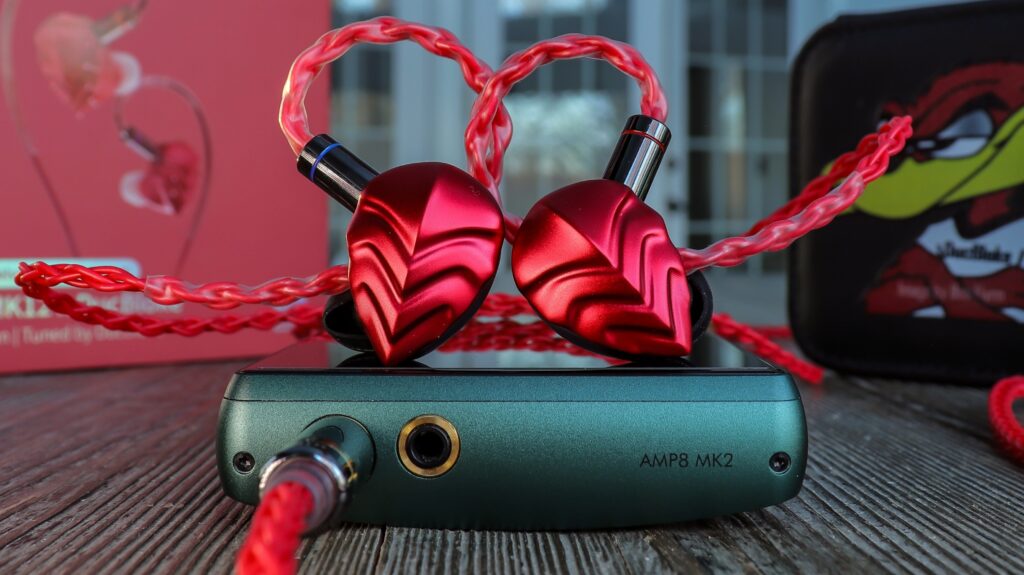
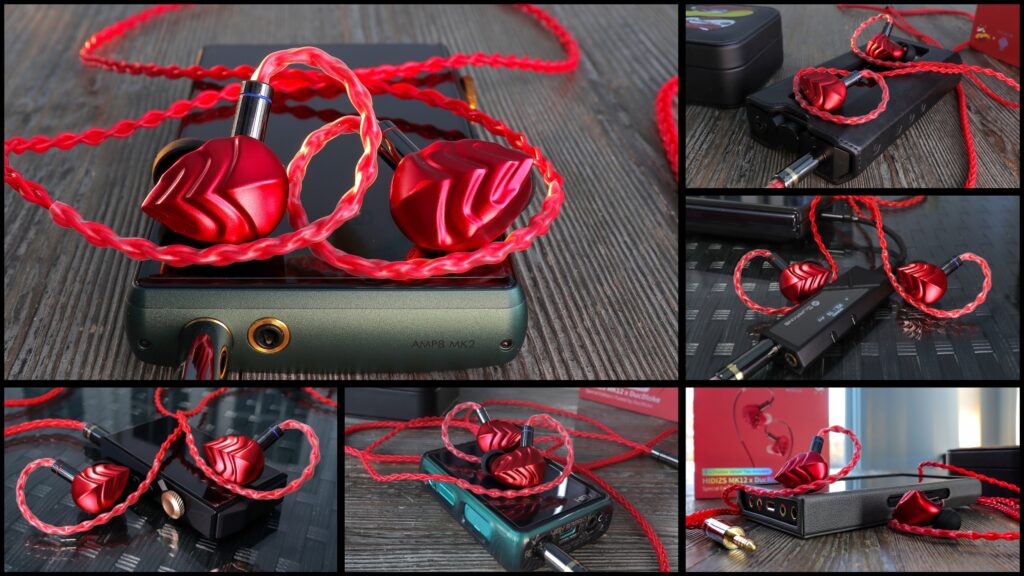
–IBasso DX240 with Amp8 MK2
-Many more sources used including weaker Android 3.5 set phones, iPad, and a few weaker 3.5 se dongles
Packaging / Accessories
Unboxing
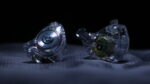
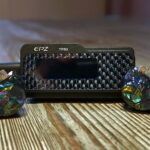
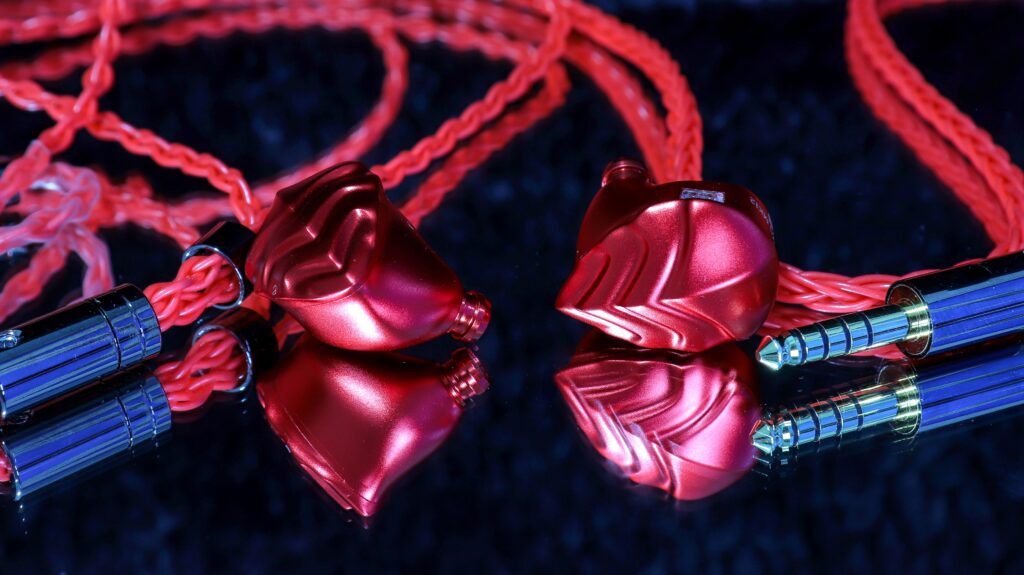
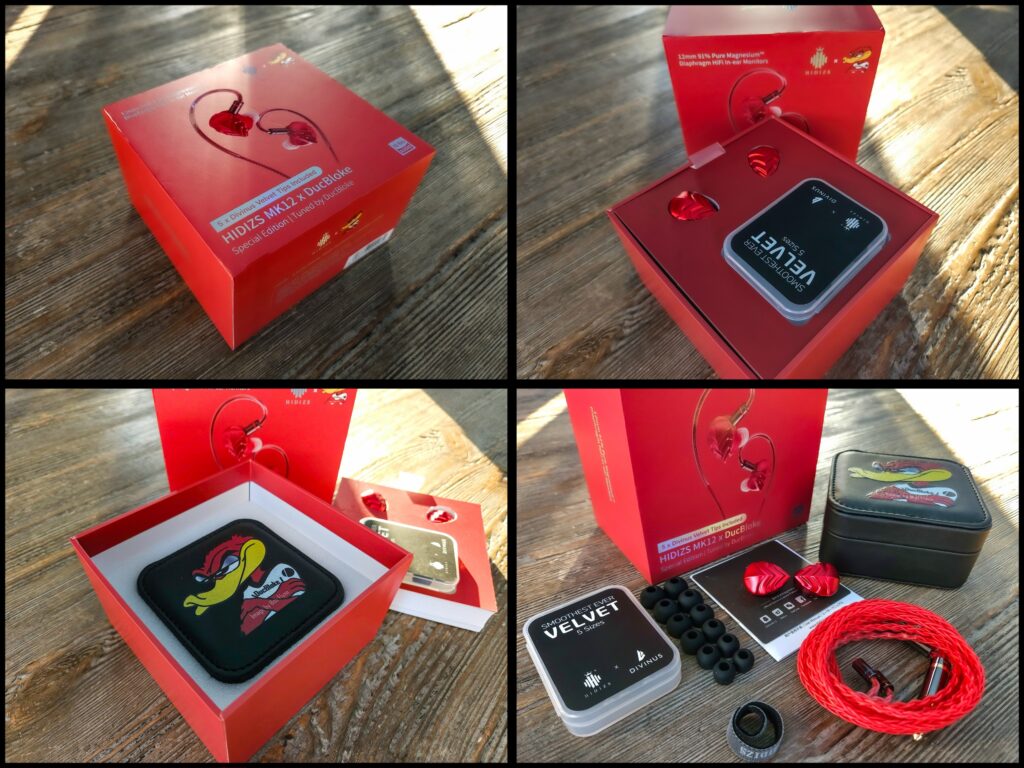
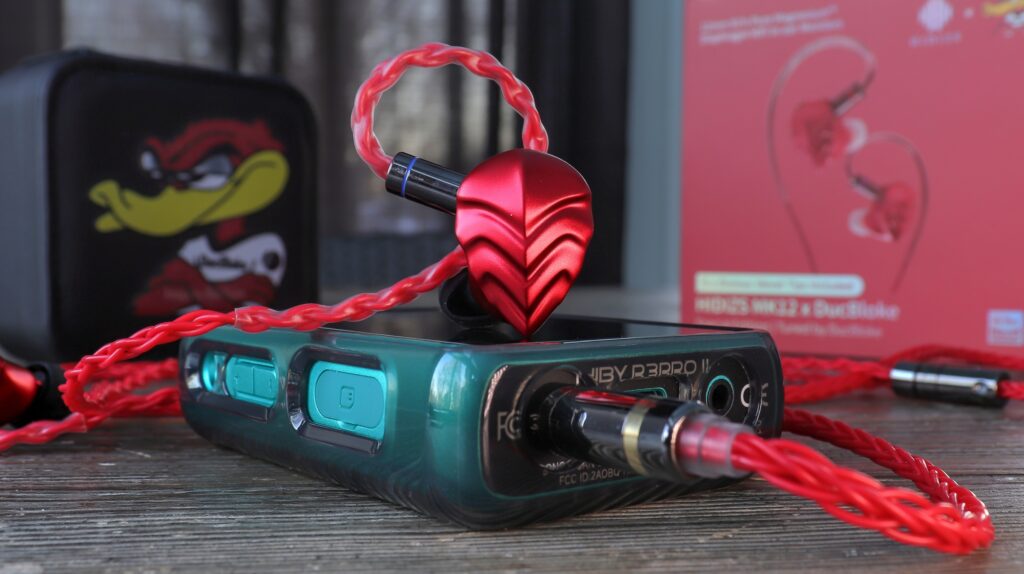
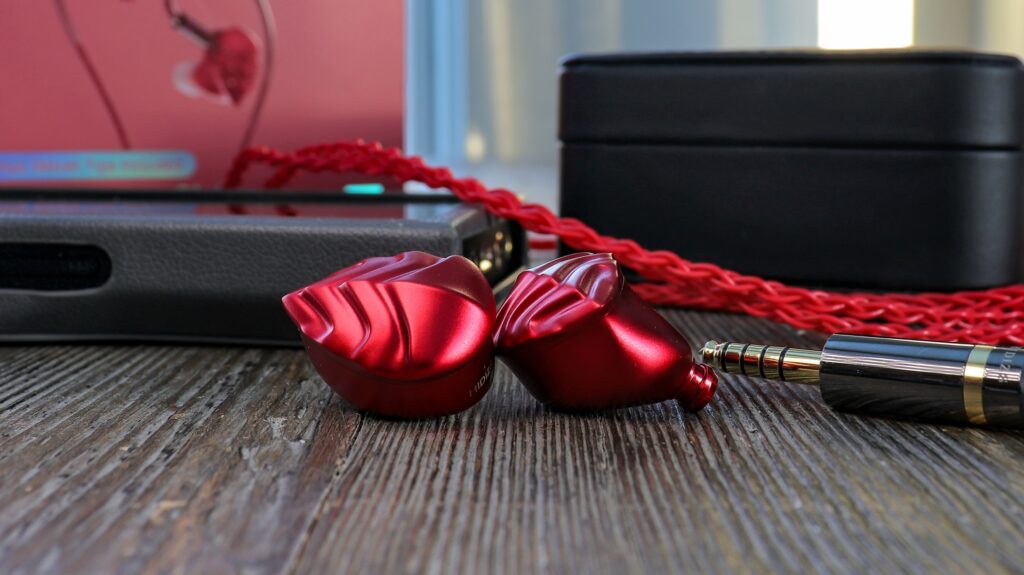
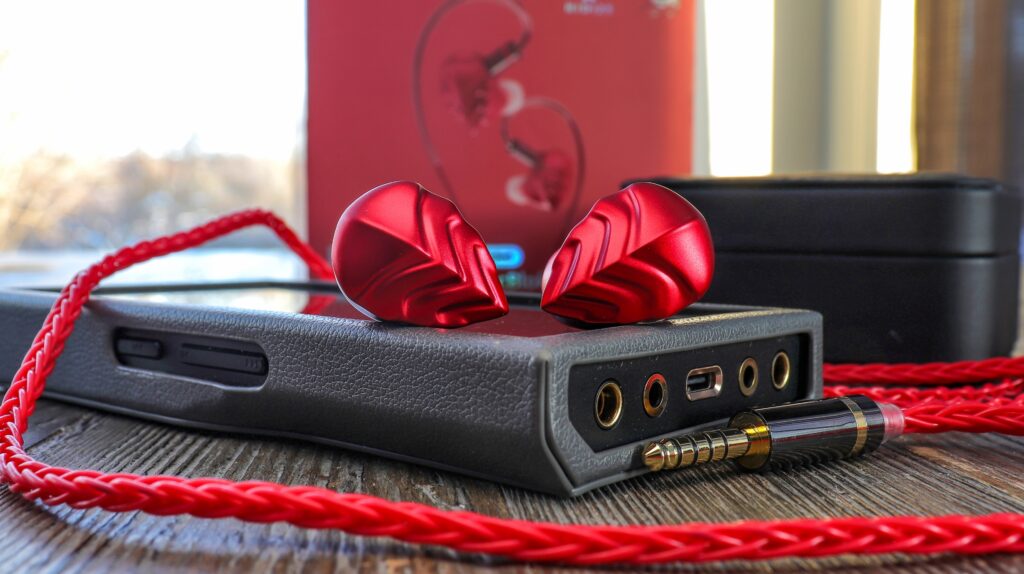
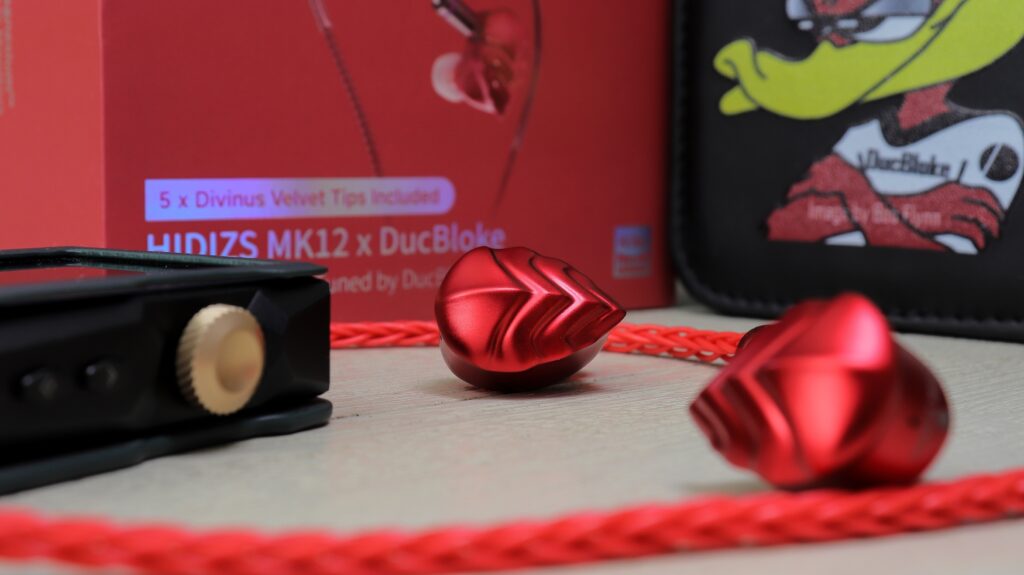
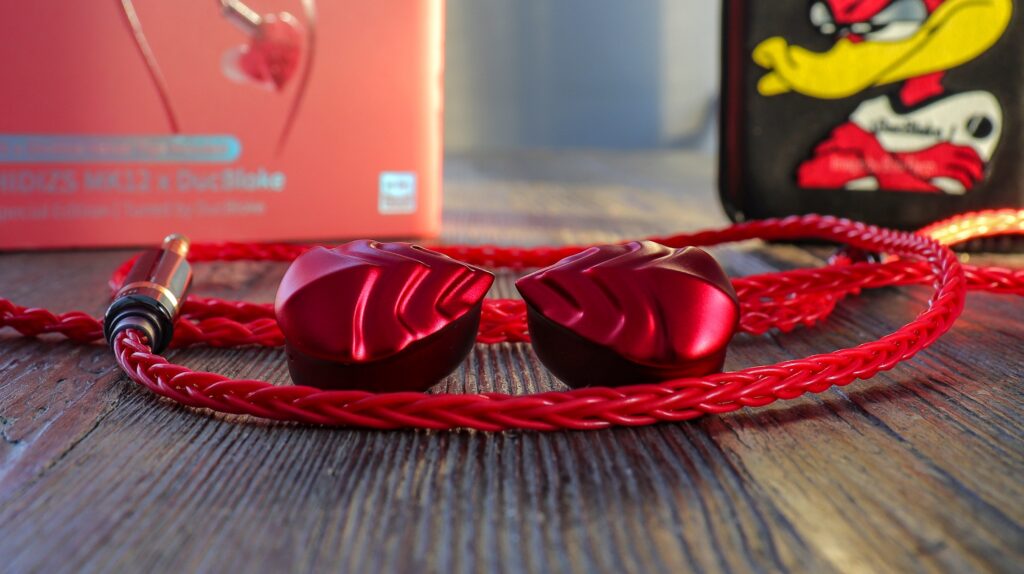
The Hidizs MK12 X DucBloke arrived at my home in a medium sized tall rectangular red box which features a picture of the candy red MK12 X on the front as well as Hidizs and DucBloke’s logos on the upper right corner. There’re also some specs on the back. Pretty normal I’d say. The box opens from the top and when you do so you will see the gorgeous fully red MK12 X’s staring back at you sitting in foam cut-outs. Lift off that layer of foam and you’ll see the cool square carrying case which has the DucBloke logo imprinted on the top. Inside the case you’ll find Divinus Velvet eartips in a nice plastic holder as well as the bright red cable. There’s really not much more to the unboxing. Hidizs kept it simple with a nice enough unboxing for the cost.
Eartips
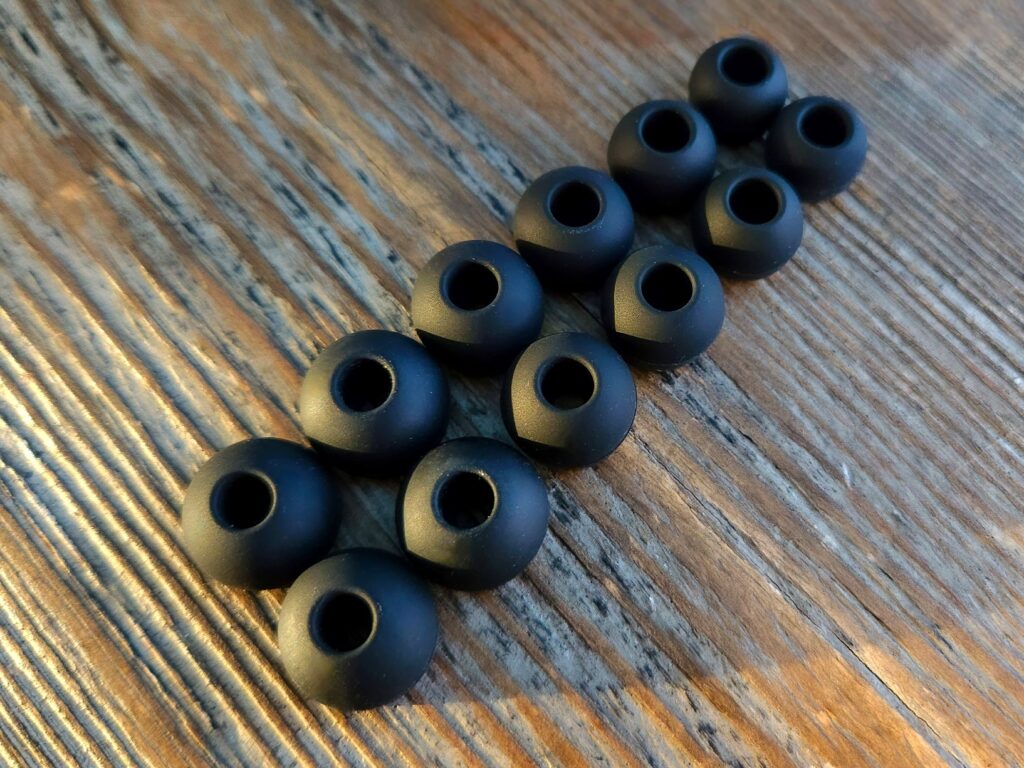
As I said, Hidizs added in five pairs of some very nice Divinus Velvet eartips (which I love). The eartips come in a small plastic case/holder of sorts which was a nice surprise upon opening the package. So, the Divinus Velvet are some very solid eartips which were created to not just enhance sound, but to be very comfortable too. I have always loved these eartips as they seal so well in my ears and never seem to put unwanted pressure anywhere on my ears either. Just fantastic inclusions into the packaging. However, sonically, the Divinus Velvet eartips are supposed to influence a more balanced approach to your iems and they are supposed to provide a smoother sound altogether. This happens because Velvet eartips are a semi-wide bore promoting that balance of upper frequency energy and bass depth. Really fantastic eartips and a great addition to the unboxing experience. I was happy to see them, let’s just put it that way.
Carrying Case
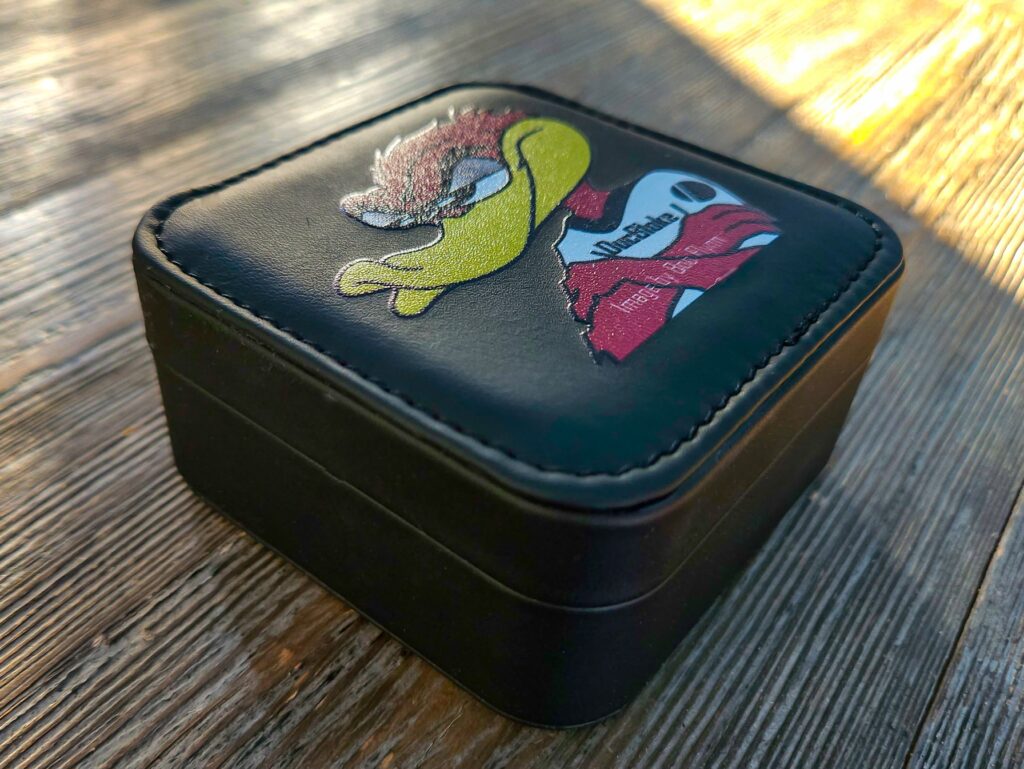
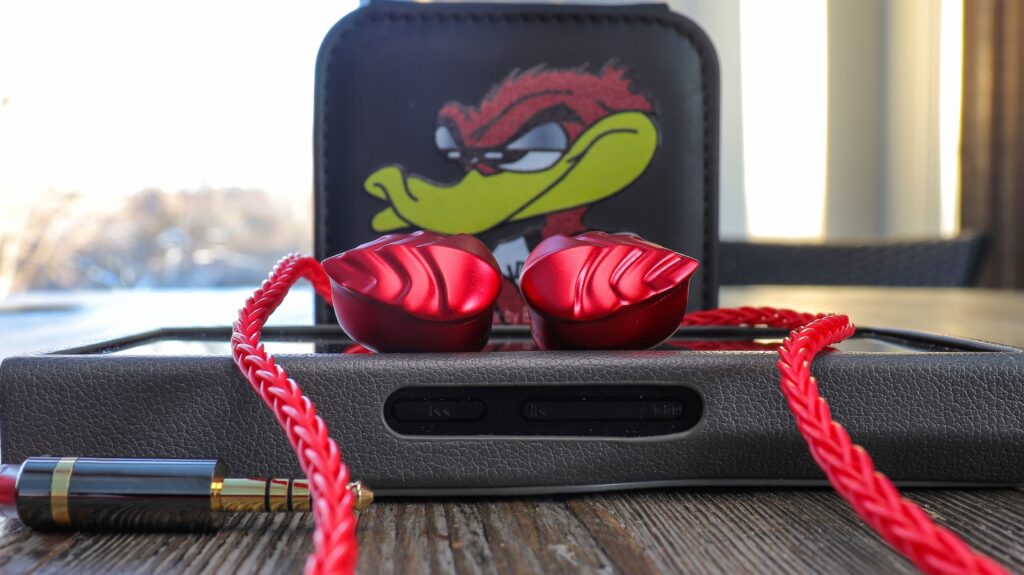
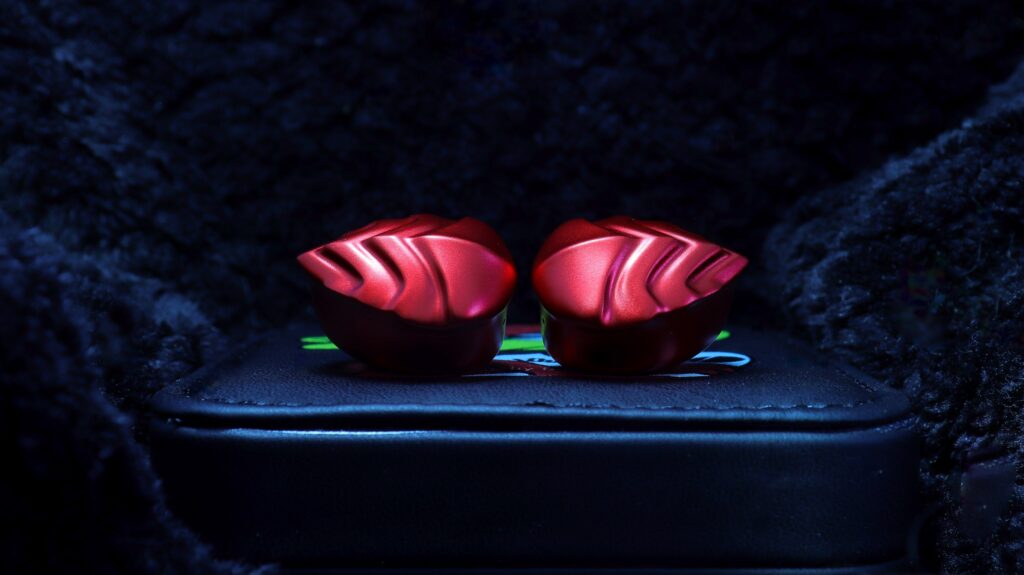
Now, usually Hidizs doesn’t add in carrying cases with their iems. Typically, they will provide that cool leather baggie instead. However, upon opening the packaging I was kind of taken aback when I saw the pretty square case with the DucBloke logo sitting squarely in the center of the case top. So that was a nice addition. At any rate, the case itself is a black case with what appears to be faux leather cladding covering it and the case stays shut using a strong enough magnet. Once again, the DucBloke logo sits squarely in the center of the case top and looks pretty slick. The carrying case is decently sized too. Large enough to comfortably fit the earphones and the cable attached along with some extra tips and such. So, not bad for simply throwing into a bag. You won’t have to worry about your precious MK12 X’s getting damaged. However, you obviously probably won’t be stuffing this case into your pocket. Someone would think you were happy to see them. Lol.
Cable
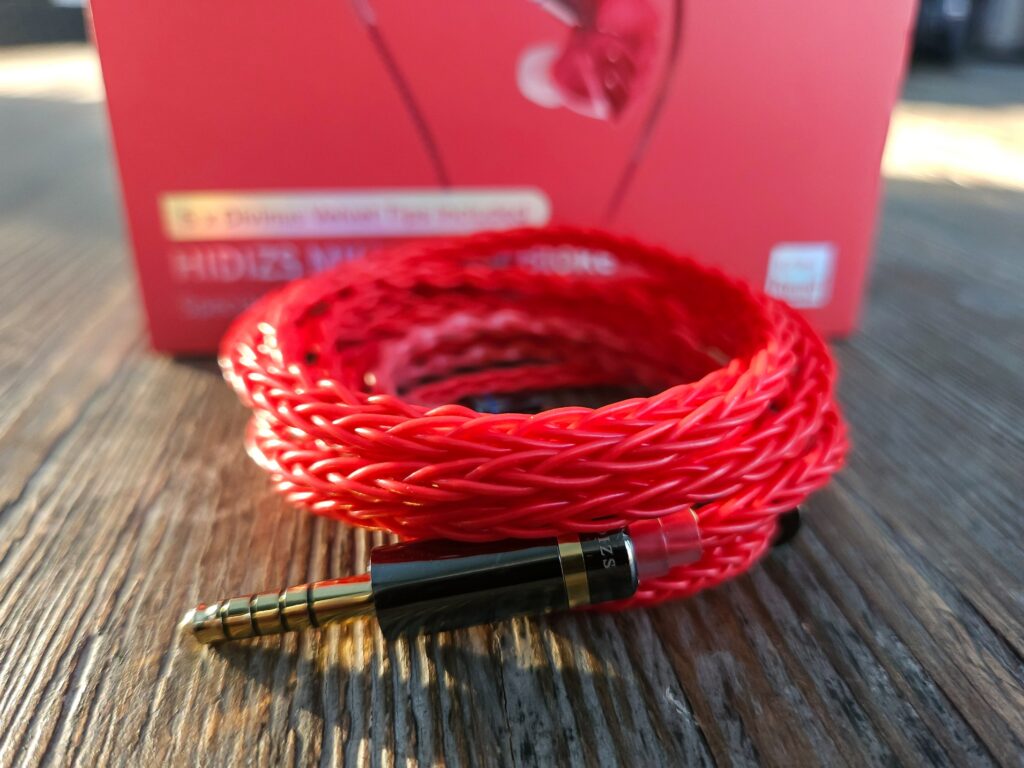
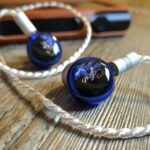
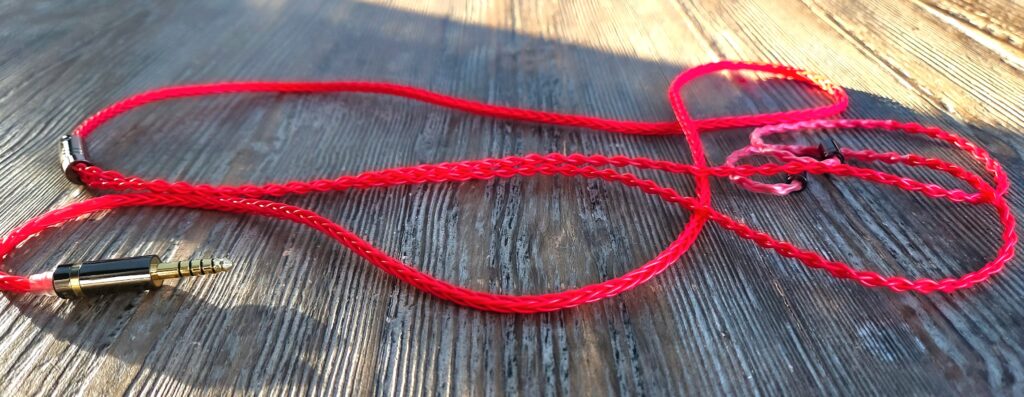
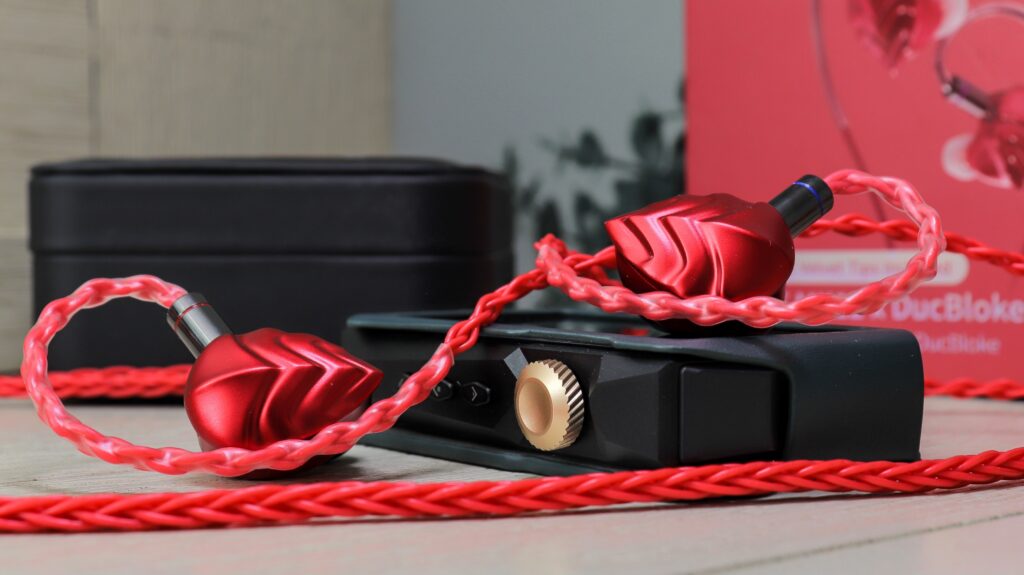
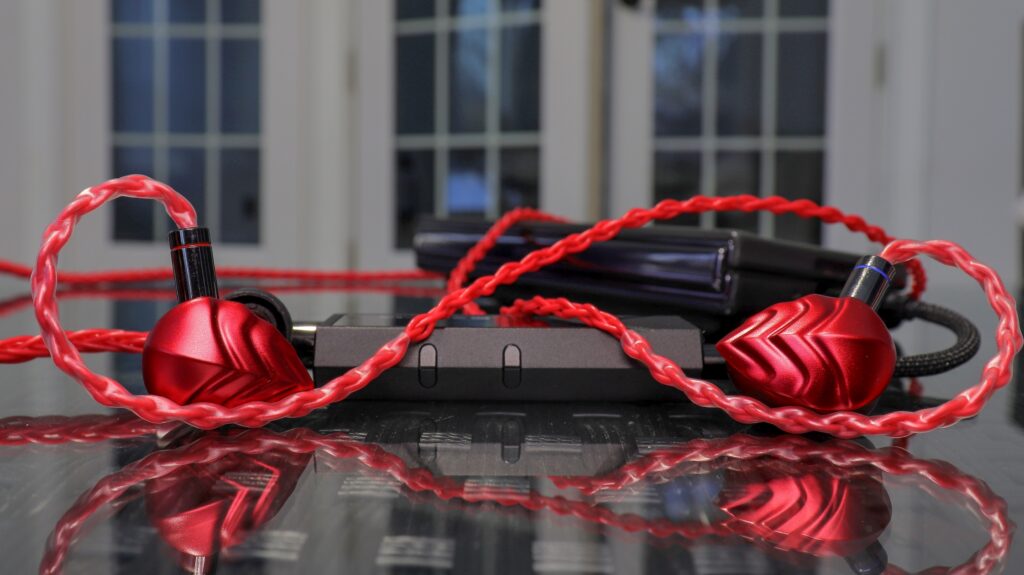
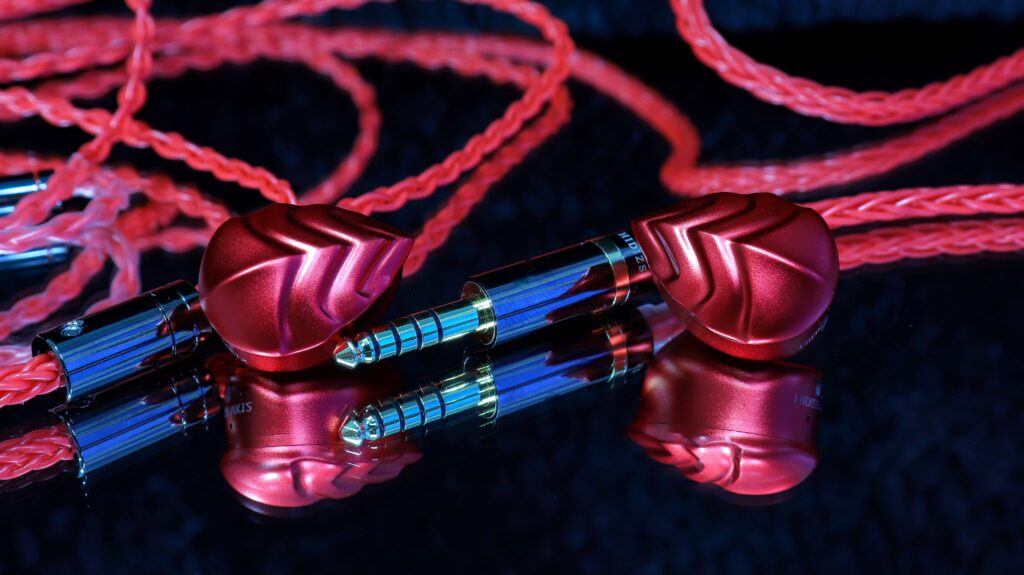
Another quality accessory added into the overall packaging is the cable provided. I love this choice folks. The cable is a bright red cable which perfectly matches the color of the earphones and is very pliable and easy to use, comfortable to use too. To be exact, the cable provided is a 4.4 balanced, 2-pin, made using 8-cores of silver-plated high-purity oxygen free copper wires. I think silver-plated copper was a good choice for this set and it seems to pair well with the MK12 X. While the included cable isn’t the most luxurious that I’ve ever seen, it is very functionally nice. For a few reasons. For one, it doesn’t ever give off microphonic sound. I hate microphonic in my ears as it annoys me very much. This cable doesn’t do that at all. Next, this cable rolls up perfectly. When I go to store the red cable and my MK12 X’s the cable sits exactly as I set them and they don’t spring apart. Third, this cable doesn’t weigh on my ears and isn’t hard or rigid. The way it is braided makes it very pliable and moves easily. So, no, it isn’t some 22 AWG fat boy cable, but it works very well, looks great attached to the MK12 X, and sounds very solid with this set.
Build / Aesthetic / Internals / Fit
Build Quality
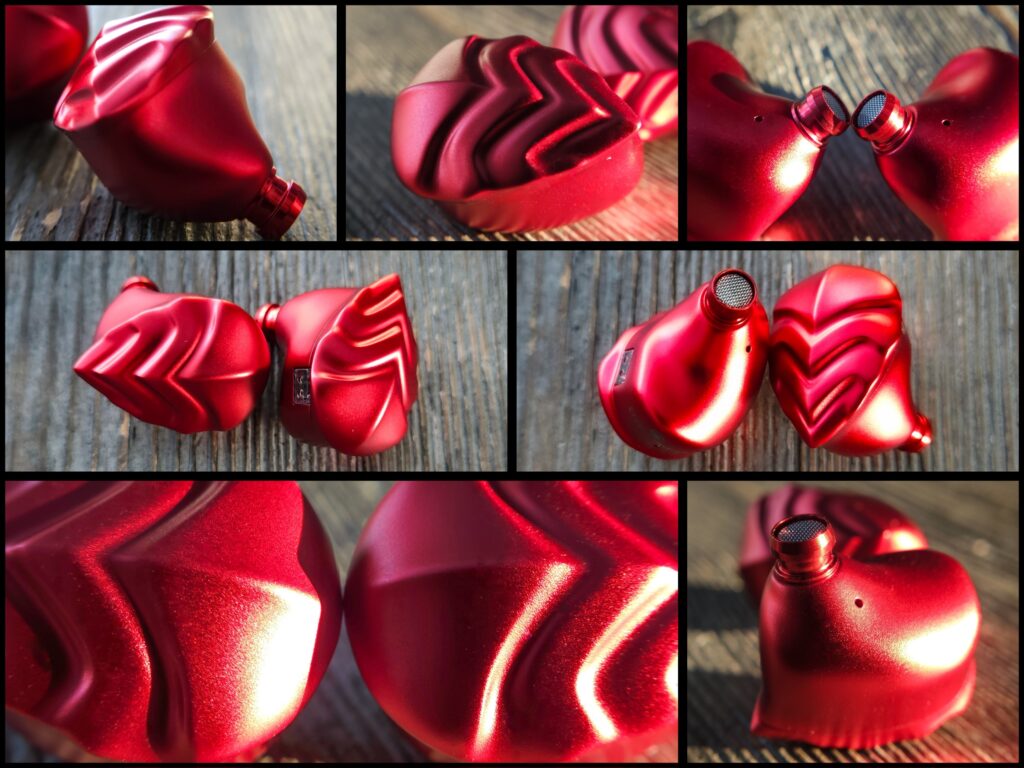
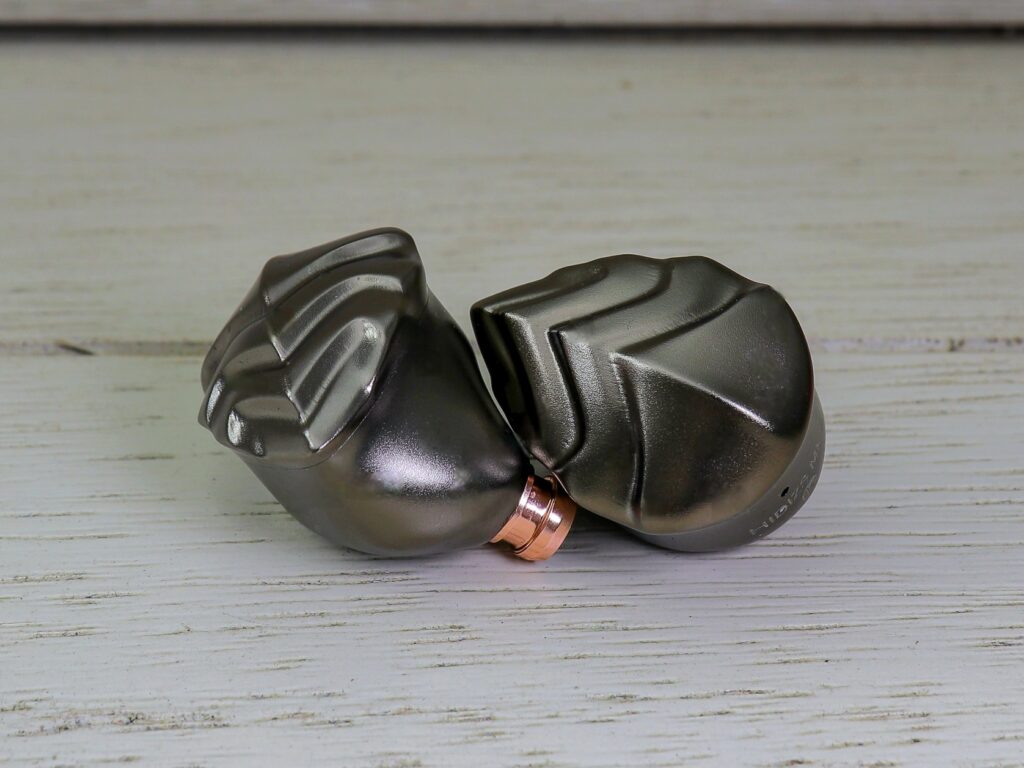
The Hidizs MK12 X DucBloke is built exceptionally well. Just like the original MK12 Turris, the MK12 X is also made entirely from one piece of machined aluminum. Very light, very sleek, fairly large, but very ergonomic. The MK12 X is built wonderfully, I really mean it folks. Hidizs is known for their nice build quality on all of their products, and the MK12 doesn’t buck the trend. It’s built very well. Personally, I like this build for comfort first. After reviewing so many iems it comes down to “what’s comfortable?” I’d say that the MK12 X is in that pool of comfy sets and a lot has to do with the particular shape and the weight of the MK12 X. Coming in at 19 grams is fairly light for an all-alloy material and disperses the weight perfectly. Aluminum really is one of the best materials to use for earphones for many reasons and weight, durability, and aluminum’s anti-corrosive properties, as well as its low resonance reflection makes the alloy fantastic for iems. At any rate, the MK12 X is what I would call fairly large in size, so anyone with smaller ears may want to take note. Though the shape of the MK12 X seems to fit the curvature of my ear very well. The nozzle width is roughly about standard at 6mm while the length is what I’d call about average. I notice two small vents. One for each cavity. There’s one near the front and one towards the rear of the MK12 X. Once again, you can bet that if you pick up the MK12 X it’ll be built very well.
Aesthetic
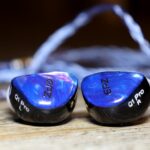
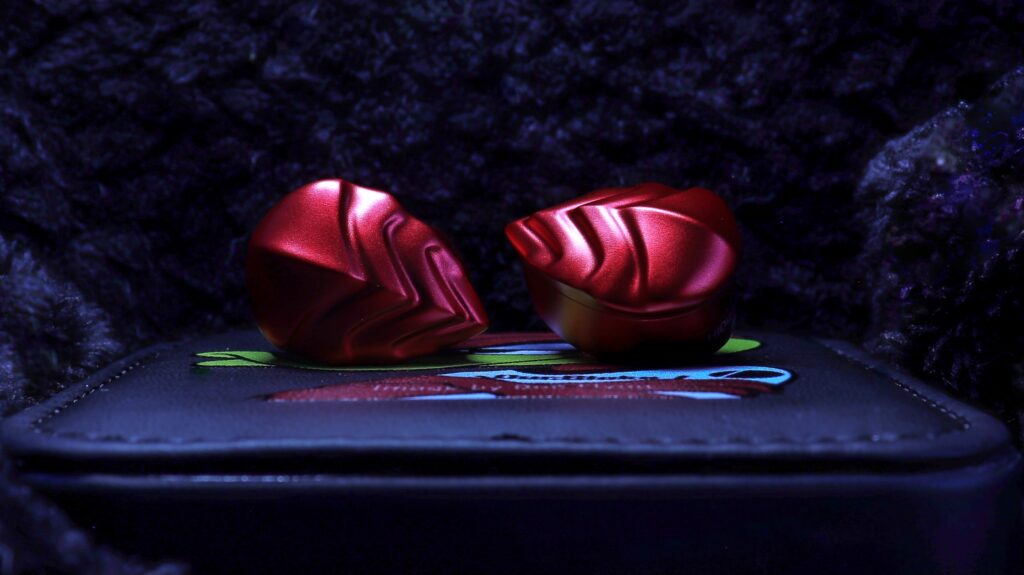
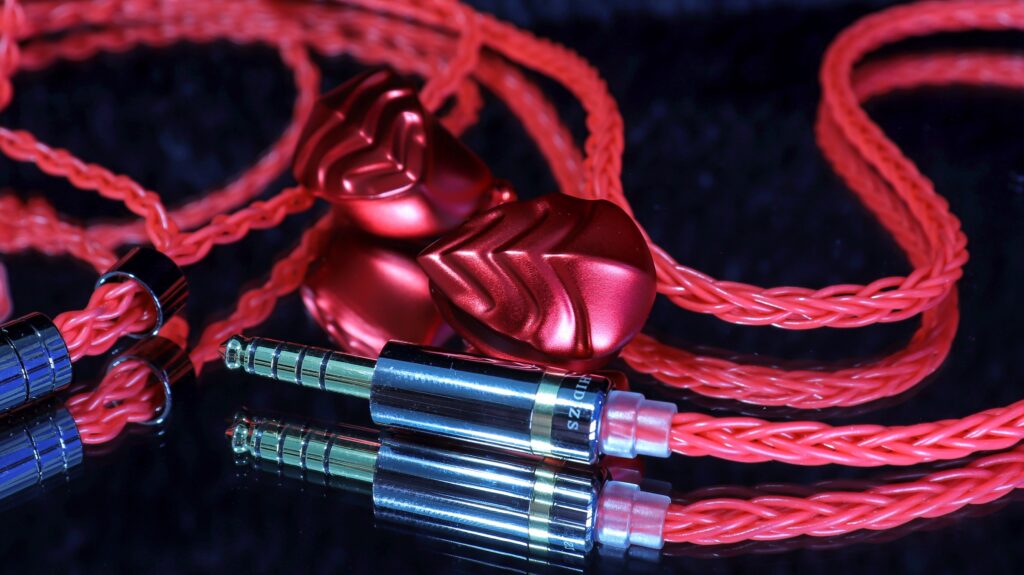
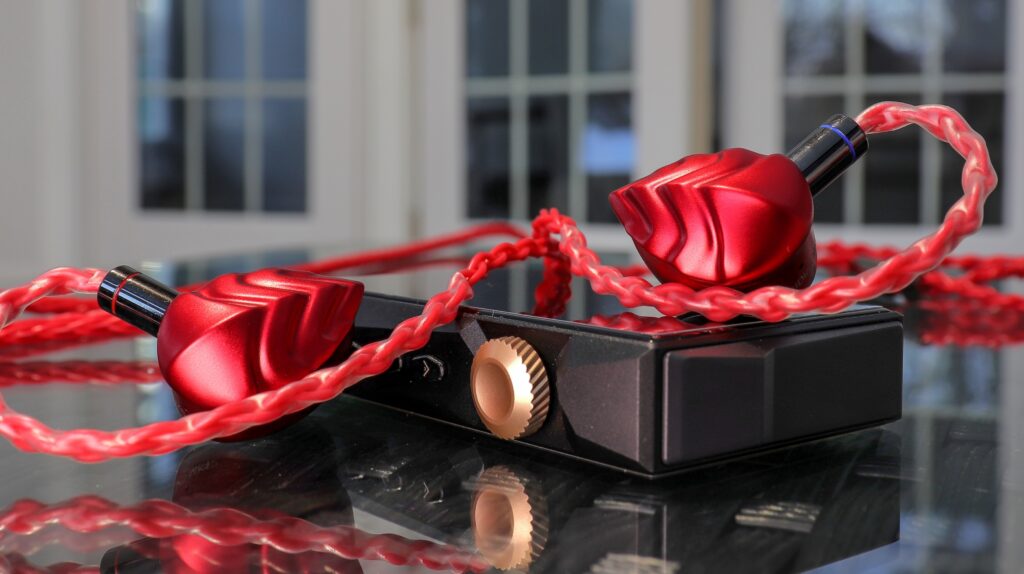
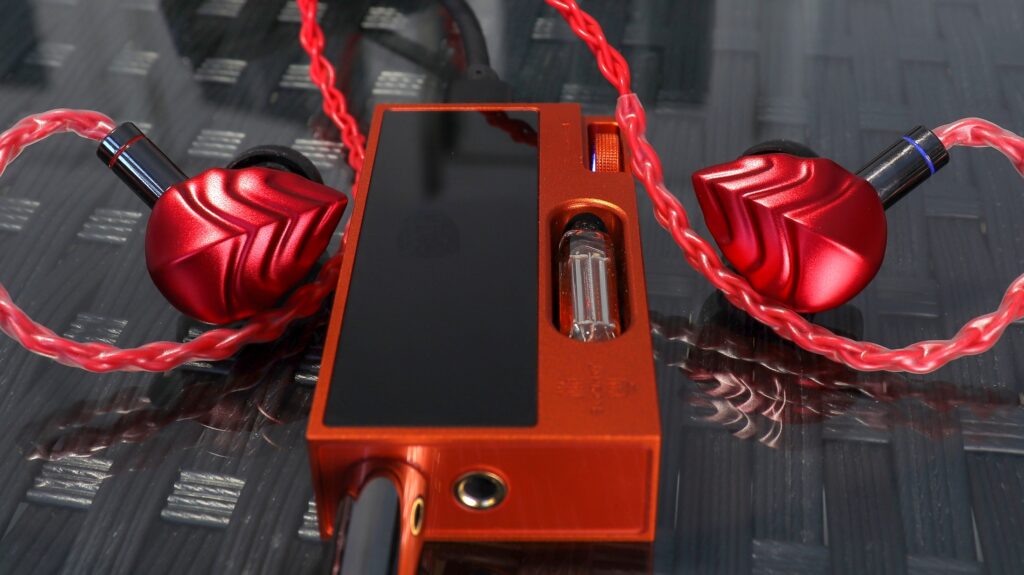
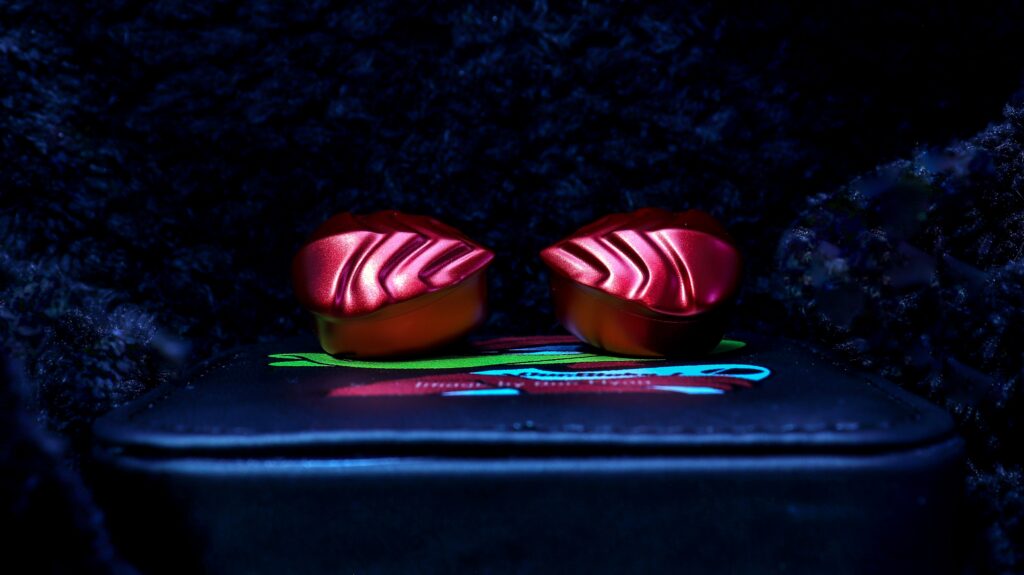
I think this set has such a dope design/aesthetic. I love the bright vibrant candy red color. I’m not even a fan of red. Not entirely anyways. I suppose I don’t have anything against the color, but man this set is drenched in vibrant red and totally has me rethinking how dope red can be when it literally is draped on everything. That’s the MK12 X. Also, it doesn’t hurt at all that the Hidizs MK12 X DucBloke is quite literally a carbon copy of the original Hidizs MK12 Turris, sharing the exact dimensions, exact material of build, the exact shape and most importantly the exact aesthetic design covering the faceplates. Just like the MK12 Turris, the MK12 X also has that unique design of the Turritopsis Dohrnii, or the Immortal Jellyfish. As honest as I can be, I don’t really care what it’s designed after because it just looks cool. Without question the MK12 X is going to be a set which stands out in a crowd. If you are wearing them out and about, I’m sure that many will at least take a second glance.
Internals
Okay, so one of the most awesome aspects of this set isn’t the build, the design, or the unboxing, but it’s actually within the driver and the driver material chosen for the MK12 X. Which is obviously the exact same driver and driver material used with the other two MK12 series sets. To be exact, the MK12 X carries a 12 mm huge single dynamic driver. However, that driver is actually made out of magnesium and carries an “M” shaped dome pattern. By the way, that’s 91% Magnesium alloy, and the other 9% is a Hidizs trade secret. But really, I believe it’s binding agents, some trace elements, and possibly coatings of some sort too. Another hugely awesome quality is that this driver also has 1.5 Tesla magnetic flux density which powers and drives that stiff magnesium driver. Brands are always shooting for the lightest, stiffest, most rigid materials with the best elasticity and magnesium alloy is one of the most sought after on the market for these properties. Of course, one doesn’t just go to the local store and pick up magnesium alloy. It has to be crafted with an intricate process of casting, rolling, extrusion, and forging. The magnesium needs to be extracted folks. Please hear me. The reason you don’t see these drivers often is because they’re very hard to make. Just like pure beryllium. It isn’t easy. So, know what you are getting with the MK12 X (or the MK12 Turris & MK12 Titanium Edition). Friends, this set is special, just like the others in the series. The MK12 X has a fantastic driver, and it shows up in my listening sessions every time I hit play.
Fit Comfort
For me and my ears the MK12 X fits very well. Again, this set is decently sized and so anyone who has smaller ears should at least take note. However, I really don’t think that anyone is going to have an issue with the MK12 X fitting their ears. Hidizs did a nice job of distributing the weight so that they don’t feel bulky, they don’t fall out, and they don’t cause any sort of wear fatigue. Of course, I can only speak for myself and as always, the fit may be different for you. So, try to keep that thought in mind. Really, it’s a nice fitting set, just the same as all of The MK12 variants have been.
Drivability / Pairings
Sensitivity
The Hidizs MK12 X DucBloke is rated at 32 ohms as well as a sensitivity rating of 111 db’s which means that the MK12 X can be played with relative ease off of just about any source, anywhere. This is a relatively sensitive set. Of course, 99/100 iems are sensitive. Sometimes I feel that we are taking the wrong approach to sensitivity though. Just because a set is easy to play off of a phone and a 3.5 single ended jack, doesn’t always mean that you are hearing that set in its most prolific form. In fact, listening in that way is rarely the best way to hear your iems. As far as the MK12 X, it plays easily off of my old Android smartphone with a simple 3.5 se setup. I swapped cables and paired this set with every weak source that I own, as always. Well, what I found was that the bass most definitely will not be nearly as clean, much wider/slower in decay and the treble isn’t quite as extended. Just as I found with the MK12 Turris, and the MK12 Turris Titanium Edition, the driver that Hidizs used for these sets desires to be pushed, to give them some juice, a good source, a clean source, and a source which will maximize their potential. However, if you simply want a bassy and boomy listen then just get a 3.5 cable and have fun. The MK12 X has no problem with that.
Scalability
Just as I alluded to in the last section, the Hidizs MK12 X DucBloke most certainly scales very well when providing additional clean amping as well as with better, cleaner, higher res. sources. Most certainly there’s a fairly large difference going from a 3.5 single ended dongle dac with the 30mW of power output to the Hidizs AP80 Pro Max (for instance). In all truth, the MK12 X doesn’t need vast amounts of output either. It simply sounds better, cleaner, more open, tighter bass, and tighter transients across the board once you provide this set with a good 4.4 cable (included cable is great) and a solid dongle dac. At the least. Absolutely it makes a difference, a notable and noticeable difference from a discerning ear. I hear it clearly and plainly. Of course, this subject sounds like a broken record from me. I haven’t conducted a review in two years where I’ve said that more power “doesn’t” help. The reason why that set (review) didn’t help was because it had cheap drivers which couldn’t handle any more output. Friends, the 91% Magnesium driver that the MK12, MK12 Titanium Edition, and MK12 X have is a fantastic driver. I mean, feed this sucker whatever you want. Now, there is a plateau where adding more power (specifically) will not gain you any greater results. That is with every set. However, I also said that better, cleaner, and higher res. sources also scale the sound. So, the MK12 X will also further scale to the ability and fidelity of your source too. I found that the sound of the MK12 X really started to show its fruit when I attached it to the Shanling UA6 (361 mW @32 ohms). It sounded better (scaled) with every “better” source that I used that had reasonable output.
Source Pairings
Okay, when it comes to source pairing, I just want to explain my rationale with you and maybe try to help you out in the process. First off, every reviewer on planet earth is going to say that the MK12 X will sound better with neutral to slightly cooler sources. They say that to combat the warmth. In hopes to tighten the bass, add some possible levity to the treble, and simply even-out the tonal coloration of this set. Dare I say, to help it sound similar to the OG MK12. However, they say this thinking that everyone wants that balanced sound. You see, they (and me at times) are trying to “correct” the MK12 X, as if it needs to be corrected. Well, I’m not going to tell a warm lover, bass lover, that a cooler source is going to sound better, because to them a cooler source and less bass focused source may attenuate what makes the MK12 X special. I’m just going to put it like this; for bass lovers or warm/smooth lovers I’d go with any source which ranges from warm to neutral. A neutral source won’t dissipate the bass presence, and a warmer source will only boost the warmth and lack of treble sparkle that you enjoy. Of course, more warmth will slightly thicken the sound and make for a less clean-lined and energetic sound. For bass lovers who also love a sparkly treble I’d go with warm/neutral to a slightly brighter source. I still feel that the bass emphasis is enough that even a brighter source won’t kill the bass too much and maybe the upper-mids and treble will sound a hair more forward and brilliant. For those who bought this set (for some reason) for its balanced properties (this isn’t the OG MK12) and realized that it is warm and bassy, well, get a neutral to brighter/colder source.
My bias
I hope that made at least some sense. Now, for me and my “personal” taste, I’m happy with any source from warm to cool. That’s no joke. I love how this set handles all of those tonal Pairings and how it changes in accordance with the source coloration and tuning. PLEASE MAKE NOTE; there is a very real change in sound between sources. I think the MK12 X driver is fantastic, and it does very well when matched with almost any tonal coloration. Having said that, I most enjoy the MK12 X with warm/neutral to neutral sources. Like, the iBasso DX240, the Fiio Q15, the Shanling H0, UA6, Surfans X1, Hiby R3 Pro II, Hiby R6 Pro II 2025 etc. They all sit in that range, and all have plenty of output. Still, in the end, the MK12 X sounds good no matter what I pair it with, and guess what, it changes to the source pretty well without losing its character, or its target sound. Again, this set definitely sounds much more alive and spirited with a slightly brighter source but that’ll depend on what you enjoy personally.
PEQ
Lastly, there is one thing that I didn’t speak on yet and something that I will speak on at greater length later, and that is DucBloke’s PEQ settings. Which, “almost” render all of this source talk at least partially obsolete. I have to admit that I actually enjoy the MK12 X just as it is out-of-the-box more than anything. However, his PEQ settings are well done. I really mean that. This guy is no slouch with his settings. He’s done his homework and knows how to use a PEQ. They do change up the sound to a degree and what he labels his PEQ settings makes sense for how they influence the sound of the MK12 X. The source coloration will ever-so-slightly affect the overall sound even with these PEQ settings, but not to such a degree that it really matters from source to source. Providing those sources have the ability to use PEQ settings. Does that make sense?
Sound Impressions
*Note: just a little note to preface before I dive into this review. I want you to know that I did burn in the MK12 X for roughly around 3 full days. I also want you to know that nothing seemed to change. In truth, I really don’t feel that burn-in is super necessary with this set. I burn in every set no matter what but I’m not positive that doing what I did will help this set sound any better. Every track I use for critical listening is a flac or better file (a few MP3’s) which is stored on my devices. The Android player of my choice is mainly UAPP (USB Audio Player Pro). I also use Hiby Music Player with some of my daps as well as Eddict Player. I used the packaged cable and the packaged Divinus Velvet large sized eartips.
What’s it sound like?
The Hidizs MK12 X DucBloke is certainly a warm leaning iem with what I’d call an out-of-the-box analog sound which leans organic through and through. If ever there was a set that I’d call “earthy” in its timbre, the MK12 X is certainly a dead ringer for that. The MK12 X is a bass weighted, bass focused set that isn’t without representation across the rest of the mix. You can hear the driver DNA present in the MK12 X fairly easily as this younger brother seeks to show himself in all of his glory. Different, but the same. Hidizs, in collaboration with DucBloke did a nice job of creating that “almost basshead” sound with a very musically alive sound, solid energy, richness everywhere, just not a vibrant or brilliant sound. At least not to the point that the balance shifts to the brighter or vibrant side. You won’t have a very balanced sound with this set, and you aren’t going to be hearing something that comes across perfectly naturally, but you are going to be getting a set which is very melodically enjoyable, to the point that I’d call this a guilty pleasure style iem.
Guilty Pleasure
What makes an iem something which could be deemed a… “guilty pleasure” iem? I can tell you right now that the words make audiophile truthers recoil. Well, the first set of criteria is without a doubt… bass. But it can’t be “bad bass”. No doubt the MK12 X just hits that mark for me. It’s the addition of a bigger bass emphasis which skews the MK12 X’s tuning from the traditional boundaries of what is considered to be “audiophile” or… mature, to something closer to what I used to have when I was in my youth. Like when I bumped down the road in my cheap Ford Tempo as a kid. Windows rattlin’, Geto Boys as loud as my system would allow, and my seat so far back that it’s a wonder how I could even see to drive. The MK12 X’s out-of-the-box tuning is right in that pocket of what I’d call a guilty pleasure style sound. That big, booming, but very well controlled bass rumble pulses in my ears informing my young 47-year-old self that I am in fact still young, at heart. The sound isn’t correct; it isn’t what I’d call “natural” (too colored for that). The MK12 X isn’t going to wow you with its realistic woodwinds (sometimes you may be surprised), or its sweetly and subtly abrasive strings, it’s perfectly manicured ability to conquer complicated tracks. Details aren’t going to jump out of every dark and hidden corner of your music. However, the value that the MK12 X endues for this guy has absolutely nothing to do with anything “correct”. I can find that in a thousand iems. Granted, I love a balanced and natural sound too. But when I’m in the mood for the good ole’ days the MK12 X does a fine job of getting me there. I actually have a handful of iems that I reach for to quench that desire and without question the Hidizs MK12 X DucBloke has been added to that list for me.
L-shaped, V-shaped?
I really trailed off there, let’s bring this review back into focus. So, the MK12 X “out-of-the-box” definitely carries a slight V-shaped to possibly L-shaped signature that doesn’t leave out the mids and the treble. As I just said, there is some contrasting treble energy, just not enough to change the overall warmer tone color. L-shaped isn’t quite perfect for me because as warm as the MK12 X is, it still carries plenty of upper end luminance. There is some levity to the sound, but it’s simply toned-down vibrance when mixed with the prominent bass. Timbre is what I’d call “organically bassy” and if you haven’t gathered this yet, it invokes some warmth. Also, remember, Hidizs intentionally tuned this set warm so as to further dial in the sound for use with DucBloke’s PEQ settings (I’ll cover those in a minute). Still, the out-of-the-box sound really is quite good. Hidizs could’ve easily promoted the MK12 X strictly for its base sound and I’m sure gotten plenty of fans who would rally around it. The PEQ settings however do offer valid changes, without changing the character of this set altogether. That said, the base tuning is a lot of fun, explosive, very dynamic too with plenty of capped energy which never spills over into shout, glare, harshness, or sibilance. Honestly, this whole review will be me trying to find the best way that I can to communicate that… for a bass-boi worthy sound, the MK12 X doesn’t seem to suffer the typical hindrances of this type of tuning to the degree that most similarly tuned sets are burdened with. It’s the driver and a very smartly crafted acoustic setup internally.
With respect to warmth and richness…
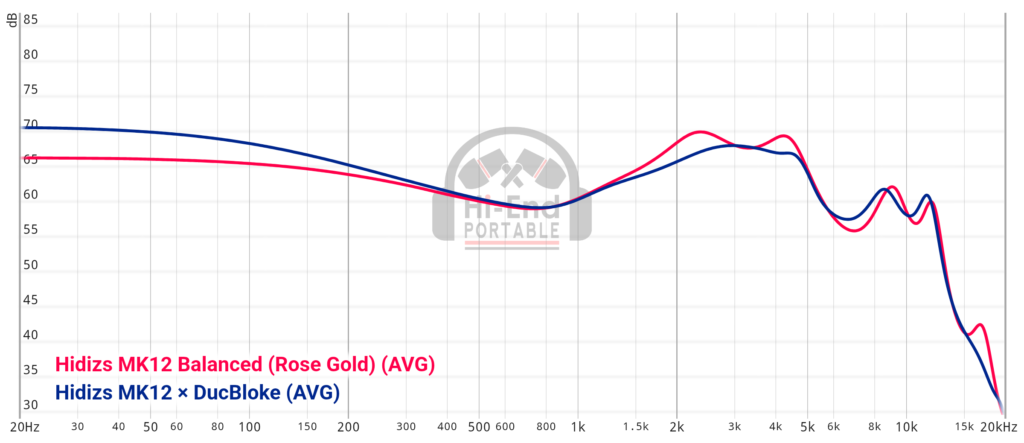
To my ears the MK12 X has a thickly rendered note body (across the mix) which doesn’t sound gummed-up in congested sonic mush. Basically, the MK12 X isn’t without some touches of cleanliness and clarity. This somewhat clean-lined sound is very much like previous iterations of the MK12 series in that I don’t hear a lot of clouded veil, it has a black background, no grain anywhere, no fuzz outlining each note, and the MK12 X has a warm-clarity carved from transients which are actually fairly tight. This is no small thing people. Sure, the bass emphasis (12-15 dB bass) is large and doesn’t flatten out until close to 700 hz, which literally douses warmth upon the rest of the mix. But in respect to that warmth & richness I hear some cleanly presented notes. Certainly, more condensed and tighter than I ever would’ve thought after seeing the frequency response graph. Sure, resolution is going to take a hit, no surprise there. However, I really don’t think it’s to the degree that you may think. Remember, this is basically a bass lifted, treble slightly attenuated, and still perfectly organic version of the “OG” MK12 Turris. Still…
Technicals
This is no forensic tool folks. Please do not purchase the MK12 X DucBloke for its technical abilities. Not to say they aren’t solid for the tuning, but please know that you aren’t going to hear every last detail. This is in no way a clinical sounding set (I think we’ve established that). This is an analog sound all the way. It’s a very buttery and smooth sound across the board. Good for a very melodic playback abounding in tunefulness, or good for drawing out the sentiment from music, or the… artist’s intent. One of those sets which effortlessly draws the emotion out of every track. If you want to “feel” what Adele is trying to convey in a rich and smooth way, then I have a set for you. The Hidizs MK12 X DucBloke is much more about fluid rhythmicity and atmosphere, rather than clean & lean precision. Again, we’ve established this (yes, I repeat myself). Due to that smoothness, the bass endowed sound, that creamy sound, you obviously won’t have quite the same distinct sound separation, noticeably salient or striking imaging, and the sound won’t be as airy as many sets tuned with a better balance. Now, you may be at least somewhat surprised to know that the stage is pretty holographic in its sound field presentation. Also, I’ll say it again, transients are most certainly not loose, and they aren’t sloppy, or slow. Sure, decay isn’t ultra tight, but it’s definitely tight for the tuning. Also, detail retrieval actually isn’t bad by any stretch of the imagination and definitely what most would probably call “better than meh” for a $250 bass-boi caliber single dynamic driver set of earphones.
DucBloke’s PEQ
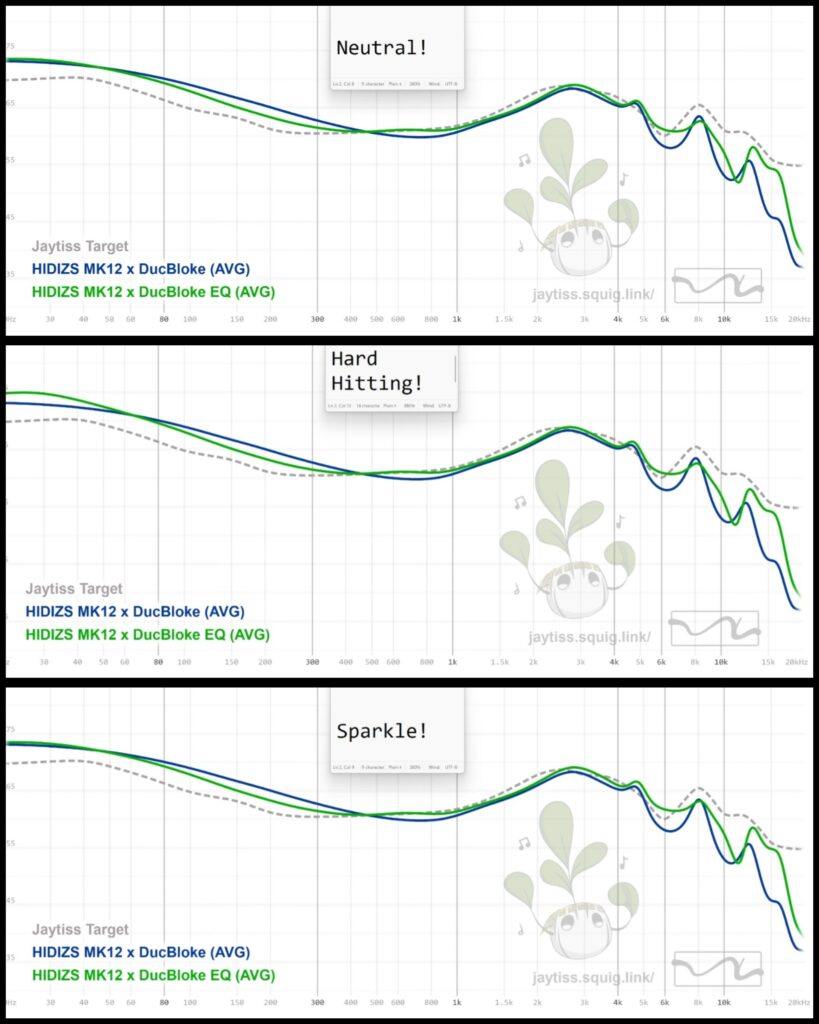
I told you we’d get here. So, the whole idea and point of this set was that it is supposed to be used in conjunction with DucBloke’s PEQ settings. Well, I have to tell you, without question his settings do what they are intended to do based upon the name they were given. DucBloke came up with three distinct styles of PEQ settings which need to be manually entered. He provides them for the Hidizs AP80 Pro Max, for UAPP, and other music players. I was able to secure those settings and plugged them into both UAPP as well as my Hidizs AP80 Pro Max. The names of those three settings profiles have each been appropriately named: “Hard Hit”, “Neutral”, and “Sparkle”. I think you can gauge at least partially what each of those profiles might do for the MK12 X DucBloke. Let’s check each one of those out…
Hard Hit
The Hard Hit profile does exactly what it proclaims to do by boosting the sublevels a couple db’s as well as slightly dialing back the mid-bass for a slightly puncher and less plush bass slam and impact, with a cleaner roll-off, less mud and more punch. Next, there is an Ever-so-slight dip in the upper-mids to lower treble as well as a boost into the upper treble. Perhaps a hair more V-shaped, but the sound comes across with better clarity, deeper sublevel response, tighter transients down low, and even moderate sparkle & extension up top. Obviously, there’s a bunch more I could say but this is a very broad stroke look at this profile.
Neutral
Now, the Neutral profile isn’t what I’d call “Neutral” in tonal color. I probably wouldn’t have called it that. Though, in respect to the base tuning’s big amount of warmth, I suppose you could call it that as it certainly is headed in that direction. The sound is still pretty colored in warmth though. Anyways, one of the things that DucBloke did was slightly attenuated the mid-bass by a hair, slightly boosting the 800hz range as well as giving a large boost to the treble (+3.4 db’s @ 6600khz) and upper treble (+8.7 db’s @15000khz). So, no doubt there is a ton cleaner treble energy which truly doesn’t cause any undue splash, sharpness, or sibilance from what I can hear. I actually really like this setting. Eh, I actually like ’em all.
Sparkly
Now, the “Sparkly” setting is actually what I’d call the closest to balanced out of all three of the profiles. One thing I noticed was that DucBloke slightly lessened the entire bass response while adding that same 800hz midrange area, then a tight drop (-4.0dbs @ 4900khz) in the presence region and then very quickly followed by a quick spike at 5800khz (+4.0 db’s). Also, what some would consider the presence region. DucBloke decreases the mid treble just a hair but provides huge boosts at 12000khz and 15000khz of about 9db’s each. Without question this adds that sparkle, that subtle shimmer, and definitely the treble does seem to contrast the bass much better allowing details to shine through much better and even a touch of crispness as well.
My thoughts on the PEQ
Friends, there is no question that DucBloke knows what he is doing when dealing with a perimetric equalizer. I find that these settings are clearly well thought out and help the MK12 X to sound confidently different to enough of a degree that it’ll help anyone who’d like to mess around with PEQ settings on their gear. I should also add that these are DucBloke’s preferred settings and obviously you can tweak them however you see fit. He does a good job of laying out the groundwork though, which is very nice to see. I spent quite a lot of time in each setting over the last month of having this set and I went back and forth with the question “How am I going to review this iem?” Should I focus on the PEQ settings? Should I only mention them? Should the entire review’s sound portion be an ode to the PEQ settings. After all, those settings are quite literally part of the promotional for this set. However, after much thought, as nicely composed as these settings are, I think I want to describe this set with its out-of-the-box base tuning. I honestly, really-really enjoy the base sound and I think others will too.

Bass Region
The low-end of the Hidizs MK12 X DucBloke is most certainly the focus of this set. I find the MK12 X to be right at the cusp of basshead levels as the bass shelf rests right around 12-15 db’s depending on whose graph you are looking at. However, the bass extends quite a bit more, is more pronounced, and simply more prominent than any other area of the mix. Not to say the treble or midrange is non-existent, but the bass definitely wears the crown as the most authoritative portion of the frequency spectrum. Having said that, I have only enjoyed this set folks. Sure, the bass ties the MK12 X down and it suffers for certain genres, but for those genres and tracks which accommodate its bigger low-end emphasis you’d be surprised how awesome this set sounds. I think everything stems from the fantastic magnesium dynamic driver. Because of this driver I hear tighter than usual transients, and harder edged punch, a more cleanly-outlined note delivery down low. There is a certain undeniable rigidity to this bass, a certain concise precision, and the type which holds its mass very-very well. Friends, you won’t hear anything sloppy in respect to that emphasis. Now, don’t get me wrong, less full-bodied bass replays will sound better defined and sharper. However, you have to keep context while reading my words. Remember, this is a big bass. Okay, I think we can keep going…
Clean for its size
This is a bass predicated on power, authority, with a high horsepower intensity which is stabilized by that resonance damping shell, and the sheer technical prowess of a fantastic driver. This bass region carries what I’d call explosive boom and slam yet can reach super deep levels of extension with a very textured and less plush sound. Nothing softened, but rather very dense, which is so satisfying. Now, there’s no doubt the bass is fairly rounded, very convex, and it has a broad feel to it. Much has to do with the fullness of the mid-bass in conjunction with the bullish and dense feel of the sub-bass. No matter how good a driver is, with 15 db’s of bass shelf against a max of 8 db’s of pinna gain and not much treble intensity, you are going to have a sound which is widened, broad, less defined, slightly bloomed and usually a hair more atmospheric. Can’t get around that without spending $1k. However, I cannot impress on you enough how nicely done this bass is for the price point and the configuration. Kick drums feel massive, with a good tacky snap on attack (especially with the Hiby R3 Pro II or iBasso DX240), and bass guitars are vivid, with that sweet dark vibrance and edge detail ripping through the guttural depths. So, for any basshead or bass-boi who wants that almost basshead sound which is very clean for its size and extremely fun without a harsh note to be found… the MK12 X DucBloke is likely a set for you. Of course, there are “issues” for audiophiles and those who want clarity across the range. Of course.
Sub-Bass
As I’ve said already quite a few times the sub-bass is very bullish and can extend very deep in pitch with a physical presence and a prominent haptic feel to any track which is recorded in that way. I do want to stress that I still do not feel that the sublevels are all consuming or overtly muddy. No sir. This sub region of the bass has some tactility, some finesse, even some agility with a ductile ability to maneuver even complicated bass lines for the cost. Within reason of course. We have to be reasonable. You’ll read some glowing words from my pen, but please keep the context as you read. At any rate, it’s clear just by hearing that the sublevels own the greatest portion of emphasis downlow. I don’t need a graph for that. It’s also pretty clear that while the bass isn’t the most defined, you’ll ever hear, for a more robust bass it is fairly textured and hard-lined instead of soft around the edges. There’s an unmistakable accuracy in the cadent structure from note to note, even with its size. Like Lorde’s “Royals” which shows off a MK12 X sublevel rumble that sounds much more like textured extension, structured note outlines, and good ole’ physical pressure. Never so much to overwhelm the intimate vocals whilst revealing even the subtle synth style undertones, feeling grounded. Not bloated. Another is “By the Ton” by Meshugga (used for testing purposes) with its double kick drums and its raging bass guitar play. I actually hear a decently layered sound here folks. I hear individual note attacks without the sound derailing into a blurred mess as I thought it was going to. It’s a fun set and the sub-bass tuning plays a large role in that.
Mid-Bass
The mid-bass is certainly less forward and pronounced as the sub-levels, but this region still has plenty of good and solid punch creating an authoritative slam adding warmth, groove, and rhythm to the mids without completely blurring them. Certainly, great for any genre which needs physicality and impact while keeping a nicely tuned downhill glide in such a way that this region sounds like a very nice balance of agility and power. I find that the mid-bass does an adequate job of maintaining clarity and even some good enough separation in complex tracks too. Beyond that, the mid-bass is speedy when it’s called to be that. Tracks like “Anthem Part 3” by Blink-182 which has blazing fast drums. The MK12 X has that aggressive style snap and sounds full-bodied sounding visceral in its textured slams, over and over again. The bass guitar kicks in with a rounded weightiness and never sounds bloated against the main verse or chorus. Pretty well defined if you ask me. Another is “Longview” by Green Day with its classic and relentless bass riff the MK12 X’s mid-bass seems to handle the drums and guitar with great textures, good immediacy and snap on percussions (for the size), feeling tight and controlled without sounding loose or smearing definition. No doubt DucBloke’s PEQ settings do tighten this up a bit even further, but the base tuning is special in and of itself. The mid-bass acts as a great counterpart to the sublevel rumble with a certain big-body distinctness and separation which truly highlights the magnesium driver’s capabilities.
Downsides to the Bass Region
This one is fairly obvious but the main downside to the Hidizs MK12 X DucBloke’s bass region is the amount of sheer bass that Hidizs and DucBloke tuned this set to have. Granted, I have zero idea why any of you would purchase this set without knowing that it carries a bigger bass, but still, not everyone wants a bigger bass against a less emphasized treble. Furthermore, not everyone wants a warm bass either. I know so many people who always are seeking out sets with that tight and ultra snappy bass and who don’t want or need anything powerful and authoritative. Another downside is that the mid-bass bleed carried over from the elevated quantity will certainly thicken the low-mids and won’t come across quite as clear and pristine as a set with a steeper and sooner mid-bass roll-off. The bleed also adds a warmer atmosphere for vocals and midrange instruments and to some will sound more like veil than anything else. I’d also say that some fast EDM tracks may sound a hair too softened for clear note separation among other genres. Furthermore, I do have to say that the MK12 X will sound a hair too thickened with warmer daps and dsc/amps. Beyond those issues, I think the bass region is great folks.
Midrange
The midrange of the Hidizs MK12 X DucBloke centers around its organic and earthy timbre as well as its constant smoothness. This is a midrange which definitely prioritizes musicality over all else. This is a midrange which is smooth and rich across the board and with no real deviations from that. Lush, creamy, no sharp edges, but more like polyester than wool. If that makes sense. To add to that, the midrange is not one which I would call “forward”. In the same breath I also don’t feel there is some enormous recession either. However, the midrange (especially the low-mids) does sit a touch behind the bass region, gently recessed, relaxed in its positioning and easy in the ears. In spite of that comment, the midrange also isn’t typically buried in bass either as the mids ever sound distant. So, if you are a consumer who desires that beefier bass yet with a midrange which is pretty even keeled, not rambunctious, and fairly reserved in character then the MK12 X might just fit the bill. Of course, I don’t want you thinking this midrange is dull either, because it really isn’t. There is some tamed energy in the upper-mids which does provide some edge detail and levity, some luminance, and so this isn’t just a straight dark/recessed and boring midrange. For me anyways.
Musically Gifted, Emotionally Gratifying
Now, positioning aside, the tonal coloration most certainly leans warm. I think I made it pretty clear that the bass definitely forces its will (to an extent) on the midrange with a long, drawn-out downhill roll-off which finally flattens around 700hz. Its basically warmth infused until just prior to the pinna gain when and the pinna begins to climb again. As might be expected, this warmth most certainly infills every midrange note with good richness and body. As I said earlier, the midrange is thickly rendered, with solid density, very substantive, and also fairly well clean-lined as well. So, just because you have a richer/warmer midrange doesn’t necessarily mean you have to have a sloppy and congested mess. Actually, the midrange in this set is pretty clean. There is adequate amounts of levity to the sound brought on from the pinna and lower treble areas. Certainly, nowhere near bright or brilliant, yet just enough glow to uplift the region from being caked in overbearing warmth. You can most certainly further tighten and lighten this region using the Sparkle or Neutral PEQ settings. Keep that in mind. However, I find the MK12 X to carry a very musically gifted and emotionally gratifying midrange. That said, stuff like transient textures aren’t quite as sharp as they do lean more rounded, smooth, and refined rather than crispy defined. However, transients in general hold the same speed as seen on the OG MK12 Turris. That is, generally tight, compacted, and less congested.
Lower-Midrange
The first thing I’d say about the lower midrange is that it is most certainly body-rich with notes that absolutely never come across lean, thin, or frail. Every voice is bolstered by the warmth and weight of solid bass infusion. Males sound more authoritative and robust. Albeit they also sound less defined and less etched too. Tunings like this are naturally a hair less resolving and less clearly defined. Having said that, I find that I enjoy this lower-mid presentation which leans more towards the musical side, the analog side, helping males to sound palpable, visceral, more earthy and swollen rather than clarity-rich and resolute. Tuned for musicality and fullness rather than neutrality and cleanliness. Having said all of that, the lower midrange is not without presence at all. Quite the contrary actually. Sure, stuff like male vocals sound swollen, thickened, and rich, but they also don’t sound recessed, drab, or boring either. The MK12 X does male vocalists pretty well and it comes out in many tracks. Of course, that is a wholly subjective thing to say but I find males to really come across awesome.
Males
Tracks like “Heavy Hearts” by Syml is a great example of just how well a full-bodied and warm male vocal can also sound very satisfyingly embossed with solid presence and so very melodic folks. The MK12 X has a keen ability to enhance the sentiment of the track with an emotionally gratifying presentation. For me anyways. Mellow tracks like “I’m Still Fine” by The Red Clay Strays showcase Brandan Coleman‘s intimate vocals with this chesty timbre that sounds very centered, grounded, earthy, and even somehow more wholesome than some other competing sets. The electric guitar & drums have that punchy feel without overtaking his voice. Though, the dialed-back treble does soften the guitar peaks a bit. All-in-all, the low-mids are nice for such a tuning.
Upper-Midrange
The upper midrange is without question safe, very smooth, yet also somewhat pronounced without harshness added to the equation. Again, there is nothing sharp or harsh about the Hidizs MK12 X DucBloke. However, the upper-mids are certainly more forward and perhaps more engaging than the lower midrange offering an immersive atmosphere. I should also add that the upper-mids do have some instrument bite, some toned-down vibrance, with a definite glow about them. Enough to enhance stuff like female vocal intelligibility, adding this soft focus on woodwinds, a touch of edge for strings, and even some subtle snap on attack for percussive instruments. Nothing that sounds overly energetic, but certainly organic and well bodied too. Also, the upper-mids have even better presence in the mix. Great for females and anyone who enjoys moist female vocals with clear articulation of female inflections without sounding dominant. The low-mids feather into the upper-mids gradually and with only an 8 dB pinna rise the upper-mids sound very cohesive. I’d call it a forward yet relaxed region bridging the gap into the lower treble perfectly. Certainly, very forgiving for nearly any genre’s vocals. To add to that, this driver only helps this type of tuning rendering sibilants, percussive attacks, or even guitar harmonics and overtones with a more realistic timbre & tonality to my ears. No metallic tinge, no shout, no 3k glare, which sounds much more rhythmical and fluid rather than edgy and abrasive.
Females
Now, you have to be into a slightly warmer and less intensive upper midrange to appreciate how the MK12 X replays this region. However, females still have that presence I was talking about coupled with some weight to their vocals which actually sounds quite appealing if you ask me. At least a solid change of pace from the sea of analytically proficient iems out in the market. Or more balanced sets. Females have this warm-ish analog glow which does a tremendous job of sounding separated from the bass forward sound of this set retaining the sweet harmonics, the realistic sibilant, and most certainly the breathiness of a female voice without coming across as sharp. Females like Gabrielle Aplin in “Half In Half Out” sound so feminine and rich as every undulating silky inflection sounds luminous without sounding etched or dry. Another is “Reckless” by Madison Beer which comes across absolutely lovely friends. Her lyric soprano voice shows off her soft velvet range and dreamy, sexy timbre as her every intonation floats like a wave on this track listening with the MK12 X. The MK12 X’s upper-mids teamed with the low-mids seem to capture her smooth vibrato, those lingering harmonics, as well as the chesty-earthy and emotive feel to this track. Madison’s voice has this holographic and full-bodied presence that is nice to hear. Females sound very nice on this set, even on the base tuning.
Downsides to the Midrange
The biggest gripe concerning the midrange is going to be its warmth. Of course, there are going to be folks who are against anything beefing up and clouding the mix. No doubt the MK12 X midrange converges and mixes with the bass region adding that weight I’ve been talking about as well as subtle losses in clarity when compared against some other sets tuned differently. I could list many possible “issues” that some people may have. Stuff like, detail retrieval is not going to be its greatest asset, Imaging isn’t perfectly discernible at all times, and while transients are quick enough, each note is also weighted and relatively thick which can blur some of the finer lines. The midrange is not a technical showcase and if anyone is expecting that then I think you should’ve read more reviews. The MK12 X is good for what it is, but it was tuned to be emotionally charged, warmer, richer, and more engaging without ever crossing the line into shout or aggressiveness. Not everyone is going to be a fan. I should note that DucBloke’s PEQ settings most certainly do help in this regard. Especially the Sparkly and. Neutral settings. I realize I haven’t spent a ton of time on the settings, but that would be a lot to cover. They certainly do help thin the sound a hair, while adding more upper register brilliance and air.
Treble Region
It’s my understanding that Hidizs was targeting a relaxed treble region made for long listening sessions and comfort. In all honesty, you really aren’t going to get much energy or excitement from this treble region, on the base tuning anyways. However, that doesn’t mean that the treble is dead either. I definitely hear some subtle lift in this region helping to at least somewhat contrast and uplift the spectrum against the emphasis of the bass. To my ears I hear smoothness across this region. Not a lot of bite, or crisp note attack. Granted, there are most certainly tracks which will go against that, but for the most part the treble rains a very smooth and fatigue-free region. I do hear some decent details at times, and I wouldn’t call this treble totally sanded-down and blunted. That said, the treble simply isn’t boosted to the stars. In all truth I find the treble to fit the character of the set very well. Certainly not for anyone who desires more air and sparkle, but that’s what DucBloke’s PEQ is for. Without question when I load the Sparkly profile, I hear a much closer to balanced sound where the treble has the energy to counter the bass in an effective way. Even in the Neutral profile I’m hearing a decent step-up in treble lift.
Technical Stuff
Oddly enough, extension actually sounds fairly natural and definitely not artificially boosted in the highest of highs. I can hear the natural decay from the secondary harmonics of a cymbal strike which never sounds followed by treble tizz or smeared splash. They sound natural. Of course, you aren’t going to hear the most forward treble harmonics or upper treble extension, but it’s there enough to carry the region well enough and with awesome control. In my opinion it’s the treble extension which stands out in this region. Once again, detail retrieval isn’t going to make detail hunters come out of the woodwork, but of course this tuning wasn’t created for that. What the treble does do is act as a wonderful supporting actor to the bass and mids upholding the organic and analog style playback to the tee without letting any harsh and abrasive sharpness, glare, sibilance, or synthetically forced resolution into the overall sound. Nothing is forced here. Definitely tuned to sustain the musical theme of this set with just enough energy to create a nice glow, mild levity, and some decent energy. However, back to details, I do feel that the MK12 X may surprise some of you when micro-details are brought to the surface fairly easily in less complicated and less bass focused tracks. No doubt this magnesium driver also carries those tighter transients into the treble too. So, the MK12 X’s base tuning isn’t without any semblance of technical ability up top. Definitely a musicality-first iem and the treble performs well blending into the overall sound, and yes this is definitely a very safe, very laid-back treble flow, but there are still some tracks that make me raise my eyebrows as the MK12 X will draw out the subtleties reasonably well in the perfect situation.
Pleasant
In the end the treble is a very well-tuned partner to the bass and mids and is absolutely awesome for listening to your music for hours on end without ever needing to turn down your music. Or you can do as I do… turn it up. There is so much joy I can glean from a tuning like this. Once that brain burn sets in and you begin to enjoy this set for what it is rather than what you may or may not want it to be, it can truly sound fantastic. I think much has to do with the smoothness of the treble and the fact that nothing comes across disjointed. The transition from the upper-mids to the lower treble is perfectly feathered-in sounding like one musically homogenized and cohesive blending of the spectrum. Plus, the treble does have some levity. Certainly not to the extent of many sets nowadays, but just enough lift to bring upon some subtle snap for percussion, some bite, some edge inflection tartness for vocalists. The best part is that the MK12 X’s treble has zero of the negative consequences of a more emphasized treble. No peaks whatsoever, no sheen of treble glare creating smeared and tizzed-out brilliance. Just radiant enough to make a good showing without causing a problem. I hear zero sibilance as each note flows organically with no artificially boosted and forced resolution. It’s simply a pleasant sounding treble if you can get with the tuning.
Downsides to the Treble Region
The biggest gripe that most people will have is the fact that the treble is on the warm side, and some may even perceive it as dark. The treble doesn’t quite balance the mix dynamically which leaves everything sort-of layered in warmth without the contrast and there will be those who simply can’t get with a set tuned this way. Which is to be expected. Also, stuff like detail retrieval isn’t top shelf as you aren’t going to be detail tracking the entire time you are listening. Maybe on some less complicated tracks the MK12 X’s treble can show off a bit, but for the most part the treble is very safe, dialed back, and less intensive. Naturally (like any tuning) the MK12 X won’t be adored by everyone. I want to add again that DucBloke’s PEQ really does make up for some of the radiance loss and really does add some of that bite, the note edge definition, and certainly does provide a more detailed presentation too. So, if you get this set, I do hope you’ll plug in his settings and even explore on your own some. This driver can handle quite a bit, and impressive results can occur when using it.
Technicalities
Soundstage
If I were to call the soundstage of the Hidizs MK12 X DucBloke anything, I’d say it’s pretty darn impressive for a warmly tuned, bass heavy single DD iem. Now, width is moderately wide, certainly not narrow or congested, but not some grand panoramic of sound. However, height is very nice and much better depth of field than one may think. In my mind I see this stage presentation as something akin to a 3D medium sized venue. No, I cannot tell you what “medium sized” is. I only go with my gut explaining these things. Just know that the sound isn’t congested or closed-in, at all. There’s a fullness to the sound field which really does bring solid life to my music. I really enjoy that there is some depth and the stage isn’t simply a flat plane of music in front of me. I totally understand that we “reviewers” throw around the word “holographic” far too often and I do apologize for being one of the ones who do this (I’m not going to stop), but there’s truly is a non-flat sound with good front to back dimensionality which definitely adds to the experience of this set. Very much similar to the OG MK12 in my opinion as far as 3D presentations are concerned. Not class leading or anything like that but definitely a “Pro”. I should quickly note that the soundstage width gets a nice boost using DucBloke’s PEQ.
Separation / Imaging
Now, in terms of separation of elements within an imaginary stage, the MK12 X isn’t going to win any prizes, nor should it. In fact, come to think of it, I’d hate to ruin this awesome musicality for a few cleaner lines between notes. Let’s face it, the MK12 X has a definite forward lean to the bass with some long and drawn-out bleed into the mids (all the way to 700hz) which certainly does thicken every midrange note while slightly squeezing some of the air out of the listening experience. You won’t notice blank spaces between notes in complicated tracks as easily. Now, the tighter transients from this awesome magnesium dynamic driver definitely helps and is probably the saving grace in this regard, but again, no prizes here. Certainly not so congested that there’s no instrument separation. Obviously super bass heavy tracks will clog some of those spaces a bit more while masking some sounds as well. So not perfect and I’m cool with that. Imaging is better and I find it fairly easy to place instruments within the sound field. It doesn’t hurt that you have adequate width and very good depth of field along with fantastic note control out of these drivers. I will say that imaging isn’t as clean-lined and acutely precise as the sound of this set is smooth across the board, but no doubt instruments are precisely placed left to right with even some layering of sounds front to back. Overall, pretty good.
Now, using DucBloke’s PEQ settings (Sparkly, Neutral, and even Hard Hit) most certainly helps to free up some space, add some cleanliness, and slightly dial back the bass enough to sound more distinct when it comes to separation.
Detail Retrieval
As I’ve said in many moments within this review, the detail retrieval is probably not going to sound quite as articulate as some of the more analytically tuned iems. In fact, I take that back, there’s no “probably” about it. The MK12 X “definitely” won’t sound as articulate as some of the more analytically tuned sets. It’s just the nature of sound coming through small nozzles into our ears. Tuning makes a huge difference in how well those subtleties rise to the surface. However, with that said, please allow me to explain that for a warm, bass-forward and smoothly rendered iem with a warmer treble the MK12 X has very good detail retrieval. I mean, some of the best that I’ve encountered in this type of tuning from a single DD. Stuff like finger slides, breath in mics, reverb trails, and non-descript micro-details come through surprisingly well with the MK12 X’s nice transient attack through decay speed. Folks, these are details which aren’t enforced from artificial boosting of the treble. These are organically created details. Nothing is forcibly etched forward here. So, no, the MK12 X wasn’t tuned to be a master class detail monster, but it is very good for this type of tuning.
Comparisons
Hidizs MK12 Turris ($164)
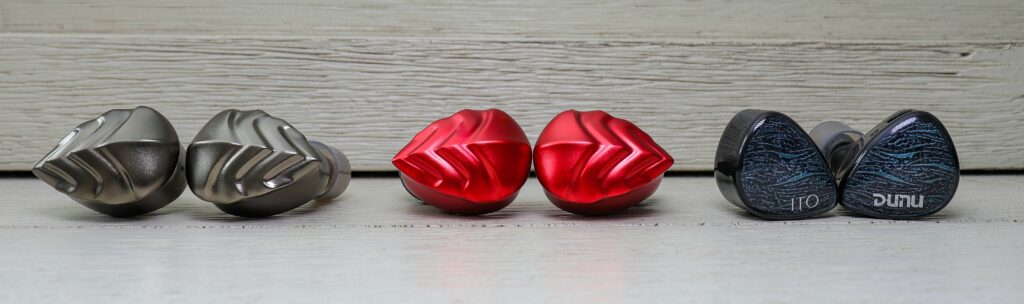
I reviewed the Hidizs MK12 Turris (MK12 Turris Review) sometime in the summer of last year when it first came out and I was so overjoyed to give that review. I say that because the MK12 OG hit every listening need of mine at the time and I quickly fell in audiophile love. Of course, the MK12 was actually outdone by the MK12 Turris Titanium Edition (MK12 TE Review) a few months later, but it was also more expensive (for good reason). I only use the MK12 OG to simply help explain the sound of the MK12 X and I do hope it helps. But I digress, the MK12 Turris is also a single dynamic driver earphone which coincidentally uses the exact same driver, 91% magnesium diaphragm, 1.5 Tesla magnetic flux, exact same housing, same acoustic cavity too. The sound difference comes by way of DucBloke’s tuning strategy using custom physical tweaks using damping and nozzle tweaks getting the MK12 X close to his target sound. So, there are most certainly differences, and some similarities too. Let’s check ‘em out.
Non-Sound Stuff
When it comes to a comparison with these two brother iems it is clear to me that they certainly share identical DNA. However, there are some differences. These differences have nothing to do with any physical characteristics as both sets are identical in build, size, weight, and appearance (different colorways of course). That said, the DucBloke special edition MK12 X does have a more premium packaging which helps it to show its $50 premium over the OG. You get a cool case with the DucBloke logo whereas the OG MK12 only has the Hidizs carrying bag. The eartips which come with the MK12 OG are nowhere near as good as the Divinus Velvet eartips which come with the MK12 X. Also, the cable which arrives with the MK12 X package is clearly a better cable. Like I said earlier, as far as appearance, I never would’ve thought that I’d like a candy red version of this set as much as I do. I actually feel it’s one of the more dope looking sets that I have. All red…everywhere. No doubt the OG MK12 looks slick itself and I like all of its colorways, but the red is too slick. I should also mention that the OG MK12 does have three nozzle filters which do change up the sound and so it has a bit more versatility there whereas the MK12 X has fixed nozzles. In fact, the MK12 X used the same “Red” nozzles (bass focus) used in the OG MK12. Other than these differences, there really isn’t much else to speak of other than the MK12 X comes with specialized PEQ settings which DucBloke himself took the time to dial in. Which is nice.
Sound Differences
Now, this is where you are going to hear some pretty massive differences between the OG MK12 Turris and the new Special Edition DucBloke version of the MK12. I will keep this pretty short folks, but the MK12 X is without question leagues warmer than the neutral sounding MK12 Turris. The MK12 OG has a much more balanced approach using its Rose Gold (Balanced) nozzles helping it to come across much more versatile and more of an all-rounder type of set. The MK12 X has more of a specialty tuning leaning heavily on its boosted sublevel response which has a long and drawn-out mid-bass and warmth cast frequency wide. The OG MK12 is better across the board technically as it’s simply tuned to be better. However, the MK12 X has the smoother, more musically gifted sound with more of an emotional pull, it’s more fun too, and definitely carries that “guilty pleasure” moniker whereas the OG MK12 cannot boast such a description. However, both sets have those faster and tighter transients in respect to each set’s tuning and both have that organic and natural feel as well. Both sets are easy to drive, and both perform better when scaling with clean power and better sources.
Between the 20’s
As far as bass response the MK12 X is right at the cusp of basshead while the OG MK12 may be considered bass lite to some. The OG MK12 has a better-defined bass, better textured, better agility, and has far less bleed into the mids. Though the MK12 X has much deeper and darker extension with a denser and more rigid bass that slams with more authority, is much fuller in body and more bulbous in every way. Looking at the mids, the MK12 X is far warmer, richer by a mile, and has far less of a chance for fatigue. The OG MK12 is cleaner, more sprightly, more vibrant, and closer to what natural sounds like to my ears. Also, it has better midrange separation, more precise and distinct imaging as well as having the more fine-lined control. The treble is more sparkly on the OG MK12 with more sparkly shimmer, note bite, and more treble punch. Listening to the MK12 X I find it has a far less sharp, less offensive treble that comes across much smoother, but less detailed. Extension on both sets is solid without sounding splashy or smeared. Again, detail retrieval is clearly easier to discern on the OG MK12 with far less bass fused masking occurring along with easier to hear note separation. Imaging is solid on both sets though once again the OG MK12’s imaging ability is aided by the more balanced approach with more distinct note outlines making imaging easier to recognize. The soundstage of the OG MK12 is slightly wider by a small margin. Both have good height, both have good sound field depth and both simply have really great soundstages in my opinion.
Final thoughts on this comparison
This is somewhat of a skewed comparison and a total “preference battle” which puts two totally different tunings against each other. It’s almost not really fair in some respects. If we are talking sheer musicality and fun, the MK12 X wins hands down. If you are seeking a more balanced and audiophile approach to tuning than the MK12 Turris wins hands down. Two totally different tuning philosophies which cater to different types of hobbyists. Neither wins, or both wins here. Neither is necessarily better than the other and both represent their respective tuning targets marvelously well. I do need to add that much of this comparison would sound quite different if I incorporated DucBloke’s PEQ tuning into the equation. I realize that the point of this set was to use his PEQ, but honestly, I feel that the base tuning is very well tuned for what it is and I feel more comfortable speaking on that than using his settings for comparison.
Dunu x-Koto Ito ($199)
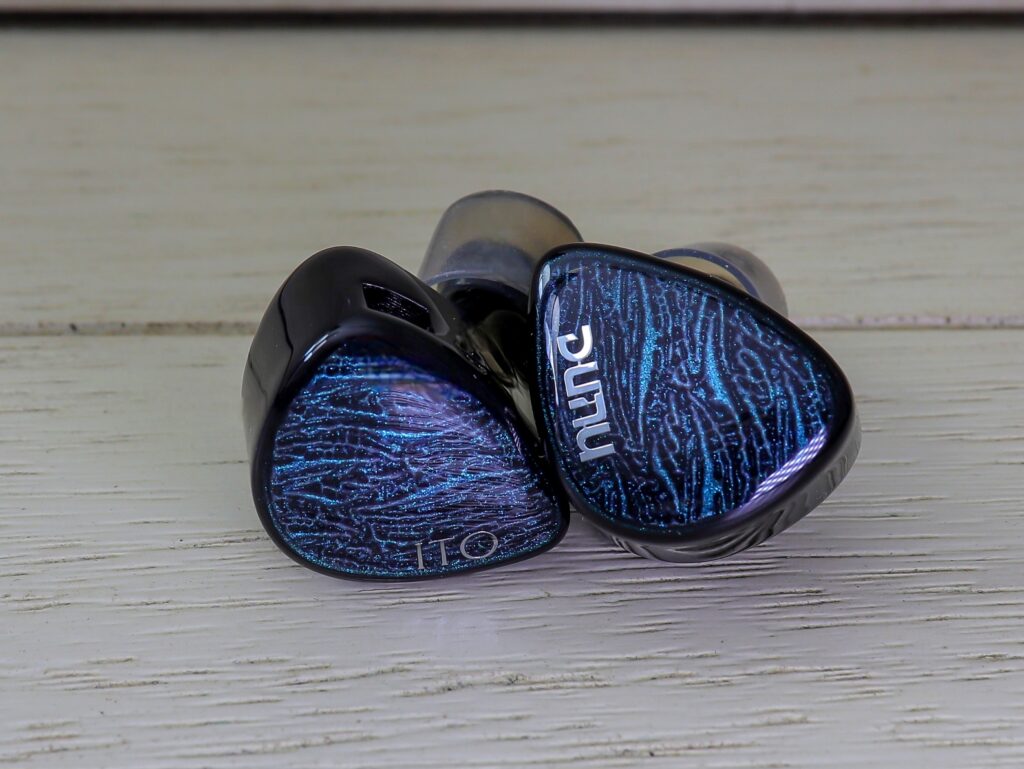
I just completed my review of the Dunu x-Koto Ito (Koto Ito Review) only a few short weeks ago and was immediately impressed with what Dunu Audio was able to do. The Ito is actually a four-driver hybrid iem and so it has a totally different makeup and configuration. However, it does share one similarity in that it too is a very musical sounding set with a heavily raised bass section and both sets are collaborative efforts with YouTube personalities. You see, the Ito is in a three-way collaboration with HiFiGo, Dunu Audio, and YouTube personality Kaji Kaji who is a respected Japanese reviewer. Now, the Ito sells for right around $200 and so it seemed to be at least somewhat relevant for comparison in my eyes. Hopefully it is at least a tiny bit helpful to you. Now, those four drivers Co trained within the Ito’s shells are two dynamic drivers and two balanced armature drivers. This can be an advantage in some regards and not so much of an advantage in others. Let’s look at some differences.
Non-Sound Stuff
To begin, the package of the Ito and the MK12 X are both very well done. You do get a few more eartips with the Ito as well as a modular cable, though I wouldn’t say one cable is better than the other, or one package is better than the other either. The build of the MK12 X is far better as it’s made entirely out of aluminum compared to the resin shells of the Ito. Though, for a resin set the Ito is very well done. As far as aesthetic appearance I find that both sets have a very nice look. Both are very attractive in their own ways. Again, I can’t say which is better looking and I don’t think you’d care either. All in the eye of the beholder. I do think the Ito is a hair comfier for longer sessions, but I am really splitting hairs with that statement. Both are comfortable. Again, the MK12 X is a bit more expensive at $259. Of course, DucBloke took the time to provide specialized PEQ tuning profiles whereas the Ito doesn’t have those readily available. Furthermore, you are getting those settings from a person who does a very fine job of creating these profiles.
Sound Differences
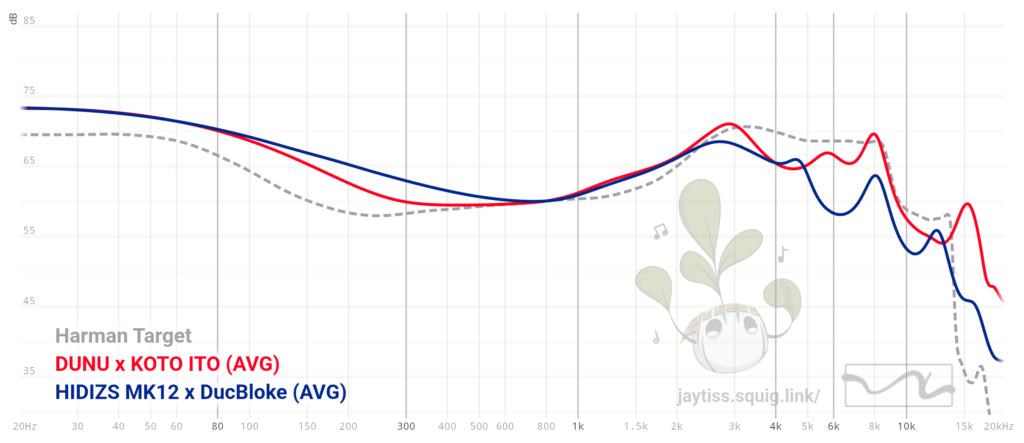
There are some distinctions between these two sets when comparing and there are some similarities too. In my opinion both iems have a definite warmth to their tunings though the MK12 X is certainly warmer, even darker sounding. I definitely find that the Ito has an advantage in regard to its technical capabilities with a more boosted upper end of the spectrum illuminating more details, coming across airier, and sounding a bit more resolving too. That said, the MK12 X is once again the more musically inclined iem with more of a penchant for drawing out the emotional sentiment within my music. I’d definitely say that the Ito has a more V-shaped signature with a brighter hue, more brilliant, more vibrant too which ultimately makes it sound perceivably cleaner. Both sets are reasonably easy to drive.
Between the 20’s
The Ito has a tighter and more defined bass while the MK12 X has a deeper and more bass-forward sound. Having said that, both sets are about equal in respect to sub-bass emphasis, yet the MK12 X has far less treble influence contrasting that bass making it sound more forward, more prominent in the mix (12-15 dB shelf). I’d definitely say that the MK12 X has the denser, funner, and more palpably authoritative bass, though the Ito seems to handle complicated tracks a hair better. The Ito’s bass is also a hair leaner, which does affect how some instruments and voices come across.The midrange of the Ito sounds more forward, closer to neutral, and slightly less organic. The MK12 has that vocal friendly richness with a more analog sound and no shot at shout or peaky glare. Of course, the Ito can come across as too glaring at times. I find the MK12 X has the better midrange for my taste, but both are nice. You’ll notice the Ito has the thinner, leaner, and less robust note weight in comparison and the midrange simply sounds less songful, canorous, and any other word describing something musical. Though more technically adept. The treble of the MK12 X has less emphasis, less radiant, less sparkly, and less extended. I think it’s the treble which defines the largest difference between these two. The Ito has clearly better detail retrieval, note bite, sound separation, and it comes across more extended up top. In fact, I’d say that frequency-wide the Ito has the more technical sound with better illumination of details, instrument separation, and distinct imaging. Though placement is just as good on the MK12 X. However, the MK12 X does have a more holographic sound field to the Ito’s slightly wider stage.
PEQ
I once again have to add that using the PEQ profiles provided with the MK12 X from DucBloke effectively shrinks the gap technically between the Ito and the MK12 X. DucBloke’s PEQ profiles really do help this set to sound more balanced whilst not losing the fun bassy spirit. So, that’s just something to keep in mind when I’m comparing these sets.
Final thoughts on this comparison
Once again, the comparison between these two fantastic sets seems to be a comparison of tuning philosophies. I find that both sets offer a unique bigger bass perspective to their tuning styles. Both sets are fun and even very musically adept. I’d definitely say that the MK12 X carries the crown in that regard between the two, but I can’t discount how awesome the Ito is in ways that the MK12 X isn’t. Really these are two sets which complement each other very well in a collection. Personally, I enjoy both iems. Lately I’ve obviously been more attached to the MK12 X, but that shifts by the week with me. In reality I was hoping this comparison would help you. Though, I notoriously choose bad comparisons. My bad.
Last Words on the Hidizs MK12 X DucBloke
I will try to keep this relatively short as these reviews of mine are like marathons anymore. But I do want to give credit where credit is due because the Hidizs MK12 X DucBloke is a very fine set of iems. Having said that, it’s also a very polarizing set of iems in that it leans so far to one side of the spectrum. At first listen you may decide that the MK12 X is bass, bass, and more bass. Especially if you haven’t spent time with a warmer, smoother, and darker sounding unit. Nevertheless, there will come a point when brain burn sinks in, the bewildering amount of bass becomes familiarized in your frontal cortex and you begin to see (hear) the beauty in what Hidizs has crafted. No doubt the bones were already there. Hidizs already made some of the best single dynamic driver earphones under $300 with the MK12 Turris and the MK12 Turris Titanium Edition. All they did was tweak the tuning. Some damping here, some tweaks there and what you have is this robust sound with a purely and totally emotionally charged tuning carrying an abundance of rich flavoring alongside the same fast, and tight transients as seen on the first two iterations of the series. Everything comes down to that fabulous driver which seems to naturally make everything skew…natural. I think that DucBloke and Hidizs had a fantastic idea which definitely resulted in one of the best warmly rendered iems that I’ve spent time with under $300. The one huge and glaring caveat is that you have to enjoy a warmer sound. Also, the MK12 X won’t cover all genres perfectly, but I’ll touch on that in a little bit.
Somewhat Polarizing
I usually will add in some paragraph describing some of the competitors within the same range as the set I’m reviewing around this time and within most of my reviews. After all, these reviews are mostly about helping you, and hopefully that rings true. However, I honestly don’t think the MK12 X has much competition. Not for this bass-forward tuning. Brands aren’t betting on these specialized tunings as much anymore which makes this collaborative effort that much more awesome. I’ve said countless times that I truly enjoy every tuning style, every signature, and I can wrap my brain around every specialized set, whether bright or dark… if it’s good. That’s my caveat. It has to be good at what it was tuned to be per the target it was intended to hit… from my perspective. I am the person writing all of these words after all. That said, it still takes a brand betting on something different, going against the grain a bit, and deciding to test those consumer waters, so to speak. Be that as it may, I cannot discount that the MK12 X is going to be somewhat polarizing. Of course, the word “polarizing” always seems like the wrong word. With all of that said, there’s no universe or dimension that I would say that the Hidizs MK12 X DucBloke is a bad set. It is a very nice iem per its target tuning. These are my opinions and I know that everyone won’t share my opinion, but I most certainly rec this set for anyone who desires that warm, holographic, smoothly rendered, and bassy sound. In fact, it’s an easy rec for a set that sounds great for $259.
I ran out of time for my next section “The Why”, which I always put into my reviews. Basically, it’s a section in which I briefly and with broad strokes try to explain the highlights of the set I’m reviewing. Perhaps I can edit that into this review after it is published.
MK12 X Pros
-Build Quality is once again stellar in this latest MK12 variant
-Also, the same solid design & aesthetic
-The MK12 X is a very comfy set for me
-The MK12 X’s 91% Magnesium DD is fantastic
-Nice accessory haul (Divinus eartips, solid carrying case, great color matching cable).
-Musical and engaging presentation perfect for bass-driven genres
-Smoothly rendered warm & analog tuning. Very much organic, earthy, and definitely bassy.
-Richly flavored across the board with thick note weight… everywhere
-Bass digs very deep with a palpable slam. A very fun bass, very rigid & dense
-Milky midrange, very melodic, and never sharp
-Easy going and relaxed treble means easy going and relaxed listening experience
-Imaging is well done
-Soundstage is holographic with nice width, good height, and great depth of field.
-Comes with DucBloke’s very own PEQ profiles made specially for the MK12 X
MK12 X Cons
-Fit may be troubling for some folks (decently sized set)
-Bass will be too emphasized for many listeners, can veil at times
-Not everyone wants a very warm, thick, and colored sound
-Not a technical beast. Don’t expect top shelf details & separation. Good for the tuning.
-Treble is very laid back (intentionally) and relaxed on the base tuning so definitely not for analytical listeners, or anyone who enjoys some brilliance up top
-This is more of a side-grade variant to the OG MK12 and not considered an upgrade. The differences are too great tonally
Genres
With a “specialty tuning” like the MK12 X’s, you are going to have some genres which work, and maybe some which won’t perform quite as well. That’s the nature of beast folks. No doubt the PEQ settings help the MK12 to become more of an all-rounder (to a degree), but the base tuning is certainly a specialized sound tuned to be musically gifted rather than technically astute. With its bigger bass and somewhat attenuated treble you’ll naturally have some genres which won’t fit this set as well. Again, this set was created to use with the PEQ profiles engineered by DucBloke so please keep that fresh in your mind. I am speaking only to the base tuning. With that thought in mind, you can obviously use a Parametric Equalizer for any set in your collection. DucBloke simply gives you the values that he has personally tested. Also, obviously you can tweak his settings as well. This is why I felt it best to review off of the abuse tuning.
Genres which work
One thing is clear, the MK12 X works very well with genres that emphasize the bass or are typically bass forward. Or those genres which really don’t sound as good with a brighter treble too. That’s a majorly generalized explanation, but I’m sure you understand. At any rate, there are a number of solid genres that fit the tuning of the MK12 X. Genres like EDM, House, even Techno (at times), obviously Hip-Hop as well as R&B (totally bass driven). Any Rock music and even Alternative music usually sounds great along with Country, some Blues stuff, and those rich vocal Singer-Songwriter tracks. I also tend to enjoy some Punk tracks too. Obviously, I have only named a few, but these genres tend to sound pretty nice.
Genres that won’t work as well
The genres which don’t really work as well with the base tuning of the Hidizs MK12 X DucBloke aren’t as many. Furthermore, just because I feel that these genres don’t necessarily translate as well in the MK12 X, doesn’t mean that you do too. However, in my opinion I find that Orchestral or Classical music tends to be a hair too bass forward which does disrupt the fine layering needed. This is all my opinion, but I typically like something with a closer to a neutral sound which really seems to bring out symphonies to their most resounding form. Also, I really don’t think that the MK12 X is built for Hardcore Metal. I mean, cymbal stacks, multi-layered aggressive guitar riffs both demand that sharp treble bite and intensity. The MK12 X just sounds too smoothened, rich, composed, and less raw than I typically enjoy. There’re a few other questionable genres like some of my Jazz tracks. Like, “My Funny Valentine” by Ella Fitzgerald which doesn’t necessarily sound bad, but it simply doesn’t have the top end finesse to recreate those breathy vocal nuances or the light cymbal brushes. Again, not bad but simply not as sparkly as I’d like. So, it’s stuff like that where genres which need those finer lined tinsley touches and more brilliant inflections that the MK12 X simply doesn’t have. Honestly folks, I have a long list of tracks which didn’t sound quite right (as per usual) as I go along. However, I have an even longer list which sound darn good. Again, these are only a few, but I simply want to give you a road map (if you will) to what may or may not work. Also, it’s just my opinion.
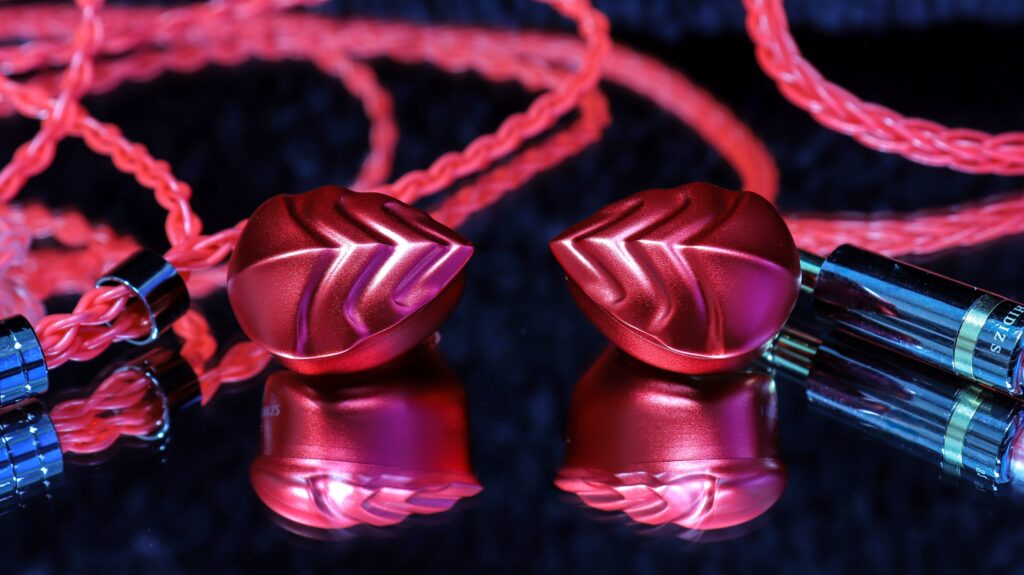
Conclusion
To conclude my full review and feature of the Hidizs MK12 X DucBloke, I first have to thank the awesome people of Hidizs. Friends, these people are so great all the time. They never ask anything of me but my truth, and they are always considerate of my space as a writer and reviewer. I truly couldn’t thank them enough. Always a stand-up team of people who are very helpful, extremely polite and always courteous. Thank you very much to all of you with whom I speak with and for those who make these reviews possible. Thank you. Also, I thank you, the reader, for trusting my reviews and clicking the link to get you here. Thank you, I will always tell you exactly what I hear every time I speak a word, and I always hope those words help you. But really, and more importantly, thank you for trusting mobileaudiophile.com. It means the world to us every single last time you click the link to our website. Thank you.
Other Perspectives
Now that you’ve read my review (or lightly glossed over it), I implore you to check out other thoughts. It is of the utmost importance that you take the time to read, watch, or listen to someone else’s thoughts on this set. Especially this set. I really feel that others may have a different perspective. We have such a diverse hobby folks. I feel it’s the most subjective hobby on planet earth. Name me another more subjective hobby. Let me know when you figure one out. It’s the most subjective, and each human can be radically different. Not just with our likes and dislikes, but with our ability to even hear the same things. I cannot stress this enough to you all. Believe me… it is something that many people forget. We are different folks. We hear differently, we have different gear, different sources, different music libraries, and we’ve all been down different journeys through audio. That makes a huge difference in how we hear what we hear. So please take the time, do your homework, and find what works best for you. That is the end goal for me. I want to envision you, eyes closed, and melting into your music. Beyond that, I hope this review has helped in some capacity. Anyway, I’m done friends. So, take good care, stay as safe as possible and always… God Bless!!




Hi,
If someone owns the original,
Will auto eq on the them be enough to not having to buy this sidegrade?
Thanks
Kind regards
Sam
That’s a great question Sam. I have to assume you can manipulate the sound via EQ well enough to get very close. Use the red nozzles (I think) which offer the most low-end emphasis and tune the rest using EQ. I haven’t tried but it’s the same shells, same driver, only the MK12 X DucBloke uses different dampers internally to get it to sound the way it does.