


























































Disclaimer
Hey everyone! Quick thing before we jump in. I want to be clear with you all and say that FiiO sent me the SNOWSKY DISC so I could test it out and share my honest opinion on it. I’m not getting paid for this, and FiiO didn’t tell me what to say, didn’t ask to see the review before it went up, and didn’t set any kind of deadline for me either.
Table Of Content
- Disclaimer
- Introduction
- Unboxing
- Technical Specifications
- Specs
- Special Features
- The DAC setup
- The processor and OS
- Build quality
- The screen
- Storage
- Connectivity
- Battery
- Auto power off
- Actual performance
- Features inside
- Comparison to the Snowsky ECHO
- Who each one fits
- Conclusion
- Pros
- Cons
- Q&A
- Who is it for?
- Who should avoid it?
- Alternatives?
Everything here comes from my own time with the SNOWSKY DISC. I always try to be as fair and objective as I can, but at the end of the day this is still my personal take. We all judge things differently and care about different things, and honestly that’s a big part of what makes this hobby so great.
Big thanks to FiiO for sending this one my way, and a huge thank you to you for reading and supporting my reviews. It really does mean a lot to me!
Introduction
Now, I know I’m a bit late to the party with this one. The DISC has been out for a while already, and plenty of people already covered it before me. I hope this review still ends up useful for some of you anyway, even if it’s coming a bit later than it should have.
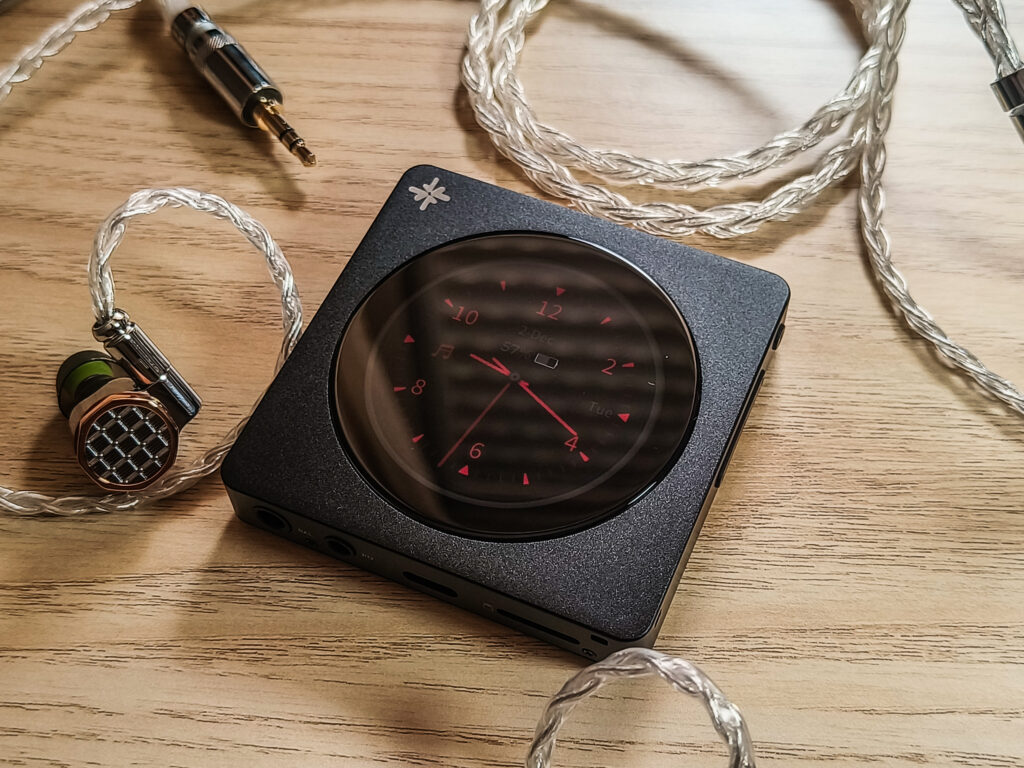
So FiiO put this out under their Snowsky sub-brand. It’s priced around $80 to $90 depending on where you buy it from. And honestly, the design is quite cool and unique. It’s a tiny round screen DAP that looks something like the Discman or MiniDisc. And that’s kind of the idea behind the SNOWSKY brand, which offers many retro style mostly budget products.
Snowsky already came out with the pretty successful Echo lineup. The DISC takes what they have succeeded in with the Echo and adds some cool new features on top. The most obvious addition is the touch screen, of course, and about the rest we will talk later in this review.
So today we will see if the DISC sounds and performs well enough for the asking price. Or does it just look cool, and that’s the selling point?
I’ll also be comparing it with the Echo later in this review, since they come from the same family and share a lot of the same architecture inside.
Unboxing
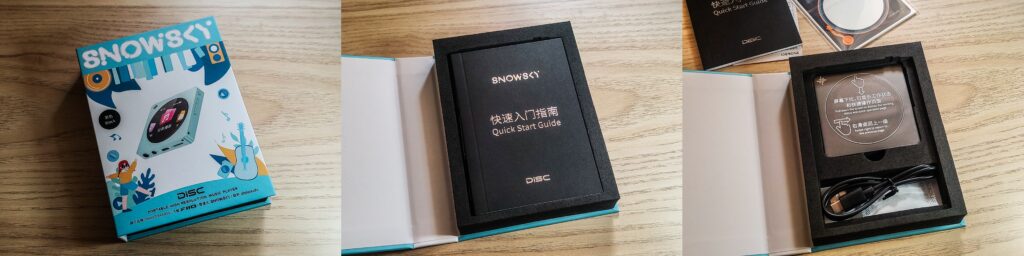
The box is teal and white, with the typical Snowsky look to it. My unit came in black, but Snowsky offers a few other colors too.
The box opens like a little book. Flip the front cover over, and you see a quick start guide sitting there with some stickers to put on the DISC, but I actually really like the look of it, and I didn’t put the stickers on it.
The DISC sits in the foam, screen facing up. It’s already showing a couple of usage tips right on the display. Swipe down for status info. Swipe right to go back a page. Small touch, but a nice one so people won’t get confused.
Next to the player, you get the USB cable for charging, coiled and tied off, and it doesn’t come with the charger itself as most devices do nowadays.
Now here’s my biggest gripe with the whole package. The included cable is not USB-C to USB-C. So if you want to plug this straight into a phone to use it as a USB DAC off your phone, you can’t. Not with what’s in the box. You need to buy a USB-C to USB-C cable yourself. The DISC supports USB DAC mode, so leaving that cable out feels a bit strange.
You can also buy a protective case for it separately if you want, and it comes in several different colors.
Still, for an $80 to $90 player, the unboxing experience is quite nice. Just budget in that extra cable if you plan on using it with your phone in addition to as a player.
Technical Specifications
Specs
General
- Colors: Blue, Black, Pink
- Dimensions: approx. 68 x 68 x 12.9 mm
- Weight: approx. 77.2 g
Hardware
- Display: 1.8-inch circular LCD, 360 x 360 resolution, fully laminated touchscreen
- Processor: Ingenic X2000, dual-core, Linux-based OS
- DAC: Dual Cirrus Logic CS43131
- Headphone outputs: 3.5mm single-ended, 4.4mm balanced
- Coaxial output: shared with the 3.5mm jack
- Storage: microSD up to 2TB
- Battery: 1450mAh, rated up to 12 hours
- USB-C: data and charging, UAC 2.0 only
- Bluetooth: 5.4 with LDAC
- Wireless: AirPlay, Roon support
Audio performance (high gain, 3.5mm output)
- Output power: 135mW+135mW @16Ω, 125mW+125mW @32Ω, 15mW+15mW @300Ω
- Output impedance: under 0.4Ω
- Crosstalk: over 73dB
- SNR: over 117dB (A-weighted)
- THD+N: under 0.0008%
- Dynamic range: over 117dB
- Frequency response: 20Hz to 80kHz
Audio performance (balanced 4.4mm output)
- Output power: 280mW+280mW @32Ω
Special Features
The DAC setup
The DISC runs dual Cirrus Logic CS43131 chips. One chip per channel. This is the same DAC FiiO has used across a bunch of their entry level players and dongles, so it’s a very known chip at this point. It’s not the newest chip on the market, but it’s still considered one of the best low power options out there for this price range. Each channel getting its own chip means cleaner separation between left and right.
The processor and OS
Instead of Android, the DISC runs on an Ingenic X2000 chip with a custom Linux based system FiiO built themselves. No app store, no bloat, no background processes eating the battery or causing lag. It boots fast and is quite responsive for what it is. The tradeoff is no native streaming apps. If you want Spotify or Tidal on here directly, you’re not getting it… You get AirPlay instead, which lets you stream from your phone through the DISC.
Build quality
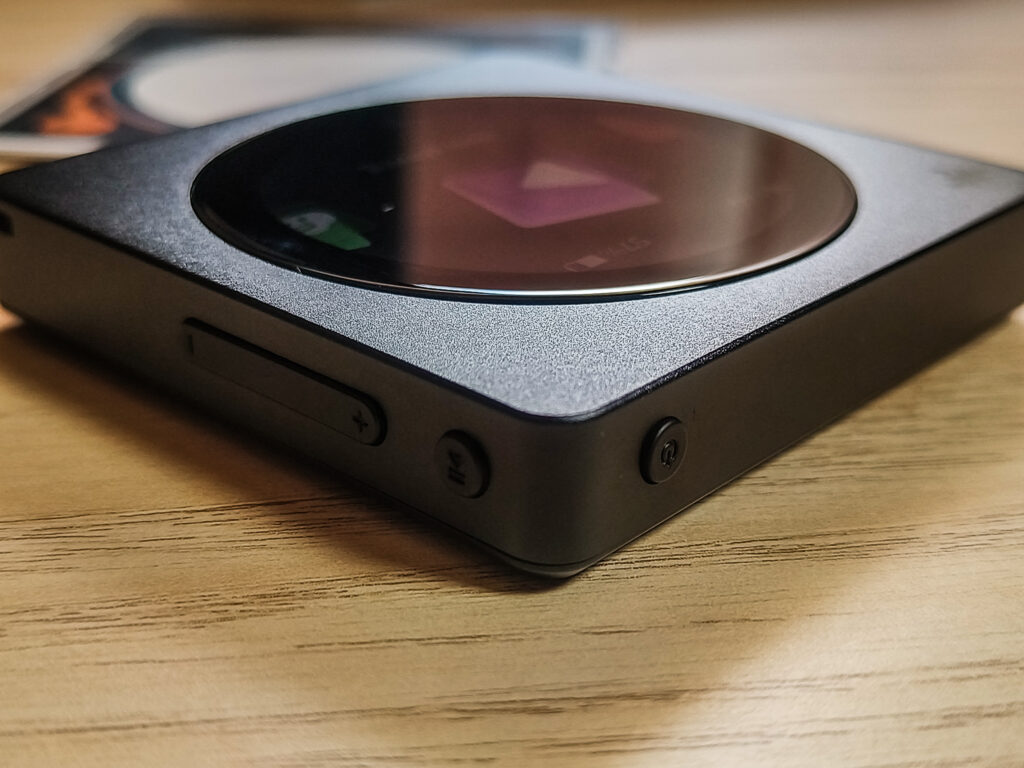
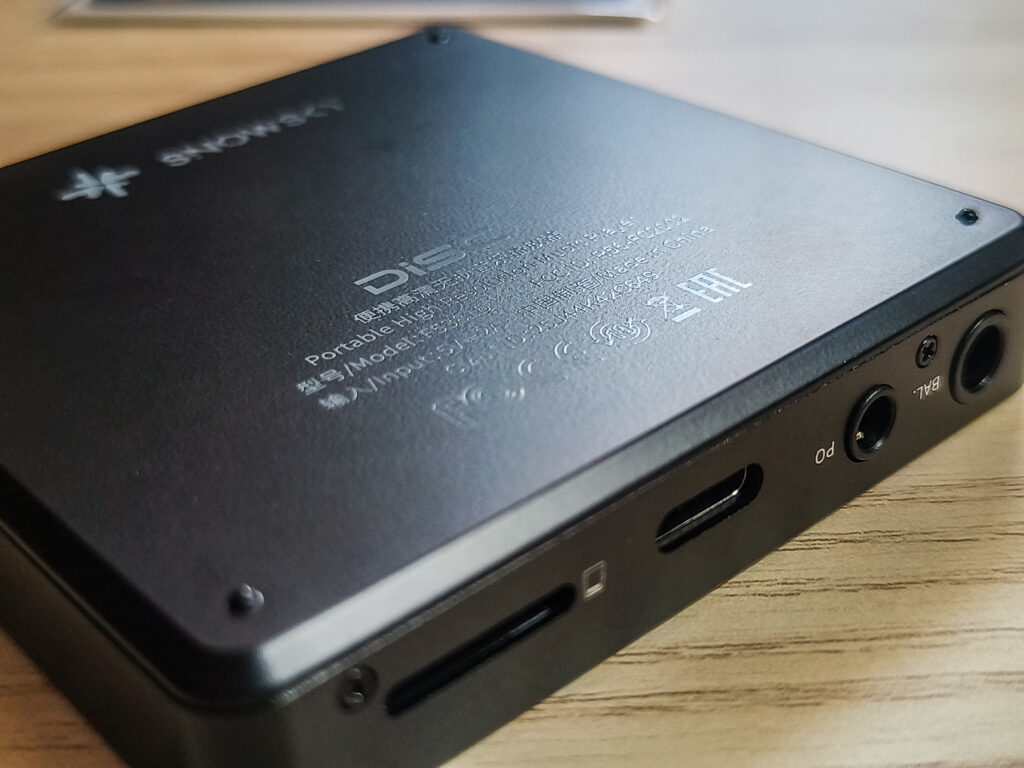
The DISC feels really good for what it is. The upper half is metal. Gives it a bit of weight and feel to it, the kind of thing that makes a small player feel premium. The bottom half uses plastic. Not a deal breaker. But you do feel the difference if you pay attention.
The screen itself feels plastic too, not glass. Not bad exactly, it feels cool, just keep in mind that it can catch scratches more easily. Glass would have matched that metal top better, but the price probably would go up as well if you want everything made of premium materials.
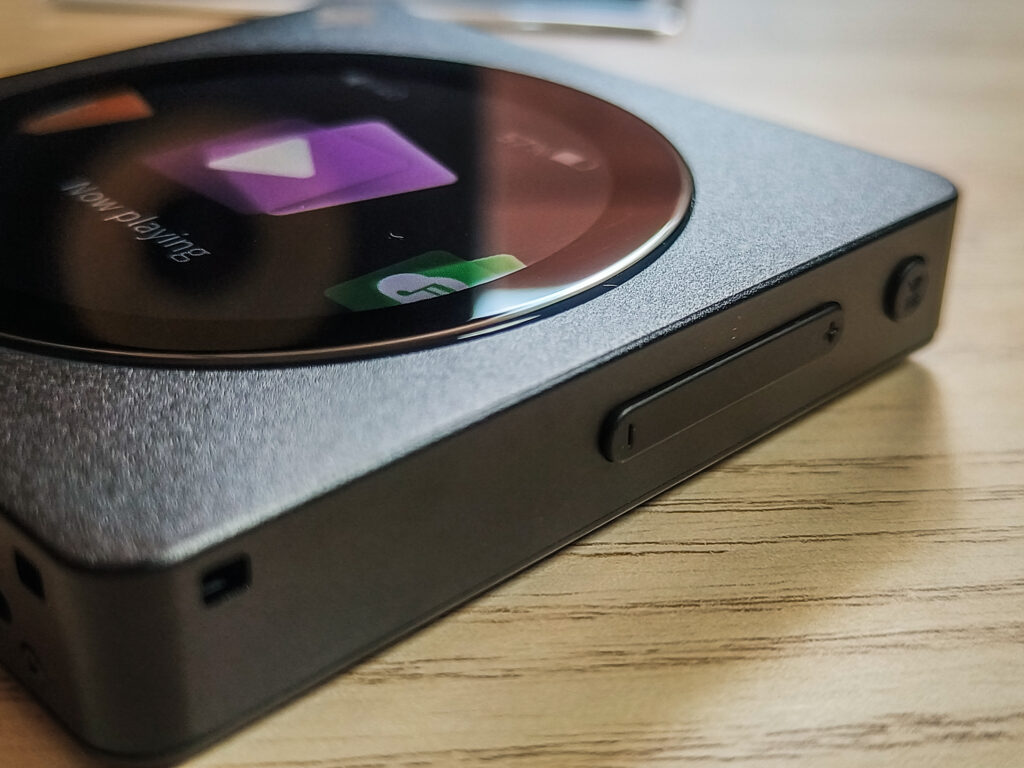
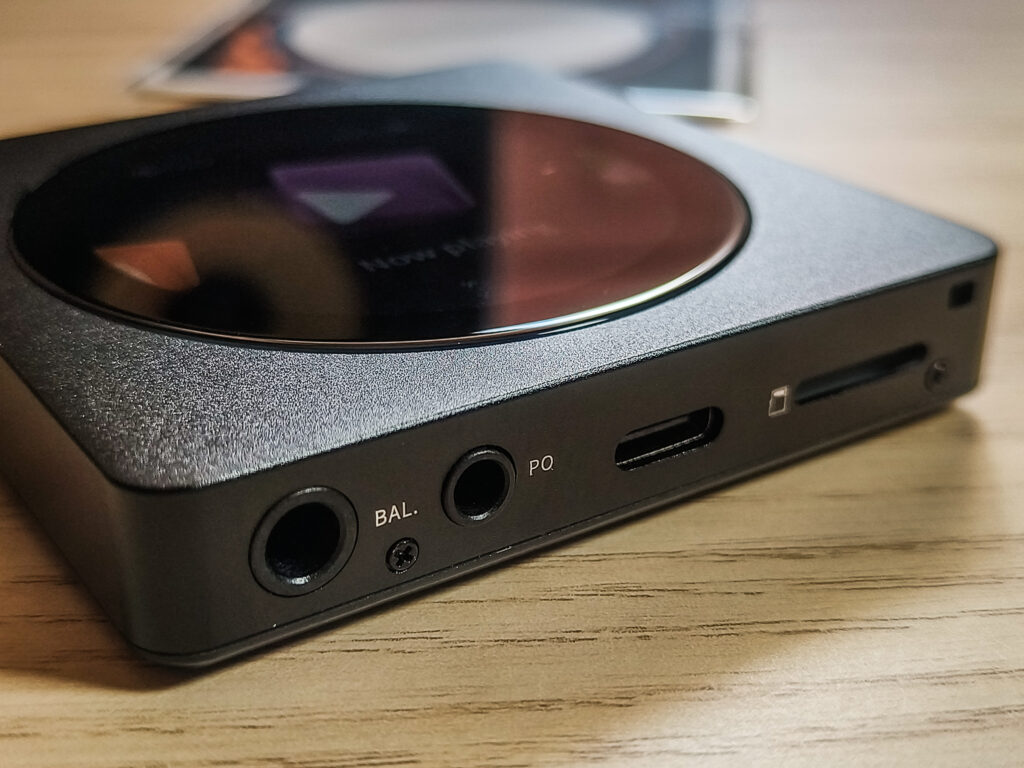
Layout wise, the power button is up top. Play/pause and volume are on the right side. Down at the bottom you get USB-C, the SD card slot, the 3.5mm jack, and the 4.4mm balanced output, all lined up together.
My one real complaint here goes back to the controls. There’s no next or previous track button anywhere on the body. Every other control got a physical button. The one you’ll actually use the most while walking around or at the gym doesn’t, so you have to control it on the screen.
The screen
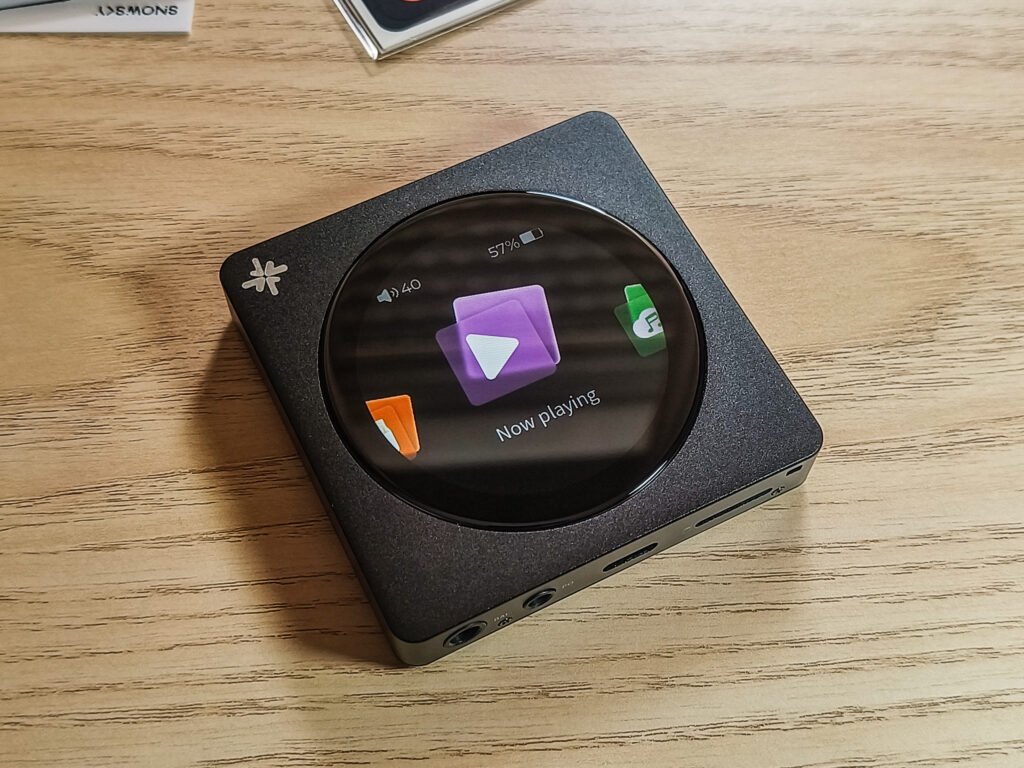
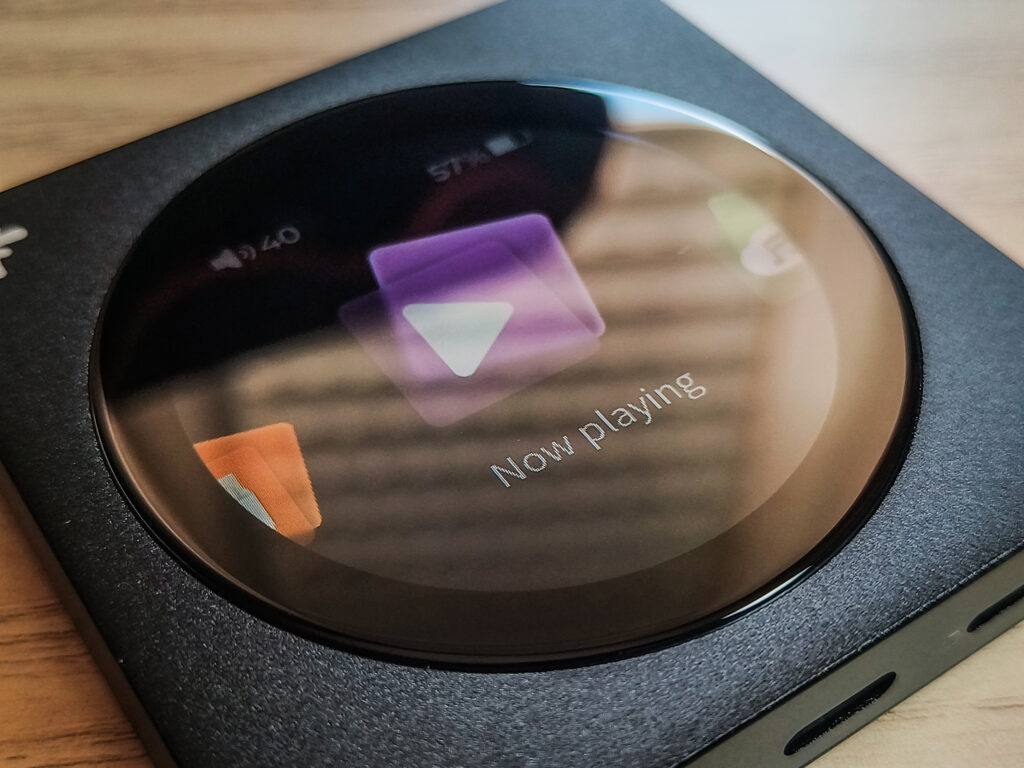
That circular touchscreen is the centrepiece of the whole design. It’s 1.8 inches, 360 by 360 resolution, and fully laminated so there’s no air gap between the glass and the panel underneath. It shows album art, spins like a little disc while a track plays, and can also display lyrics too if your files have them tagged. It’s a small screen, but I really like how it looks and feels.
Storage
MicroSD support goes up to 2TB. That’s a massive amount of headroom. You could load your entire lossless library onto one card and never think about storage again. No internal storage, so you rely only on the SD card.
Connectivity
Bluetooth 5.4 with LDAC for your wireless headphones. Wi-Fi gets you AirPlay support and also online updates. USB-C is for charging and file transfer and doubles as a USB DAC input so the DISC can act as an external sound card for your phone or laptop. One thing worth knowing is it only supports UAC 2.0, not UAC 1.0, so older devices and some game consoles won’t talk to it properly.
Battery
1450mAh inside, rated for up to 12 hours. In my own use, I’m not getting there. I’m getting a bit less, and I end up charging it at least once a day. For a dedicated music player, that feels low to me. A device like that should hold a charge longer than my phone does with twenty apps running in the background. Worth keeping in mind if all day battery life matters to you.
Auto power off
One thing I like is that you can set an auto power off for ny time you like from 5 min to 120 min, and if nothing is playing, it shuts itself down automatically. Saves your battery from draining overnight in your bag because you forgot to hit the power button. Small thing, but it’s the kind of detail that shows some thought went into the daily use side of this player.
Actual performance
Let’s start with sound. For an $80 to $90 player, the DISC sounds great. Really. It sounds clean, controlled and detailed. Nothing about it feels odd to me. I’m not breaking it down into bass, mids, and treble here as modern DACs from reputable brands all land close to each other these days. The real story with a player like this is everything around the sound, not just the sound itself. Though it’s not less important, I already said that it sounds really nice, so let’s move to the actual usability.
Power wise, the balanced output gives out 280mW. In real use, it was enough for nearly everything I threw at it. Every IEM I tested drove without issue. No struggling. No lack of headroom. Most of my headphones did fine too. You’d need something really hungry to ask for more than what this thing can give. Most people buying a player this size aren’t running gear like that anyway.
As I mentioned earlier, the OS is simple. No Android, no apps, no bloat. It boots fast. Gets you to your music quickly. The album selection feature fixed the worst sorting complaints I’d read about before my unit arrived. Your library, actually, somehow is possible to navigate in.
Again, it’s just the controls where I wish there was a bit more. No physical next or previous track button. Every skip happens on the screen. The touch isn’t always sharp either. Sometimes a swipe doesn’t register on the first try. You end up swiping two or three times before it finally works. It’s not broken, just not the snappy, reliable response you’d want from a device built around its screen as the main control method.
As for the feel in hand, it’s split. It really looks cool and also feels nice too. The plastic bottom and plastic feeling screen pull that down a bit. Not cheap overall. Just not as premium as the metal top alone would have you believe, although I still like it, especially for the price.
Features inside
You get eight EQ presets here. A selection of digital filters too. Multiple playback screen themes so the display looks different when playing music. Screen rotation. Gain control switches between two power levels, High and Low. OTA updates land straight over Wi-Fi, no plugging into a computer needed. Small stuff but still nice to have.
Comparison to the Snowsky ECHO
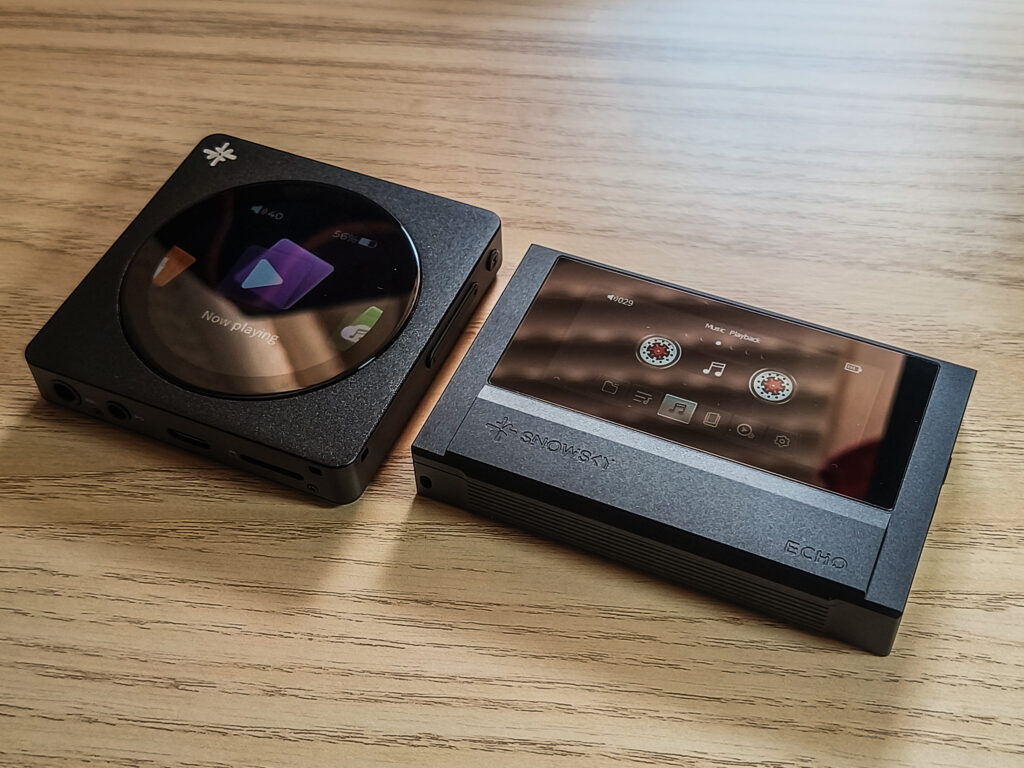
Sound wise, there’s barely a gap. Both use a dual Cirrus Logic setup. Both sound clean, with no hiss or background noises. Modern DACs from a brand like FiiO rarely show a real difference anymore. If sound alone is your deciding factor here, you’re picking based on nothing. The real differences sit in everything else.
The build goes to the ECHO. Full metal, top to bottom. The DISC uses a metal top and plastic bottom. Even the screen feels plastic. The ECHO just feels like the sturdier piece of hardware.
Storage flips the other way. The ECHO carries 8GB built in, around 7GB usable. Its microSD slot tops out at 256GB. The DISC skips internal storage entirely. But the DISC’s microSD ceiling goes up to 2TB. Way more headroom than the ECHO, but the internal storage of the ECHO can be nice to some.
Power is close. 260mW balanced on the ECHO. 280mW on the DISC. Both drove my IEMs without any issues. Don’t expect either one to be your endgame amp for power hungry full size headphones.
Wireless is the biggest gap between these two. The DISC got Bluetooth 5.4 with LDAC. It also has Wi-Fi for AirPlay and Roon. The ECHO is stuck on SBC only. Output only. No Wi-Fi at all. If wireless matters to you even a little, the DISC takes this easily, although it still can’t be used as a Bluetooth receiver.
Controls go to the ECHO too. It has dedicated buttons for play, pause, skip, and volume. The DISC has no physical next or previous buttons. Every skip needs to be done on the touchscreen. The screen isn’t always reliable on the first tap either… But still, having a touchscreen makes life easier sometimes.
Both share one annoying habit. Neither includes a USB-C to USB-C cable in the box. Plugging either one into a phone takes a separate cable purchase first.
Who each one fits
Want a simple, offline player with a sturdier build? The ECHO is a nice pick.
Want more storage flexibility through microSD, better Bluetooth, and Wi-Fi features like AirPlay? The DISC is also nice. Just be ready for a touchscreen that occasionally needs a second tap, and no physical skip button to use while it’s in the pocket.
Conclusion
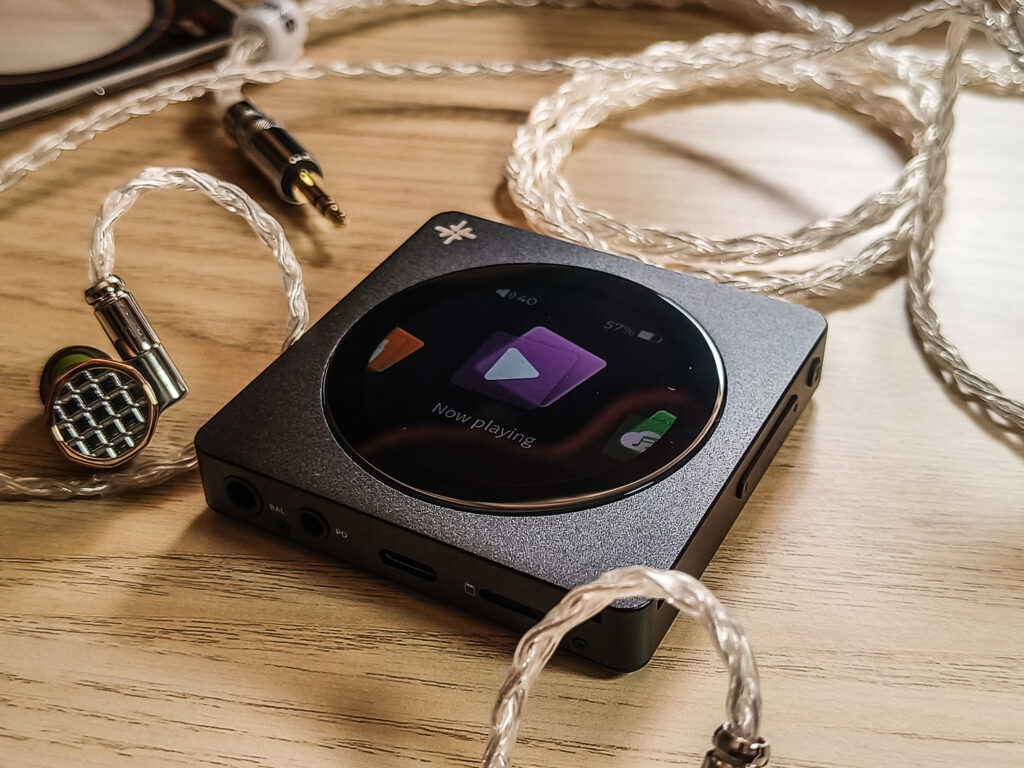
The SNOWSKY DISC is a fun little player with a cool and unique design. The sound is great. The power is enough for IEMs and most headphones. Wireless options like LDAC and AirPlay are nice to have rather than being stuck with wires all the time.
Where it loses points is in the daily features. No internal storage means you are relying entirely on the SD card. No USB-C to USB-C cable in the box means you can’t connect it to a phone right out of the box. The touchscreen controls work, but not always on the first try. Battery life also fell short of the rated 12 hours in my own use.
None of these are dealbreakers on their own. Together, they are the kind of thing that turns an $80 to $90 player from a clear win into a more “depends on what you can live with” recommendation. If you go in knowing what you’re getting, the DISC still earns its spot as one of the more interesting budget players out there right now.
Pros
- Clean, detailed sound for the price
- 280mW balanced output handles IEMs and most headphones easily
- Bluetooth 5.4 with LDAC plus Wi-Fi for AirPlay
- microSD support up to 2TB
- Unique retro design that actually feels good in hand
- Auto power off when idle
- Firmware fixes like the album selection feature
Cons
- No internal storage at all
- No USB-C to USB-C cable included
- No physical next or previous track button
- Touchscreen response can be inconsistent
- Didn’t quite get the 12 hours of battery life
For more Info: (Non-affiliated! None of my reviews use affiliated links!)
FiiO Official Website
Q&A
Who is it for?
You want a fun, compact player with a touchscreen. You want Bluetooth and AirPlay. You’re fine relying entirely on a microSD card. If that’s how you want your device to be, the DISC can be a good pick.
Who should avoid it?
You desperately need physical skip and previous buttons. You want a screen with consistently fast touch response. You want all day battery life without a recharge. If any of that is very important to you, the DISC will frustrate you more than it impresses you.
Alternatives?
The Snowsky ECHO is the obvious comparison. It gives up wireless features and pretty good flexibility. And you get a sturdier metal build and physical buttons. If neither one fits what you need? Worth checking what else FiiO offers in this same budget range before buying.







No Comment! Be the first one.