








































































Dunu x-Koto Ito Review
Intro
Hello, this review and feature covers one of the latest hybrid iems from the audio brand Dunu named the Dunu x-Koto Ito ($199). The Iko is actually a three-way collaborative effort involving the very popular Japanese YouTube personality and audio gear reviewer Koto aka: Kaji Kaji (apparently he uses “Koto” for collaborations), an even more popular Dunu Audio, and one of the industry’s largest online audio stores on the planet…. HiFiGo. Needless to say, there are multiple entities hoping that the Ito does well in a market flooded with quality iems, especially around $200US.
Table Of Content
- Intro
- Koto Ito
- Dunu
- Reviews
- They arrived
- Non-Affiliated Purchasing Links:
- Ito Pros
- Ito Cons
- Gear used for testing
- Packaging / Accessories
- Unboxing
- Eartips
- Carrying Case
- Cable
- Build / Aesthetic / Internals / Controls
- Build Quality
- Aesthetic
- Internals
- Fit / Comfort
- Drivability / Pairings
- Sensitivity
- Scalability
- Source Pairing
- Sound Impressions
- What’s it Sound Like?
- Technically solid, for what it is…
- Polarizing?
- Bass Region
- It’s pretty clean too
- Sub-Bass
- Mid-Bass
- Mid-Bass cont…
- Downsides to the Bass Region
- Muddy? (Downsides cont…)
- Midrange
- Techs
- Lower-Midrange
- Upper-Midrange
- Females
- Downsides to the Midrange
- Treble Region
- Technicals?
- Tuned to a target…
- Downsides to the Treble Region
- Technicalities
- Soundstage
- Separation / Imaging
- Detail Retrieval
- Comparison
- Dunu X-Gizaudio DaVinci ($295)
- Non Sound Stuff
- Sonic Differences
- Between the 20’s
- Final thoughts on this comparison
- Last Words on the Dunu x-Koto Ito
- Not for everyone or every genre
- Better for these genres
- The Why…
- Conclusion
- Other perspectives
Koto Ito
The Dunu x-Koto Ito is actually a four-driver hybrid iem consisting of two dynamic drivers and two balanced armature drivers and once again, this set comes specially tuned by Dunu to Koto’s parameters. Now, I have yet to receive the Ito, but I am very intrigued by this iem, for multiple reasons, but in particular because this iem is supposed to represent Koto’s version of a rhythm-driven sound created around his very own personal target. From what I was told, the Ito is supposed to have a bass-centric, fun, but also serious style tuning. This remains to be heard from my ears, but I have an idea of what a multi-driver set with those descriptors may sound like. The obvious bonus is that Dunu and their enormous wealth of experienced tuners/sound engineers, designers, and people with quality ears are the ones doing the tuning. That is a huge advantage and one that I highly doubt is going to result in a bad sounding set. Rumor has it that Dunu has crafted hybrid iems before. That was a joke. Seriously though, this is an easy set to get excited over, even more so because of another high quality Dunu Hybrid collaboration named the Dunu X-Gizaudio DaVinci happens to be one of my personal favorites. We shall see if the Ito can also sit highly on my personal favorites for its tuning style.
Dunu
I don’t have to do this because all of you know who Dunu is. However, if by chance you haven’t heard, Dunu is easily one of the more praised audio brands within the Chinese personal audio market. Can I tell you something that is pretty crazy? Did you know that Dunu has been around since the mid 90’s?! Folks, I thought for sure they’d been around since around 2010, or something around then. Apparently, they have their roots in OEM/ODM production making audio & telecommunication products for other brands. Supposedly, around 2006 they shifted gears and decided to start selling their own products under their name… Dunu. Located in the Dongguan, in the Guangdong Province of China Dunu has been doing some pretty big things. Not to mention their Kima series, SA6 series, their Falcon series, their Titan series, along with all of the other highly respectable iems and audio products over the years. I always give mad respect to any brand who can stick around this long and stay at such a high level that Dunu has maintained. Every release has all the eyeballs on them, and every last set is scrutinized or praised fairly heavily, just because of their status in the community.
Reviews
I personally have only reviewed a handful of Dunu products, but I’ve spent quality time with many of them as well as owned many more. A few sets I chose not to review for personal reasons (they simply didn’t jive with me), but by-and-large I have seriously enjoyed this brand over the years. Again, I’ve only published a handful of reviews, but each one got high marks from yours truly. Sets like the Dunu Kima, Dunu Kima Classic, Dunu Kima 2, Dunu Alpha 3, and the Dunu X-Gizaudio DaVinci. However, my partners at Mobileaudiophile.com have also reveiwed a handful of other Dunu sets as well, like the Dunu Titan S, Dunu SA3 Mini, Dunu Titan 1es, Dunu Vulkan, Dunu Talos, and the Dunu Vivaldi. So, while I haven’t been able to publish every set from this brand, I have seriously enjoyed products like the Dunu SA6, the Dunu Falcon & Flacon Pro among others. I’ve also greatly enjoyed many of their cables, most notably the Dunu Hulk Pro which I appropriately have attached to the Dunu X-Gizaudio DaVinci. The point of this section is not to brag on what I’ve reviewed or what I own, but rather to set the tone for what to expect with a Dunu product. From my perspective, Dunu usually creates iems with a more musical sound, always melodic, usually fun, and always-always-always… built very well with a wonderful unboxing. You see, Dunu is one of the few brands who knows what the consumer wants. Give us a solid presentation, a good cable, give us that dope design language, and they always make darn sure to tune their products in line with market trends. Which is usually what I said earlier; melodic, musical, fun, but also fairly well technically inclined too.
They arrived
Okay, well that was quick. I wrote this intro yesterday and they got here today. I love Amazon shipping. But I digress. Friends, one thing I can tell you with absolute certainty is that the Ito is going to be adored by many fans of a bigger bass that doesn’t come across muddy. I will definitely burn-in the Ito for around three or four full days, but right out-of-the-box this set has some serious musical chops and is very-very fun. One of the more enjoyable guilty-pleasure style tunings that I’ve heard in quite some time. Of course, that also means that it will be quite polarizing for many people too. I’m sure Dunu is well aware of that though. So, this review is for you fans of a big and skilled bass. I truly hope it helps you in your decision making. Anything written from my mind is always geared towards you and trying to help you understand what products truly sound like. So, without further ado, the Dunu x-Koto Ito…
Non-Affiliated Purchasing Links:
Ito Pros
-Solid all resin build. Typical of Dunu
-Always slick designs from this brand. The Ito is no different
-Solid unboxing experience
-Nice Dunu cable. The “LEO” cable
-Very musical sound, emotionally gratifying, very rhythmic, smooth
-Earthy & organic timbre even with the strong coloration. Bassy-organic
-Big bass presence that isn’t overly flabby or loose, and it has that solid grip with palpable enough texture and authoritative weight for 15 dB boost
-Midrange vocals are lively for both male & females and not too overly recessed
-Clear midrange for such a bass presence
-Treble is non-fatiguing, smooth, crisp enough, boosted enough to add “some” clarity
-Solid “technicals” for a basshead worthy iem. Far better than I ever would’ve thought
-The stage feels open and doesn’t implode due to the bass weight, no real congestion of the sound field
Ito Cons
-Not everyone wants a borderline L-Shaped signature, warm, bass elevated
-Bass can become fatiguing for those adverse to a bigger bass
-Upper mids can exhibit mild shout in high energy & bright tracks
-Not great with very complex music. Nice resolution for the tuning, but still not perfect for busy tracks (this should be expected)
-While the cable is great for me, it may be a hair too thick for some. Plus there is some memory there (not really a hard con)
-Resolution subtly falters in congested tracks
Gear used for testing
–IBasso DX240 with Amp8 MK2
-Many more sources used including weaker Android 3.5 set phones, iPad, and a few weaker 3.5 se dongles
Packaging / Accessories
Unboxing
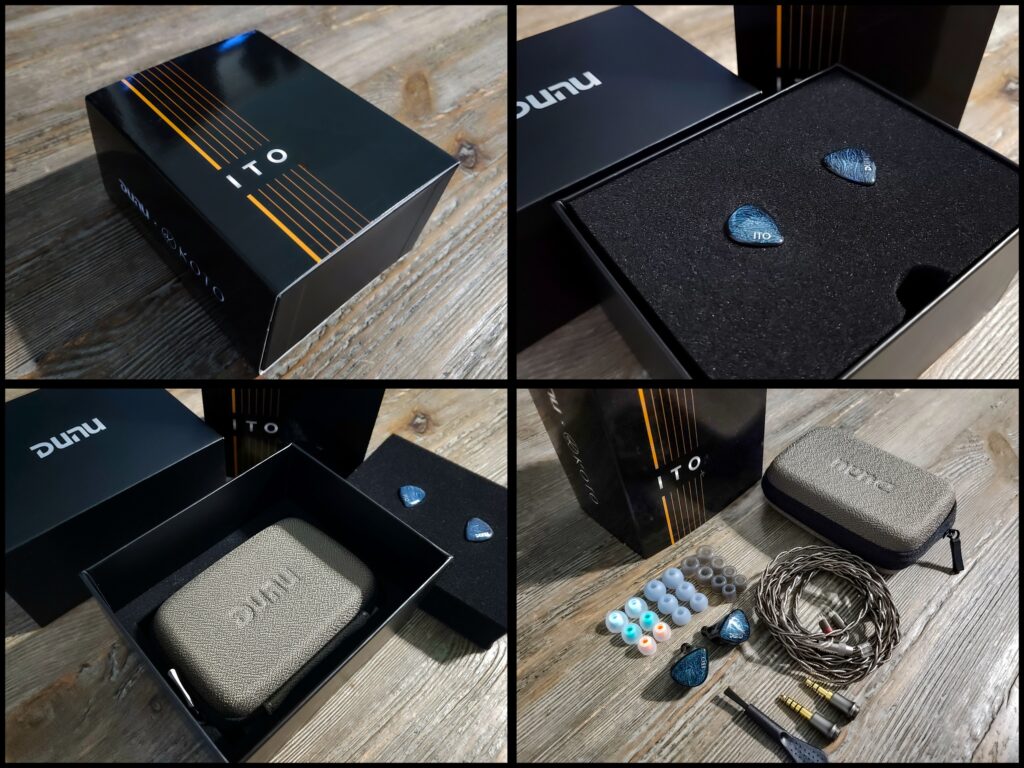
The box that the Ito arrived in is a medium sized box, not much wasted space and nice enough to look at. Actually, it’s fairly simple in design. It’s a black rectangular box with an outer black sleeve with “Ito” imprinted on the front, “Dunu x-Koto Ito” imprinted on the sides, and some specs on the back. Nothing too over-the-top. Take off the sleeve and you’ll find an even simpler black box with a simple “Dunu” right in the center. Open the box top and the Ito will be sitting pretty staring back at you in all of their clean and pristine glory chilling in foam cut-outs. Take off that layer of foam and all you’ll see is the big Dunu hard case. Inside of that hard case is a bunch of baggies. By the way, who else cannot stand these little baggies? Anyways, I digress, inside of those little baggies you’ll find an iem cleaning tool, the cable adapters (3.5 se & 4.4 balanced), all of the eartips (#3 baggies of different eartips), and the beautiful cable. Once again, this is not some amazing unboxing, it’s easy, simple, and it has all of the stuff you expect from a solid $199 iem.
Eartips
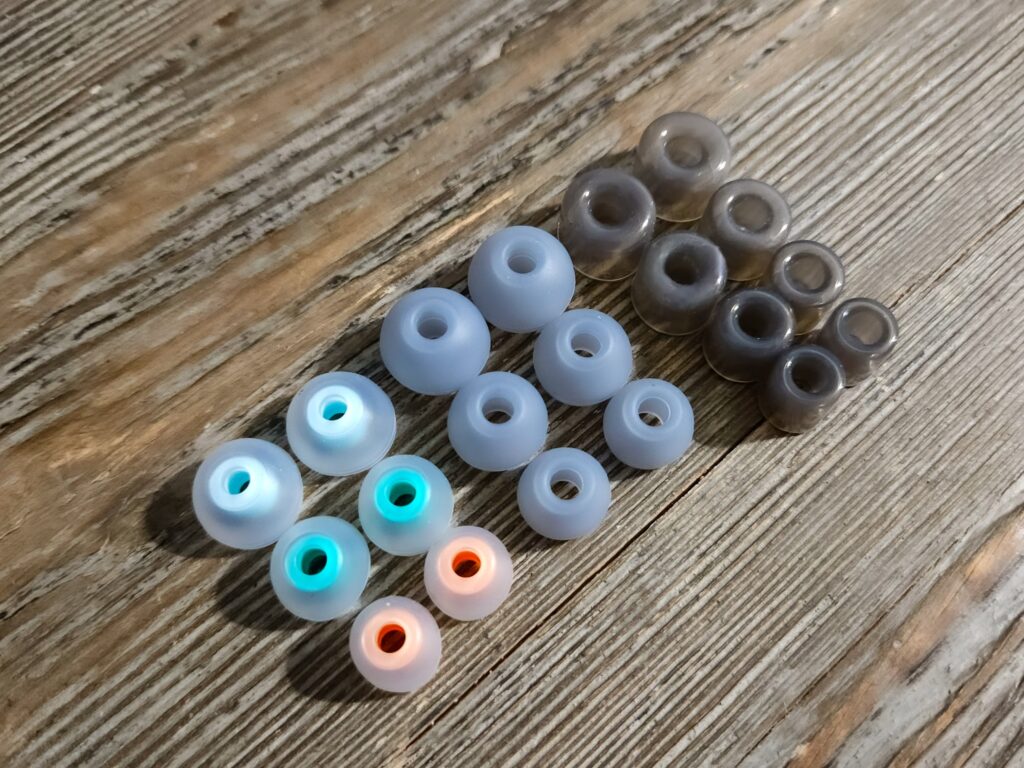
Dunu provides three different types of eartips to help tune your brand-new Ito. That is nine pairs of tips in total provided in sets of three. The first set of three (S, M, L) are some light blue silicone tips with a longer flange, firm flange, and they fit very deep with a narrow bore. There will be moments that these tips are useful and great to have in your collection. The next set of three (S, M, L) are the Dunu Candy Tips which are a colorful bunch of silicone tips with a white flange, and differently colored stems per their sizes. Anyways, these are very nice semi-narrow bore tips with a firm flange, and they aren’t nearly as long as the first set that I talked about. Very nice tips that I use often and they can be sold separately too HERE. The candy tips will come in handy folks. The last set of three (S, M, L) are some of my absolute favorite eartips on planet earth. Those being the gray silicone square tips named the Dunu S&S tips (they can also be sold separately HERE). The S&S (Stage & Studio) tips are longer tips, deep fit, wide bore, firm flange, less rigid stem, and they seal beautifully for me. I adore them and use them routinely. Coincidentally, it’s the S&S tips that worked best for me when critical listening to the Ito. Anyways, I was very happy to see the assortment of eartips provided. Each style provided are good tips that will alter how the Ito sounds. Now, I do feel that you should go through all of the tips in your collection to find out what suits you the most when listening to the Ito. However, Dunu always does a fine job of adding a nice assortment.
Carrying Case
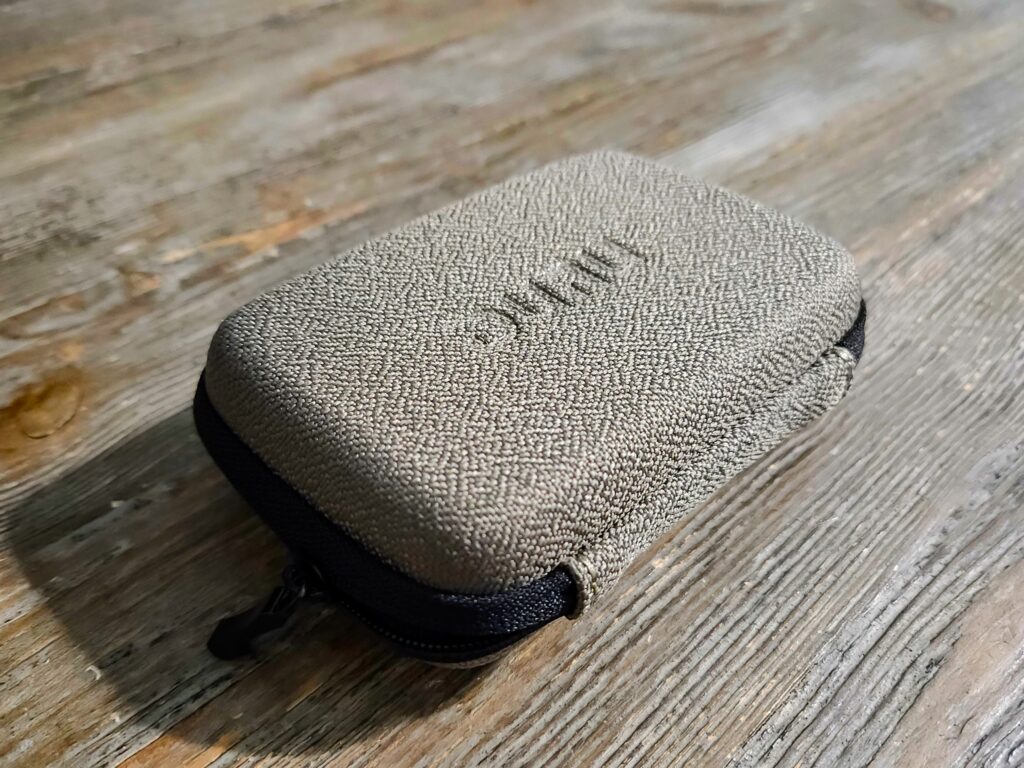
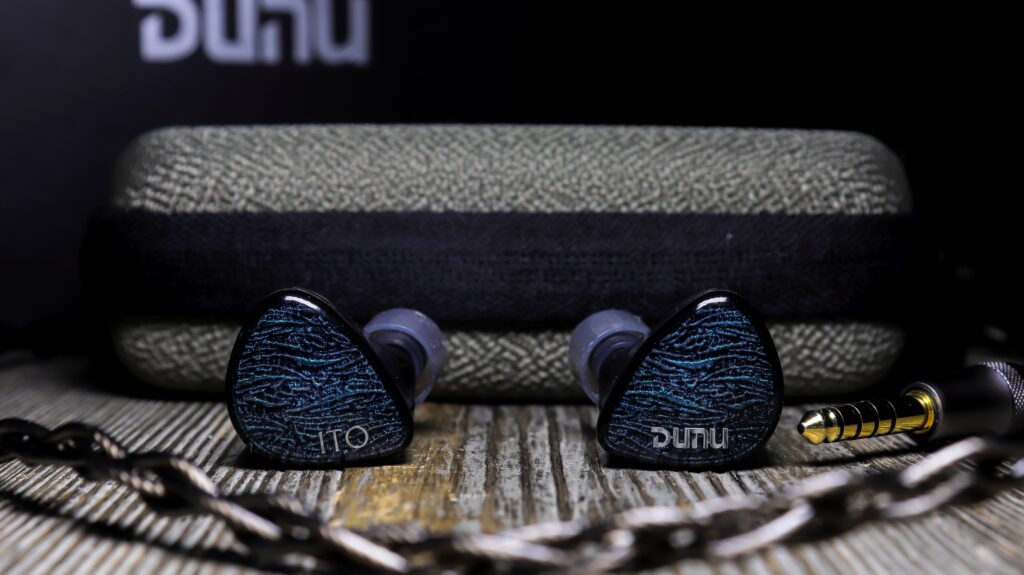
The carrying case that comes with the Ito (and many Dunu earphones) is a fabric cladded tannish colored zipper case. This case has plenty of room for my earphones, the cable, cable adapters, many eartips, and even a dongle dac if need be. At the moment I have a handful of these exact style cases, and I do actually use them from time to time. That is not something that I can say for 95% of the rest of the sets which cross my desk. So, it’s a nice addition to the package from Dunu and very usable.
Cable
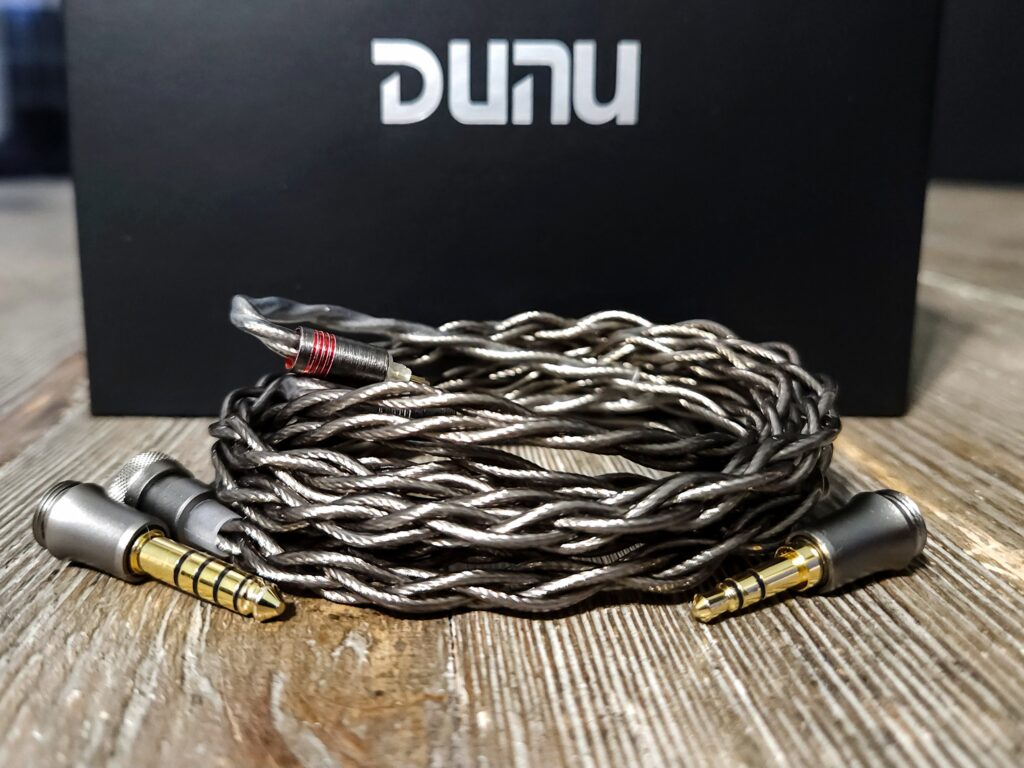
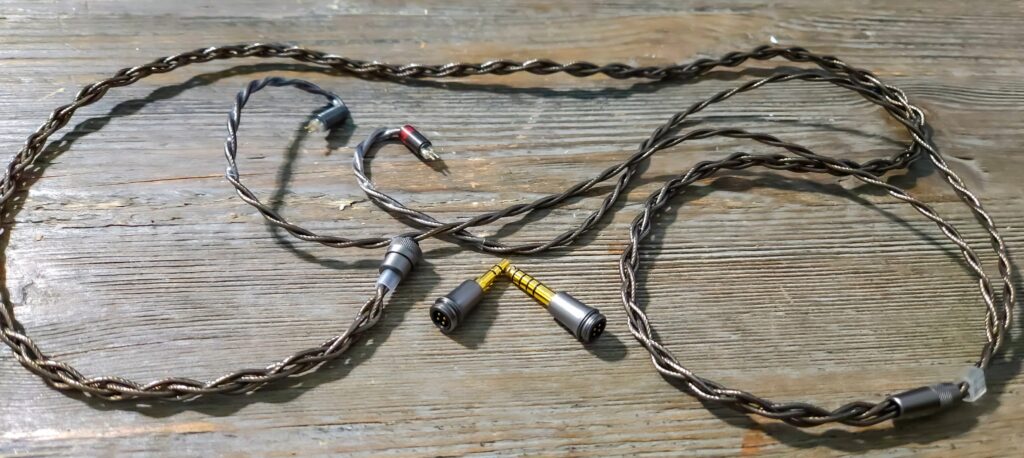
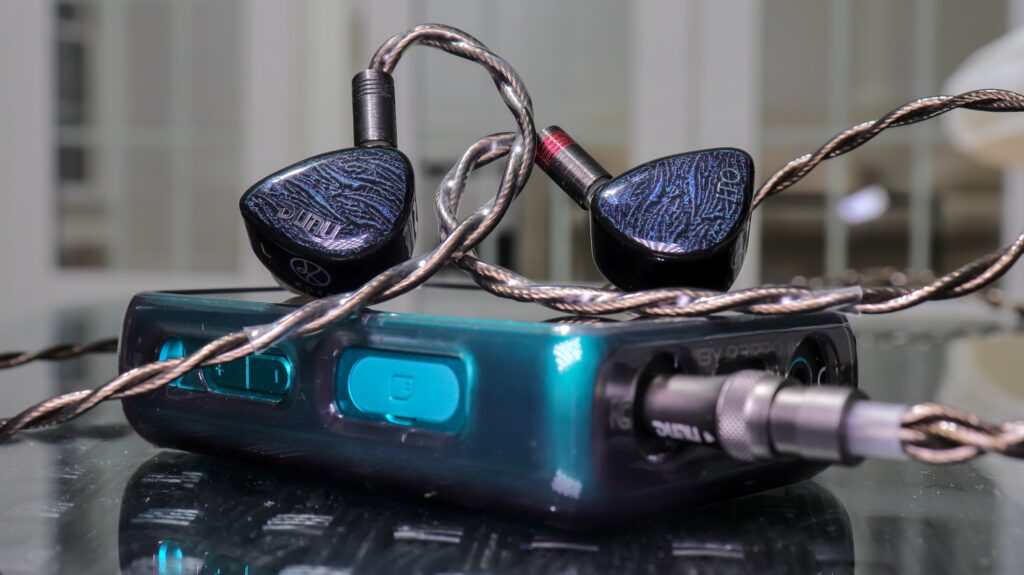
Like I said, the cable which comes packaged with one of the better cables around the $200 price point. The name of the cable is the Dunu Leo, and it can be found with a few other sets like the Dunu X-Gizaudio DaVinci, and the Dunu DN142, among others. Clearly a nice cable, it’s modular, which means that you can swap connector adapters to either 3.5 single ended or 4.4 balanced jacks. The setup is very nice as the Leo has a very nice threaded connection at the adapter and a threaded barrel which screws each adapter on tightly. Dunu has actually patented this modular tech calling it their “Q-Lock System”. Let’s jsut put it this way; the Leo is one of the more premium looking cables to come with a $200 iem. Internally the Leo is made up of 4-cores of single-crystal copper and silver plating. It is a 22AWG thick cable (thicky-thicky) and comes with a Litz braiding. If anything, I’d call the cable a brownish shade of bronze, if that makes sense? I absolutely enjoy using this cable, it sounds great, wonderfully made and aesthetically pleasing to the eye. However, it is fat, and it is stiff, and it does retain some memory. More so than other softer and more pliable cables. So, be aware of that. I can tell you that it really doesn’t bother me at all, but that’s me. At any rate, really a great inclusion into the packaging for the Ito and I’m just glad that I didn’t have to find a cable for this set. Very nice.
Build / Aesthetic / Internals / Controls
Build Quality
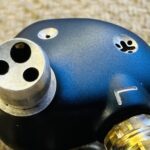
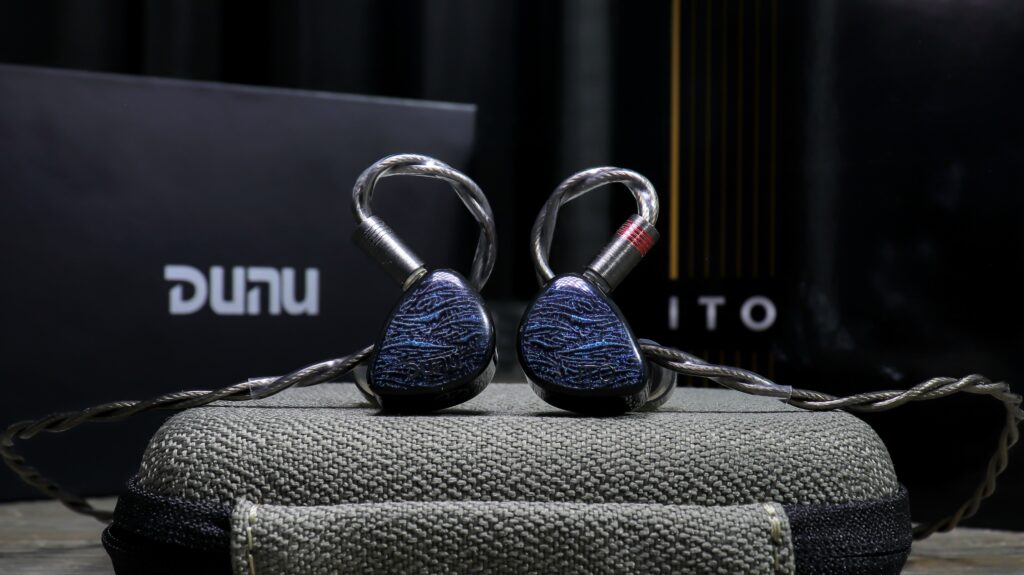
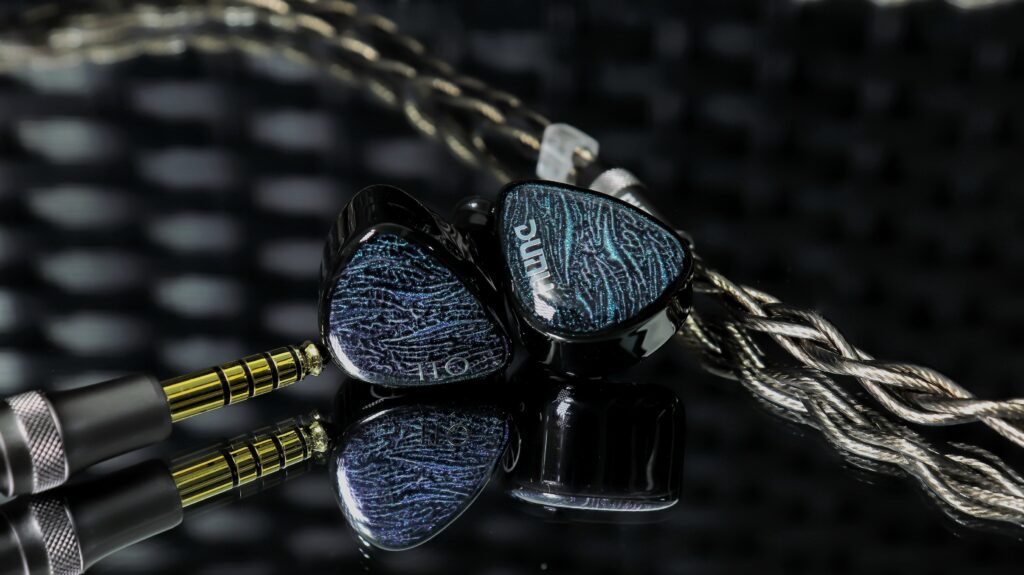
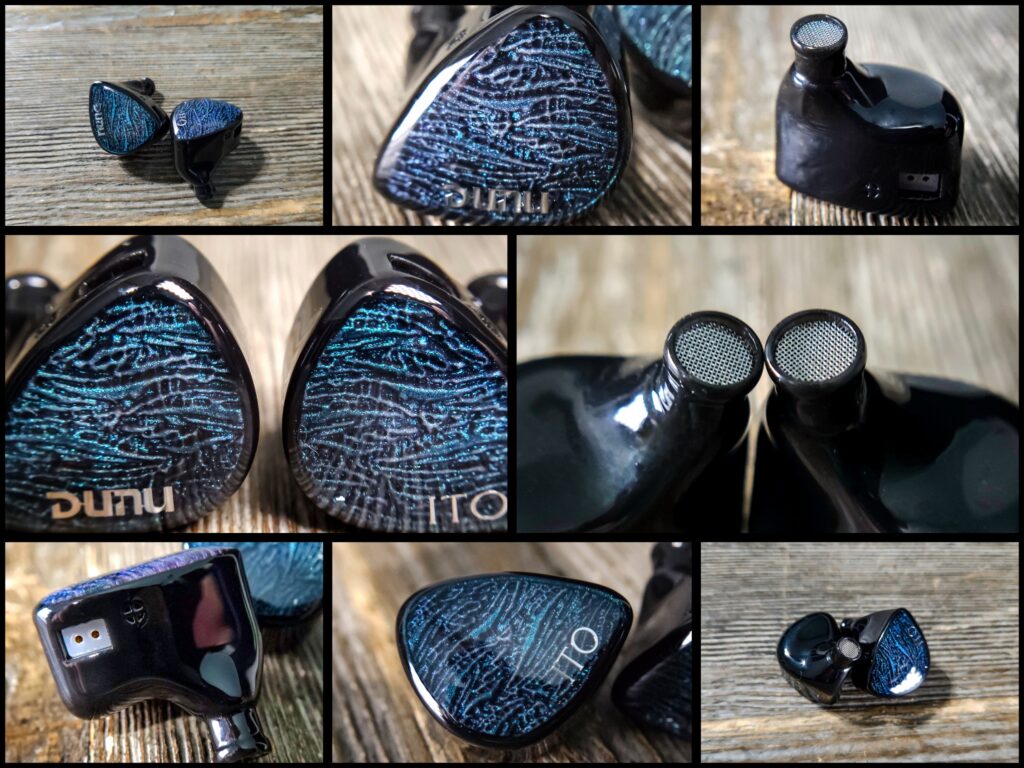
The Dunu x-Koto Ito is yet another all skin-friendly all-resin iem built by way of 3D printing from Dunu. Dunu likely used acrylic resin as it has such a nice and clean look. I think the one thing which makes a Dunu build a bit different from some other brands is more about how clean the final presentation is. No glue, no obvious seams, and every side, corner, and edge is smoothened. Always very comfortable too. Good for us that Dunu basically copied the build style of the X-Gizaudio DaVinci and the DN142 is very much similar too. I don’t think the Ito necessarily feels more robust than most resin sets, but it is simply presented better. Now as I said, these sets are comfortable. Part of the reason for that comfort is because the Ito only weighs 6-grams which is very lightweight for a set of earphones. The nozzles are average length. Meaning, not too short nor longer than a typical set and the nozzles have about a 6mm width, which is about standard. Dunu also added in a fairly large vent near the rear of the shells as well. At the end of the day the Ito is a nicely built set. Certainly not anything that we haven’t seen before, but still nicely built.
Aesthetic
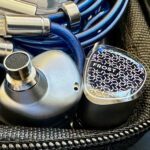
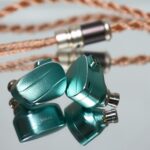
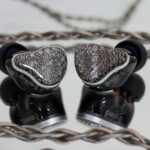
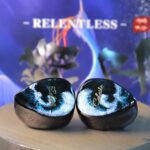
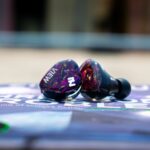
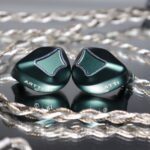
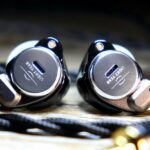
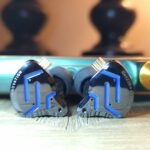
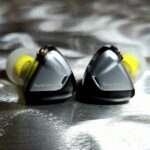
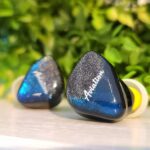
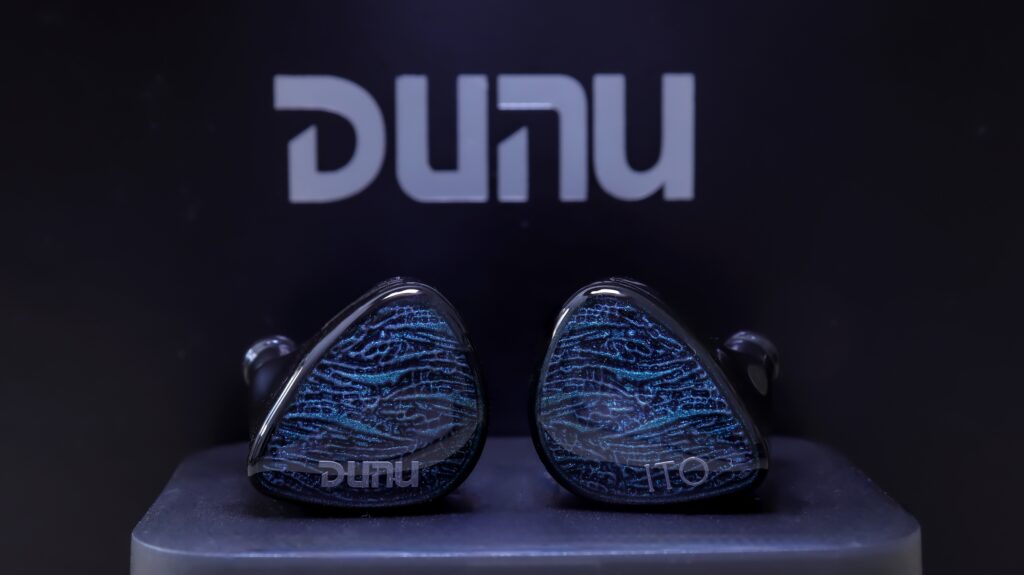
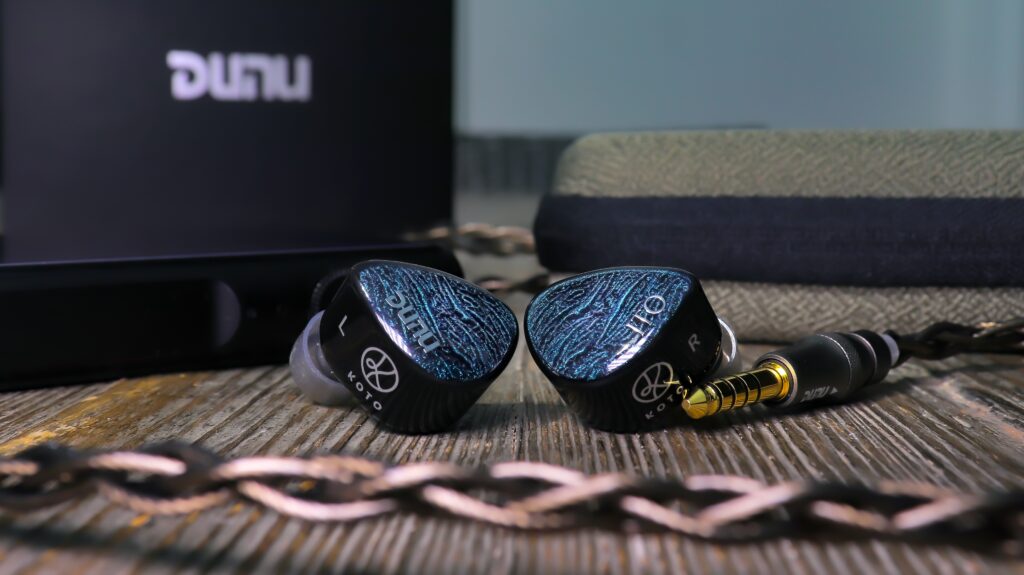
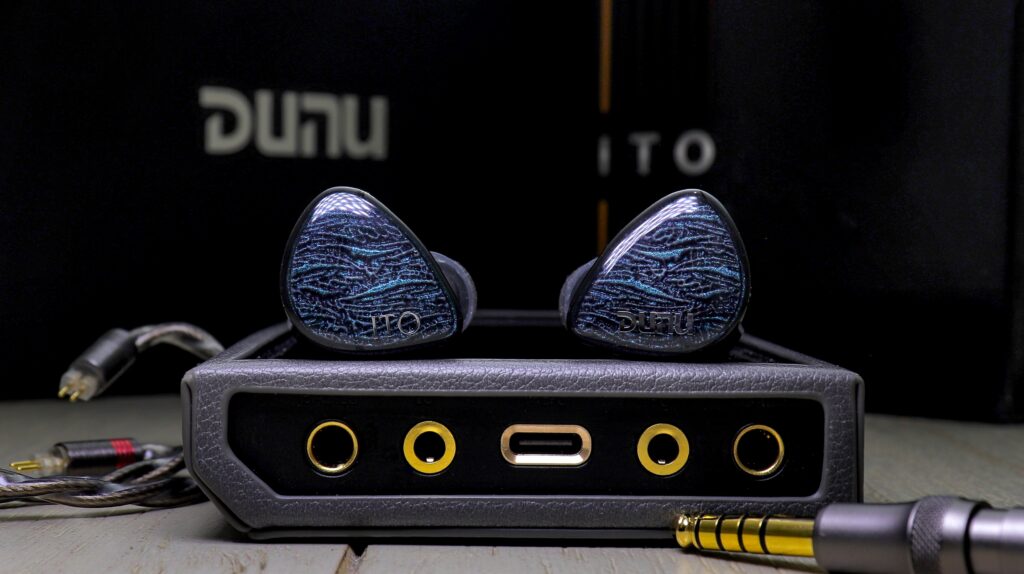
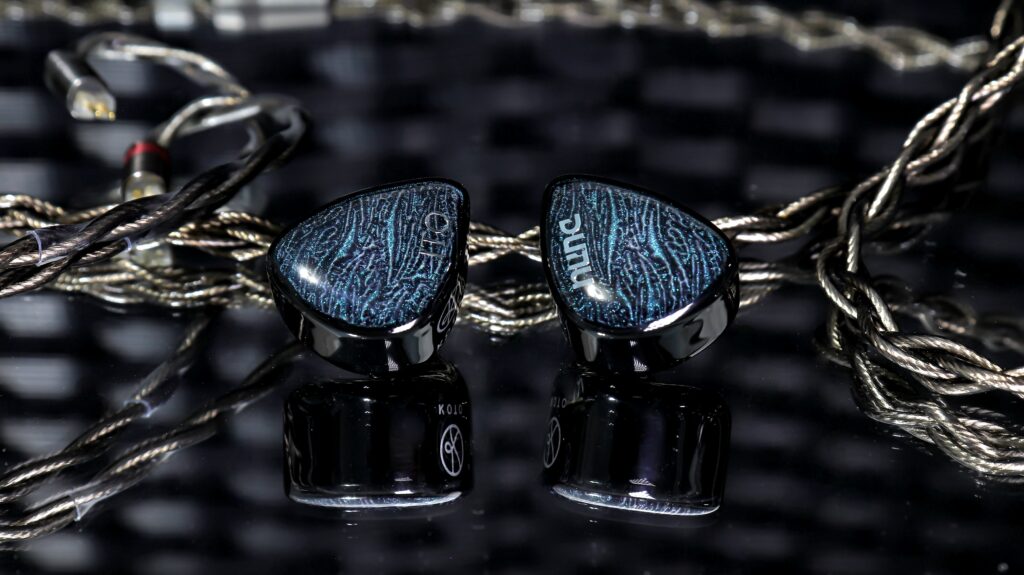
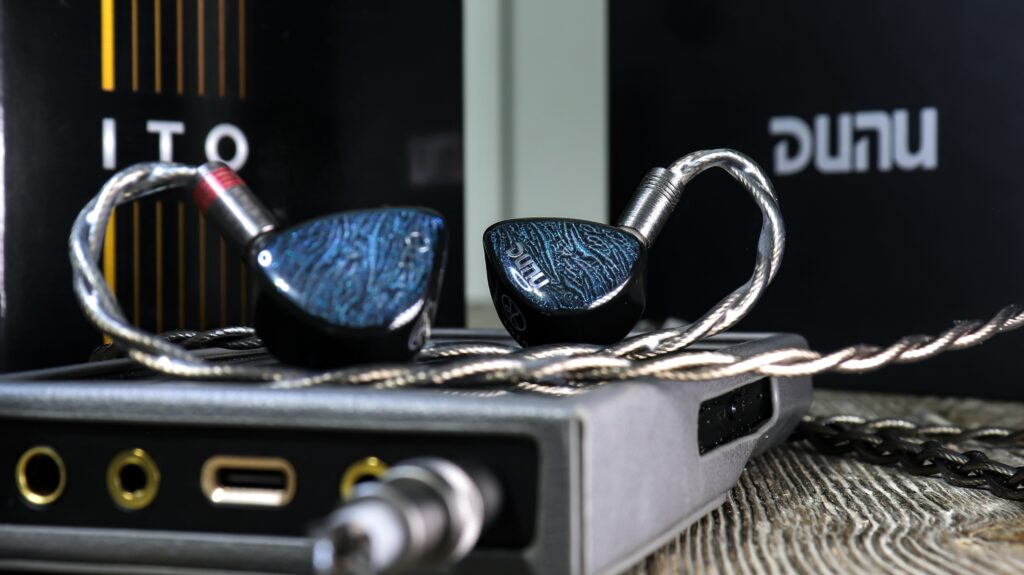
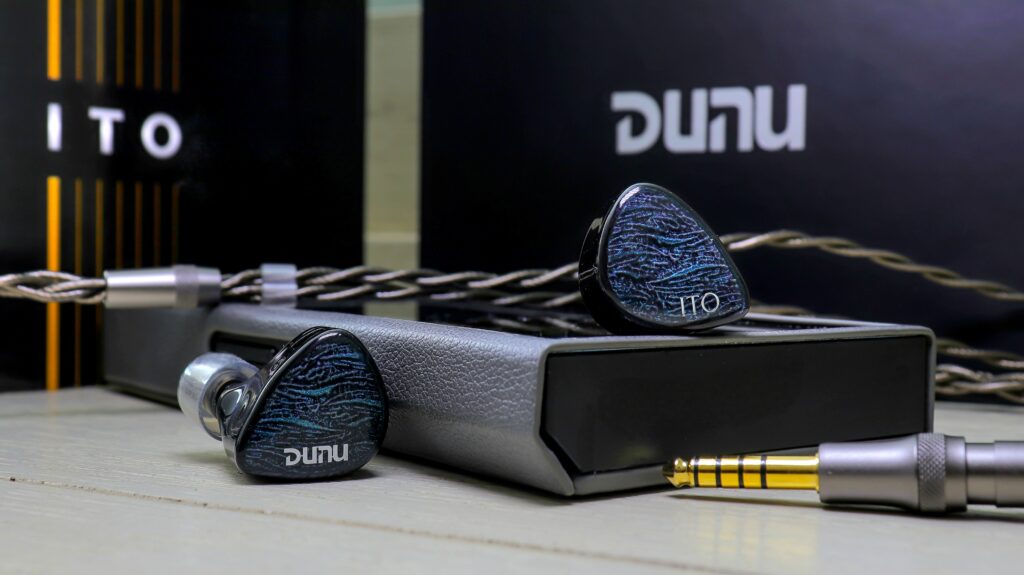
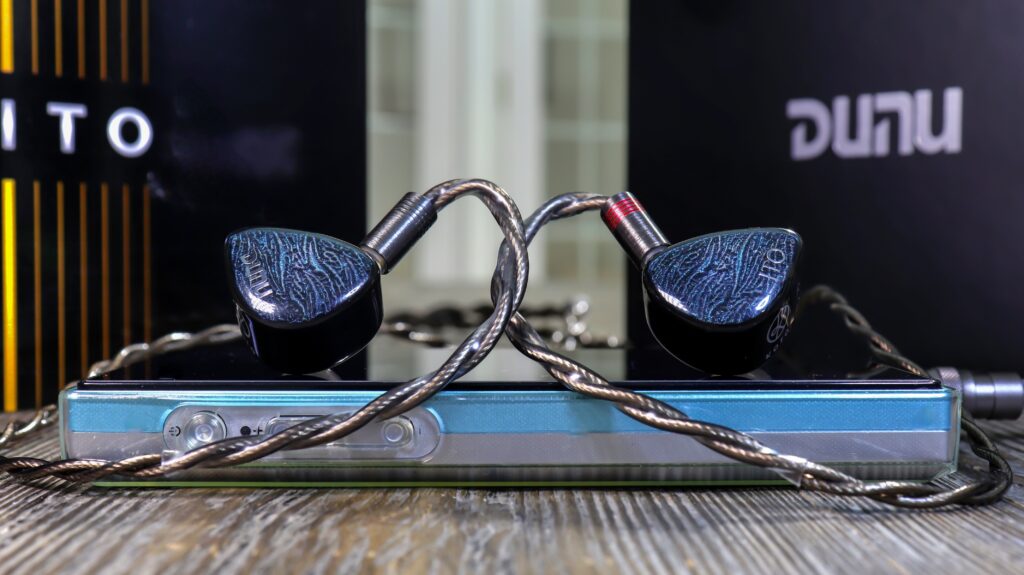
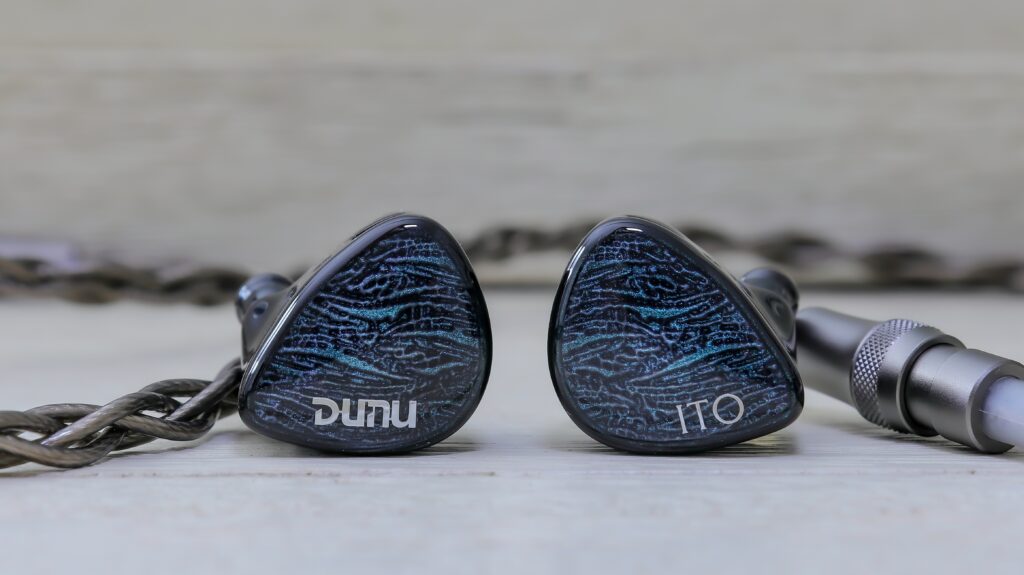
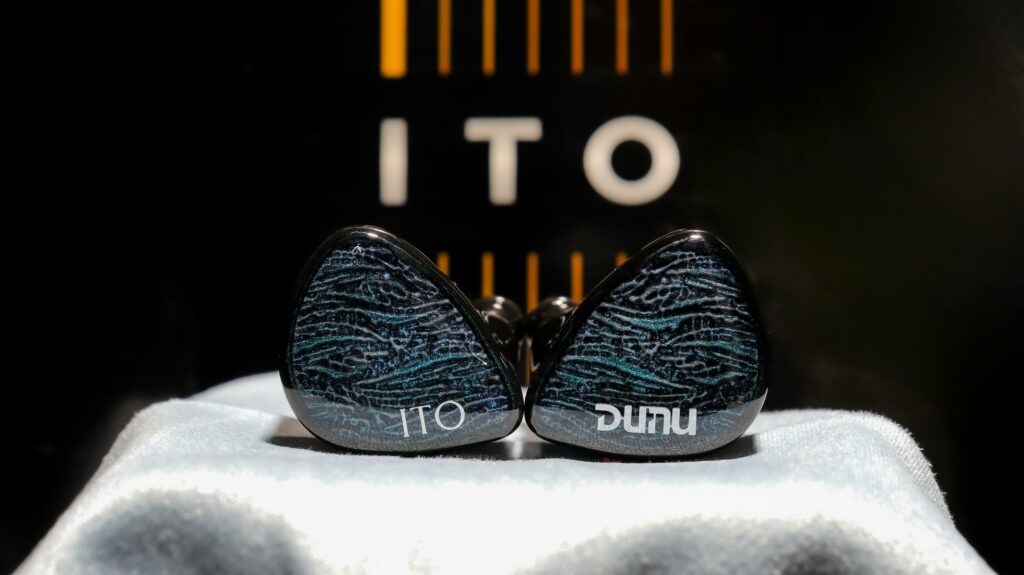
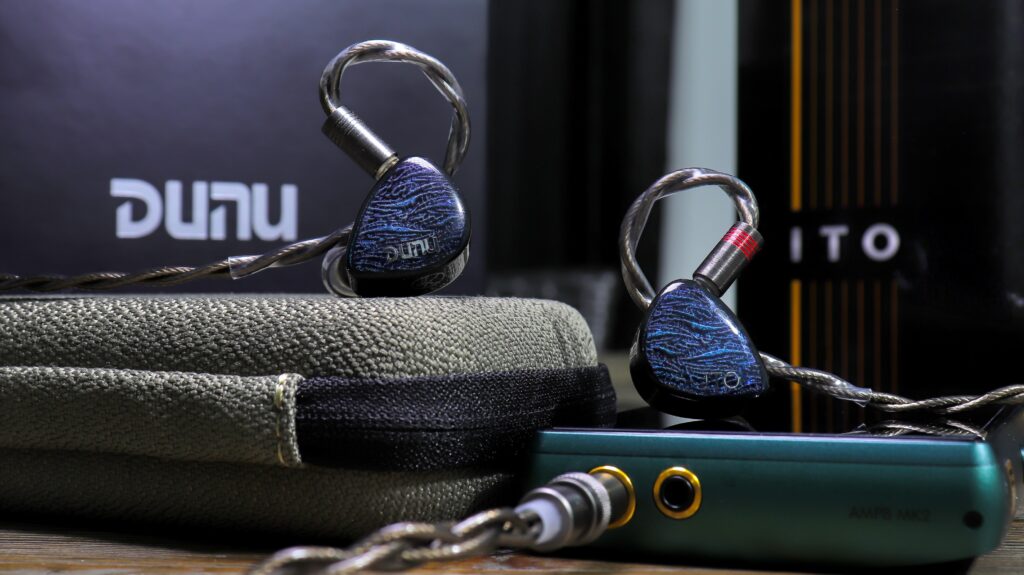
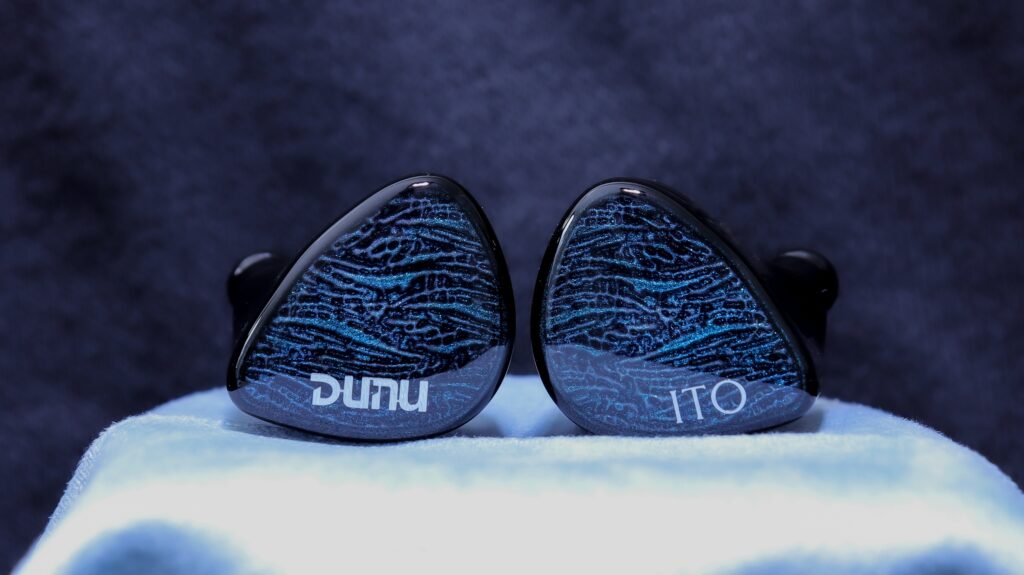
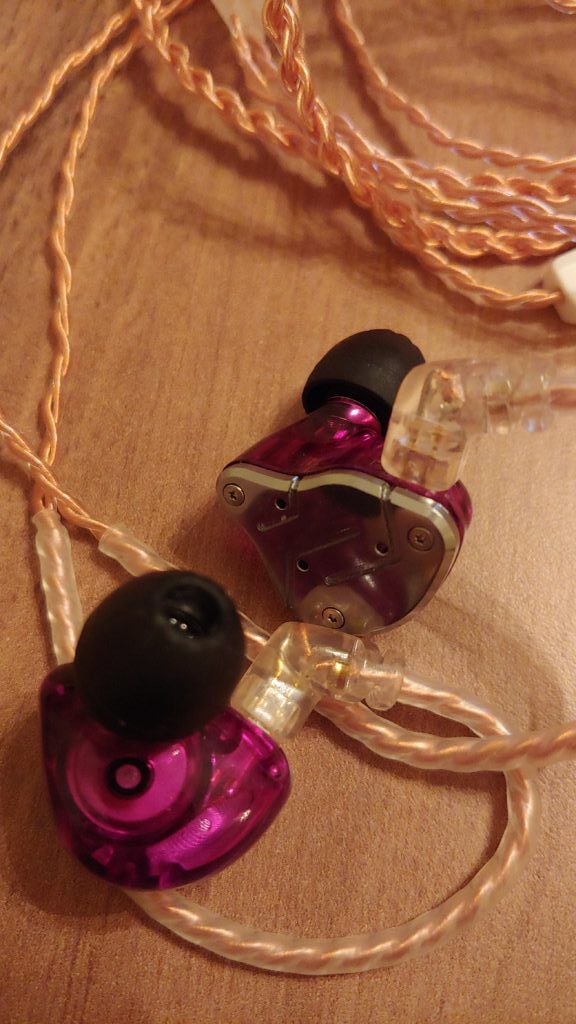
I think that the Ito takes a big leap when it comes to the actual design language of this set as the aesthetic appeal is high. Without a doubt, the look and appearance of the Ito is not what I’d call a flashy design. Dunu stayed relatively reserved in their color choice. I actually prefer this as sometimes the flashy stuff starts to become a bit cheesy and almost too adorned in decorative artsy bling. Certainly not a “loud” design. You can see my pictures; the Ito has a very nice but mostly minimalist decorative faceplate with its flowing pattern that almost looks wind-brushed as ripples line the flat faceplates. You’ll also notice some very light glittering which isn’t at all gaudy or “too much”. Again, reserved, still artistically dreamt up, but less flamboyant. The iems themselves are almost a smoky blue with black mixed in there too. It also has a grayish-blue barely transparent shell body. Really, I can barely see anything. I’d say that the look is pretty unique and there aren’t a ton of other sets which resemble the Ito very much. Overall, I think Dunu did a nice job. This is a set you could wear out in the market and others would look on at you not because you have some jewelry-like flashy thing in your ears, but rather because you have a dope looking and serious looking piece of audio gear instead. Nice work Dunu.
Internals
As I said, Dunu opted for a tried-and-true driver configuration of two dynamic drivers and two balanced armature drivers. All of the sets that I’ve tried out with this configuration have been solid. Every one of them. Of course, I highly doubt I’ve tried them all so take that for a grain of salt. However, it makes sense and it works and usually any set with this configuration sounds very cohesive and the drivers usually sound very homogenized tonally. So, to start, Dunu decided upon a 10mm Bio-Diaphragm DD to handle the sub-bass duties. For the mid-bass and the midrange, they went with an 8mm LCP (liquid crystal polymer) driver. Next, for the highs Dunu opted for one customized balanced armature driver and one BA for the upper treble too. So there you have it, nothing crazy, no BC Drivers, no super treble EST tweeters, no mini planar or anything else. Dunu instead opted to tune a simpler setup and utilize each of those drivers to the peak of their ability. I’m all for going back to what works folks. Granted, I love some of these crazy driver configurations, but when did we lose sight of what matters most… music. Anyways, Dunu gets it. Beyond the drivers, I really have no other info on crossovers whether physical or electronic. I assume an electronic crossover to blend the bass (DD’s) into the highs as well as the other drivers, but I cannot know for sure. Usually in Dunu hybrid sets they will also have dedicated tubes running from the drivers to the nozzle area. Unfortunately, the Shells aren’t transparent enough to see inside well. Even with a flashlight right on the shells. Of course there will be some intelligently placed damping going on top. That’s about it folks.
Fit / Comfort
The fit of the Dunu x-Koto Ito is about what you expect from an all resin set nowadays. Like I said earlier, the Ito earphones are extremely lightweight which definitely makes them easier for wearing over long periods. There was never a moment where I felt the Ito wasn’t comfortable. They seal well in my ears, they sit well in my ears, and I barely notice they are there. How they will fit you is beyond me. It’s one of those things that you just have to take your chances on. No reviewer can tell you if the Ito is going to work for your ears.
Drivability / Pairings
Sensitivity
In my opinion the Dunu x-Koto Ito is an easy enough set to drive, but also not so sensitive that it is hiss prone, at least not to my ears and with any of my sources. The Ito actually has an impedance of around 37 ohms and a sensitivity of about 105 db’s. As always, I tested the Ito with every weak source that I own, and I had zero issues driving this set. It’s only 37 ohms and 105 sensitivity which makes it great for driving with weaker sources like my old Android phones (w/3.5 se jack), my iPad, my weaker dongle dacs (old 3.5 Conexant dongles), and even the KZ AN01 (super weak), and any other weak source that I am forgetting. I had no issue with any of them. However, just because I could bring the Ito to volume and they can play loudly, doesn’t mean I am driving this set to its fullest. One of the benefits of the Ito is that like most iems nowadays it scales well with power…
Scalability
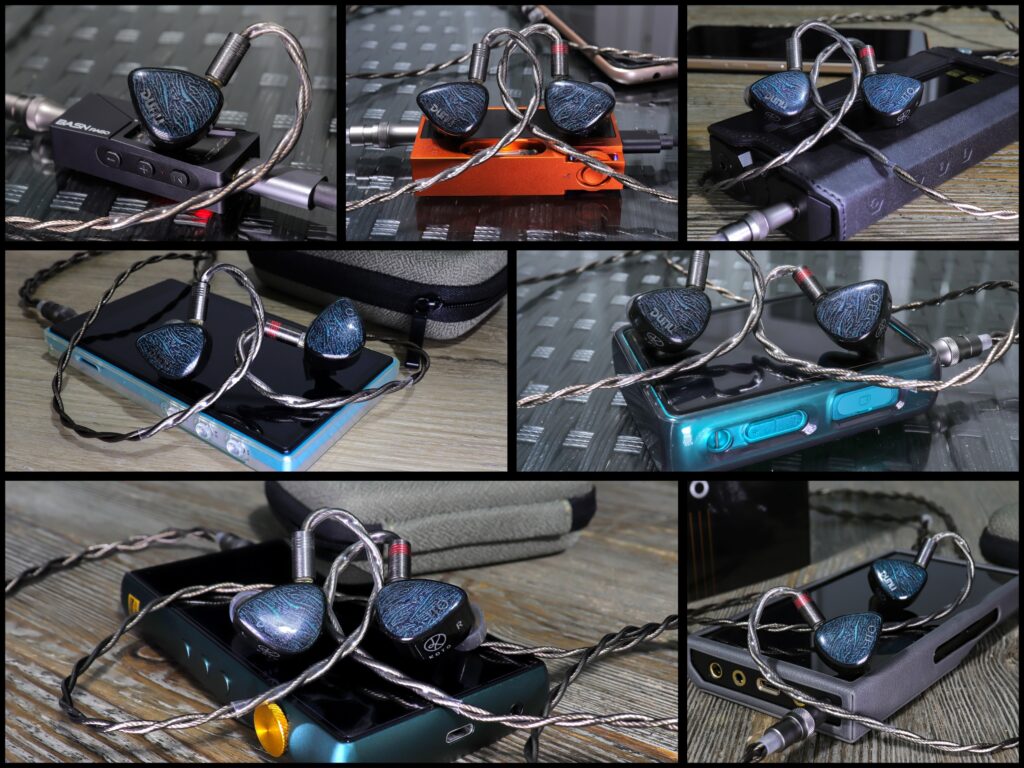
Like most iems nowadays, I find that the Ito does well to scale to more power and to better sources. I don’t mean desktop grade power is needed but having at least a solid dongle dac similar to the Shanling UA6 or Shanling UA7, maybe even the EPZ TP50, just for a few examples. To add to that, giving the Ito power like you’ll find on a mid-tier dap ($300-$800), or even budget tier ($150-$250) daps will certainly bring plenty of juice for this set. For instance, the low cost ($179) Fiio JM21 really drives this set in a fun way, or the Shanling M1 Plus ($199). However, jumping up to the iBasso DX240, the Shanling M6 Ultra, the Hiby R6 Pro II 2025, or even the Fiio Q15 all provide way more than enough juice, but also come across cleaner and more refined. Basically, the Ito will scale to power, and to the sonic ability of the source you are pairing it with. Yes, you can call me Captain Obvious. With most any solid dongle, decent dap, 4.4 balanced and more juice it’s easy to hear the robust low-end of the Ito begin to tighten up, less loose, wider & more immersive stage too. Power will also add some subtle depth, even begin to add perceived layers and note separation too. Furthermore, the treble and upper mids seem to gain more cleaner vibrance and simply sound more confident. Again, you don’t need desktop grade power, but at the very least a good 100-150mW @32 ohms dongle dac on high gain will have more than enough juice to open these drivers up. Most dongle nowadays eclipse that mark by a lot. As you add better source and cleaner amperage the Ito tends to reciprocate.
Source Pairing
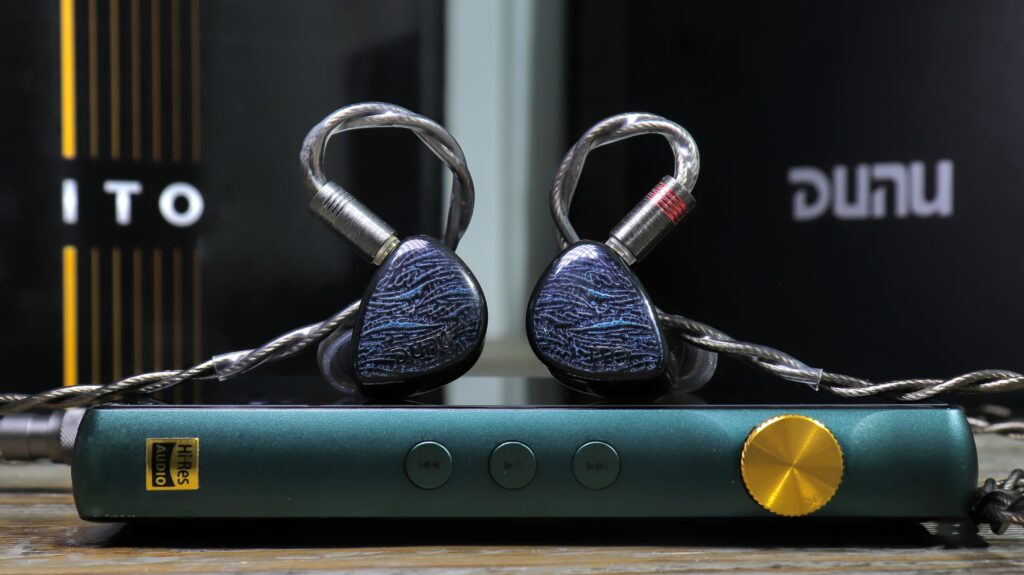
So, for source pairing with the Dunu x-Koto Ito, you have to think about its warm to warm/neutral and full-bodied sound with an upper half that’s emphasized enough to keep the sound from becoming dark. Certainly warm. Now, in my opinion, I happen to enjoy any source device that ranges from warm/neutral to neutral attached to the Ito. I do feel that adding even more warmth does somewhat blunt the Ito’s crisper edges a bit. I would say that basshead or warm lovers probably wouldn’t mind pairing it with a warmer source. However, as bassy as the Ito is, it isn’t devoid of upper mid and treble energy. There is some sparkle there. So, I don’t really like bright or super cold sources. I think the sweet spot is a source with a fun and musical warm/neutral to neutral sound with a slight bass lift. You don’t want a source which would kill or lessen the one aspect of the Ito’s sound (Bass) which separates itself from the pack of $200 iems. Obviously, you know what you like and you don’t need me to tell you what you “should” enjoy, but from my perspective the Ito definitely has a sweespot with a very fun, energetic, and also very fluid sound with a well measured tuning. Not perfectly balanced but nicely doled out frequency range emphasis across the spectrum. Also, give em’ a bit of clean juice, the Ito will thank you for it.
Sound Impressions
*Note: just a quick note before I jump headfirst into the sound portion of this review. First off, I did burn in the Ito for almost exactly four full days. I was in the middle of another review and simply left them there. This does help to add some density to an already dense bass. Plus, there was the faintest metallic tinge before burn-in that was gone after… completely gone. So, I do recommend giving the Ito some run-in (burn-in) or even listen-in. If you do “listen-in” then I wouldn’t judge them too harshly for a good week or so of solid listening. Also, I have zero idea how much you actually need to give the Ito. Could be 10 hrs, could be three days. Next, I listen mainly to flac or better files (some MP3) which are stored on my devices and rarely stream anything. I used the packaged Dunu S&S eartips along with the included cable. I listened with way too many different sources to jot down here. The Android music player of my choice is mainly UAPP (USB Audio Player Pro), on some daps Hiby Music Player, and on some Eddict Player. When on Bluetooth I use Poweramp exclusively.
What’s it Sound Like?
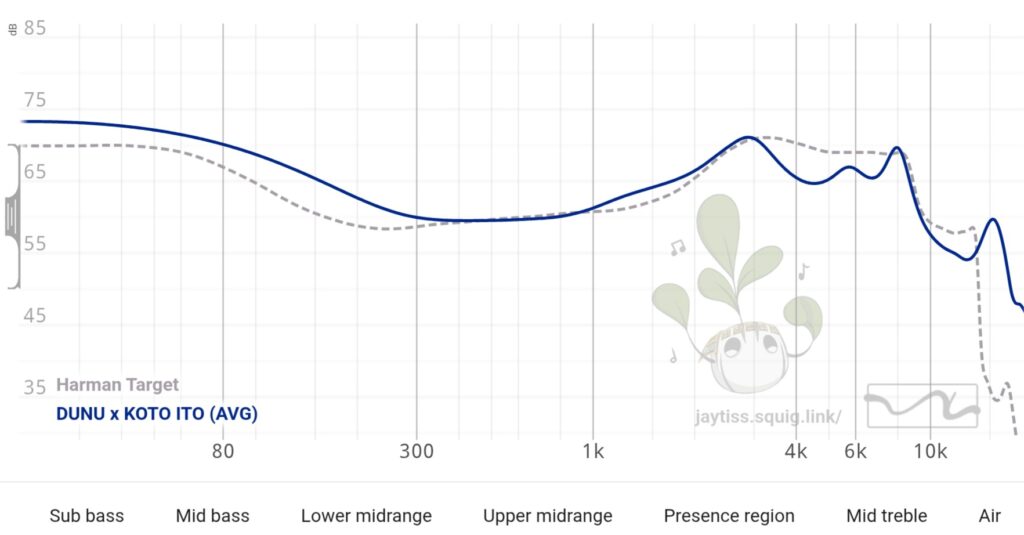
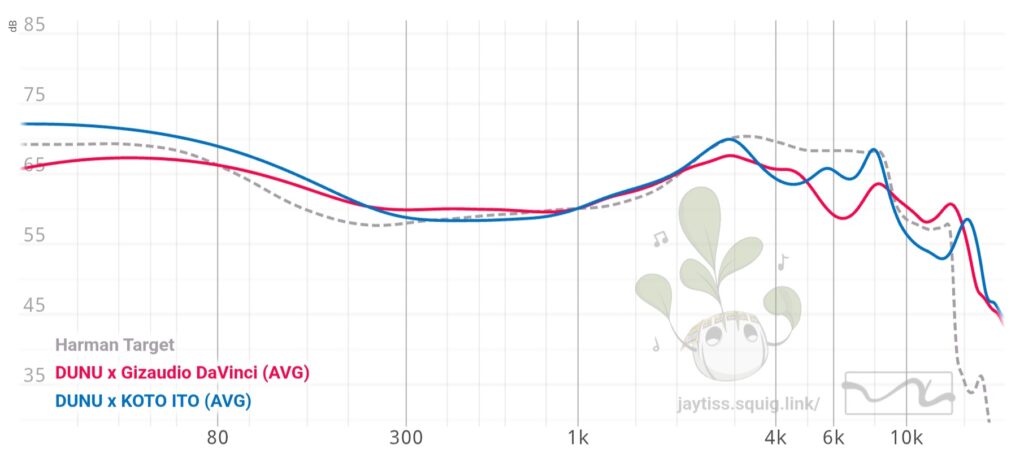
The 1st thing I’d say about the Dunu x-Koto Ito is that this set is flat-out… fun. Without question it is a bass-forward authoritative and totally energetic sounding set with the type of rhythmicity to emotionally grip the listener and enough deep-seeded, subwoofer style rumble and guttural depth to add a very potent foundation to any track. The sweet thing is that while the Ito carries a bass heavy, basshead worthy, and totally bass-driven sound… it also isn’t a muddy mess. Actually, the Ito has surprisingly good technical chops with enough levity across the mix as well as clean-lined clarity and sprightly energy past the bass to keep from ever sounding veiled. 15 db’s of bass emphasis and I’m still saying it has clarity and doesn’t sound veiled is quite nice. Certainly not unheard of though, as many V-shaped basshead sets can have some brighter treble. However, Dunu added a nicely measured allotment of emphasis to each region (bass, mids, treble). In fact, due to that measured tuning, I wouldn’t even call this set totally L-shaped. It isn’t. It isn’t so warm, so rich, so smooth, and so dark that there isn’t any luminance, vivacity, or vigor. I hear nice levels of vibrance. Certainly not bright, but not dark either. Perhaps “slightly L-shaped” but probably closer to “slightly V-shaped”, yet with a sub-focused bass, a very nice midrange presence, and even some subtle sparkle up top. Let’s put it this way; think of the Ito as a high-clarity basshead iem that gives precedence to fun & rhythmical engagement over precise analytical precision, yet without blunting the texture, smearing the edges, or flattening the details completely. Overall, I’d say that the Ito has a warm and robust sounding lower half with just enough upper-mid lift to provide vocals with some energy. Furthermore, there is some treble sparkle to ever-so-slightly open up the sound yet not enough to ever offend.
Technically solid, for what it is…
Though I quickly covered this, I should add that the Ito is better technically than one might initially think by looking at the frequency response graph. Not that the Ito is some technical beast or anything, but it isn’t a clouded or veiled sounding set either, as I said earlier. One thing that helps is past the sub bass region the transient response is fairly tight. Not saying the sub-bass isn’t transient tight either. I hear a fairly clarity-rich sound which isn’t typical of a big bass iem, where instruments and vocalists benefit from a fairly well textured playback. Without question the Ito carries a smoother demeanor, but there is certainly at least some crispness to help define and help contour midrange and treble notes. All things considered, for a bass boi caliber set the Ito is one of the more technically proficient $200 iems that I’ve heard. Please don’t confuse me though, I did say “For a bass-boi caliber set”. No doubt there are plenty of other iems which handle technical skills better. Sets which are tuned to illuminate the small subtleties in a more articulate way. More analytically inclined, clinically tuned, and simply more balanced sets will obviously come across more crystalline and cleaner. The Ito is one which gains all of its technical ability from a smart tuning and solid enough drivers. Now, I’ll speak on this at greater length further into this review, but I can’t help but be impressed with the Ito’s detail retrieval, note separation, and its decent ability to place instruments within the sound field, in the right tracks. The only thing which falters the Ito’s technical ability (in my opinion) is complicated and congested tracks, or tracks with a heavy sub & mid-bass emphasis.
Polarizing?
No doubt the Ito is going to be appreciated quite heavily by many people. I can tell you that with confidence. Without question the Ito is very good at being what it is. However, on a large scale, I think the biggest issue that this set faces is the other quality hybrids which are positioned around the Ito’s price point. That said, the fact that the Ito is a basshead caliber set is one thing which will certainly separate it from the rest of the pack. What I mean is that those seeking a basshead set are obviously not going to check out the Simgot SuperMix 5 that I just reviewed. They aren’t going to check out the Letshuoer S12 2024 Edition, or the Hidizs MK12 Turris Titanium Edition. They know what they want and that’s a bass forward sound. I usually call a set tuned in this way a “polarizing” iem. The sheer fact that Dunu gave the Ito 13-15 db’s of bass shelf cuts out many potential buyers right from the jump. This is a good thing, and a not so good thing typically. It’s a good thing if the basshead set is tuned well and very good at what it was tuned to be. It’s a very bad thing if there aren’t many basshead style listeners seeking to purchase and it’s not so good that the frequency graph alone will keep many from picking a set of the Ito up. So, no doubt this is a slightly polarizing iem. I say all of this for a reason. I say this because the Ito does a lot of things very well. It isn’t just a one trick pony. Sure, it has a beefy sublevel response, but it’s also very clean after that with a smart tuning that doesn’t negate the rest of the spectrum. The Ito might just reach past only bass lovers and land in many different collections from folks who typically wouldn’t go the bigger bass route. Dunu did a fine job.
Bass Region
I think you already have a good idea that the Dunu x-Koto Ito is most certainly a bass-forward hybrid iem and one of the huge reasons for purchasing this set. Also, I’ve said many times already that the Ito is in the “basshead” camp of iems. However, please let me clarify my position on this. Yes, the Ito is a bass-boi, bass hefty, bass dominant set, and it’ll bump with some serious weight behind it; but it barely puts its foot into the door of what I consider a true “basshead” set. Barely folks. Meaty? Oh yes! Bullish? Without a doubt! I just don’t want you thinking that the Ito is “all about the bass” when really… it isn’t. Now, it’s a sub-bass focused low-end with a shelf that extends to about 14-15 db’s at its peak. Once again, to me, that just makes it into basshead territory. In all honesty, let me show you a good 20-30 dB bass shelf on some of these true bass maniac style sets and I’ll show you a true basshead canon.
It’s pretty clean too
With all that said there is no denying that the Ito does bring some guttural and juddering rumble and can really sound authoritative. However, you may not know that for a bass heavy iem… it actually has some fairly clean bass for such an emphasis. This isn’t always the case with bass focused iems. The one iem which comes to mind with the same sort of emphasis is the QOA Adonis New. An iem that I praised up & down for its heavy bass presence, warm tone, and clean style note articulation. Let’s just say that the Ito carries a more condensed and rigid bass with cleaner note outlines. Not necessarily denser, but better definition and the Ito does a better job of freeing up the rest of the mix. At any rate, the point is that the Ito is truly a well-done set when it comes to a hefty sublevel rumble with a punchy and full-bodied mid-bass slam, but it’s also not just a “one trick pony” and honestly has some great representation in every area of the mix. The bass on the Ito isn’t going to come across as well defined and articulate as many other sets. I don’t want you expecting some ultra defined and streamlined bass that can tackle anything that you throw at it. You don’t get planar speed or BA agility here. What you get with the Ito is a very organic and atmospheric bass that doesn’t overly lag in its transient decay and actually sounds quite natural. It just … Really-really hits hard when a track calls for it.
Sub-Bass
The sublevels of the Dunu x-Koto Ito is most certainly the biggest focus on this set, seemingly with its own gravitational pull of the sonic spectrum. In truth, what I hear is something much more akin to a subwoofer style representation of this region. It simply has that feel to it. No doubt the Ito has the kind of sublevel juddering drone that can tickle your ears on the right track. I’m talking about “Golden Child” by Lil Durk. Once that funky bassline drops the Ito skillfully meanders through every undulating and deep note with a much nimbler finesse than one may think. Lil Durk’s voice comes through crystal clear folks as well. I find this on many tracks though. You see, this is not a sub-bass rumble which produces bullish-weighted notes when a track doesn’t have it. The sub-bass won’t inflict its will frequency wide. I hear very impressive extension into the lowest of lows. The Ito’s sub-bass carries that physical and rigid density which is foundational and very satisfying. Due to this, if you aren’t a fan of this style then it’ll likely become fatiguing. Though, I established that I’m not speaking to those people here. I’m talking to those who desire a big and full-bodied bass. Well, with the Ito just expect a very haptic and vibrational presentation that comes and goes relatively quick considering the density and fullness. You hear nothing pillowy here, no softened note outlines, and you won’t hear anything cloudy, or overtly one-noted. I’m telling you, for a bigger sub-bass, the Ito runs a tight ship. Also, the sub-bass is clearly distinct from the mid-bass, which is saying a lot for a set with this level of emphasis.
Mid-Bass
The mid-bass is one which also carries a very sonorous and thundering boom. However, once again I have to declare that it only shows up when a track calls for it. Dunu truly made this set to sound very distinct in the bass. The mid-bass only bleeds a tiny bit. Sounding almost like there’s a tuck yet bleeding enough to add a touch of warmth without blemishing any mid-clarity. It’s a very smart tuning. In any case, the Ito’s mid-bass does sound like it has a hair less gravity and sound influence than the sub-bass. Again, it comes across separated from the sublevels of the low-end nicely. Of course, this isn’t the easiest thing to listen for. Specific tracks will show this more than others. However, the bass is skilled, and the mid-bass showcases that. This is a tight bass for the amount of perceived sonic mass that hits your ears. Well, as fast as it can sound. Many ultra speedy bass tracks were handled very well.
Mid-Bass cont…
Tracks like “Anthem Part 3” by Blink-182 is one. The drums which start this track are lightning fast and the Ito separates and dissects every note with a scalpel. The cool thing is that I can feel and hear every note with good enough clarity. Obviously not to the level of less emphasized bass replays from other sets, but very impressive for a set tuned in this manner. Of course, everything I’m saying rests in the ear of the beholder. To some this set is going to sound bloomy and too boomy. Especially for anyone who doesn’t enjoy a bass forward sound. Others, like me, will tell you that without question the mid-bass is very nice for what it is. It’s textured well, not so rounded or blunted, not soft, with a physical slam and a very potent impact. I hear very full-bodied bass guitars with a clean enough edge. Perhaps not the stickiest grip on dynamic fluctuations, but very good for a heavy bass. Also, kick drums satisfy. That tacky initial hit has just enough fast snap and kick while the following boom feels resonant, full, and booming in bigger kick drum moments. Like “Glass House” by Kaleo. All in all, I’m happy with this set and the main reason for that is why anyone initially buys this set in the first place, the bass. However, it’ll be those folks who quickly find out that they purchased something which is much more than just a basshead set. There’s going to be some smiles across some hobbyists’ faces.
Downsides to the Bass Region
Friends, I cannot tell you how many big bass tracks I’ve listened to with this set. Trying to garner some kind of explanation for you. I have #447 tracks in my “Bass-Boi Checker” Playlist (yes I give them stupid names) and I’ve gone through every single one of them at least partially, and many I’ve listened to over and over again. I say that to declare with absolute certainty that the Ito will either be loved or… complained about. The biggest drawback of this set (as a whole) is the emphasis afforded to the bass. Like I said, having this much of a lift will definitely come across as polarizing.
Muddy? (Downsides cont…)
In spite of that I have a huge bone to pick with anyone who doesn’t do their homework and purchases this set, yet they don’t enjoy a bigger bass… and then they complain about it! Surely people will say stuff like “the bass is muddy” “the low-end is bloomy” “Notes are too rounded”. Now, I’m not saying I have Golden Ears, and I’m not saying I’m right for everyone. What I am saying is… “No kidding!” of course it’s bloomy compared to less emphasized and more balanced sets! Nobody buys a basshead set for perfect technicals either. Good techs are a far-off bonus. Of course, the Ito is less sophisticated and less articulate than less “boosted” low-end iems. Of course! So, in that vein I do agree that in more complicated passages of music (multi-layered metal or some prog metal etc.) with already slightly blurred lines of bass the Ito will sound less separated, more smeared. For instance, tracks with fast double-kick drums, speedy and tangled bass guitars etc. hitting at once the sound will come across closer to a “blended wall of sound” rather than separated elements within a sound field. A track I use just for this purpose is “Stabwound” by Necrophagist (not my favorite but great for testing). The Ito doesn’t sound bad at all and keeps up well, but its bass replay won’t sound quite as partitioned and precise as some sets tuned differently. As good as this set can sound, it will not match a good planar, a fast and less lifted DD, or a nice balanced armature set. It’s just the nature of a mid-fi heavily emphasized iem with a dynamic driver covering the bass, most of the time. Spend +$1k and you’ll definitely find bigger bass sets which can sound more correct, more articulate, and they’ll sound more distinct in these types of tracks.
Midrange
The midrange is what I would call slightly recessed in that they aren’t quite as forward as the boosted bass or even the slightly more prominent upper-mids. You definitely have a less pronounced lower-midrange on the Ito. The midrange still manages a very coherent and clean transition from the bass to the mids providing a touch of bleed into this range. A touch of warmth, but overall, the mids retain quite a bit of original clarity. Despite the relatively clean sounding midrange I also hear fairly smooth, pretty engaging, and less dry or etched sounding mids. Having said that, I also don’t hear the bulkiest note weight. As I said before, the bass is very much like a subwoofer, detached from the rest of the mix and even though a touch of warmth is carried over in the bass-to-mids transition they are still somewhat lean. This is not a very lush sound. Dunu went for clarity here and the result is pretty awesome. Not quite perfectly natural either but leaning in that direction with nothing that sounds “artificial” to my ears. Not enough that I’d call it out anyways. The midrange is one with a tighter transient attack-through-decay and fairly clean-lined note edges. Still much smoother in cadence than it is “edgy”, but not without some crispness too. The midrange also has some pretty nice vibrance as well. Especially in the more boosted upper-mids which does help to give percussive instruments that decent snap on attack, some edge to strings, and a touch of luminance for woodwinds etc. Again, this set is not an “all bass” iem. The midrange has a very melodic sound, I’d even say immersive, and it isn’t a slouch when it comes to details.
Techs
Let’s put it this way, nobody should purchase the Ito for its technical abilities. That said, those who pick up this set for its big bass abilities will likely get an “icing on the cake” style surprise when they find out that it is much better than one may initially expect technically. It has pretty nice resolution and notes flow through with nice contour along with decent-to-good layering of sounds. The sound field is not congested in the midrange (not usually anyways), and the sound does have a slightly more holographic feel rather than restricted. Now, there’s no doubt that bass heavy tracks will suffer the macro-separation, Imaging transparency, and detail retrieval. Outside of those tracks which have a masking style bass presence, the Ito does surprisingly well. Not “top shelf” or “elite”, but solid for the cost. Dense and complicated tracks or bass heavy tracks may slightly inhibit the way the Ito can sound open, crystalline, or exact in its note delivery, but for the most part it does a stand-up job. Be that as it may, seriously, who is buying a bass dominant set for its technical skills?
Lower-Midrange
The lower midrange has just a subtle shade of warmth added from the low-end to only slightly bolster this region. I actually feel that the low-mids come across leaner than anything else. Not quite my favorite way to hear male vocalists but they certainly have good presence against the rest of the mix. There is also a subtle recession to this region which is fairly easy to hear. Clarity makes up for that recession well enough that nothing sounds disjointed, dull, lacking, or frail, and not dry either. Still, male vocalists can sound a hair less authoritative and robust. I hear no honkiness and the timbre is pretty much uncolored to my ears. However, the low-mids do have a nice transient decay and recovery that doesn’t ever sound prolonged and they don’t drag. Decay is a tough thing to perceive sometimes, but I find that the Ito makes its case fairly easily. You don’t have that rich, lush, and overly thickened timbre slowing down those transients, clogging spaces between notes, or sanding down the intricacies, and so what you are left with is a pretty agile lower midrange and it shows with instrumentation. Again, not perfectly natural, but the lower midrange coexists with the rest of the mix in a natural way, if that makes sense. It all blends together well sonically which doesn’t really make this lower-midrange a “con” for me. Though I’m sure it will for some. Not bad at all though.
Upper-Midrange
The upper midrange is one which has enough forwardness, enough pinna rise gain, and enough exuberance to do a solid job countering that bigger bass presence. Definitely not a 1-to-1 differential, but the upper mids are lifted enough to keep from being drowned out, enough to sound forward and vibrant enough to come across energetic. The beautiful thing is that I would not consider the upper-mids to be shouty or too strident on a regular basis. For sensitive listeners the only shout you’d have is in very high energy and bright tracks. Other than that, it is non-offensive. I hear enough vibrant energy to pierce through any low-end weight. Lifted enough against the bass to have very good clarity and resolution while sounding focused and articulate and lifted enough to ward off any veil. Females are prominent, with nice lucidity whilst also having a natural hue to its neutral timbre. This is not a “relaxed” upper-midrange folks. I get a clear sense of immediacy in note attack, with plenty of crispness and knife-edged note peaks without coming across abrasive or coarse. Furthermore, the transition from upper-mids to lower-treble is smartly tuned, featuring a gradual decline. I say all of that to try to give you a picture of what I hear. Granted, I am not you. You may totally disagree, and I couldn’t (wouldn’t) argue with you because there are many sensitive people around that 3-4khz range. I find the upper midrange almost exciting without all of the pitfalls and issues which usually follow a more forward upper midrange. Nothing sibilant, not in the least. I hear nothing metallic at all, nothing grainy, and the upper-mids generally sound clean-lined and open enough as well.
Females
Female lead vocalists mostly sound engaging more than anything else. Very clear and unsullied while coming across prominent in the mix, as though they’re highlighted. Even a bass heavy track will not suffocate this region, which in my mind is a good marker of a solidly tuned big bass iem. The timbre/tonality in the upper mids is semi-smooth, textured, sparkly, without any blatant sharpness. Certainly, well enough controlled region too. Regular test tracks like “High” by Caitlyn Smith is a good barometer for how the Ito can handle brightness, and complex moments. First off, her voice goes from feathery, breathy, and forward, to powerful, resounding, and forward as you go from the 1st verse and into the chorus. The Ito handles the chaos in the chorus well too, which is no small thing. The Ito preserves the emotion in the track which is good to hear. Of course, that is a very subjective thing to say. What does that even mean? “Preserves the emotion”? What I mean is that the Ito keeps it’s rhythmic and fluid musicality helping the intent of a track by reproducing the subtle emotionally intended inflections, swells of dynamism, and organic textures. The Ito does a nice job of keeping some edge and some brilliance without flattening, thinning, or dulling the sound field providing a solid enough canvas for the human voice and instrumentation. I may not have explained that too well, but I tried. The point is that the Ito generally has an emotionally charged sound while also being quite forward and crisp and not too sharp. Unless you are very sensitive, then just disregard anything I’ve said. While the Ito isn’t a perfect vocal-centric iem, it has a nice upper-midrange for a basshead caliber iem costing $199.
Downsides to the Midrange
The biggest gripe (I would think) would be for anyone who has a real issue with any sort of vibrance at all. For those who only enjoy warm, even dark, possibly warmth veiled music. Those people may have an issue. While I don’t feel that it is a real problem I certainly wouldn’t be surprised if I get a message from someone asking me why I said the Ito was non-offensive. It takes all kinds folks. So maybe those people may have a problem with the Ito’s midrange. I think that those who love a mid-centric, mid-forward, and vocal-centric iem with no real bass prominence may not enjoy the presentation completely. It’s hard to say. Also, those who want their male vocals to have some warm authority in their voices and don’t really dig a thinner and clearer male vocal, they may not be totally impressed. Lastly, those hard-core analytical heads who are all about chasing details and trying desperately to hear every single last nuance, they might have issues too. All things considered, the midrange is well tuned. Dunu did a nice job of providing a bass heavy sound with clean and clear midrange notes and enough lift in the region to cut through the bass presence with some presence of their own.
Treble Region
The treble region is one which seems to follow suit with the rest of the mix in that its first duty is to uphold the musicality-first and fun sound without imposing harshness into that sound. Certainly not a bright or prominent treble. However, I see that the treble generally has enough sparkle, extension, and lift to not come across dark, narrow, or congested, in my opinion. I’d put it like this; the treble nurtures the Ito’s overall sound with enough lift to let you know it’s there, to provide some sparkle, illuminate some details, to add some snap, but it wasn’t tuned to be a focus. This is what I meant when I said that Dunu took a measured approach to the overall sound of the Ito. It’s not analytical in nature, or dark, or muted. It’s somewhere in between. The kind of lift which enthuses snap on percussion and enough boost to bring presence and impact to hi-hats, & that sweet subtly abrasive edge to strings etc. Just enough lift, without coming across so prominent in the mix that it sits forward in relation to the bass and upper-mids. The treble remains in the non-offensive camp, and it leans smooth at all times. I think we can confidently declare that treble heads aren’t going to be clamoring to get their hands on the Ito. Still, for a marginal basshead presentation which upholds clarity past the bass the treble certainly isn’t dead or flat which is a nice thing to hear for me. I like a treble which is a supporting actor at times. I’ve heard a lot of treble focused iems of late and while they are good for many reasons… ease of listening typically isn’t one of them. So the emphasis may not be boosted to the moon, but that doesn’t mean this treble doesn’t have some talent, and it doesn’t mean that it isn’t a solid treble either (for the tuning).
Technicals?
In fact, to my ears the treble sounds fairly clean (to a degree) and also fairly open, just less pronounced in boosted luminance. There’s a decent sense of space in this region as it doesn’t feel narrow or congested most of the time, and transients seem to develop naturally. Not too fast and zippy, or too slow and drawn-out. I hear a touch of crispness, a touch of bite, and a titch of that dynamic punch. Yet in the same breath, nothing is overdone, overcooked, or oversaturated and I hear zero instances of forced resolution. Whatever the case, the Koto Ito is not a set which uses tuning tricks to illuminate the subtleties, but instead focuses on upholding the overall musical and fun target sound. I say all of that to profess that detail retrieval is good on the right tracks, but may sound a hair more blended in complicated passages of music. Note separation is also fairly easy to hear in the same situations. Also, the sound field isn’t so masked in bass warmth that the treble can’t clearly place instruments, unless you are listening to a heavy sublevel track. So no, the Ito’s treble won’t perform to the level of an analytically tuned iem. I will say that extension into the upper treble is pretty nice too. Treble tizz doesn’t smear the region making secondary harmonics of a cymbal strike sound splashy and I don’t hear a mess of sibilance either. At least not that I’ve paid attention to. Still, don’t expect top shelf technicals. The Ito is solid in the right setting but once that bass takes prominence some of those details etc. may not come through as distinctly.
Tuned to a target…
There really isn’t much more to say concerning this area of the treble region. Don’t expect anything overtly bright and radiant and don’t expect a treble that’s dark and too rolled-off. I find that it is very good at what it is and plays its role perfectly. I’d hate to derail the overall sound of this set just so that we can say that details are better than “pretty good for the tuning”. Dunu did the right thing here. They had a mission to create a fun set with a serious side. Enjoyable and engaging but also controlled and pretty clean. The treble on the Ito really does serve that target well. It’s just bright enough to add some levity, draw out some details, and extended enough to not sound rolled off and that extension does expand the stage a bit too. But it also won’t be considered anywhere near clinical or airy enough for those tech-heads who need a more skilled and more precision-based sound. I should add that having a good and powerful/clean amp does help to clean up the top end and will come across slightly better detailed and articulate, but for the most part I hear a very easy going sound up top.
Downsides to the Treble Region
The biggest drawback of a less enthused treble region is the fact that it is… less enthused. The Ito’s treble is not the focus, it isn’t the main attraction, and the treble is not here to show you how good it is. It’s here to uphold and uplift the rest of the mix and play along as a supporting actor. Dunu never said they were making a treble head’s delight. Dunu never said that they were creating a technical beast either. They told us what they were making with this set and the treble lines up with that target. Perfectly! I honestly don’t have a thing to complain about. I know other reviewers will likely have a thing or two to say, but really folks when a brand tells you they’re making a fun, bold, and “RHYTHM-FIRST” tuning. In my understanding “rhythm-first” never means… Technical Monster. Having said that, details aren’t bad at all. I hear plenty of them all the time. In fact, the only time I don’t is when the sub-bass and mid-bass go nuclear. Other than that, the Ito is very clean. Sure, the treble is smoother than it isn’t, and it won’t come across as perfectly contoured & crisp with loads of treble bite. But also, I wouldn’t want that for this bass heavy sound. It would throw the entire tuning off and wouldn’t be nearly as enjoyable. Again, Dunu told you all. They told me too. So, for what the tuning is and what it is supposed to be… it’s pretty darn good. Nice one Dunu and good ears Koto!

Technicalities
Soundstage
The Dunu x-Koto Ito’s soundstage is certainly on the large and vast side of the scale. Not “tops in class” or stadium-like, but spacious. Definitely above average in every direction against most $200 bass forward sets. By the way, I haven’t done the work to prove that, but it certainly sounds correct. I say that because I hear some very nice stage width. Especially when you have a track that isn’t too congested, and you are using some clean and decently powerful amping. The height always seems to be good no matter what I use or what track I have playing. Next, the sound field generally has very good front to back spacing which shows up as good depth. The Ito certainly has a more spacious experience and never feels or sounds too congested or constricted. If you ask me the Ito has what I’d call a holographic stage. However, before I go too far with that, I have to specify that in congested and complicated music the soundstage won’t come across quite as deep, front to back. The width and height never seem to falter or collapse. It’s just with super busy music and super bass heavy music makes the depth a bit more difficult to hear perfectly. Overall, the stage is a bonus for sure.
Separation / Imaging
When it comes to note separation and the Ito’s imaging ability, I find that both technical skills are very solid on the Ito. That is until you run into heavily congested tracks. We have to expect this with a heavier, beefier, smoother, and more musically inclined set. I can say with absolute certainty that I’ve heard many tracks which sound like the Ito has top scale separation of notes. Tracks where it will sound very open, very airy too. Add in the fact that clarity and resolution are very high on this set and what you’ll have is usually good note separation. You can certainly hear distinct enough note outlines and space between notes. Until you put in a complex and raucous track or a bass focused and bass heavy track. At which point those clean spaces between notes seem to blend in a bit more and become less resolving. Imaging is actually fairly solid all the time. I’m always able to hear and spit instruments clearly enough as I’m able to focus on elements on the left, the right, and the center well. Maybe a hint too smooth to compete with analytical sets, but pretty solid overall. This also ties into the perceived layering ability of the Ito too. However, once again, the Ito comes across a hair too smooth to have that crystal clear imaging and the bass can flatten and overly smoothen some of the finer imaging abilities at times. Still, very solid for a $200 iem and definitely good for what it is. In the grand scheme of things, the Ito does a fine job.
Detail Retrieval
Now when it comes to detail retrieval on basshead iems it is usually not even a thought. Usually that basshead set will not come across in detail retrieval and will usually fall pretty flat in this department. In comes the Ito with its higher clarity sound as it has the ability to really surprise me on the right tracks. Certainly, great for a basshead caliber iem. In fact, it is top class for a basshead set. At least against what I’ve heard. Obviously, the detail retrieval has the same issues as the Ito’s ability to cleanly separate notes and image the stage when it comes to complex tracks and big bass presence. No doubt there will be masking occurring and you will have some smoothened-out note edges as well as subtle smearing at times. However, who out there is listening for details in bass heavy tracks? It has to be a rare thing. Honestly, most of the time the Ito does a very good job illuminating the minutiae within my music. I’d even go so far as to say that there are tracks that will make the Ito sound like it’s a flat-out “detail beast”. Having said all of this, I really do think we all know (at least partially) what to expect out of this set. It wasn’t created to be a technical iem. It just wasn’t. The Ito wasn’t made to be the picture of technical skill and overall, I think it’s a better iem because of that.
Comparison
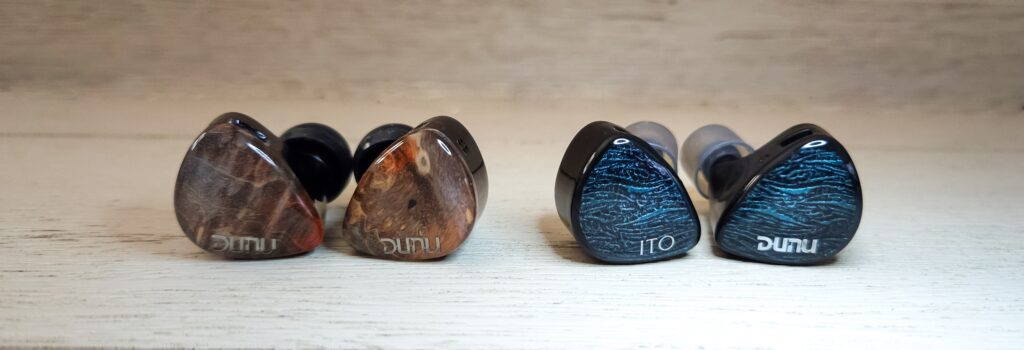
Dunu X-Gizaudio DaVinci ($295)
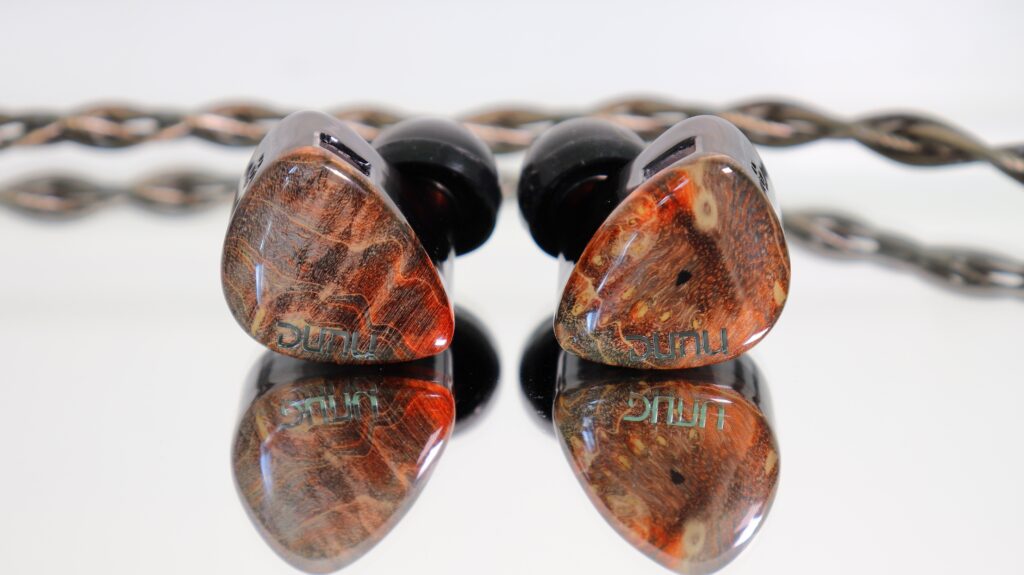
The only comparison that I have time for is with one of my favorite sub $300 iems named the Dunu X-Gizaudio DaVinci (DaVinci Review). I actually reviewed the DaVinci last year and truly found it to be spectacular for what it is too. Just like the Ito it is definitely a bass forward iem and just like the Ito it is also a collaborative effort. However, the DaVinci happens to be a collaboration with Gizaudio of YouTube notoriety. The DaVinci does have a couple more drivers within its shells as it has six in total. That is two DD’s and four BA’s. Also, it costs quite a bit more too at right around $100 more. So, no doubt this is a tough competition for the Ito. Or is it? Perhaps they are more different than you may think or maybe that $100 difference is what makes the Ito a much more appealing product? I suppose we shall see…
Non Sound Stuff
To begin, both sets come with very similar packaging and the exact same accessories. Literally, the box art is different. Everything is the same. As far as the build, both sets are made identical with fully resin shells. However, the DaVinci happens to have alloy nozzles. Also, both sets are decently large in size too. Perhaps to give the four Ito and six DaVinci drivers some space. I personally don’t have a problem fitting with either set, though smaller ears may want to pay attention. As far as design/aesthetic, take your pick. Both sets are dope looking. Again, the DaVinci is about $100 more, and it has two extra drivers. Let’s check out the sound differences.
Sonic Differences
To begin, the DaVinci comes across slightly more organic than the Ito as it does have a better balance tonally. What I mean is that the DaVinci doesn’t have quite as recessed of a midrange with a richer sound than the Ito. The Ito is great, but it is a hair brighter in the upper mids and slightly thinner which skews it from being considered perfectly natural. However, these things are subjective opinions here folks. I have zero issues with either set’s timbre. There are moments where both sets suit my taste better. I do find the Ito easier to drive by the smallest margin. In fact, it’s so small that I’m not quite sure why I even mentioned it. The DaVinci actually comes across less energetic, more relaxed, but slightly better technically overall, at times. I also find that the Ito actually has a touch better clarity too. Granted, in big heavy bass tracks that won’t be as apparent, but overall, the Ito has the more crystalline sound. Let’s check out each 3rd of the mix…
Between the 20’s
Definitely, the bass on the Ito has much more weight and a bigger emphasis across the bass region. The Ito is in the basshead camp while the DaVinci is not. The crazy thing is that I still look at the DaVinci as a bass forward set. Anyways, the Ito also has the tighter bass, better defined, cleaner too. The DaVinci has a more atmospheric style decay with a less separated bass replay which bleeds into the mids a bit more. Now, the midrange of the DaVinci is its bread and butter as it truly shines with vocals and instrumentation in a very nice way. While the Ito has a slightly thinner and more transient tight delivery and better detail retrieval, the DaVinci is more musically adept with a more emotionally alluring sound. The Ito has a more energetic sound, bigger macro dynamics, and sprightlier. The DaVinci is smoother, like a wave in the sea it’s creamy and so nice to just casually jam with. The treble of the Ito has a slightly greater emphasis, it’s more brilliant, tighter transients, similar details, but a touch better extended up top. However, it also has the bigger bass contrasting that brilliance too. The DaVinci is more relaxed, even less fatiguing, better balanced to its bass region, and the DaVinci has the smoother treble, but also a better controlled treble with slightly better detail retrieval. Both have very nice treble replays. As far as detail retrieval I find that the Ito is a touch better down low while the DaVinci slightly edges the Ito up top. Having said that, it’s a very close call. Neither set is inherently bad at detail retrieval for musicality-first iems. Note separation is a toss up. Probably going to the Ito with its sprightlier transient attack and thinner note body along with its slightly brighter treble. Imaging is comparable on both sets. Both sets also have solid soundstage replays though the Ito has the wider stage whereas the DaVinci has the slightly deeper stage.
Final thoughts on this comparison
This is a very tough comparison because these two are not very similar when it comes down to it. This comparison was more about giving the reader an idea about how the Ito sounds. Between the two I favor them both at different times. One is a touch sprightlier and more energetic while the other is a little more organic and balanced tonally. One is a surefire basshead set while the other is musicality through and through. I do believe that more people would probably enjoy the DaVinci a bit more just because it is more of an all-rounder style tuning, closer to balanced, less intensive. However, anyone who desires a more fun experience, more energy, deeper and more physical bass may want the Ito. It really comes down to what you prefer and if $100 makes a huge difference to you. Definitely the Ito is the better buy as they aren’t so far apart sonically to really declare the DaVinci “better”. Really, it’s just different.
Last Words on the Dunu x-Koto Ito
This was such a fun experience getting to know the Ito. I really did have a blast, and I think I will get to continue that musical enjoyment for a long time. You know, Dunu really surprised me with this set. I didn’t ever expect them to go this route, at all. I never expected to see such a graph from them, and I never expected the set to sound as good when I did see the graph. The Dunu x-Koto Ito is a surefire awesome basshead iem. It’s got all the intangibles which make for a musically expressive and totally engaging presentation with one of the cleaner big bass displays anywhere near $200. Also, it’s simply got a smart tuning folks. Definitely an easy set to enjoy if you typically gravitate towards that meaty bass and rhythmic type of sound. There are a few other iems which are somewhat similar with their low-end bass emphasis, but really, the Ito represents one of the finer overall presentations that I’ve personally heard from a set with at least 14 db’s of bass shelf. Again, it was fun getting to know the Ito, and I do hope that some of you can also find some enjoyment with this solid collaboration set.
Not for everyone or every genre
Before I conclude, let’s be realistic. Yes, this was a glowing review. However, it was a glowing review in respect to its tuning. I don’t review from one tiny perspective folks. I love all sound signatures and find enjoyment in them all, if they are tuned well. That’s a big caveat. It just so happens that the Ito is tuned very well for its style and deserves the praise (in my opinion). However, as I said earlier, this set is not going to be for everyone. No doubt the bass is going to be far too much for many people. I totally understand. This set has a very specific sound and the way that it can be somewhat polarizing is in the same way that a bright and treble focused set can be polarizing. To add to that, not all genres are going to be perfect for the Ito. In my opinion this is not an all-rounder style. Granted some folks may love it with all genres, but in truth it won’t be as great for stuff like singer songwriter or acoustic stuff where the slightly thinner and somewhat recessed midrange kind of takes away from some of the ambiance and melody to a degree. Definitely some big and energetic metal or prog metal which have those multiple densely layered intricate guitar riffs which can smear a bit on this set. There’re a few other genres which may be questionable for some folks too but I’ll just leave that alone right now as it’s up in the air. So, it won’t be perfect for everything.
Better for these genres
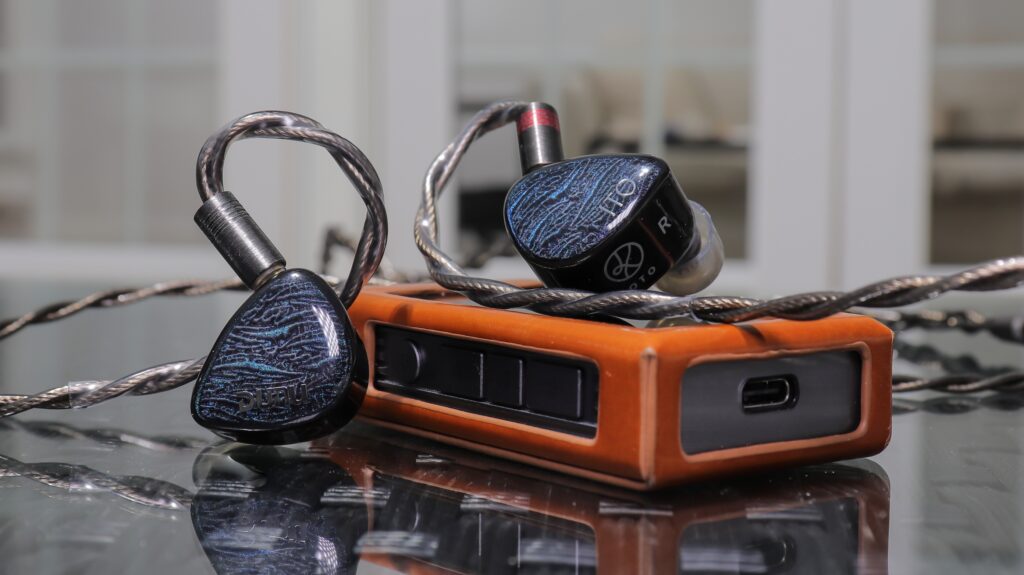
However, the Ito is tailor made for some genres too and this set absolutely excels in a few specific types of music. Most certainly EDM will sound great with those sublevel synth drops sounding flat-out awesome and the stage size creating that big venue feel. Or Hip-hop, Rap, & R&B. I think it’s obvious why this set would work for these bass reliant genres. However, the clarity and separation in the midrange as well as the subwoofer effect really do fit these genres to the tee. Also, definitely Classic Rock and Rock in general will sound really nice. I mean, guitars have that energy to cut through the deep bass guitars and bullish drums and nothing ever truly sounds overly fatiguing. Once again, there’s other genres which do well but I’m not going to go crazy describing every single one of them. I think you get the picture. Really a great set that is worth the asking price and an easy rec for anyone who enjoys the “good” genres listed as well as the tuning I’ve described.
The Why…
Because the Dunu x-Koto Ito comes with a fine packaging for the cost. Inside of that package is a slew of solid eartips, a nice and large carrying case, as well as one of the better modular cables (Dunu Leo) that you’ll find for $199. The build is durable, all resin, and has a nice ergonomic fit (for me), with a super slick design language that is so cool looking to me. Especially with that fat Leo cable attached, it’s dope. However, it’s always about the sound for any set. Folks, I won’t go too long here but the Dunu x-Koto Ito has such a musically engaging sound that carries one of the more potent bass replays that I’ve heard in a while whilst also carrying a very taut and clean bass. Very much a subwoofer style and very-very fun. Definitely guilty pleasure style. Next, the mids may not be as rich as I’d like, but they are melodic and surprisingly well detailed at times with fantastic clarity, macro-dynamic energy, and vibrance. Next the treble has a solid helping of crispness, brilliance, while also coming across totally non-offensive. Something that you can listen very loud to. Also, the treble has some nice extension too. Details are better than I ever would’ve guessed, Imaging is very nice, and the stage has that big and holographic feel to it. Honestly, this set is very well done. Congratulations to Koto (Kaji-Kaji), HiFiGo, and Dunu. You created a very fun, rhythmic iem that provides an enjoyable listen every time. Easy rec.
Conclusion
To conclude my full review and feature of the Dunu x-Koto Ito I first have to thank the friendly folks over at HiFiGo for offering up the Ito in a giveaway. I happened to be the winner of that giveaway, and I am so very thankful for that. This was not a review sample and so it was very enjoyable to be able to finish on my own time and go at my own pace and learn all that I could. Still, thank you to HiFiGo. I also need to thank you, the reader, for taking the time out of your day to click the link which brought you to mobileaudiophile.com. Thank you very much, it means the world, and I truly hope this helps you.
Other perspectives
Now that you’ve read this review, I hope you will click some more links and check out other reviews of the Dunu x-Koto Ito. This is such a subjective and personal hobby folks. No two people are exactly alike. Heck, no two reviewers are exactly alike. We all have different tastes, different likes and dislikes, different gear, different music libraries, and we all haven’t been down the same journey through audio. Get other thoughts and ideas about this set before plopping down the money for it. So, I do hope you take the time to read other thoughts. There are so many amazing reviewers who also want to help and may make it easier for you to find the perfect product to spend your hard-earned money. With that, I’m done! I hope each of you are doing well and good. Take care, stay as safe as possible and always… God Bless!





No Comment! Be the first one.