














































Shanling EC Play Review
Intro
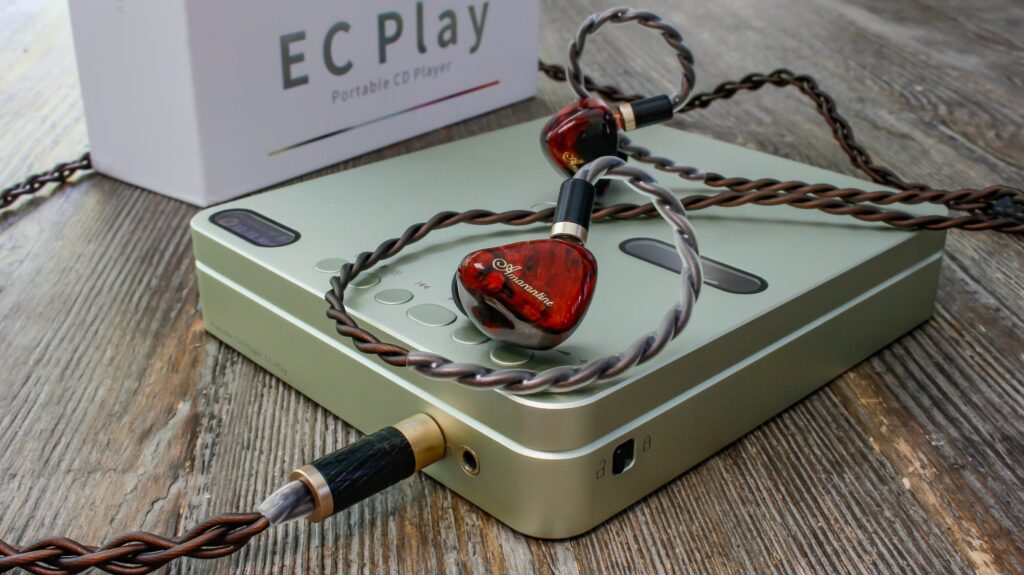
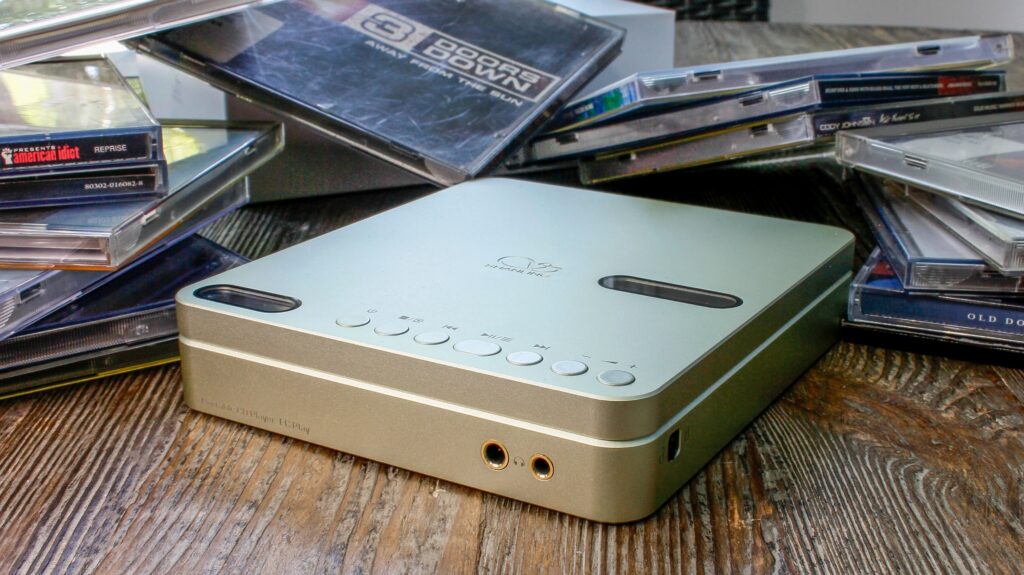
Hello, this review and feature covers the latest from the audio brand Shanling Audio, named the Shanling EC Play ($199). When I was asked to take a look at the EC Play, I found it more than fitting that it came from Shanling. After all, they’ve had over 30 years of experience making CD Players of all kinds. Among other products. If you really think about it, the EC Play is almost going back to the basics for Shanling. How wild is it that it was in the 90’s when portable CD players were all the rage. CD Players went strong for a solid decade and then… they died away. MP3 players, digital audio digital files, digital audio players, took off and the audio world never looked back. But that physical disc player still had a heartbeat. That tangible spinning disc… with some of the highest quality audio… still had the flicker of a heartbeat. I’ll say it as many times as it takes to get all of you to understand that this hobby is without question thee best hobby on planet earth. Leave it up to us audio folk to bring back a decades old tech just to hear our music in a different way. We rediscovered something which should have never died to begin with. So, here’s a little rhetorical question but… how wild is it to see portable CD Players coming back!? It isn’t just CD players though, no sir, we have cassette players coming back, record players/turntables, shoot…FM Radios came back for some folks for crying out loud! I know other brands have hopped on the CD player train; I’ve seen them all. They didn’t really interest me, but I saw them. However, how fitting is it that Shanling, who literally began their quest over 30 years ago crafting and creating CD players, is one of the brands who are helping bring this old (but pretty impressive) audio tech back into the Audioverse consciousness? I suppose that too was rhetorical. Anyways, I think it’s pretty cool.
Table Of Content
- Intro
- Full Disclosure
- Shanling
- Resurgence
- Without Further Ado…
- Non-Affiliated Purchasing Links
- Packaging / Accessories
- Unboxing
- Case
- Build / Aesthetic / Internals / Controls
- Build Quality
- Design / Aesthetic
- Internals
- Controls/Buttons
- Menu Navigation
- Navigation cont…
- Shanling EC Play Specifications
- Features
- Disc Playback
- DAC Chips
- Driving Power
- Battery
- Sound Filters
- Bluetooth
- Bluetooth Audio Codecs
- USB Dac Mode
- SPDIF Out
- Straight-up Functionality
- Sound Impressions
- Explaining Source Sound
- What’s It Sound Like?
- Sound cont…
- Technicals
- Stellar Portable CD Player
- Bass Region
- Midrange
- Treble Region
- Technicalities
- Last Words on the Shanling EC Play
- The Why…
- That Sound!
- Conclusion
- Different perspectives
Full Disclosure
To be 100% transparent, when Shanling asked me to check out the EC Play I really wasn’t quite sure how I would like it. If they asked me 25 years ago, I’d be over-the-moon with good excitement. I mean, back in the day when I was a 90’s teenager. Back when I tried (with little to no money) to get every portable CD player I could get my hands on, and my CD collection was a badge of honor displayed for all to see. Look at all of my CD’s! But that was so long ago. I gave some away, sold some, digitally copied a bunch and threw them away. No need for a large physical disc in a plastic case when I have music at the push of a button, and now at the tap of a finger. l Now I have terra bites of music files, so many albums that I forget all of what I have on file. I have multiple daps which all house my library of music. I absolutely adore my daps and my collection. So again, I wasn’t quite sure how I’d like to revert back. I saw the Facebook posts of friends who got the new Shanling and Fiio disc players and thought “Eh, good for them, but not for me”. Full disclosure, I wasn’t even sure I’d review the EC Play. Typically, I will write my intro (for most every review) prior to even receiving the product I’m reviewing. I like to do that; I’ve always done that. It helps me to learn about products, get to know them, get a little psyched to receive them. With the EC Play, I didn’t do that because I wasn’t sure I’d want to review it at all. It wasn’t until I put the first disc into that dope little portable player that everything came flooding back. CD players didn’t die, I… we… just forgot.
Shanling
What an easy brand to prop up! I’m a fan of all brands who do what they do for the love of it. Shanling is 100% one of those brands. Of course, I’m not going to attempt to declare the motives of a brand, but Shanling seems to be one of those larger commercial brands which is truly audio-first. Like, a definite established hi-fi company that genuinely loves audio and also really knows how to run a successful business too. People like to look down on success, but I suppose I’m just not that cynical. I’ve reviewed their products. I’ve seen (first-hand) the intricately designed iems, their quality made daps and dongle dacs etc. along with Shanling’s technically impressive yet wholly musical house sound. Certainly, one of the larger and more influential audio brands, but also one which keeps in touch with the consumer base. I mean, you don’t make it 38 years in the personal audio space without listening to the criticism and praise of your fan base. Success and prosperity in the personal audio world have to coincide with keeping an ear on the heartbeat of the community. Also, generally you hear solid praise of Shanling products. I know I’m supposed to be objective, or whatever these reviewers try to communicate all the time. Yeah, yeah, yeah, you’re “objective” (insert eye roll). However, my reviews are 100% subjective objectivity in which I explain what I hear, what I see and what I feel during the review process, along with a bunch of technical mumbo-jumbo thrown in there too. I can say with absolute assurance and subjective bias that I am a fan of Shanling and I don’t see that falling away anytime soon. I may say the same thing in another 38 years.
Resurgence
There’s also no doubt that Shanling has been a large player in the resurgence of the portable CD Player. I believe it was 2023, maybe 2022 when they came out with the Shanling EC Mini which was, and probably still is, a slick looking player and a fairly stacked portable CD Player. That was followed by their flagship personal CD Player, the Shanling EC Zero T which seemed like a huge upgrade featuring an R2R dac along with a massive 1200 mW of power and dual JAN6418 tube output. Basically, the definition of a BEAST! They weren’t done. Next (2025) was the follow-up Shanling EC Zero AKM which was a slightly less expensive device which now houses AKM dac chips instead of the R2R setup, same features, same design, yet with more simple amp sections and that same beautiful design language. Beautiful. Of course, their latest entry into the EC series is the one I’m reviewing today, the Shanling EC Play which is actually loaded with all of the great features that we look for in a good source device like 700 mW of power, 12 hours of battery, a simpler design and probably meant for a more casual listening experience rather than ultra-audiophile, but still so dope. This’ll be fun. Anyways, the point is that Shanling seems to be all-in on the success of this technology and certainly seems to be one of the big players in the resurgence.
Without Further Ado…
Well friends, I’ve had the EC Play with me for roughly about three to four weeks and I’ve had plenty of time to give my full thoughts and feelings on Shanling’s latest CD Player. I really don’t have anything to compare the EC Play with as I am just getting back into this form of audio and so my review will solely be about my experience with it. I know that many of you desire comparisons, but that simply cannot happen. With all of that said and all of my intro blabber out of the way I think I’m ready to get into this one. So, without further ado, the Shanling EC Play…
Non-Affiliated Purchasing Links:
Packaging / Accessories
Unboxing
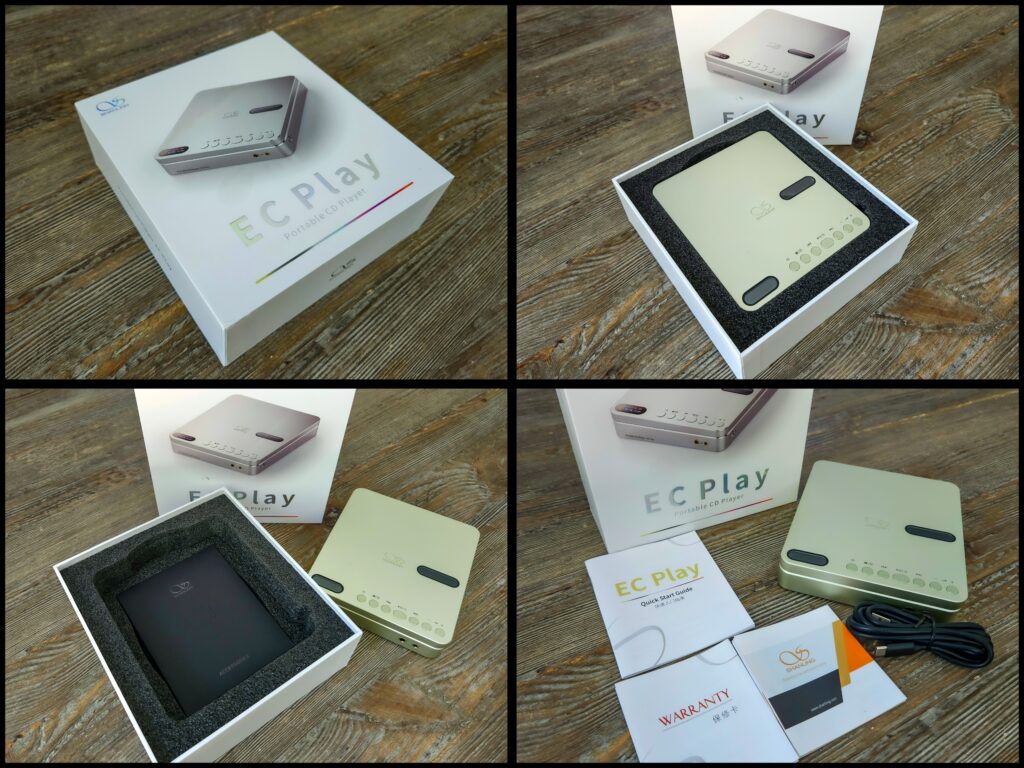
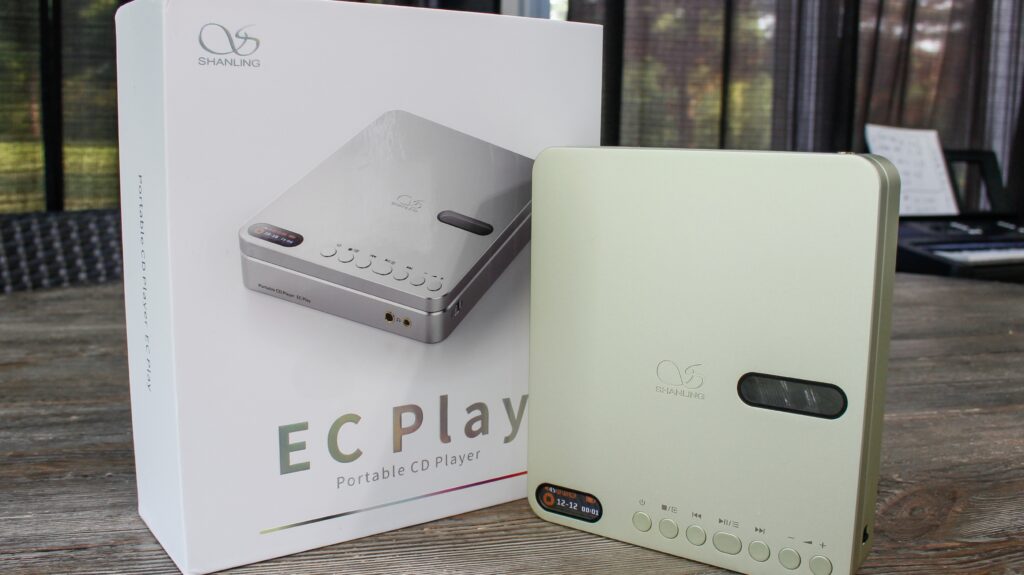
The Shanling EC Play arrived at my home in a decent sized white box (7 ½” x 6 ¾” x 1 ½”) hosting a photo of the EC Play on the cover and not much else. A very simple look. In fact, the whole unboxing is pretty simple. Of course, I didn’t expect anything but that. How many accessories would you think could come with a CD player? The answer is “Not many”. Anyways, take the box top off and right away you’ll see the nice-looking EC Play sitting nicely inside of foam cut-outs. There’s actually foam on the underside of the box top too. Take out the EC Play and underneath you’ll find a slim box that contains some reading material as well as the USB-C to USB-C charging cable and that’s about it. Unboxing is over. Again, I expected exactly that, but I wrote this so that you aren’t expecting some elaborate unboxing experience with loads of accessories.
Case
Shanling does make a beautiful case for the EC Play which doesn’t come packaged with it. You’d have to purchase the case separately from Shanling HERE. I don’t actually have the case, but on their website, you can see that they come in two different colorways, blue and a light green color. It appears to be that harder feeling fabric design with all buttons cut-out for easy access. Really it just looks very sharp. I believe it retails for $28. Now, I don’t think you really need a case, but it’s a dope look for sure.
Build / Aesthetic / Internals / Controls
Build Quality
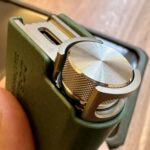
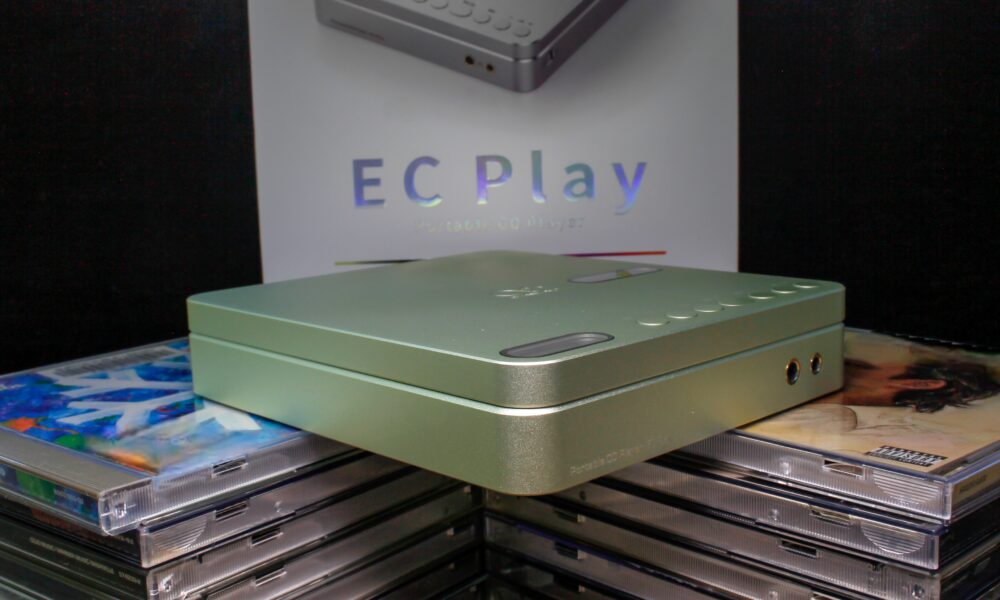
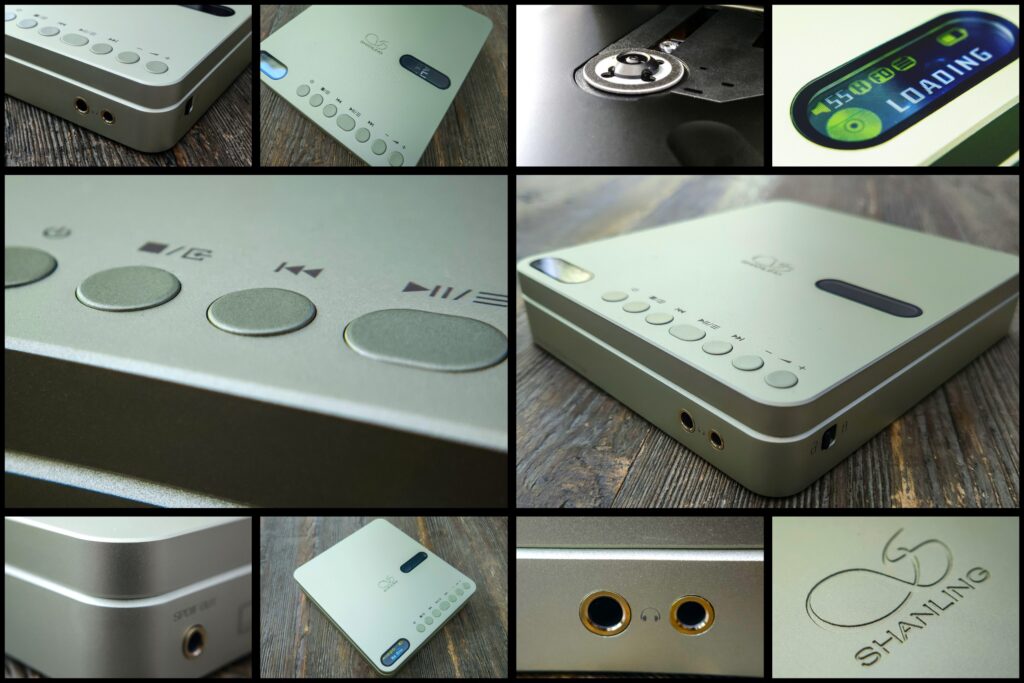
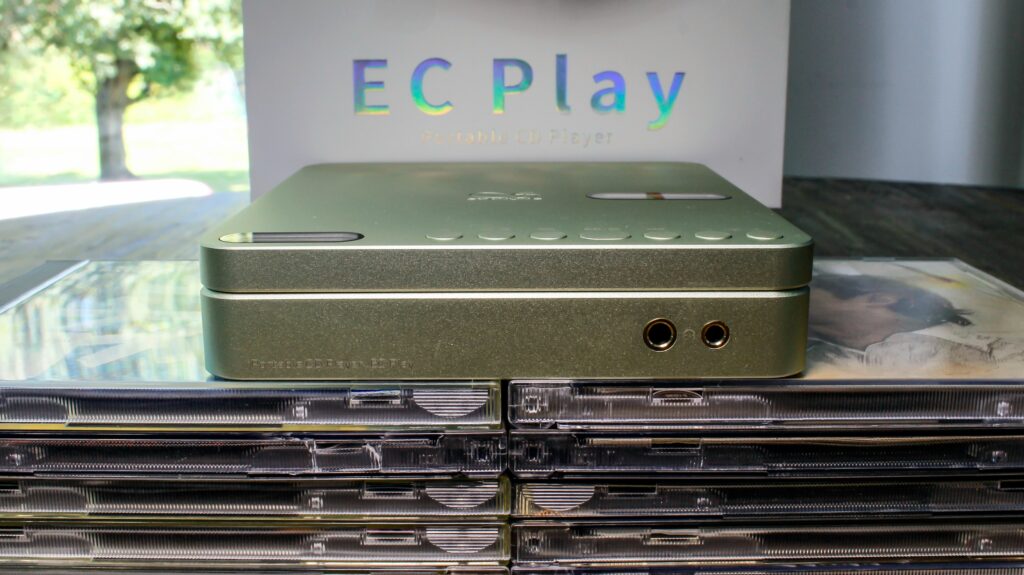
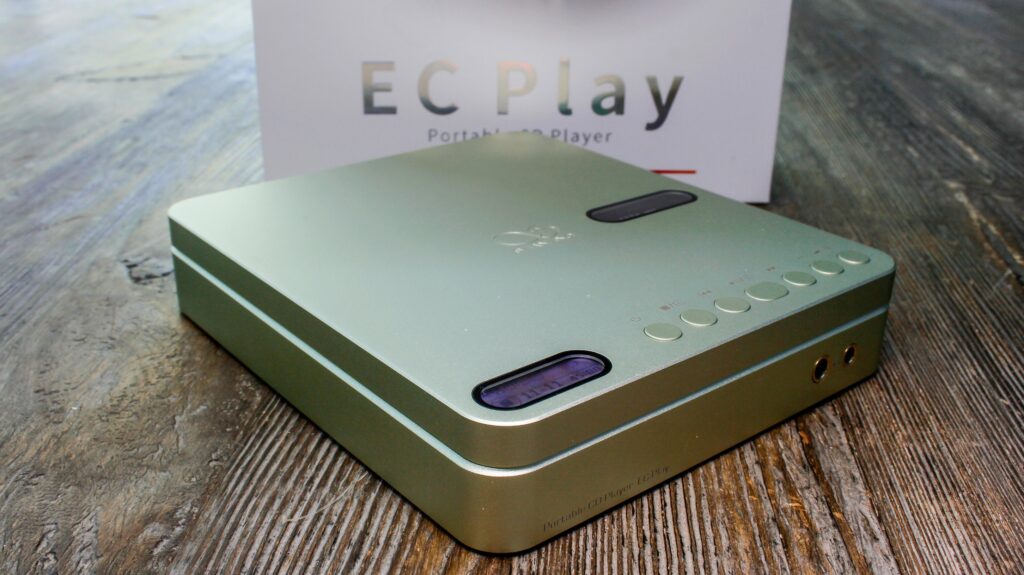
If I were to give Shanling any credit it would always be in the build quality department. Just like any and every Shanling product that I’ve reviewed (a handful) the EC Play is made very well. Holding this device in your hands will tell you that right away. It’s actually made out of aluminum alloy. Presumably CNC machined. Both the chassis and the lid are extremely durable, lightweight (418 grams), and feels very solid in hand. It was actually the build that I (for some reason) was most worried about. Being that the EC Play is Shanling’s low tier model. Of course, I had nothing to worry about at all because this is Shanling. Actually, the EC Play is almost like a solid little block, square, 90° corners, and easy to hold and walk around with. Also, again, it’s light, being that it’s made out of aluminum. The body of the EC Play also includes a magnetic anti-vibrational disc style clamp (very strong) to hold the lid closed when in use as well as a lid lock. You’ll notice on the top side of the lid are all of the buttons/controls as well as the sleek little 1.12” display screen. It has simple and easy to understand controls laid out in a very simple way. No need for any app on this device. Simple, simple, simple. I am more than happy to see that. Just like the portable CD Players of the 90’s, except it’s built much better and “not” made out of plastic. Altogether I think that this is a very well-made device and shouldn’t have any durability issues.
Design / Aesthetic
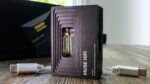
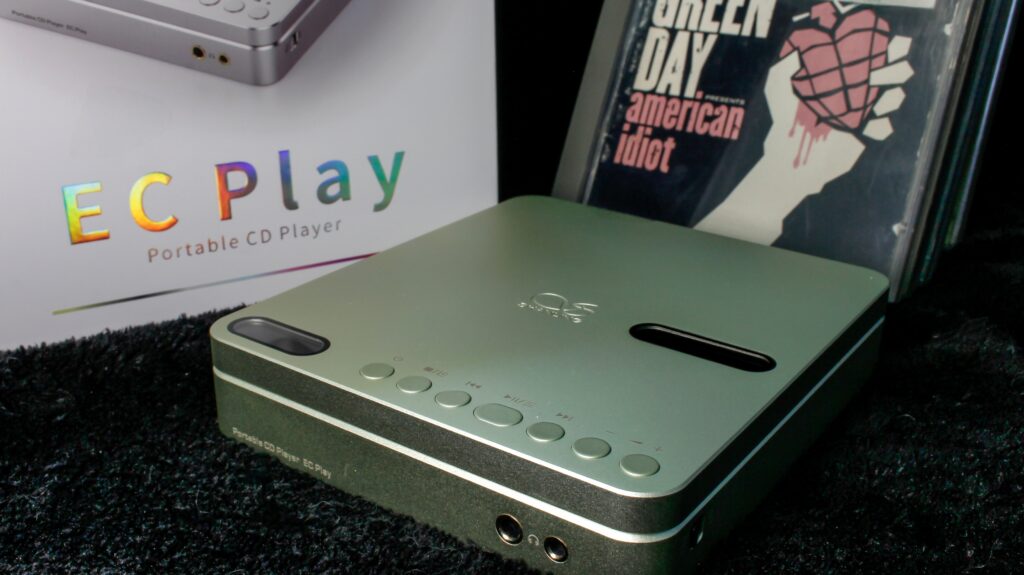
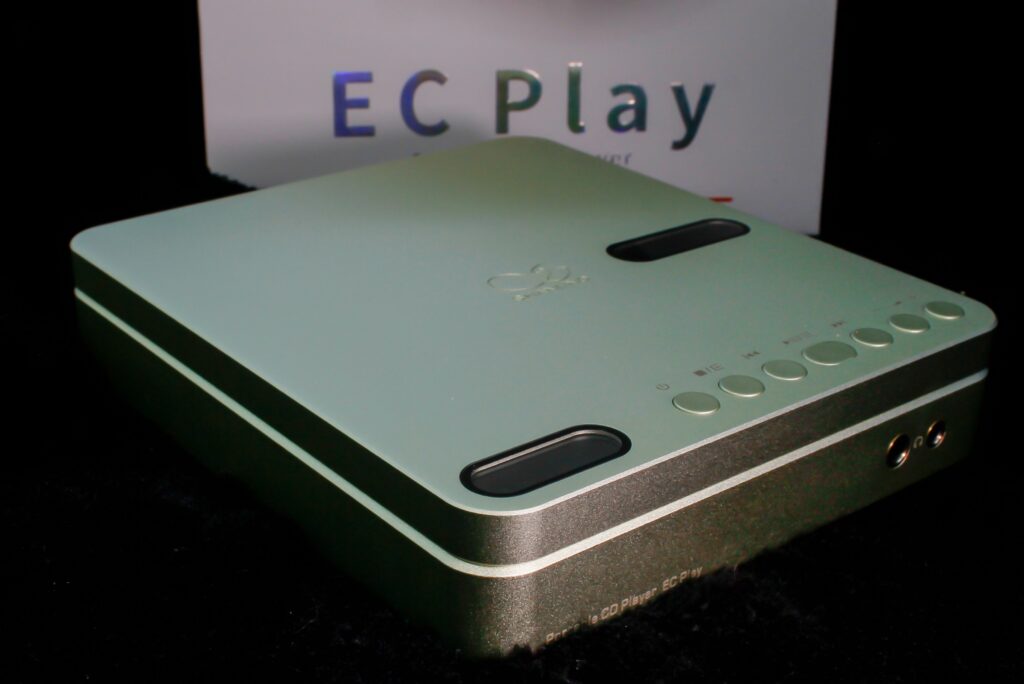
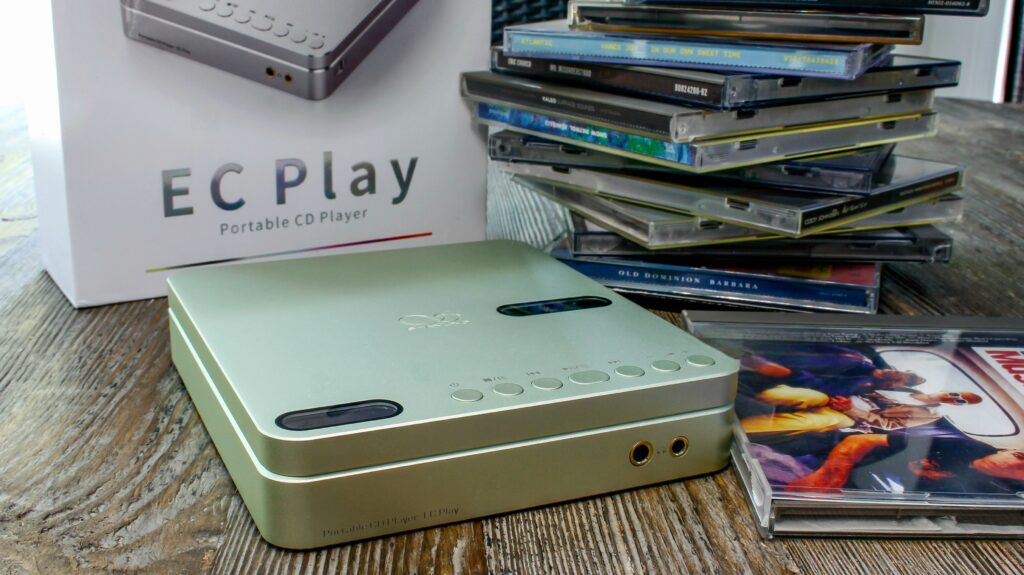
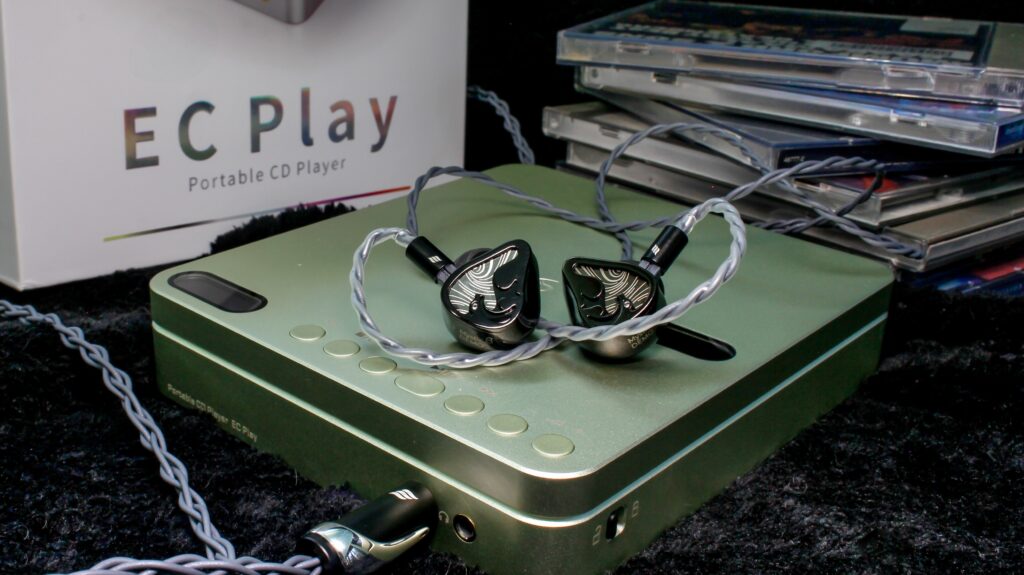
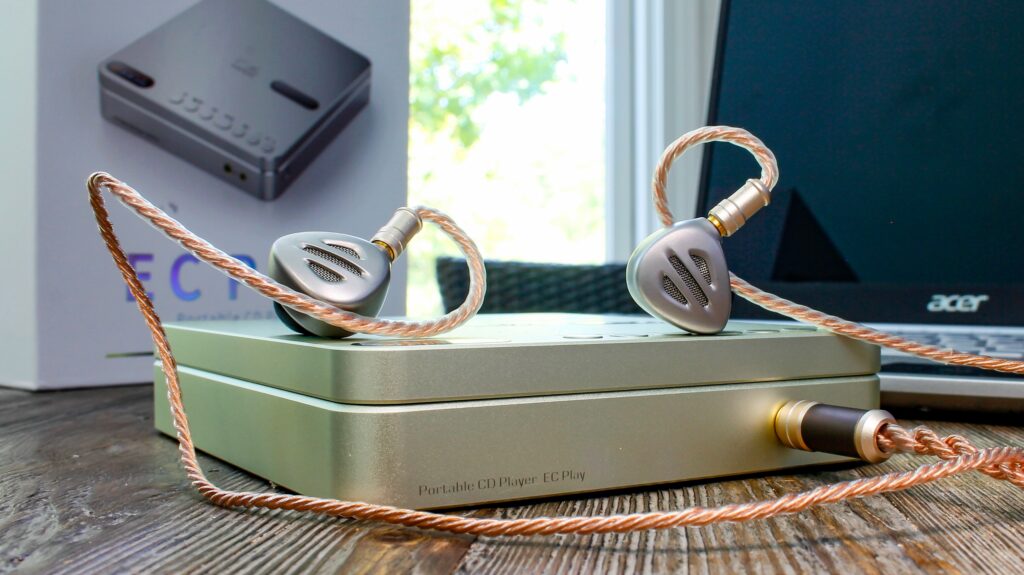
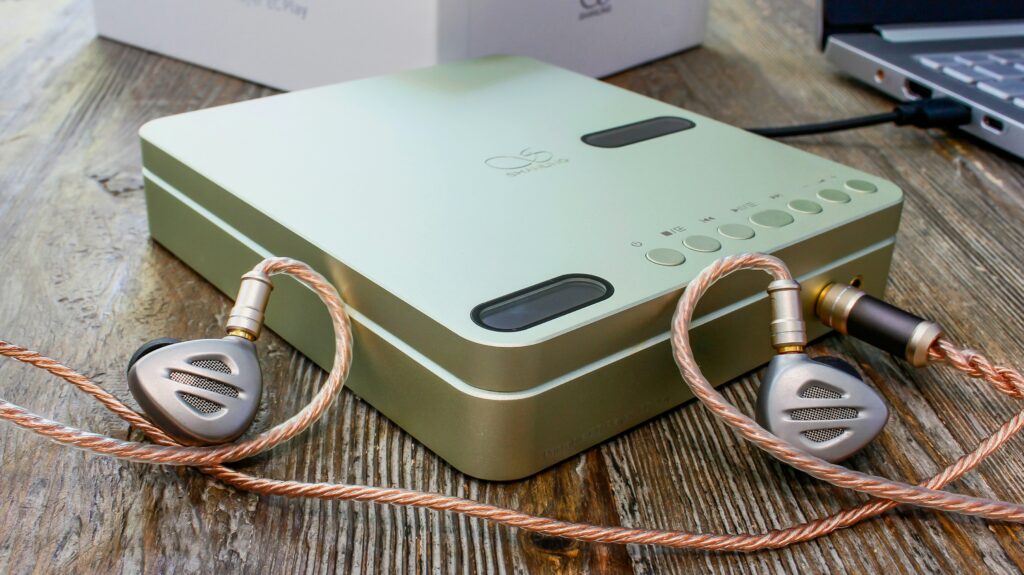
The EC Play is a pretty straightforward CD Player, nothing flashy, and basically just a square and slick looking player with a sort-of retro-modern style aesthetic. In my opinion the EC Play seems like a modern-ish style discman yet twisted for more of an audiophile hi-fi feel to it. Very low profile, nothing stands out (except the screen), while the aluminum chassis gives the EC Play that dense appearance and premium purpose-built design. I love how the flashy little screen gives the EC Play its only real colorful visual contrast. I should note that the EC Play does come in three colorways. Those being Onyx Black, Feather Green, and Moonlight Silver. All three are well thought out colors and each looks much more sophisticated and serious with just a touch of fun. My EC Play is the Feather Green colorway, and it is a very attractive unit. Certainly, a very minimalist approach by Shanling and also one that I am fully on board with. I don’t like flashy designs for stuff like CD players. That is what we had in the 90’s and in the early 2000’s. We had bright cheesy colors, bright neons, big, silly buttons, ornate but also odd & weird techy looks. I like how Shanling made a device in the EC Play that looks mature, minimalist, but also svelte and refined.
Internals
As simple as the Shanling EC Play appears in its aesthetic design, it is anything but that. It’s actually carrying some impressive tech which makes for impressive specs. To begin I have to list the main dac chip which is one of the most well-known dac chips on planet earth in the Cirrus Logic CS43198 chipset. The CS43198 affords any device that houses a great tuning base which Shanling or any other brand can then go and tune further. I’ve always been impressed with what this chipset can do (I’ll cover those further, later). Shanling also decided to use 2 x SGM8262-2 op-amps amplifier chips which is what provides the EC Play with the high balanced output power numbers (700 mW). Internally Shanling opted for a fairly large 3450 mAH battery boasting up to 12 hours of listening (more on that later). Shanling also uses an extremely well-done custom servo system along with an active magnet anti-vibrational disc clamp. It works like a charm. I shake this thing and no skips, just music. Now, I don’t know the Bluetooth chip used, but it provides Bluetooth 6.0 which offers up to LDAC audio codecs (more later). While the Internals won’t blow your mind, they are very well chosen for this player and price. Enough to label the EC Play a serious little CD player which also happens to have a few “other” ways of utilizing some of its internal tech. You can listen directly to CD’s, use the EC Play as a Bluetooth receiver or transmitter, it has USB dac mode (which is very useful), or use it’s coaxial out for home receivers letting the disc spin through a home system dac/amp. Basically, due to the internal tech, the EC Play has many useful means of listening to music.
Controls/Buttons
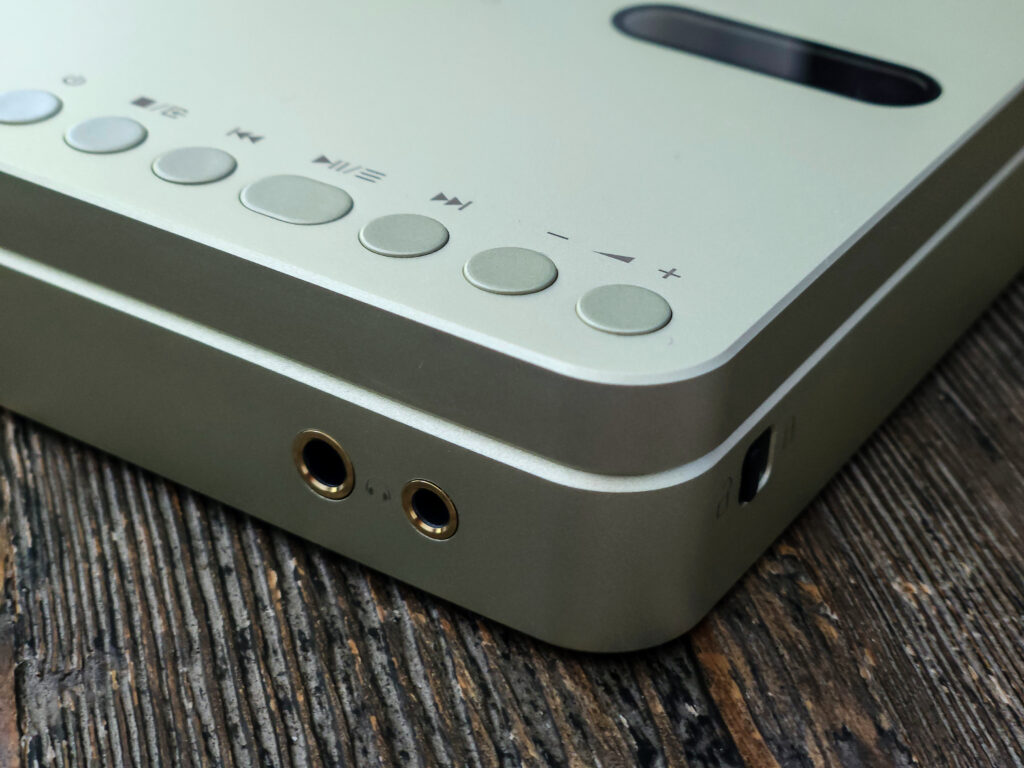
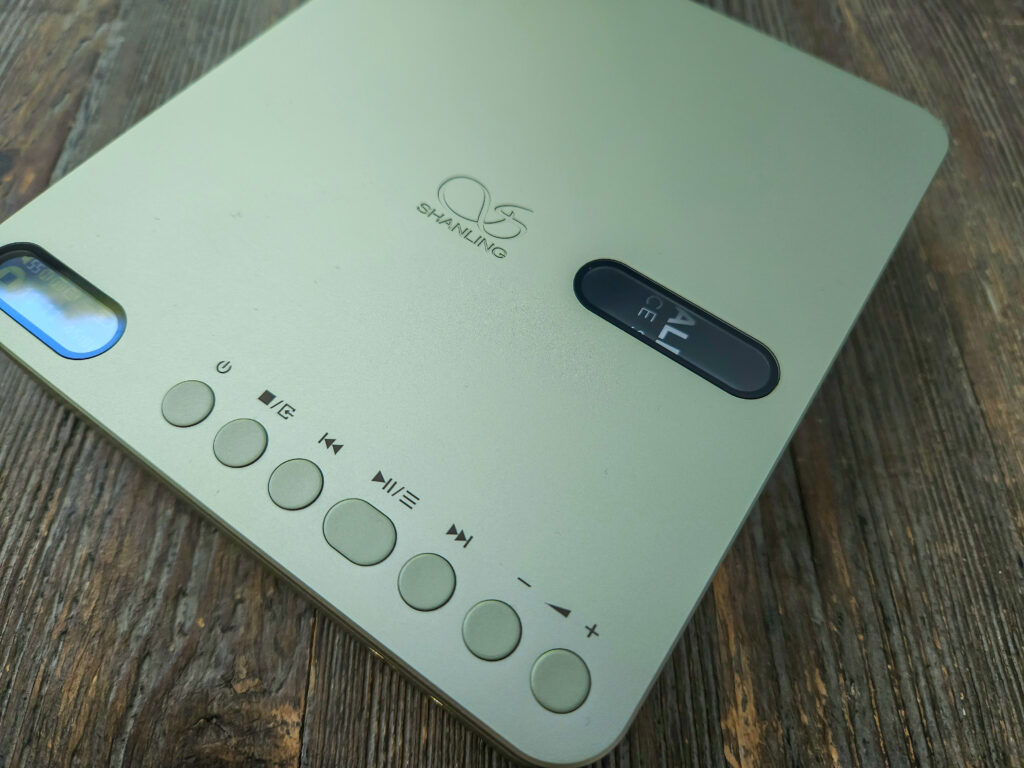
In total Shanling added seven buttons onto the top lid of the EC Play and if you ask me, they are about as straightforward as it gets. Now, each button is raised off the surface enough to be very tactile and very visible too. I really like the nice way that they’re laid out. From left to right you have the Power button (for obvious purposes). Next there is a Stop button (which has a few functions). Then you’ll see the Rewind & Previous Track button and right next to that is the Play/Pause button and Multi-Task buttons in one. To the right of that you’ll see the Fast Forward & Skip Track button, and the next two buttons are volume controls. Again, very straight forward. However, I mentioned the Multi-Task button which engages a few functions which I’ll explain below.
Menu Navigation
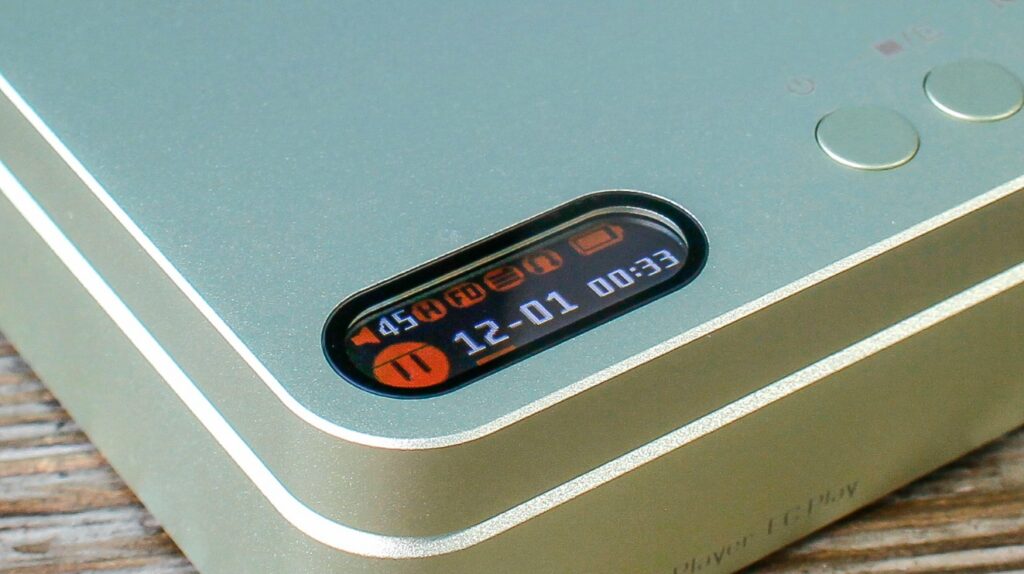
As I said, the buttons are very cut and dry but there are a few menu secrets to figure out. Again, the Play/Pause button also features a Multi-Task function which engages by holding it down for a couple seconds pulling up the settings menu. You cycle through each setting by tapping the same button once you are in the settings panel. You also can navigate through each setting using the Previous and Next Track buttons. Now, the first setting in the menu is high and low gain. I just put it on high gain and leave it, but you may want more control. The next setting is the sound filters available on the EC Play through the CS43198 dac chip. There is a total of five filters which I’ll explain later. Tap again and you’ll see the CD Play Mode which lets you cycle through different listening playback modes like “Normal”, “Repeat All”, “Repeat One”, and “Random”. Tap again and you can change the brightness of the screen. Another tap lets you control the screen and set it from Always On to 10 seconds and then 10 second increments up to one minute, or you can turn the screen off altogether. Another tap of the Multi-Task button allows you to change the balance of sound from left to right. Tap again and you’ll be able to switch up the screen theme. There’re actually some nice looking themes on there to check out. Lastly, one more tap will let you switch between “Headphone Out” or “Bluetooth”.
Navigation cont…
Another sort of “multi-task” button is the Stop button. If you hold it down, you can unlock or even lock the functions of the buttons so that nobody can change anything. Also, it’s the “Stop button” that when all music is off and not playing, or when you aren’t in “Play” Mode, you can tap the Stop button and change between a few music modes that the EC Play has. You can change between normal CD listening playback, USB Dac Mode or Bluetooth Mode. As honest as I can be, the EC Play is about as simple as it gets but I am very surprised at all of the functionality of this player. Friends, the CD players from back in the day literally always had a total of about four to five buttons, no menus, no changing any filters or gain. The Shanling EC Play is light years ahead of anything that I used to listen to. I know that Shanling doesn’t necessarily consider the EC Play their most premium CD Player and that it’s meant more for casual fun and enjoyment rather than audiophile ambitions. However, it’s pretty comprehensive for a simple player.
Shanling EC Play Specifications
Model:
Shanling EC Play
Product Type: Portable CD Player / USB DAC / Bluetooth Receiver & Transmitter
Audio Architecture:
DAC Chip: Cirrus Logic CS43198
Amplifier: Dual SGM8262-2 headphone amplifiers
Gain Modes: Low / High
Gapless CD Playback
Active Magnetic CD Clamp System
Custom CD Transport Mechanism
Supported Media:
CD
CD-R
CD-RW
USB DAC:
PCM: Up to 32-bit / 384kHz
DSD: Native DSD256
Bluetooth:
Bluetooth Version: 6.0
Receiver Codecs: LDAC, AAC, SBC
Transmitter Codec: SBC
Outputs:
3.5mm Single-Ended Headphone Output
4.4mm Balanced Headphone Output
3.5mm SPDIF Coaxial Digital Output
USB-C (Charging & USB DAC)
Output Power:
3.5mm Single-Ended:
Low Gain: 44mW @ 32Ω (1.19Vrms)
High Gain: 177mW @ 32Ω (2.38Vrms)
4.4mm Balanced:
Low Gain: 177mW @ 32Ω (2.38Vrms)
High Gain: 700mW @ 32Ω (4.75Vrms)
Audio Performance
3.5mm Single-Ended:
THD+N: 0.0006%
Dynamic Range: 120dB
Signal-to-Noise Ratio: 121dB
Channel Separation: 73dB @ 32Ω
Noise Floor: >113dB
Output Impedance: 0.5Ω
4.4mm Balanced:
THD+N: 0.0005%
Dynamic Range: 125dB
Signal-to-Noise Ratio: 125dB
Noise Floor: >111dB
Output Impedance: 0.8Ω
Frequency Response:
CD Playback: 20Hz–20kHz
USB DAC Mode: 20Hz–40kHz
Display:
1.12-inch Color Display
Battery:
Capacity: 3450mAh
Playback Time: Up to 12 Hours
Physical:
Dimensions: 142 × 125.1 × 26mm
Weight: Approximately 418g
Chassis: CNC Aluminum Alloy
Colors: Black, Silver, Green
Key Features:
-Portable CD Player
-USB DAC Function
-Bluetooth Receiver Mode
-Bluetooth Transmitter Mode
-4.4mm Balanced Output
-3.5mm SPDIF Coaxial Digital Output
-Active Magnetic Disc Clamp
-Custom Anti-Vibration CD Transport
-Supports IEMs and Full-Size Headphones
-No Smartphone App Required
-Physical Playback Controls
Features
Disc Playback
I know this really isn’t a “feature” how some would think of technology features on a device. However, explaining the playback might just be the most important feature and therefore I list it first. So, the EC Play has a couple tricks up its sleeve that us audio folks can recognize. Stuff like Gapless playback for continuous playback albums or live albums. Also, the EC Play does support CD, CD-R, and CD-RW. I don’t know how important that is, but it’s a fact. Furthermore, the EC Play has a couple very important disc playback features for actual on-the-go listening which make the experience seamless and better. This includes the custom CD drive and servo system which constantly helps the disk to keep reading in a stable and very accurate way. I can attest to this. The EC Play servo system will help to control disc speed, laser tracking, as well as make tiny adjustments or corrections to keep the disc reading without fail. You won’t have nearly any skips (if at all), less reading errors, and really just a smoother playback. Another huge feature that works side-by-side with the servo system is the EC Play’s active magnet drive-clamp system. This actually holds the disc more securely, and once again, I can attest to this. These “features” are necessary for quality playback and a reason why I added them here. I’ll speak more on this individually later, but playback as a whole is one the EC Play’s more impressive feats. Friends, this thing always works as it should. No BS.
DAC Chips
As I said earlier the EC Play utilizes Cirrus Logic CS43198 Dac chips which are (in my opinion) some of the most versatile dac chips in the lower cost range. For one, they typically sound very good. They can really make some fairly large swings in how they sound. Granted, most brands that use the CS43198 chip will basically not do a whole lot to change the sound. Usually, they sit right in the middle of musical and analytical I’d say. That said, one of the key features of this chip is its low power consumption. Everyone who knows about this chip can usually attest to its ability to not drain your battery and it’s the same with just about every device which carries it. This chip provides up to 32-bit 384khz audio support as well as a dynamic range of 130 db’s as well as other boring specs. In truth, the CS43198 chip is not what anyone would consider a “premium” chip. If anything, it is more ordinary in the world of audio. However, that doesn’t take away from the versatility of this chip and how good it can be when implemented well. Again, always a clean sound, for an unsullied analog output stage that doesn’t tend to drain batteries as other chips might, namely the CS43198’s predecessor, the CS43131 chipset.
Driving Power
I did not expect in a million years to see power numbers as high as the EC Play is able to drive. Shanling has the EC Play listed at max output power for 3.5 single ended listening around 177 mW’s which is not earth shattering. However, due to the dual SGM826-2 op-amps, in balanced mode and high gain the EC Play will afford the listener with up to 700 mW. Folks, that might just be one of the largest disparities that I’ve seen on any device under $500 between single ended and balanced. There’s no doubt that the EC Play can easily drive anything that I have in my collection. Those are mid-tier under $1k dap numbers. I had zero idea that Shanling would gift a CD Player with that much juice. I’ve used every harder to drive set that I have in my collection, and nothing has been an issue for the EC Play. Perhaps some really high impedance over ear cans would give the EC Play a run for its money, but I don’t have any of those to test at the moment. I’ve used many different planar sets, and the EC Play was always well able to bring them to a very dynamic sound with tons of headroom. In my opinion the output power is a huge “Pro” for me.
Battery
Always, the number one problem that people complain about is battery life. I never understood the true complaint. Give me a device which can provide me with at least four solid hours on max usage, driving that thing to the hilt and you’ll find a happy owner of that device in me. However, no battery number will make everyone happy. As if any of you are listening to anything over four hours at a time. Anyways, the good thing about the EC Play is that Shanling lists its battery life at 12 hours. Of course, 12 hours is best case scenario, favorable conditions, low gain, tiny screen off, and 12 hours means that you aren’t using LDAC. Basically, that 12 hours is probably not accurate for strenuous listening. However, as a base number 12 hours is awesome. Definitely a useful ceiling, but there’s also more to the story too. The EC Play is actually outfitted with a relatively huge 3450 mAH battery although it is also performing a bunch of actions requiring the battery to be used. Stuff like an “on” screen, spinning a disc, dac usage, the amp stage being powered, and you also may be using Bluetooth. Also, if you are like me, you might be using high gain at all times too. I can assuredly say that I have never felt that the battery was dropping at a fast rate. 3450 mAH is big folks. I think that “realistically” you can get 8 hours if you are stressing the EC Play. I have no hard-line test to provide you, but my gut says 8 in total, maybe 7, but very good, nonetheless. Anyways, battery life is unquestionably a “Pro” for the EC Play in my book.
Sound Filters
I wasn’t going to add sound filters as a feature, but it’s a feature. Well, it’s actually a feature of the CS43198 dac chip. Still, sound filters can be somewhat useful. Shanling provides a total of five digital filters. Those being; Fast Roll-Off, Slow Roll-Off, Low-latency Fast Roll-Off, Low-latency Slow Roll-Off, and NOS. As honest as I can be, these sound filters are not going to change your listening experience. Let’s just get that out of the way. Despite that, they do offer subtle wave form deviations slightly affecting things like sharpness of cut-off on notes, and the way impulse-like sounds are rendered. In my brain they can affect the speed and approach to transients in a slight way which does alter the sound. Most filters really show up in the upper ranges and can alter “subtly” the texture within the treble, pre-ringing, stuff like leading edge bite (to a small degree), or even added smoothness too, like a light sanding down of the edge at the crest of a note as well as post-ringing. Having said all of that, I can definitely hear differences. So much so that I always try to set every source with what I enjoy the most. But I’m also critically listening all the time too. Casually listening I could really care less. However, they have digital filters for a reason. Not a bold “feature”, but something to check out.
Bluetooth
As I said the Shanling EC Play comes equipped with Bluetooth 6.0 and can either be used as a transmitter or a receiver. I find this to be pretty cool. What this means is that it is very similar to something like a Fiio BTR17, Hiby W4, Ifi Go Blu, Qudelix 5k etc. In Receiver Mode it acts like a Bluetooth dac/amp for your phone, tablet, or whatever source you are using. The EC Play receives the music and plays that music through it’s I eternal dac making use of its awesome Internals, power output, and tuning and I can plug my earphones into the EC Play and enjoy. In Transmitter Mode the EC Play Bluetooth is flipped. It can take audio from a CD and then send that signal out wirelessly to things like Bluetooth headphones, true wireless, home stereo, and my personal favorite, a Bluetooth speaker. Either way you have quality codecs for Receiver Mode and a Bluetooth which has only worked flawlessly for me. The only big drawback for me (not really an issue) is that in Transmitter Mode it sends Bluetooth out using SBC and not LDAC or even AAC. Granted, I can’t hear any difference when I’m jamming out in my garage, but it’s a downside, nonetheless. I find the Bluetooth capabilities one of the best assets of the EC Play and I’ve used it a ton while testing and casually listening.
Bluetooth Audio Codecs
What would a good Receiver Mode be without good quality codecs at your disposal. Shanling had the presence of mind to provide LDAC for anytime you want to listen wirelessly while using the CD player. The sound is fantastic folks. Once again, transmitting the Bluetooth signal will only give you the SBC codec. Keep that in mind. Of course, that is absolutely no issue whatsoever for me because the EC Play works so well. Having said that, it’s all about receiving the Bluetooth signal for me. Thankfully Shanling added LDAC, AAC (for IOS users), and SBC audio codecs. Any audio person who’s spent any time in this hobby knows that LDAC is one of the best hi-res codecs out there. That said, some of my favorite and best sounding true wireless sets have only had SBC codec. Believe it or not. SBC can be good sounding, but latency can also be a nightmare. Still, SBC peaks around 328-345 kbps, with a bit depth of 16-bit and sampling rates up to 48 kHz. AAC is mostly used for IOS users as it’s the only codec that Apple lets their consumers use. AAC gets you up to 256 kbps, 24-bit depth and sampling rates up to 44.1 kHz. However, LDAC is the monster here with up to 990kbps, up to 32-bit depth (mostly 24-bit), and sampling rates up to 96khz. What this means is that the EC Play has a strong Receiving mode for just about any device.
USB Dac Mode
Another quality feature is having the ability to use USB Dac Mode which essentially can be plugged into any device’s USB port and that source can then play music through the EC Play’s dac and amp sections. You can use the EC Play as a desktop setup when plugging into a computer or laptop and take advantage of the power on hand as well as the strong technical sound of the CS43198 dac chip. I like that Shanling added this feature because I generally really like the tonality and sound of the EC Play and it gives the listener another option of use rather than solely for CD listening. It gives your computer or phone etc. the ability to use the EC Play as an external dac/amp utilizing its support for hi-resolution PCM audio and even its DSD playback too.
SPDIF Out
Since I’m covering the versatile options of the Shanling EC Play I’d be remiss not to again mention the SPDIF Out feature of this device. I like the fact that I can send the CD signal to my home stereo, or any other dedicated dac using the EC Play as a CD source only. I’ve actually used this feature a few times now and it’s been cool going through my CD’s this way. It works by acting like a CD transport basically. The CD disc is read inside of the EC Play then the digital audio signal is passed through the 3.5 SPDIF Out “Coax” output to a home stereo where you can utilize the dac amp of that, if you prefer. Just another option for use making the EC Play easily one of the more versatile portable CD Players that I’ve personally ever used. I know some of you have already tried and bought some of the more expensive Fiio and Shanling CD players and so you likely have even better specs and capabilities with those units. However, try to remember that I’m fresh back into the portable CD Player game and for me a device like the EC Play is very advanced. I will say this; after testing the EC Play, I really want to test Shanling’s better and more premium CD Players.
Straight-up Functionality
Let’s face it, a device like a portable CD Player isn’t going to be loaded with features. Yes, the features that it does have are much more advanced in respect to my previous portable CD Players from the early 2000’s, but they obviously are limited in their abilities to have a rich feature set. So, when I’m going through my review notes seeking out actual “features” for my “Features” section, it really isn’t a super lengthy list, and I really have to think about my experience to garner those features. That said, after sitting here thinking the one really high-quality trait of the Shanling EC Play is that everything functions perfectly. At least much better than I would’ve thought. Something I barely pay mind to because we always just assume every device will work, all the time, with no hiccups. Friends, the EC Play has none that I’ve come across. Every button press, every command that I give goes right into action and has yet to falter. So, while good functionality isn’t a true “feature”, it’s a very comforting thing to know that the EC Play will work well every time I use it.
Sound Impressions
*Note: Before I deep dive into the sound I have a few things to preface that deep dive with. First off, I didn’t give the EC Play any kind of burn-in. I didn’t leave it playing music for a lengthy period of time. What I did was “Listen-in” with this device for a huge amount of time. No, I didn’t notice any changes in sound either. Next, I used way too many iems/headphones to list them here or even specify in any list format. If I need to specify in my sound impressions how a certain set sounds attached to the EC Play, then I will do that. Lastly, I’m mainly gathering my listening impressions from plugging a set of iems into the 4.4 balanced port and letting a CD play. I did a good bit of Bluetooth listening on LDAC too. Just know that none of my sound impressions will be covering any other type of listening available on the EC Play.
Explaining Source Sound
In every source review I have to explain a few thoughts that I have towards reviewing sources (in general) because I think it helps me to know that I’ve laid everything out on the table, so to speak. First off, sources are not simply cut and dry and simple to explain when it comes to their contribution in the sonic chain. Before I say anything else let me just proclaim one thing; “The transducer (iem/headphones) will always contribute the most to the sound character and will always dominate the sound that hits our ears”. To me, source devices nudge the sound, they push and pull, they influence, sources persuade. Also, there are a number of variables that alter how a source interacts with the final sound too. Stuff like, how output impedance interacts with each different iem, noise floor, digital filtering or dac tuning, available power (amping), etc. Amp sections can really help to distinguish the sound by adding headroom dynamics, they can offer better control, as well as distortion profiles which can alter how the final sound comes across among other variables. This changes drastically between more sensitive sets or more demanding sets in just how influential these amp stages can be. The point is that I feel iems or headphones will always set the main sound, the meat of it. However, the source controls how cleanly and confidently that sound hits your ears. A source can nudge the sound a hair warmer, cooler, crispier, punchier (to an extent) and can make the sound somewhat smoother. A source can affect transients, timbre, and cadence to varying degrees. Again, influencing the transducer, nudging the edges, and depending on how a dac is tuned the tonal character of each set (iem/headphone) can vary more than you’d think between source devices. Not a wholesome and bold presented change or rewrite of the iem’s character, but a source will always add the final touch to the presentation.
What’s It Sound Like?
Now, when it comes to the Shanling EC Play, it is all about the chosen dac (CS43198) and that clean amp stage that Shanling chose. Also, it may just be me but there really seems to be another gear when listening to physical CD’s. Maybe it’s a placebo effect, but I don’t care, music simply sounds awesome listening straight off of a CD. Anyways, let’s get back to the more discernable ideas that I have covering the sound of the EC Play. In my opinion the EC Play has what I’d call a mostly uncolored sound. Certainly not what I would refer to as a typical Shanling “house sound” which is usually warmer, smoother, and what I refer to as “traditionally musical”. Not quite anyways. Shanling instead opted to give the EC Play a nice balance of technical skills, a crisp influence, some clarity, while carrying plenty of melodic charm, subtle warmth, a small low-end emphasis and a nice robust density to most notes (depending on the iem). I’d probably label the tonal coloration of the EC Play as neutral yet with a foot over the line of the warm side. There is a touch of warmth. Just a sliver. Just enough to provide that musical rendering of sound. Enough to make the sound less analytical and more emotionally engaging. Truth is, much of what you hear depends on the iems or headphone you are listening with, but the EC Play does shape that final sonic image.
Sound cont…
In my opinion the EC Play almost shows off the base tonal tendencies of the CS43198 dac very well. Again, mostly uncolored with a slight lean towards warmth aiding it’s mostly fatigue free and pleasant presentation. It is always difficult assigning any part of the sound to a source, especially when the source lets my iems/headphones “mostly” be what they are. No drastic changes to each set, no odd timbral moments, and really there’s no added negative influences. For instance, the EC Play doesn’t seem to ever exaggerate the upper mid female voices past comfort using the Sivga Que UTG. Or the EC Play doesn’t muddy the waters when listening to the Dunu X-Koto Ito during “Heavy is the Ocean” by Bush as the bass rumbles in a juddering way. But it’s always clean, it’s always clear, and it always carries an outward and profuse presence in any track. This is true with any CD that I’ve been able to listen to. Once again, the EC Play is an easy device to like. For a base model “casual listening” CD Player (Shanling’s words), it sure has a lot of audiophile tendencies too.
Technicals
Briefly I’ll just tell you that the EC Play does add a sense of air to the sound, or better said a “sense of space”. Not in the same way an iem would sound with an ultra-boosted upper treble. More like, the way the sound comes off of a CD has a certain crispness, a transient cleanliness, and those sonic attributes add space to the sound field. Of course, much depends on the iem or headphones you choose, obviously. However, when I go from something like the Hiby R3 Pro II (dap) to the EC Play it’s at least marginally evident that the sound is “perceivably” tighter, notes have a tad more bite, more compact, less digital fuzz hanging around the body of a note. Again, this could all be a placebo effect, but I don’t think so. That said, when I find the right earphones and pair them with the EC Play, I do hear an uptick of perceived micro-details, note separation, and transients do start and sustain with more exactness.
Stellar Portable CD Player
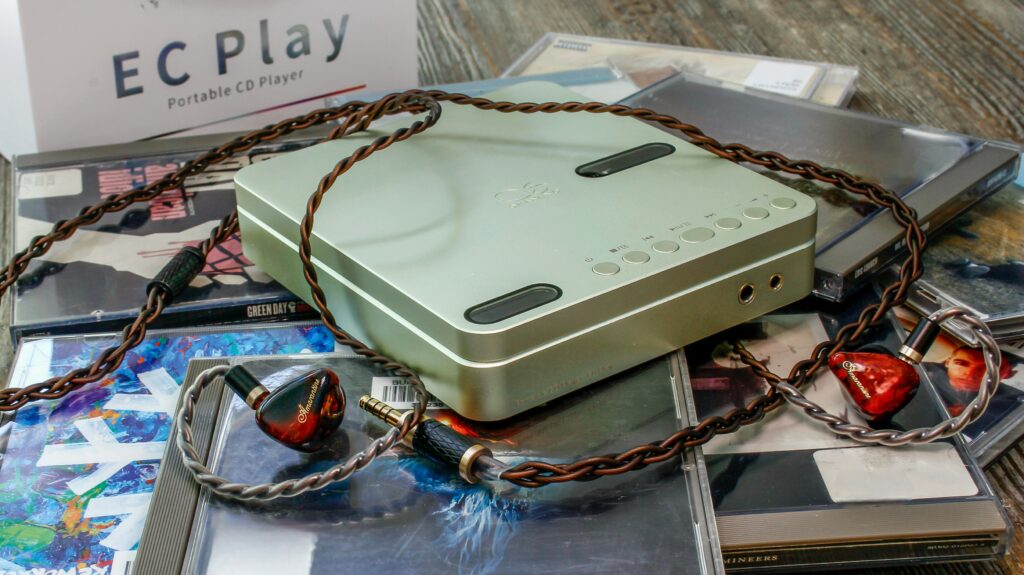
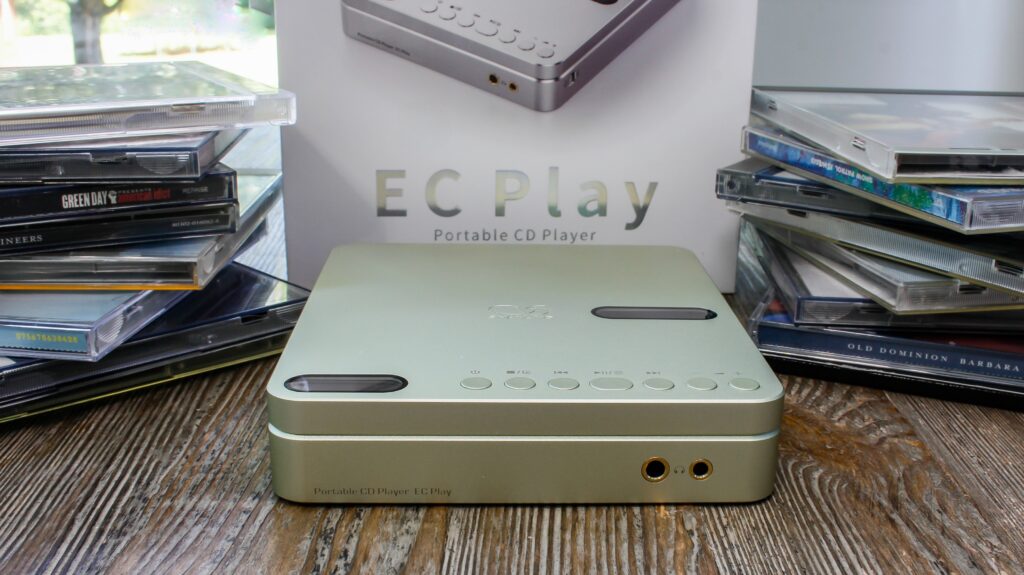
Granted, the EC Play isn’t going to trounce source devices twice its price and it won’t render daps obsolete. I still like dap listening and digital files more, but it’s a nice respite from those digital files to hear the clean playback of a physical CD. Something so nostalgic for me that adds something to the experience. I’m not album hopping like I do on a digital file system dap. I am subtly forced to stay and listen to the CD that’s playing. The inconvenience of changing out the CD every time I want to hear a specific “other track” is both a comfort and an annoyance at the same time. However, it’s also refreshing. It almost forces me to breathe in the music more, the message of the album more, and it helps me to soak in the artist’s intent with more purpose. If that makes sense? Maybe you have to be a 90’s/early 2000’s kid like me to understand. Maybe. I can tell you this, it has only been a positive experience and Shanling has done a great job going back to their roots and crafting a stellar portable CD Player… in my opinion.
Bass Region
The bass region on the ECPlay carries a moderately boosted bass that adds a slightly tighter influence on my music and a touch more of a punchy sound down low. Let’s put it this way, the EC Play isn’t going to provide more bulk, or more bullishness to an already bassy track. To add to that, the EC Play isn’t going to take a bass lite set and all of a sudden make it a bass banger set. That won’t happen. You see, this bass presentation is all about subtle warmth, just enough emphasis, just enough depth of the bass, and just enough rumble to keep a balance and to stay well defined. I’ll say it again, it is very difficult to say how much emphasis is afforded the source itself. I can only relay that the bass region sounds like a more cleanly displayed version of the tracks I typically test and each note usually has a slightly denser punch. Especially on tracks with fast, tight, and hard lined bass notes. Something like “Billie Jean” by Weezer where the Letshuoer Mystic 8 doesn’t sound more earthy, atmospheric, bulbous (which would be out of character), and its bass doesn’t carry any more warmth. That said, I can clearly hear those kick drums punch with more of an exact acute weight from other sources (not all of them). Very nice to hear by the way.
Midrange
The EC Play is not one which is going to massively reshape an iem’s tuning. Most of the music we hear in any song comes from the midrange and if there was to be some huge difference between the EC Play and other sources it would make sense to hear it in the mids. Tonality wise I hear a mostly neutral take on my music with a slightly boosted upper midrange. I will tell you that note weight does get a slight boost, and the sound is clearly more harmoniously musical than clinical or dry. At least that’s the influence that I hear. I hear no papery or dry vocals unless I am listening with an obviously dry and clinical set. For the most part vocals and instrumentation have a smooth enough cadence without added glare or reinforced sharpness. I can say with complete assurance that the Shanling EC Play and the Shanling MG600 are a perfect match. The EC Play doesn’t boost the already boosted upper mids of the MG600 past comfort. Instead, it precisely sculpts each note without adding luminance as there is a definite ceiling on the brilliance of the upper mids. Same can be said of the Simgot EA1000, the brightness of the EA1000 isn’t forced brighter. In fact, to my ears each set found a nice home in the EC Play with solid timbre and a very clean-lined rendition of what I expect to hear out of those sets. The EC Play will improve (to a slight degree) stuff like; details, sound separation, and it will usually enhance the dimensionality of the midrange sound field as well. All-in-all, the midrange is the best part of the EC Play. The mids are slightly more about tone-flow, fluidity, and natural note density, rather than the dryer, or colder side of neutral style playback, and nothing ever sounds sterile.
Treble Region
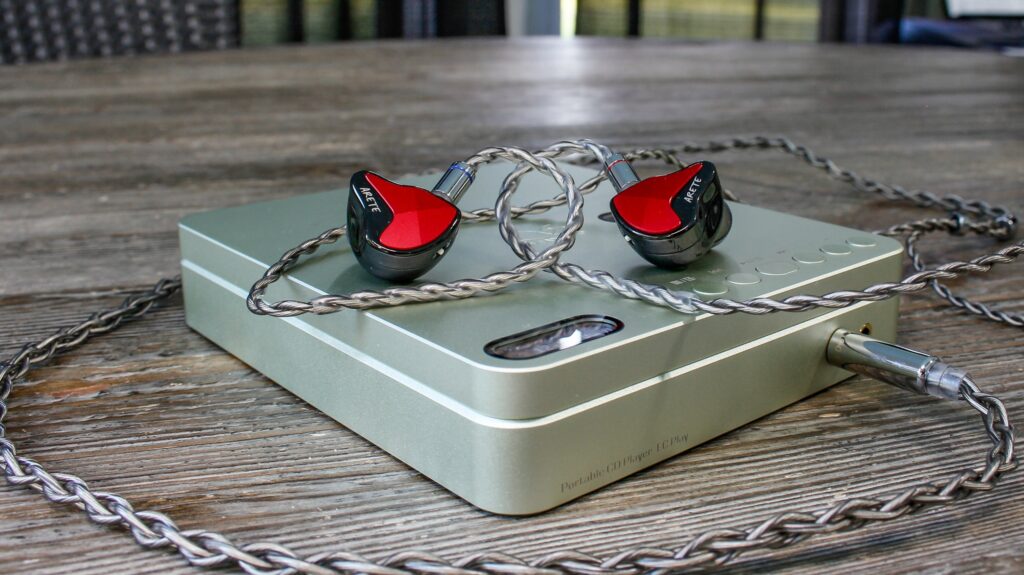
To my ears and my best judgment, the treble is probably best characterized by its smooth, semi-brilliant, and well extended upper treble. Again, this is not a treble that is going to add acute super sharp note bite, laser edge enhancement, or ultra-focused treble punch. Rather, the crispness that any iem already has (tuned to have) is simply reinforced with clean-lined note contours and a “mild” bite and a “moderate” dynamic treble punch. Again, cadence remains on the smoother side and leaves most of my iems/headphones untouched, uncolored, and most enhanced elements of the EC Play’s treble come in the form of clarity, black background, and a more lifted top end. Take a set like the Ziigaat Arete II which isn’t what I’d call some treble king set or anything. The EC Play always renders its treble in a very rhythm and flow-first and cadent way; it doesn’t boost the brilliance but enhances the tidiness of each note with the Arete II. I hope that makes sense. The actual contour, the definition, and clarity of each note, along with the separation of each note is clearly uplifted in comparison to other sources. I think that clarity is a direct response from the CD player tech itself along with the CS43198 dac chip and clean amp section. So, to break that down, when listening to the EC Play, don’t expect some Jupiter sized hike in treble sizzle and radiance. There is some illumination, but mostly the EC Play will help define notes, add focused clarity, and it’ll add some air while remaining porcelain smooth. I like it.
Technicalities
As I’ve already stated the Shanling EC Play will definitely help to make those tiny details a hair more evident. Just not in the traditional way of boosting upper ranges to get there. This is the CS43198 doing what the CS43198 does. However, Shanling added just a hair more warmth for a slight musical lean. Now, sound separation is solid. The EC Play will likely help your iems and headphones to separate elements of the stage nicely. Is it better than other sources in its range? Eh, maybe. I don’t really think the EC Play is necessarily fighting against many other sources either though. Anyways, you hear nice note separation, and you’ll hear better air around those elements than some other devices. As far as imaging persuasion, the EC Play is like any other source where much will rely on your iems/headphones as it is very difficult to say that the EC Play helps in this regard. I can tell you that it definitely doesn’t hurt with sound imaging. Also, the stage feels and sounds more open. Again, that openness is not the result of a boosted treble in my opinion. I actually find the cleanliness and clarity of the EC Play does most of the leg work. I wouldn’t call the EC Play some stage enhancer or anything, but there is a nice uptick in dimensionality. Overall, the technical stuff is handled very well by the Shanling EC Play and shouldn’t be an issue for anyone.
Last Words on the Shanling EC Play
I went into this review period wondering why I was even doing it. Not that I doubted the skill, artistry, and abilities of Shanling either. It was more a question of listening style and how that particular style of listening would translate into my daily life. Don’t get me wrong, I was surely intrigued at the thought, but I didn’t know if I’d be willing to embrace a portable CD Player such as the EC Play. I began somewhat hesitantly, but by the end of this review I really began to enjoy this style of listening, once again. I’ll always put daps or portable dac/amps first, and my digital collection is one of my most prized possessions. However, I never could’ve known that I’d have as much joy as I’ve had while listening to the Shanling EC Play. I know that none of you care how I feel about this small (fairly insignificant) journey, lol. But I think that others will be in a similar position, and they too might find joy that is similar to mine. It’s always about the music folks. All of this, this hobby, the social media posts, the long blabbering 14,000-word reviews of mine. For me, it’s about music and how best to get that music into my ears while feeling engaged, emotionally invested, and not killing my pocketbook (or yours) in the process. The Shanling EC Play undoubtedly represents one of the more rewarding ways of getting that music to my ears. It harkens back to the days when an album meant something. You’d go on a journey with the artist from beginning to end. The Shanling EC Play provides that to me. I obviously cannot know if the EC Play would be that for you as well… perhaps. Or maybe you have already been on the CD Player train for a while now and swear by some other brand’s player. The only thing that I can do is tell you what I know and what I’ve experienced. All things considered, there’s no way I could end this review without saying that the Shanling EC Play is most certainly worth every last penny that Shanling is asking. My opinion of course.
The Why…
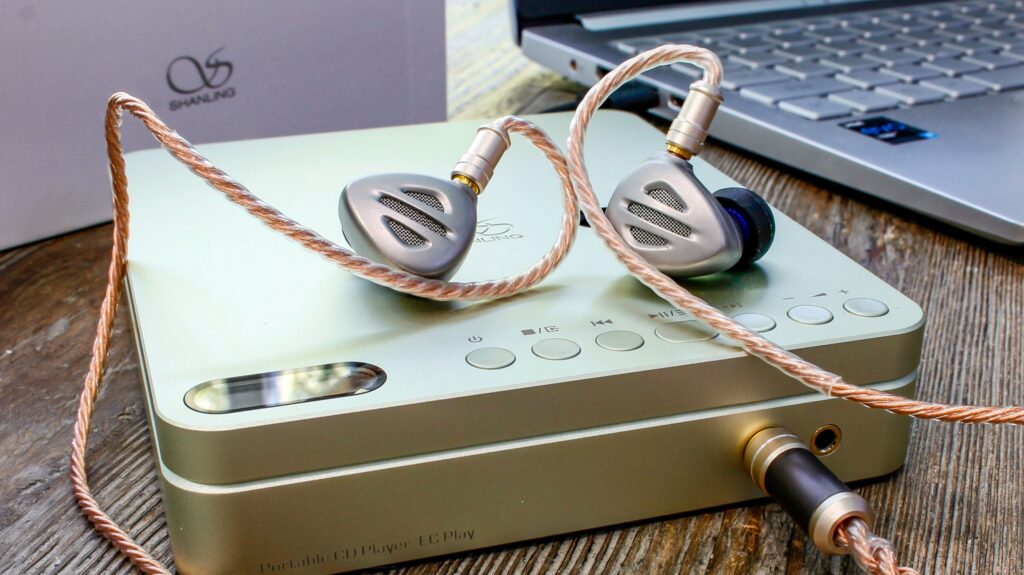
Because the EC Play is made heads and shoulders better than any portable CD Player that I have been able to get my hands on in the past. Built entirely out of lightweight aluminum and sleek in design. That clean look, simple, minimalist, and retro-modern feel is dope. The functionality, and ease of use is something that I like best. Friends, understand that the largest issue for personal (portable) CD Players back in the day was always constant skipping, song stops, you couldn’t move too fast, stuff like that. Not with this player. Shanling has obviously made a very well built and advanced portable CD Player in the EC Play. I can only imagine how amazing their more expensive players are?! Anyway, it’s an easy device to learn and operate. Simple settings menu, easy to dial in the sound as well. The small screen is very helpful as well. I feel that the 700 mW is far above what I imagined this player would have (output wise) and I like the usage of the low-cost and low power consumption Cirrus Logic CS43198 Dac chip. To keep costs down and to do so with one of the better chips on the market for that purpose is refreshing. The Bluetooth 6.0 functionality works perfectly (at least for me) too. I’m not going to rehash everything that the EC Play features here but when explaining “why” I feel a device is worth it’s cost I want to at least give you an overview. With that thought in mind the true worth of any musical device should always come down to sound.
That Sound!
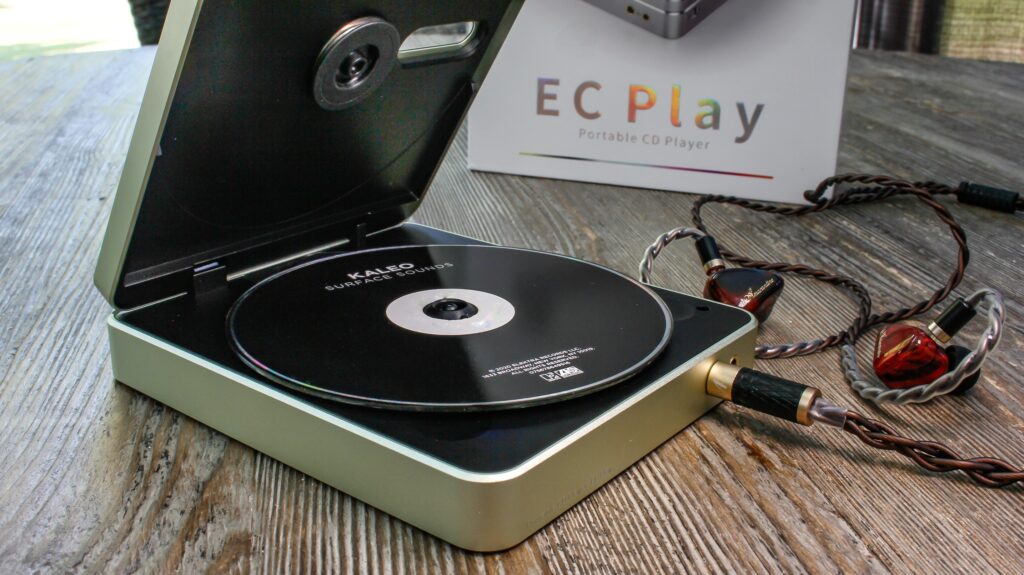
For me it’s the actual sound of the EC Play and how that sound filters through my iems and how emotionally engaging that sound is, for me. I suppose with this device the sound directly correlates with the overall “experience” of listening to CD’s, actual albums, and it’s simply more of an investment into the artistry within music. Still, the actual tonality, timbre, the cleanliness of playback, the black background, the melodic tilt to the sound is what has me sold at $199. Such a nice balance of musicality and clean-lined precision without anything exaggerating the harsher areas of the mix. I like the clean and punchy nature of this device. Add to that, the crystal-clear playback of a physical CD is awesome. Maybe it’s a placebo effect for me, I don’t know, and I don’t care. What matters to me is the experience and how that experience makes me feel. Without going into the full soundscape again I will simply say that Shanling did not disappoint with the EC Play tuning. Easy rec.
Conclusion
To conclude my full review and feature of the Shanling EC Play, I most definitely have to thank the good folks over at Shanling. Friends, I work with many brands, many online stores, and it is not always easy. Shanling makes things easy. A high-class brand who understands that a good review (not saying mine is good) takes time to develop. They have never once even whispered to me to… “hurry up” and have never asked for a timeline for my review. That is worth its weight in gold for me. If other brands were smart, they’d take note. A true experiential review takes time and always the more time spent equals a better understanding of the product. I will never receive a product today and review it tomorrow. At least 3 weeks. Shanling understands this because they have proven it time and time again with patience and again… with class. So, a huge thank you to Shanling. I also want to thank you (the reader) for taking the time to actually read my thoughts, and I do hope that it has helped you. You are one of the main reasons as to “why” I do this friends. Sure, I love to have a creative outlet to explain this hobby that I enjoy, but hearing from you that my words have helped (in any way) is always a very satisfying feeling. So, I hope I was in depth enough and I hope I’ve answered any questions you may have. Thank you very much for reading.
Different perspectives
One thing I implore out of all of you is to seek out other perspectives about the Shanling EC Play. Friends, this device is a solid purchase, but don’t just take it from me. I am asking that you read other thoughts and opinions from other reviewers so that you can get a better idea of what the EC Play is like and if it’ll fit your own personal needs and preferences. It’ll only help. We simply aren’t all the same and each of us has been down a different journey in audio, we’ve got different gear, different libraries of music, different hearing abilities and we don’t all have the same likes and dislikes. So please, don’t simply stop at me, check out some of the other reviewers out there as well. Please take good care, stay as safe as possible, and always… God Bless!!
EC Play Pros
-Build Quality is a Shanling trait and the EC Play is built very well
-I happen to like the retro-modern and sleek design
-Bluetooth Receiver and Transmitter Modes work well, no issues
-LDAC
-Many different modes of listening
-700 mW of max power is fantastic for a portable CD Player
-Easy to understand controls and menu navigation
-Fantastic for sensitive iems, low output impedence
-No skips from the anti-vibrational tech
-Huge 12-hour battery life
-Nicely balanced sound, no exaggerated areas of the mix, low coloration
-Punchy and tight bass influence on my iems/headphones
-Melodic, airy, and also very clean midrange
-Non-fatiguing treble with nice extension and a smoother cadence
-Should reinforce good micro-detail retreival
-Stage is fairly spacious for a source device, shouldn’t make your iems feel more closed-in
EC Play Cons
-For such a dope player, it is still considered niche (is this a con?)
-Bluetooth Transmitter Mode is limited to the SBC audio codec
-Small screen obviously isn’t as information-rich as a typical dap
-You are limited to CD listening unless you use in USB Dac Mode
-Anyone who streams music is pretty much out-of-luck with the EC Play
-The EC Play sounds awesome imo, however, it doesn’t carry that typical Shanling house sound and flavor as much as other Shnaling devices



No Comment! Be the first one.