




















































Shanling UA6 II Review
Intro
Hello, this review and feature covers the latest from the audio brand Shanling named the Shanling UA6 II ($209). When I found out Shanling was releasing a follow up to my much beloved Shanling UA6 I was instantly intrigued. Just so you know, I actually reviewed the Shanling UA6 all the way back in May of 2025 and have constantly used it as part of my everyday rotation. From my perspective, the UA6 was one of those dongle dacs which completely set itself apart from the continuously updating and crowded market of dongle dacs. It had an internal battery, 360 mW of output power, and the best quality was that it carried four Cirrus Logic CS43131 dac chips. So, imagine my surprise when Shanling got a hold of me to check out the next iteration? However, not only does the UA6 II come with all of the bells and whistles of the previous UA6 (except the internal battery, why?), but this time around Shanling did something which has never been done; they added eight Cirrus Logic CS43131 dac chips. Friends, my mind is still blown. Eight chips, four on each side separating the left and right channels, no channel bleed, preventing distortion, suppressing even more noise and they massively cut down the size of the UA6 II from the UA6 among other upgrades. This is all that I can see while I await the arrival of this little beast. I love to learn as much as I can while I patiently wait to receive every product. I will say that it’s not very often I’m checking tracking like I am with the UA6 II.
Table Of Content
- Intro
- Shanling
- Reviews
- The UA6 II Arrived
- Non-Affiliated Purchasing Links
- Packaging / Accessories
- Unboxing
- Cable
- Case
- 🎵 Shanling UA6 II Specifications
- Build / Aesthetic / Internals / Controls
- Build Quality
- Design / Aesthetic
- Internals
- Controls
- Features
- DAC Chips
- That Screen
- Output Power
- Eddict Player
- Digital Filters
- Magnetic Case (sold separately)
- UAC1.0 & UAC2.0
- Quad Dac Chips or Octo Dac Chips
- Quad Dac Chips or Octo Dac chips cont…
- Sound Impressions
- Source Reviews
- What’s It Sound Like?
- Timbre
- Sound Influence
- Examples
- Bass Region
- Bass Cont…
- Bass in the Quad Dac Configuration
- Midrange
- Mids Cont…
- Midrange in the Quad Dac Configuration
- Treble Region
- Treble Cont…
- Treble in the Quad Dac Configuration
- Technicalities
- Soundstage
- Separation / Imaging
- Detail Retrieval
- Comparisons
- Shanling UA6 ($159)
- Non-Sound Stuff
- Sound Differences
- Final Thoughts on This Comparison
- Shanling H0 ($109)
- Non-Sound Stuff
- Sound Differences
- Final Thoughts on This Comparison
- Shanling UA7 ($269)
- Non-Sound Stuff
- Sound Differences
- Final Thoughts on This Comparison
- Last Words on the Shanling UA6 II
- The Why…
- Conclusion
- Other Perspectives
Shanling

What can be said that I haven’t already said in many reviews thus far about one of the more famous and prolific audio brands worldwide. I actually just reviewed their awesome little dap, the Shanling M0 Pura. Of course, just like that review I am once again taken aback at just how old Shanling truly is. Did you know that they began their audio brand journey all the way back in 1988! If you don’t want to do the math, I got you, that’s 38 years of experience making LED displays, graphic equalizers, amplifiers, dac/amps, CD Players, stereo units, digital audio players, record players, dongle dacs, and even some of my favorite iems among many other products. This is a brand that moves with the times and has the versatility to do so at a high level. With the number of highly qualified people who call themselves Shanling employees, their own manufacturing plant (yes, they make their parts), and a good collaboration/partnership with OEM/ODM… the sky is the limit. Truly a world class brand who make world class audio gear. Friends, I am not saying this to puff up Shanling either as I am genuinely a fan (yes, I have fan bias, who cares?). But also, I like to speak on brands who actually deserve the adoration that they get. We are talking about a huge audio corporation which caters to venues worldwide. One thing is clear; if I see the name Shanling attached to a product I know that this product went through rigorous testing, it’ll have years of experience in its creation, and that product will have some attribute or quality which sets it apart. Shanling cares about market share, and they care about what they put out into that market. This is a business folks. However, why does it feel like the Shanling business is closer to the average consumer than further away?
Reviews
Now, I’ve personally conducted a handful of Shanling product reviews over the years, and each one was a product that I not only enjoyed but also recommended. The first Shanling review that I ever completed was of one of my absolute favorite mid-fi ($499) single dynamic driver earphones called the Shanling MG600. Made of solid Japanese wood, great tuning, and still one of the better single DD sets under $500. Next was the Shanling Tino which is a dual DD that I and others praised to the moon. Still a highly qualified set that stands easily against even today’s competition. Then I reviewed one of my favorite Bluetooth dac/amps in the Shanling UP6 which is a powerhouse of a device and sounds very nice. Then came my much-adored Shanling UA6. The awesome predecessor of the device I’m reviewing today. Also, you all know how I feel about that dongle dac. Next was what I feel is the best dongle dac under $300 in the Shanling UA7. Tons of power, JAN6418 dual vacuum tubes, and a ton of features. Also, it’s one that I always have in my rotation. Right there next to my UA6. After that I reviewed the Shanling M0 Pura which is a tiny dap that sounds fantastic and functions far better than I ever would’ve imagined. Then I reviewed one of the coolest products that I’ve reviewed in quite some time, the Shanling EC Play. This is a device which brought back the joy of listening to physical CDs. Also, it has huge output (700mW), never skips, and is made very-very well. And that brings us to the device I’m reviewing today. The point of this is to show you that Shanling has been up to some cool things and hasn’t seemed to have any misses. Here’s to many more years reviewing Shanling products.
The UA6 II Arrived
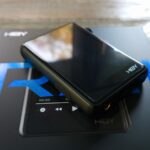
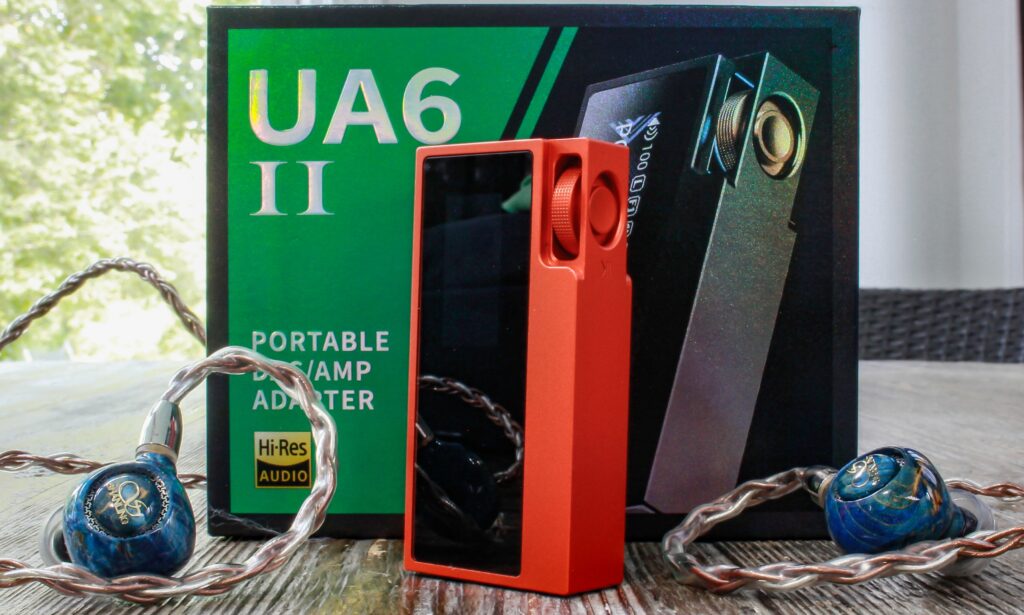
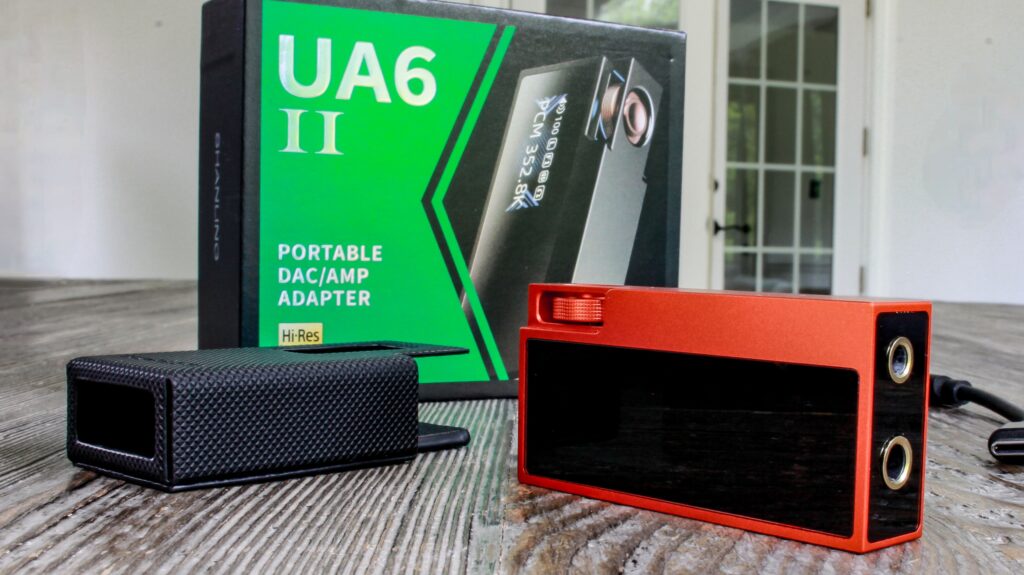
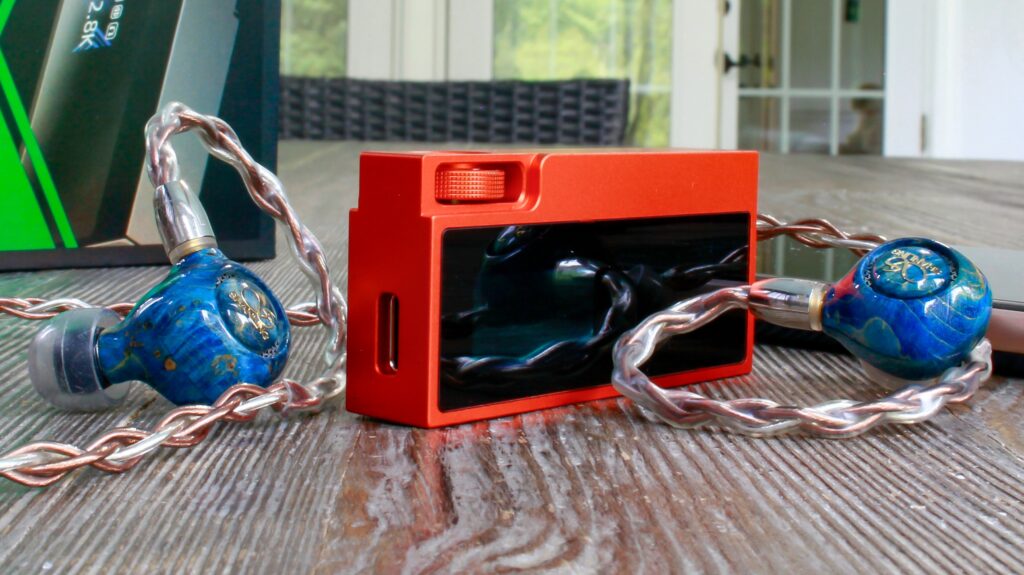
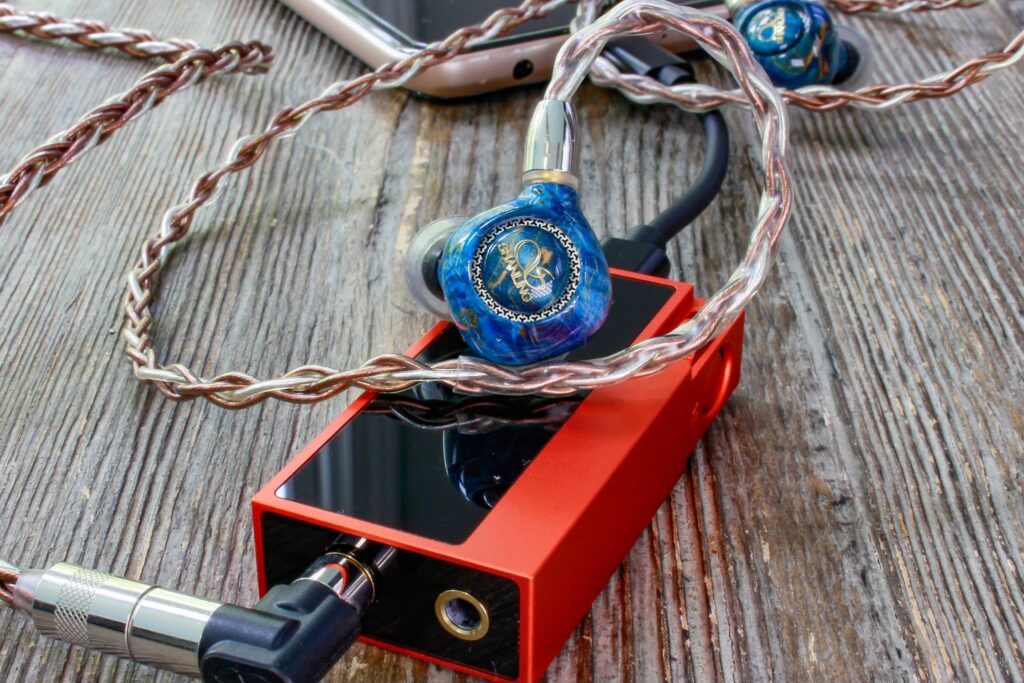
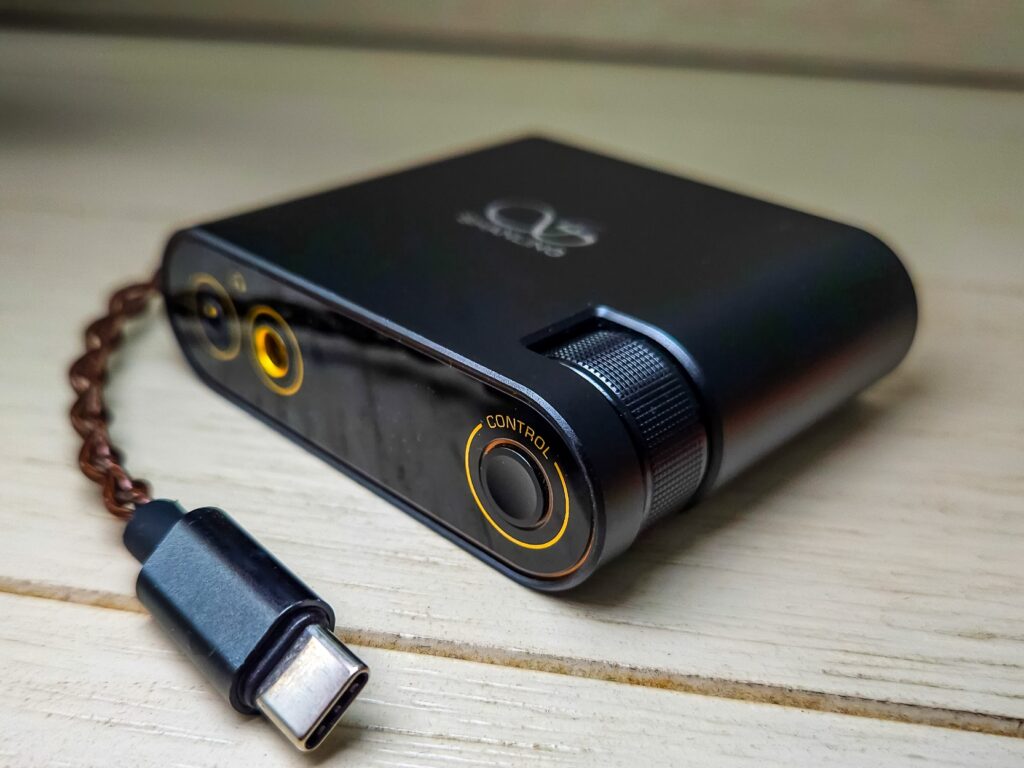
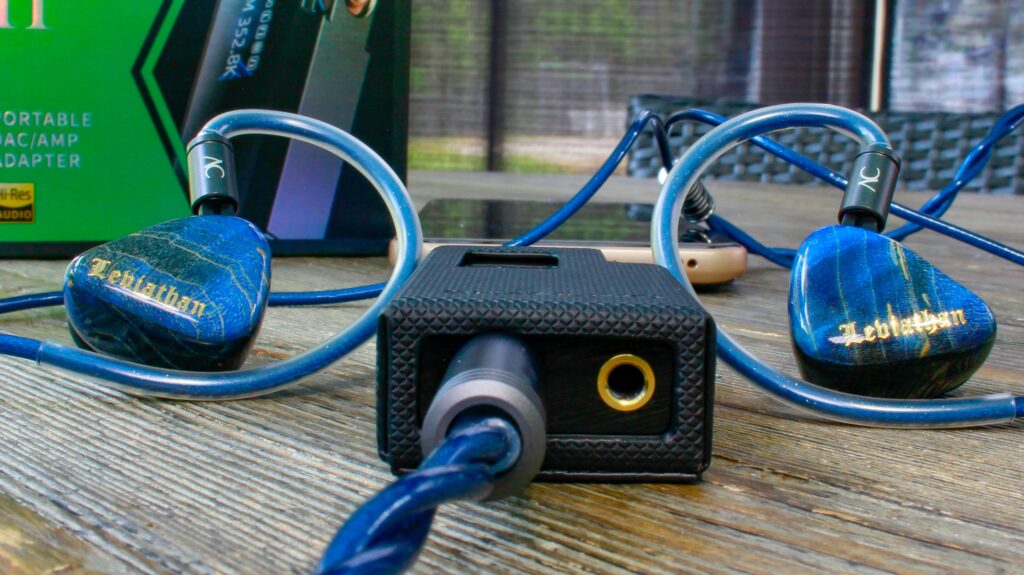
I was waiting for the UA6 II like I used to wait for Christmas and when it actually arrived at my doorstep I was surprised at just how much smaller it is than its predecessor. Four more dac chips, a volume wheel, a cool magnetic black case to stick to the back of my phone, a dope little black case, and the same design language seen on the awesome UA7, same bright orange colorway too, just in a tinier package. With that said, I immediately plugged the ODA Leviathan T800 into this little beast and instantly found that the timbre and tonality were much closer to organic and musical, adding such a nice influence on my iems. I am very happy to get to go through the reviewing process with the UA6 II and to learn all of the little nuanced features and tuning differences in this device. With that said, I’m ready to get this one underway. So, without further ado, the Shanling UA6 II…
Non-Affiliated Purchasing Links:
Packaging / Accessories
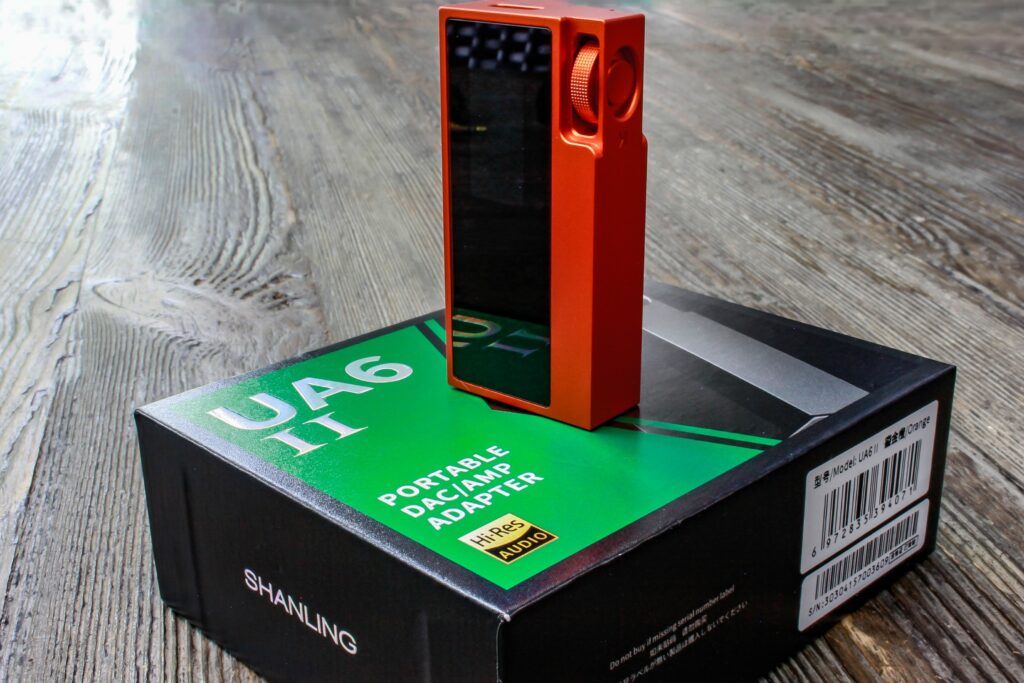
Unboxing
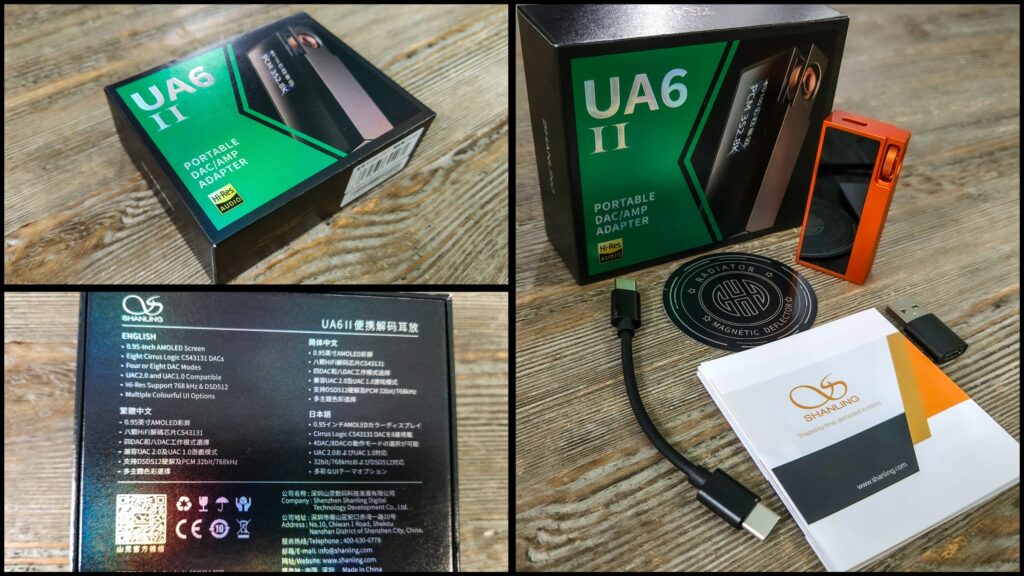
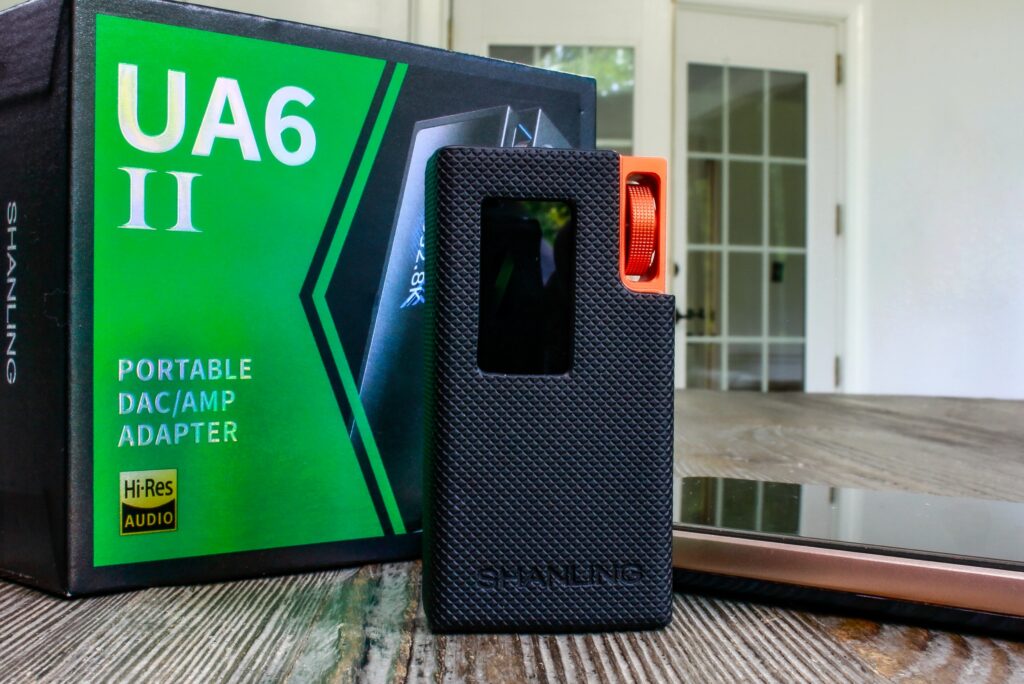
The Shanling UA6 II arrived at my home in a smaller box, which I expected. It carries a picture of the UA6 II on the cover and has some specs on the back. Nothing unusual here. Take off the box top and right away you’ll see the gorgeous UA6 II sitting all dapper in foam cutouts. Underneath that layer of foam is where the cable is hiding as well as the USB-A to USB-C adapter and a round metal piece to stick on the back of your phone which I’m assuming is for the UA6 II case. There’s also a manual as well. However, the unboxing is exactly as everyone should suspect as you will never have a huge accessory pool for a source unboxing. Anyways, not bad Shanling.
Cable
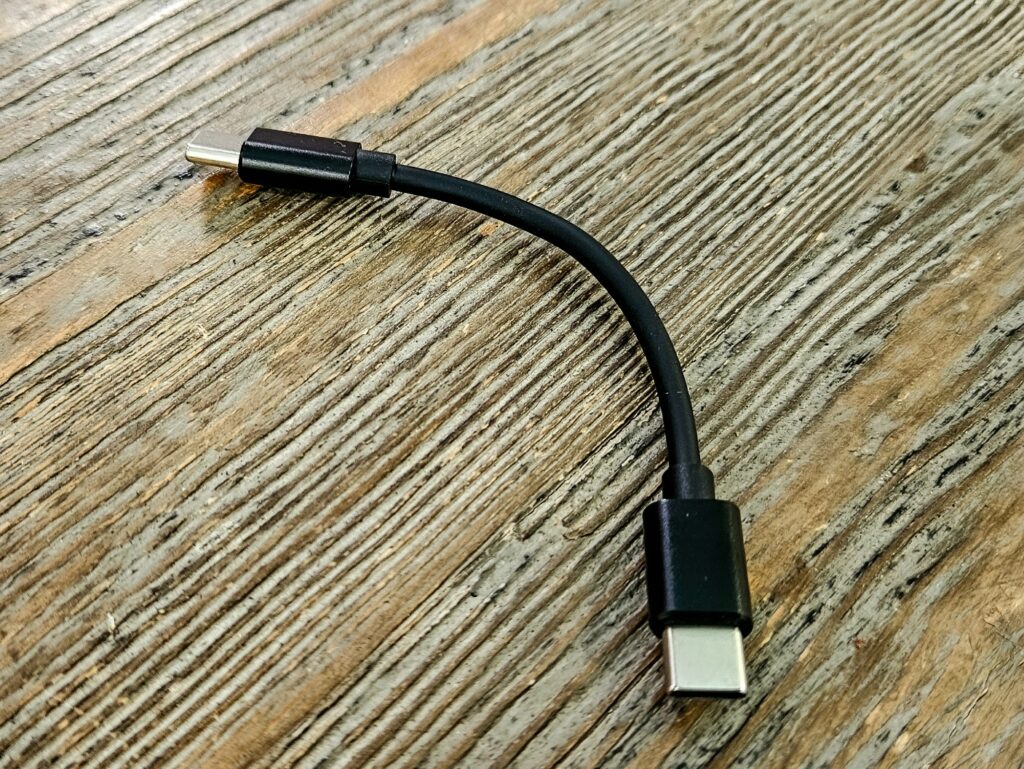
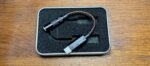
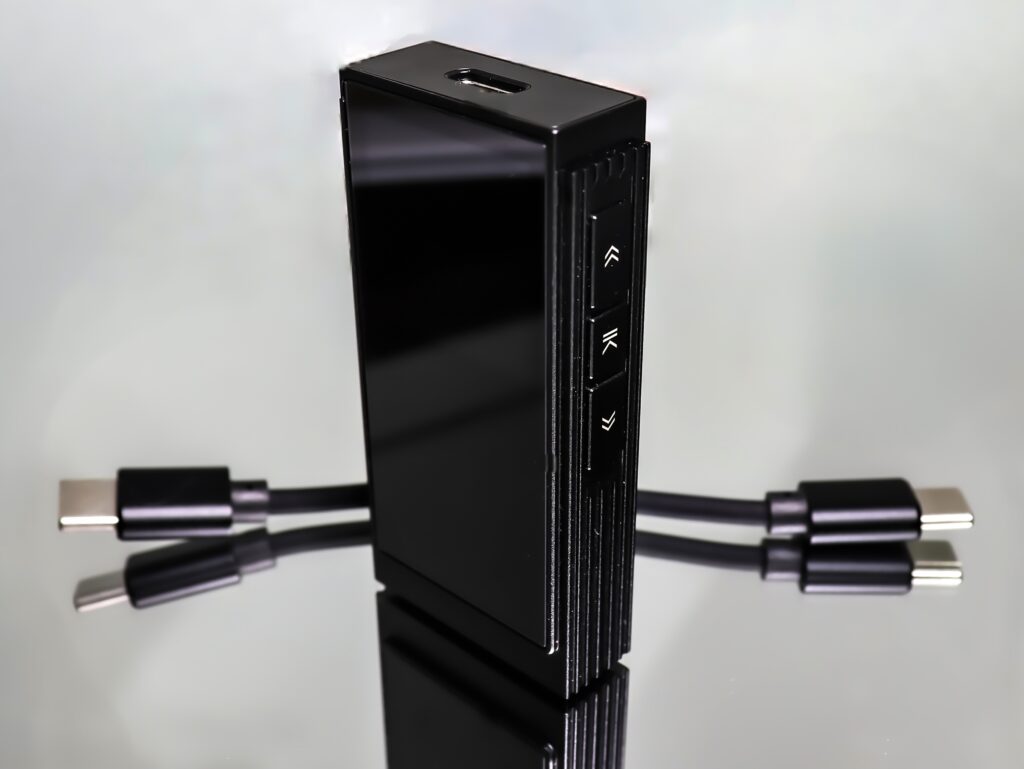
The cable provided is a shorter (like all dongle dacs) type-c to type-c cable, all black, simple. However, Shanling did make sure to add in a cable that is made well. From what I was told it is a short (4”) high-purity oxygen-free copper cable which was provided to pair well with the UA6 II. It is also noted that the conductors aren’t simply cheap tinned-copper or any run-of-the-mill CCA leads, but instead they are also made entirely out of oxygen-free copper as well. This is said to keep resistance low, better durability, as well as a more stable power delivery in comparison to regular cheapo cables typically provided with these devices. Also provided in the package is a basic USB-A to USB-C adapter which can be used with the included cable to connect to older desktops, laptops, etc. which only have USB-A ports. The cable itself is nothing to write home about or anything, but it’s included, so I’m going to talk about it.
Case
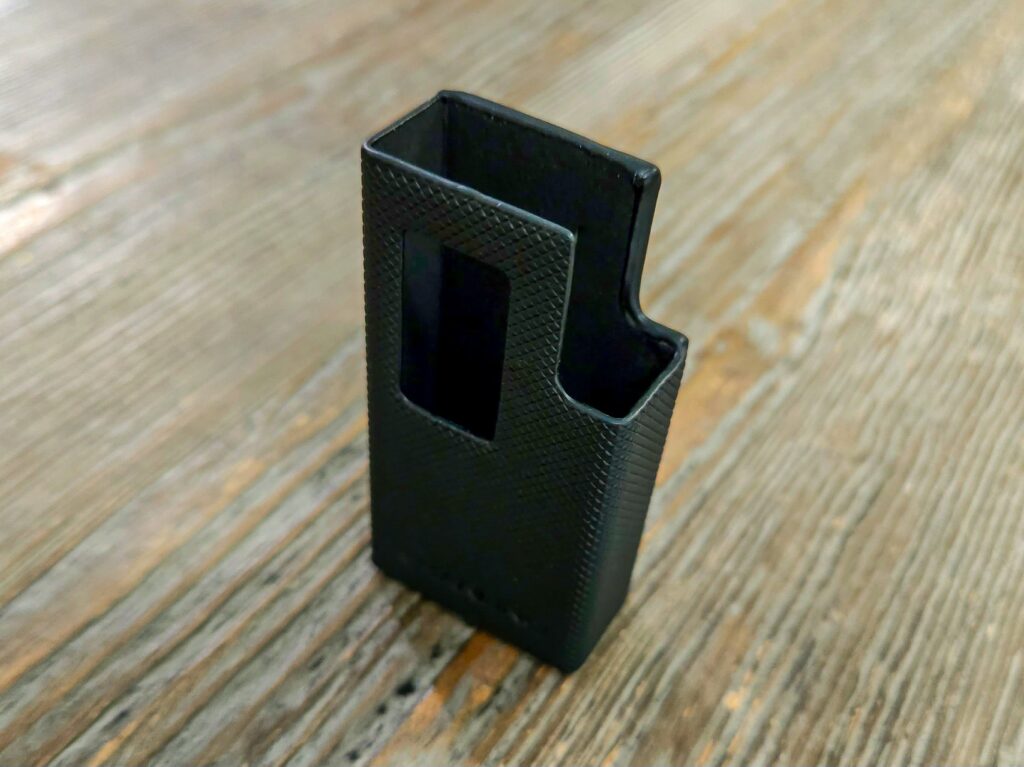
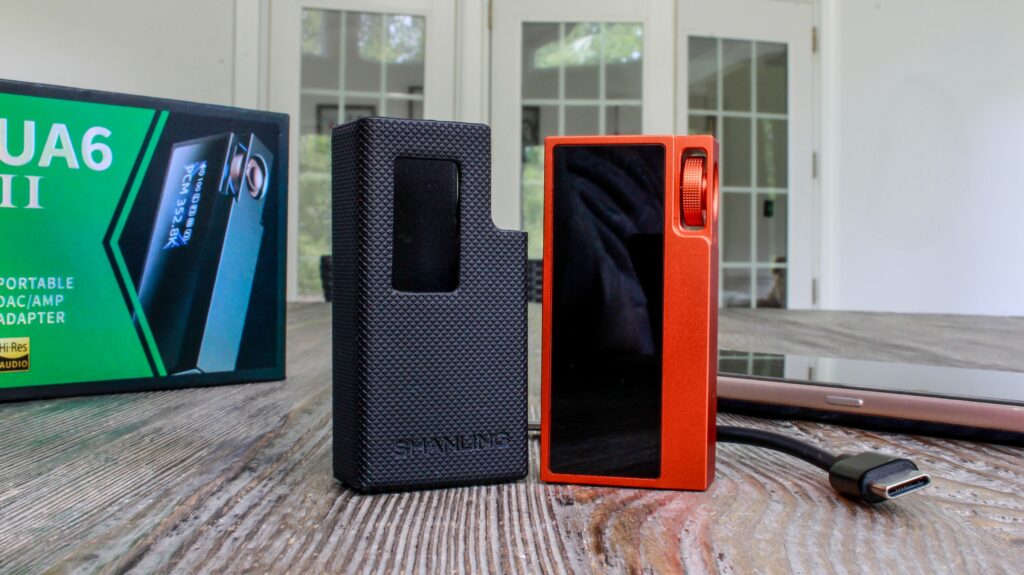
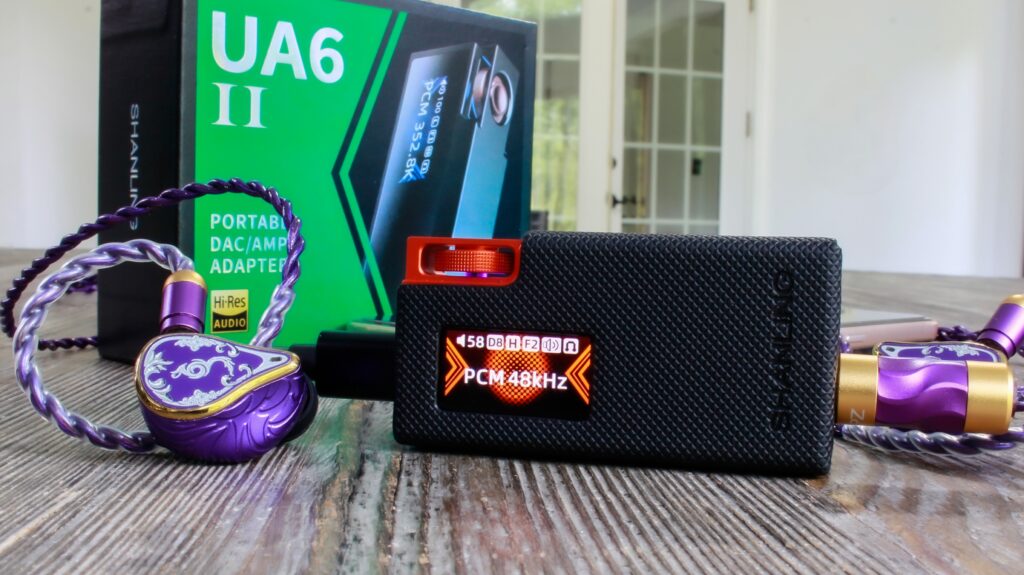
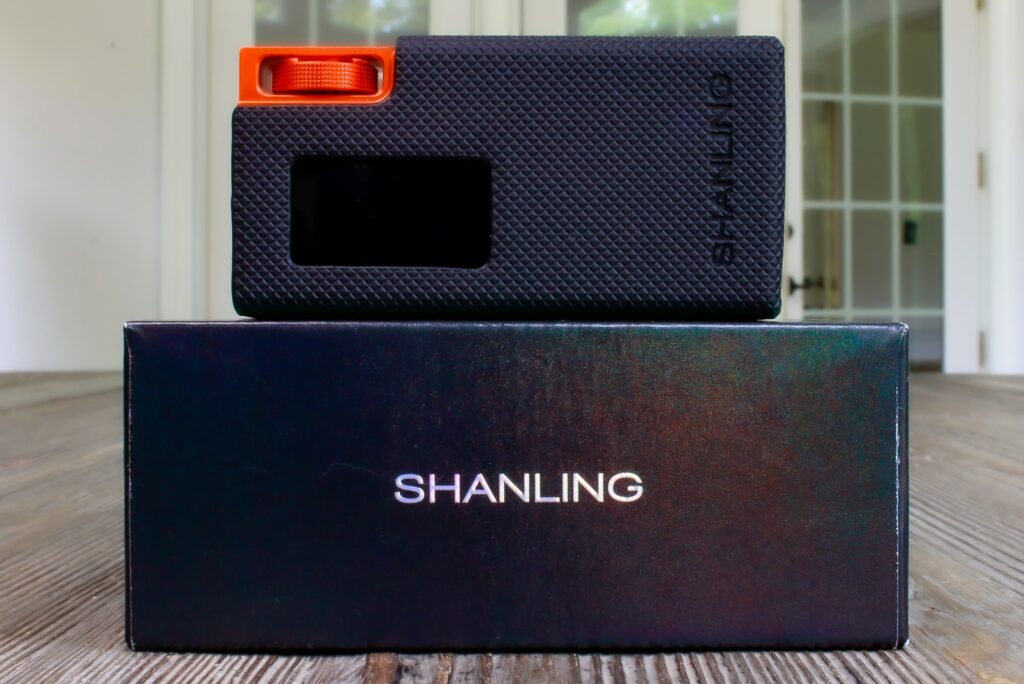
Shanling also did a very cool thing and sent me the case for the UA6 II. It’s a dope little black case with a cool trick that I absolutely adore and I’m so grateful that Shanling thought of this. First off, it is a slick looking little faux leather case that fits tightly and has cutouts for all buttons, the screen, and all ports. However, the case also has a magnetic backside which can stick to the back of your phone, and it does so very-very well. I’ve used this thing for weeks now and I couldn’t be happier that Shanling sent it as well. You can purchase the case at either Amazon ($18) or Aliexpress ($19.80). If you ask me that price is great for the convenience of it. The case comes in either black or bright orange which matches each colorway of the UA6 II. Shanling did the cool thing and had the presence of mind to send me the black case which looks dope contrasted against the bright orange of my UA6 II. It’s the little things people.
🎵 Shanling UA6 II Specifications
━━━━━━━━━━━━━━━━━━━━
🔹 DAC
– 8 × Cirrus Logic CS43131
– True Octuple DAC Architecture
🎼 Audio Support
– PCM: Up to 32-Bit / 768 kHz
– Native DSD512
🎧 Headphone Outputs
– 3.5 mm Single-Ended
– 4.4 mm Balanced
⚡ Output Power
– 4.4 mm Balanced: Up to 365 mW @ 32Ω
– 3.5 mm Single-Ended: Up to 107 mW 32Ω
🎼 Audio Specs
–Dynamic Range: 133 db
-Signal-to-Noise Ratio: 133 db
🖥️ Display
– 0.95″ Full-Color OLED Display
🎛️ Controls
– Hardware Volume Control
– High / Low Gain
– Digital Filter Selection
– Channel Balance
– Screen Brightness
– Standalone On-Device Menu
🔌 Connectivity
– USB Type-C
– Plug & Play Operation
📱 Compatibility
– Android
– iOS
– Windows
– macOS
🏗️ Internal Design
– Fully Balanced Circuit
– Ultra-Low-Noise High-Current Power Supply
– Independent Multi-DAC Configuration
📦 In the Box
– USB-C to USB-C Cable
– USB-A Adapter
– Quick Start Guide
– Warranty Card
Build / Aesthetic / Internals / Controls
Build Quality
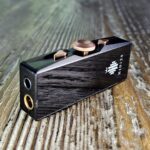
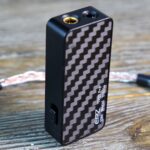
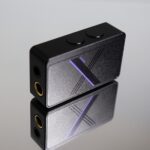
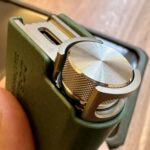
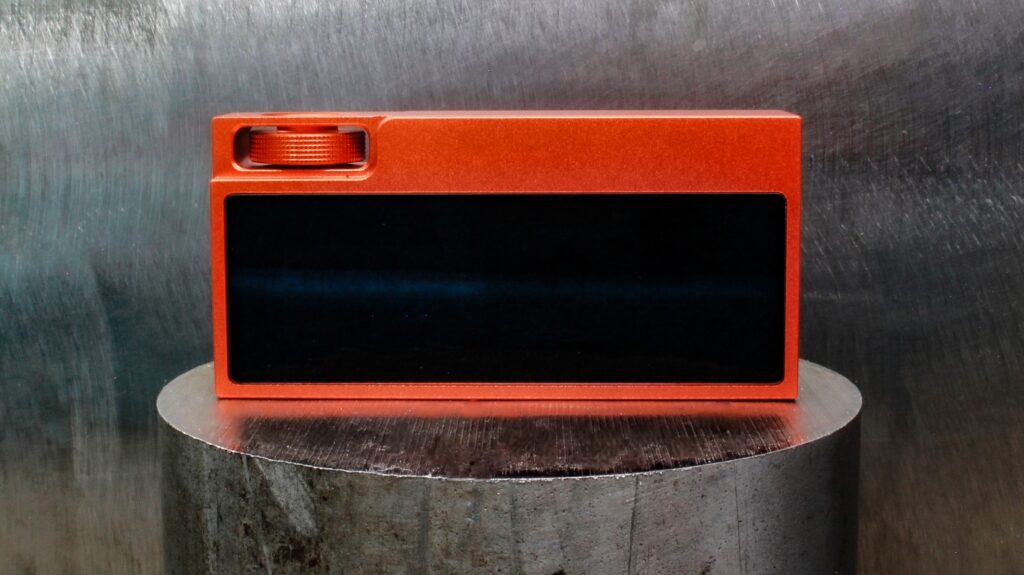
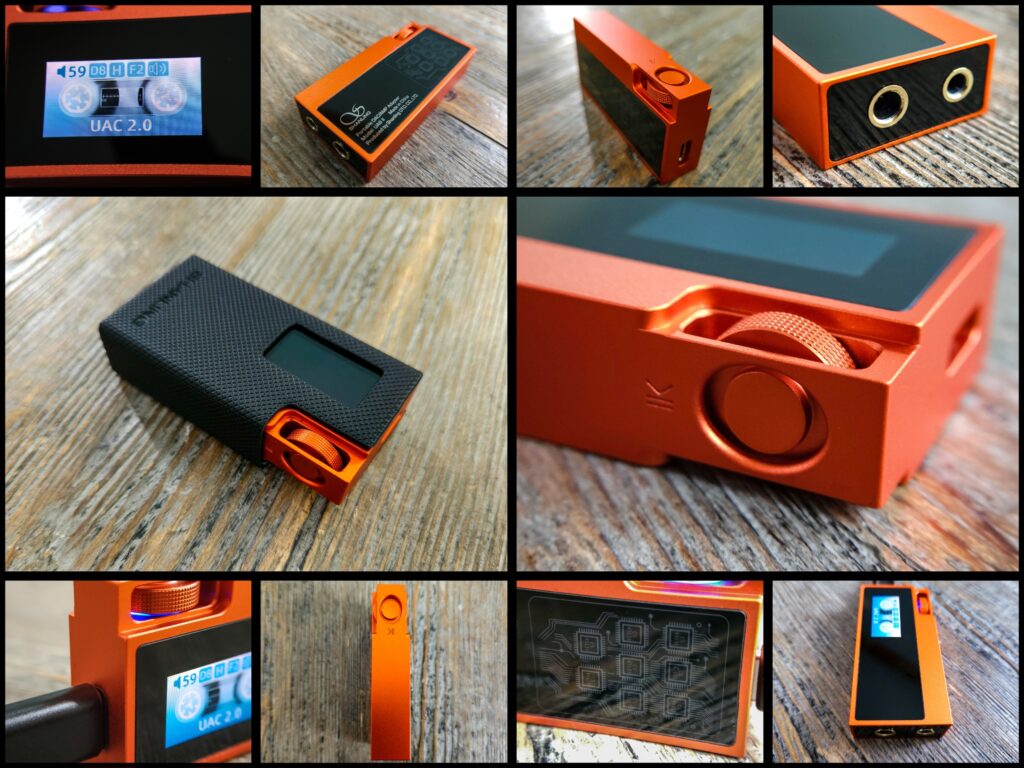
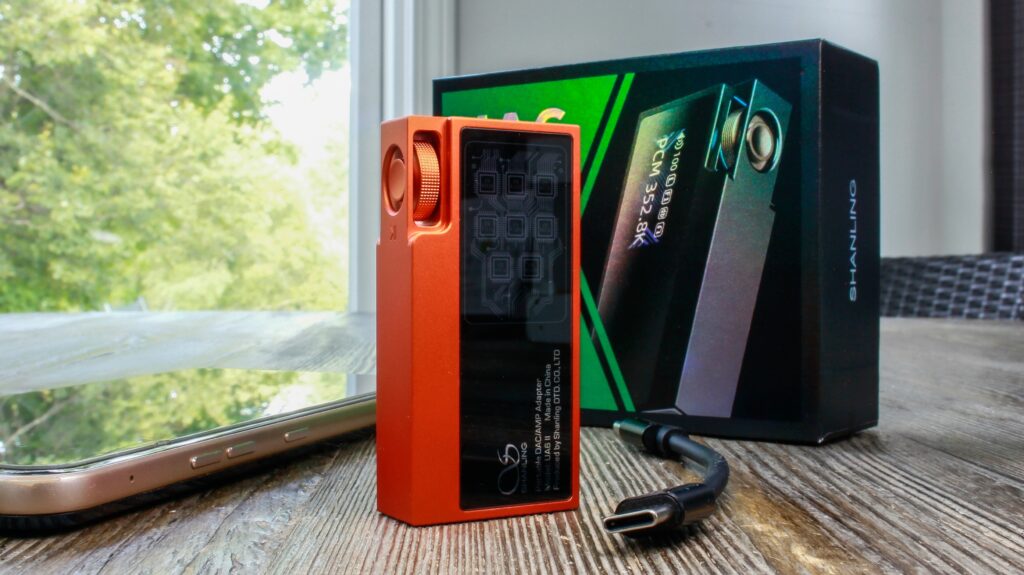
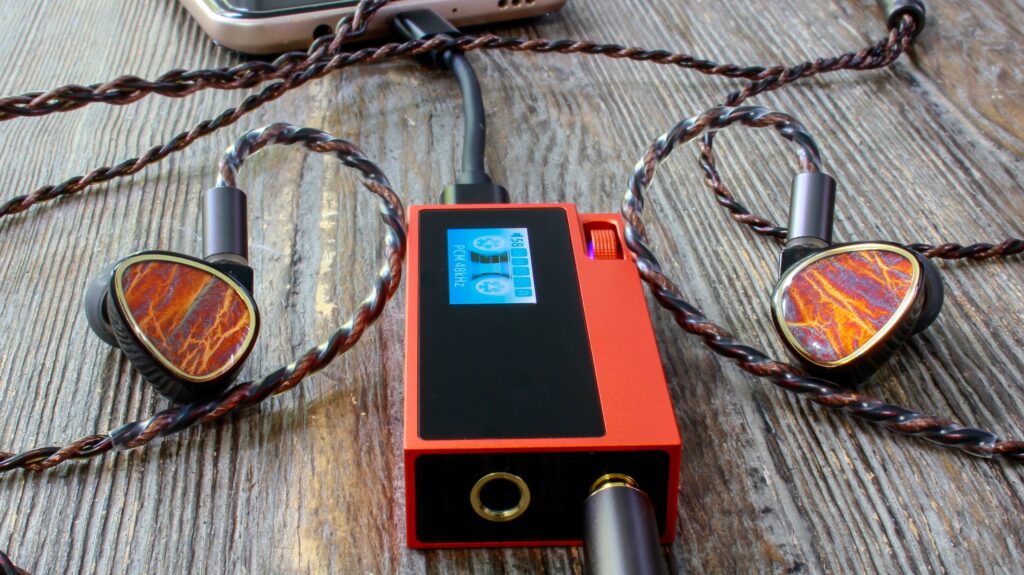
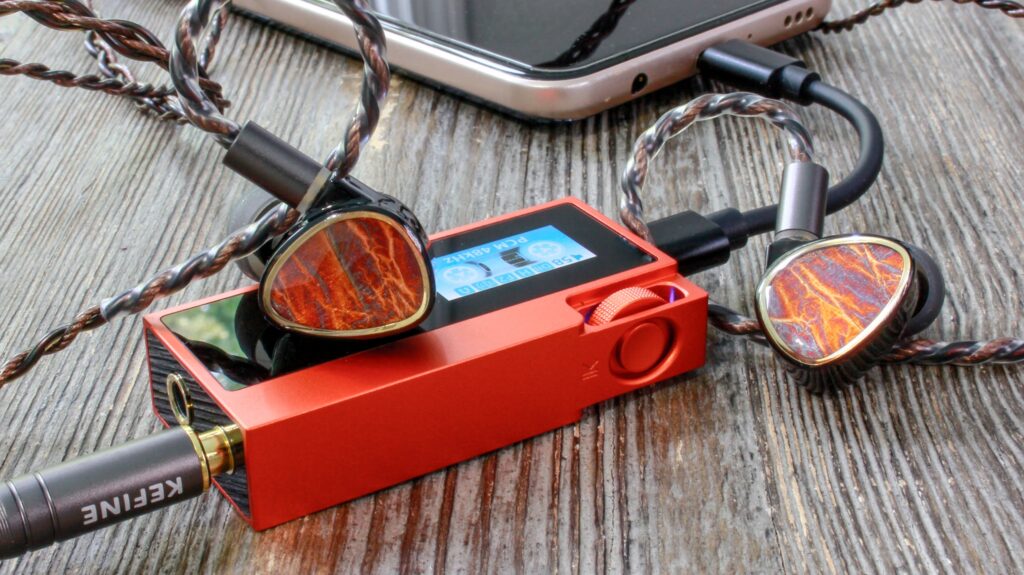
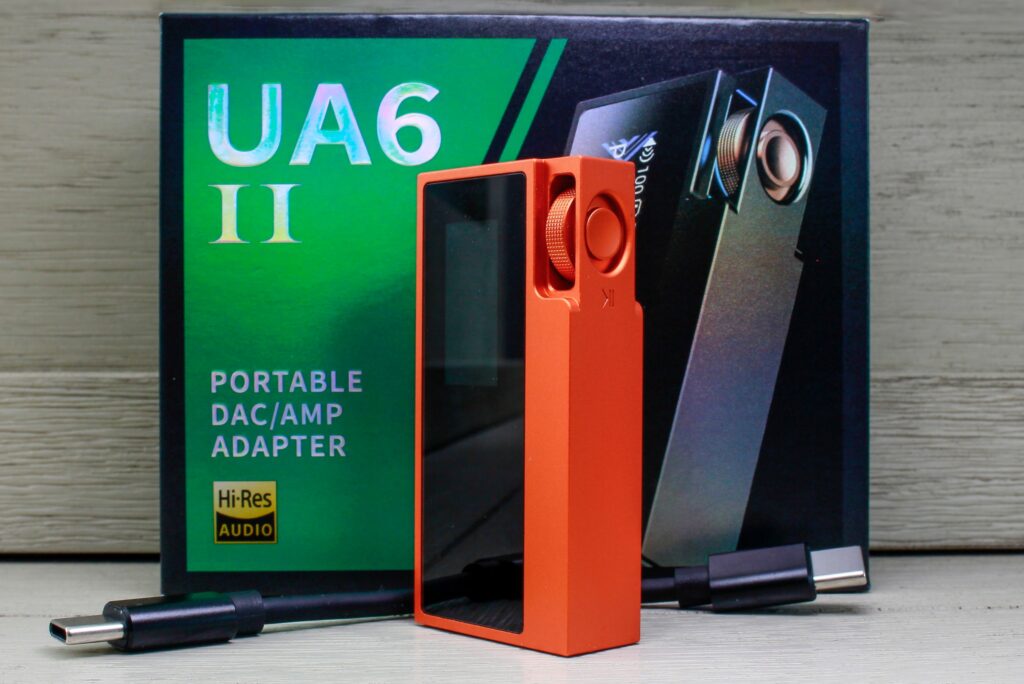
You can say a lot of things about the audio brand Shanling, but one aspect of their products that nobody can debate is that their products are always built well. This is one area where they seem to always go above and beyond. The UA6 II walks the same line as all of their other products as it’s built beautifully. Of course, I am a sucker for this design language. I love the rectangular UA7-style design. So, to be exact, the UA6 II’s chassis is honed out of one solid chunk of aluminum. Aluminum of course helps in many regards, but it helps fairly well with heat dispensation on top of the lighter weight and solid feel. The UA6 II is a somewhat small rectangular brick (a pretty brick) with tight corners, feeling dense and substantial in hand. Similar to the UA6 or UA7. It’s also a touch smaller in comparison to the UA6 & UA7 as it has dimensions of 62 x 30 x 13.5mm and it is said to weigh around 30 grams. Again, a dense little device. Shanling chose a smooth and sleek looking matte anodized finish. Off to one side on the front panel, you’ll notice a smaller front glass (I think it’s glass) which serves the nice 0.95” OLED screen. It also has an awesome volume wheel and a multi-purpose button inside of the volume wheel. On one end of the unit is a 3.5 single ended and 4.4 balanced ports and on the other side is the type-c port. While the UA6 II isn’t some crazy new design, it is a very well-built device which feels premium in hand. You can quite easily see that Shanling wanted the UA6 II to be one of their top dongle dacs.
Design / Aesthetic
Now this is one area that I am a huge fan of. That is, the look, the aesthetic, the design. I am a huge fan of the Shanling UA7 and the UA6 II looks like the spitting image of that one yet without the dual vacuum tubes. The UA6 II comes in two colorways (that I know of), bright orange and black. Again, the UA6 II really does have a premium look, very much purpose built, and very much stylish. I guess I’d call it “Industrial-modern-luxe” and it is apparent that Shanling wasn’t going for flash, but rather they were going for a sophisticated and handsome design, if you ask me. Obviously, the design was meant to impart a feeling of a serious hi-fi tool, which is exactly what the UA6 II happens to be. I think it’s very slick looking, especially when that beautiful OLED screen is on.
Internals
One of the best features of this device is its main selling point, that being it’s eight Cirrus Logic CS43131 dac chips (I’ll cover this more later). An astounding number for such a small device. Truly. Now, besides the dac chips I have little to no info about what USB interface chip which is used, what amplifier IC or discrete output stage that is used, or any of the clocking components. There also has to be some microcontroller which would be needed to control the screen, and I have zero clue what that is. I also don’t think it matters much either. Just good info to have when needed. So, this will be a very short section. Which is very much unlike me as I do try to get you all of the info possible. Oh well, sometimes these products are more of a mystery.
Controls
As I said, the UA6 II really has two modes of control on the device itself. It has a super nice volume wheel (which feels and looks great) as well as a button inside of the volume wheel. There really isn’t a ton of info on just what you can use the button for. It definitely works well for selecting certain settings in the settings menu, but not a lot of control when playing music unless you have a phone which allows that. For whatever reason my Samsung Galaxy Z-Fold 5 doesn’t allow that. Weird. So, most of my music play control has to be done using the phone instead. The volume wheel is used to change the volume, and it can help you to scroll through on-device settings as well. Now, you can change what the volume wheel controls in the UA6 II settings menu, and you do that by long pressing the button. Once you do that it takes you into the settings where you can find the “Wheel Function” setting. Here it can change between Dac Volume, Track Up/Down, or System Volume. Also, in the Eddict Player app there is more functionality that you can change for what the button can control but again, I can’t use it. Maybe with a firmware update? Of course, I could care less as I always control music with my phone anyways.
Features
DAC Chips
Again, the number one selling point of the Shanling UA6 II is that it comes equipped with EIGHT Cirrus Logic CS43131 dac chips! Friends, when I found this out, I was so excited to get my hands on it. Folks this is a genuine multi-channel, large headroom, low noise, dongle dac that comes in a small form factor. Part of the reason that Shanling did away with the battery might be to house the 8-chip array, just guessing. Anyways, the Cirrus Logic CS43131 dac chip is one that has been used forever now. I have a multitude of dac/amps which feature this chip. Some of my absolute favorite sources have used this chip. Now, having 8 of them is actually a huge benefit, especially for engineers. Of course, more chips don’t necessarily mean “better sound”. However, having this many chips gives sound engineers more room to craft better output quality, better channel separation, and a better measured dynamic range too. There is a potential for a much better technical replay and all the stuff that many of us feel adds refinement to the sound. Also, in listening it means that there is a huge possibility for better separation and perceived layering of the sound field along with a more dynamic presentation and a more effortless drive using 4.4 balanced. Also, these chips have been around awhile, and they are well known which means most engineers know them like the back of their hand. One other attribute of this chip are the sound filters that it carries too, which I’ll explain later. Really, I have always liked the CS43131 chip when implemented well.
That Screen
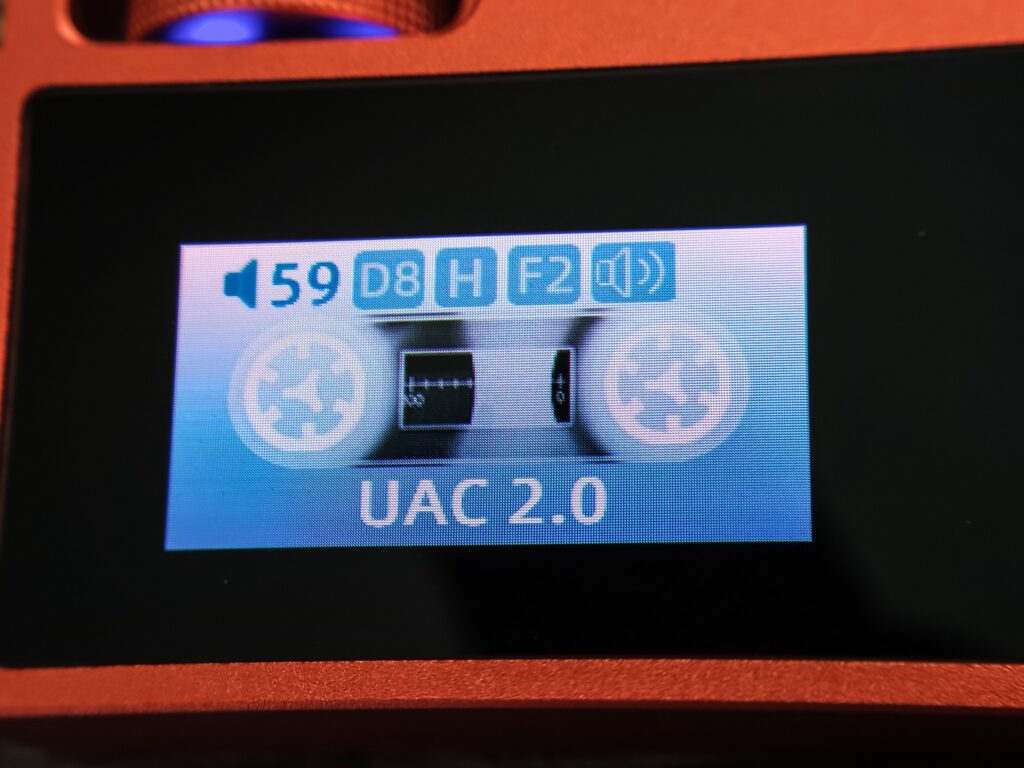
The screen which is featured on the front body of the Shanling UA6 II is a nice looking one. We’ve seen many dongle dacs which have a screen, but they are most certainly not all created equal. In the case of the UA6 II screen, I find it to be very nice looking and very useful too. So, it is a 0.95” OLED brightly lit and colorful screen. While I don’t need a screen, it is nice to have. I actually just finished a review of the Muse Hifi M3 Ultra where I said that not having a screen or bells and whistles was an enjoyable feature of it. Well, then I went straight to the UA6 II, and my tune completely changed. I say that because the screen on the UA6 II is actually helpful and very easy to navigate. Simply hold down the button (on the volume wheel) and you’ll see the settings menu come up. Then, you can scroll through all of the settings with the volume wheel and select with the button. It’s very easy and useful. Inside the settings menu you control many different audio and non-audio options. For instance, you can change any Gain settings, Balance, Brightness, Screen Orientation, Screen Saver/Timeout, Theme/Font, UAC Switch Mode (UAC1.0 or UAC2. 0), Dac Mode (4-quad dac or 8 dac chips) and lastly PCM Digital Filters. So the screen is a very nice addition and one of the better & brighter screens as well.
Output Power
Another big feature of this dongle dac is its rather large balanced output. The Shanling UA6 II is rated at 365 mW at 32 Ohms on 4.4 balanced as well as a suspected 110 mW at 32 Ohms on 3.5 single ended. Please be aware, I have not confirmed the 3.5 se specs. However, 365 mW is no joke and definitely gives the UA6 II plenty of output power for just about any iem (there’s a few which would give it trouble). Furthermore, the UA6 II can even drive some over-ear cans pretty well too. In fact, I listened to the large planar headphones, the Sendy Audio Apollo Pro using the UA6 II for quite some time and had zero issues. Granted, I do feel that the Apollo Pro could use even more output, but it still sounds great. Every iem I’ve tried does very well on the UA6 II. I should note that at even less cost you can find dongle dacs with even more output power. However, this is where I will interject that output power isn’t the most important attribute of a dongle dac. That said, the UA6 II definitely sits in the high side within the market of dongle dacs at 365 mW.
Eddict Player
I think one of the other high-quality features of the Shanling UA6 II isn’t a feature on the UA6 II at all, but rather the companion app which the UA6 II connects to, the Eddict Player app. When you open the Eddict Player simply go to “USB Control” and find your device so that it can connect. I should note that this connection only works on Android as the IOS version does not have the capability. Of course, you could always simply use the Eddict Player as your music player for Android or IOS and it is pretty good. Not the best, but good. I definitely use it on a fairly regular basis with different daps. Though I’m much more of a UAPP guy. At any rate, the beauty of the Eddict Player is that you can control many of the functions on the Shanling UA6 II, and any other Shanling dongle dac or dac/amp which can connect to the app. Really the app just provides a more comfortable way to view, edit, or change settings as it has access to additional functionality within the app. So, you can do a lot like get firmware updates, check battery status, change gain levels, toggle button controls, adjust what the volume wheel does (different modes), select digital filters for use in the UA6 II as well. It’s a nice app and nice to see for a dongle dac as true companion apps are not typical for dongle dacs.
Digital Filters
The last “feature” that I will be talking about is the digital sound filters that the CS43131 dac chips provide. Now, you can change these filters on the device itself or in the Eddict Player app. In total there are six filters and each one makes a very subtle difference. All sound filters come from the Cirrus Logic chip and Shanling simply exposes those filters for use in the UA6 II. Each sound filter is designed to attenuate or minimize pre-echo or ringing artifacts which provides some trade-offs between phase-linearity and transient sharpness etc. Be that as it may, the UA6 II’s sound filters make a subtle enough difference to include them, like most devices which employ sound filters. What a sound filter does is it reshapes the “digital” signal before that signal is turned into an “analog” signal, and it’s all done by the DSP (chip). These filters will not drastically change what you hear and are nothing like EQ. However, if you have a discerning ear, you probably will hear what I hear. Those filters are listed below. I won’t go into a breakdown of each one as my reviews are already too long. Here you go; Fast Roll-off (Minimum Phase), Slow Roll-Off (Linear Phase), Low Dispersion (Minimum Phase), Apodizing (Minimum Phase), Short Delay (Fast Roll-off, Minimum Phase), as well as NOS (Non-Oversampling).
Magnetic Case (sold separately)
Okay, this is not a feature of the UA6 II, persay, but it is a seriously awesome feature if you buy the protective case. Again, you can get this case at either Amazon ($18) or Aliexpress ($19.80). Worth every penny folks. I also realize that I’ve already spoken about this, but man is it a nice thing for me. I don’t have an iPhone with your fancy Magsafe stuff and so I have to go to greater lengths with each dongle dac to stick that sucker to my phone. It’s annoying. So, how nice is it that the UA6 II protective case has a magnet. Also, the magnet is very strong. Works great. Shanling actually provides you with the metal price to stick to your phone in the regular packaging. Which is nice.
UAC1.0 & UAC2.0
Very quickly, I figured I’d at least brush over this feature of the UA6 II. Of course, almost all dongle dacs come with the ability to switch between UAC1.0 and UAC2.0. Basically, UAC2.0 offers about 40 times more bandwidth than UAC1.0 which makes it much more apt to be used with multi-channel high resolution audio and is easily the more advanced protocol. UAC1.0 is what you’d toggle if you wanted to hook up a Nintendo Switch (for instance). Switching between the two is very simple. All you need to do is open up the settings menu on the UA6 II and use the volume wheel to cycle through till you see it. Just a button push after that. Anyways, there is a lot more that goes into this, but this is a review of the Shanling UA6 II and not an article on UAC protocols. Still, good to have.
Quad Dac Chips or Octo Dac Chips
One last thing covering the dac chips. I know I spoke on them earlier in the “Features” Header but there is more to the story with the UA6 II setup that I think you might be interested in. Shanling actually added in the option to use either four dac chips or all eight by a simple button push, or in the Eddict Player app. However, going right to the onboard setting in the UA6 II is easily the simplest way to change between the two. The beauty of that is that you can change on the spot while music is playing to hear the sonic difference in real time, one after the other. Before I cover the sound difference, one nice thing about having this option is by choosing only four dacs you are really choosing better battery life from your source (phone/tablet etc.). However, using all eight dac chips obviously gives you an uptick in performance and ultimately an uptick in overall refinement of sound (to a degree). Certainly, a well thought out option for people. I personally prefer 8 dac chips doing their thing at all times, but I’m not you and maybe you don’t need all 8 chips and would like to save some battery.
Quad Dac Chips or Octo Dac chips cont…
Now, it’s great that battery life is less affected in the quad dac chip setup, but you may be surprised to know that the sound is actually different with four chips rather than 8. I’m not just talking about technical stuff either. I mean “tonally” the sound changes. In fact, it’s almost as though Shanling gave us two slightly different tonal colorations. Obviously the octo dac (8 dac) configuration definitely provides the more technically impressive sound though it’s better balanced, more of an all-rounder you could say. That said, in the quad dac (4 dac) configuration the sound is slightly warmer, a touch more perceived bass weight and less upper treble influence. It’s the more “traditionally musical” sound. While I enjoy the 8 dac chip configuration a hair more, most of the time, there are plenty of iems which I choose to switch to the quad dac chip setup. I’d go so far as to say it is closer to the Shanling house sound. Please don’t get me wrong, those 8 chips are crazy talented and sound absolutely awesome to my ears and truthfully mesh better with more iems/headphones. Still, I love that the sound changes in a slight manner and that I can on-the-spot check the sound difference between the two. Just something to keep in mind.
Sound Impressions
*Note: before I dive headfirst into the sound portion of my Shanling UA6 II Review there are a couple small notes to make regarding the process of review. First off, I did not burn in the Shanling UA6 II. If it sounds great right out of the box, then I feel there’s no need to perform any sort of burn-in. Next, I used far too many iems/headphones when conducting my critical listening of the UA6 II. Obviously, I am not going to list everything down here, but in my review if it is pertinent to explaining the sound of the UA6 II then I will speak on what transducer it was that I was using. I always listen with high gain, and I always use either Eddict Player or UAPP (USB Audio Player Pro) for all of my listening. I listen with every genre out there and I listen mainly to flac or better files which are stored on my phone, or other devices. Lastly, whether you choose the quad dac mode or 8 dac mode will change the sound to a degree. I will explain at the end of my sound intro, but I do want to specify that I used the 8 dac mode for all critical listening.
Source Reviews
I speak on this with every source review. That is, they typically demand a much more nuanced explanation of their sound as it will always be a difficult task assigning how much of the final sound which reaches your ears comes from the source or the transducer. One thing which I always try to do is have a few other source devices to compare against to hopefully break down what I’m hearing better. Do you know that some folks actually feel that all sources sound the same? I was bewildered when I heard that. There is no doubt in my mind that every source will alter the sound to at least a marginal degree of influence on your iems/headphones. However, the question is… “how much”. In my mind, the source can offer anywhere from 10-20% (my completely made-up guess) while the transducer contributes the vast majority of sound. However, that 10-20% can be what separates a great listening experience from a less awesome session. So, what I always say is that a source will edge the sound, it will influence the sound and to what degree that the source gives influence could be a good thing or a bad thing depending on your preferences. By-and-large most sources will “mostly” let a set be what it is. However, the source can swing that sound rather dramatically, especially with a high impedance source in a sensitive iem. This was at least partially the case with the great sounding Muse Hifi M3 Ultra. Output impedance. The source can provide a cleaner slate with a blacker background, it can affect perceived transients, and a source can instill subtle tonal and note structure changes. A lot has to do with power delivery as an underpowered source can sound flat, less dynamic, not as punchy. Whereas a device like the UA6 II has the juice and power to provide that strong dynamic contrast, that bass slam, the quick stop-and-go punch. Basically, if an iem is good, an awesome source can make it great, and vice-versa.
What’s It Sound Like?
The Shanling UA6 II is one of those dongle dacs which really does provide a solid listening experience with many different sets. Similar to the UA6 but notes are more compact, clean-density, with less sheen up top. After so many hours of listening I can confidently say that the UA6 II is without question (for me) the best solid-state dongle dac that Shanling has crafted to date. No question at all. The first thing I’d relay to you all is that the UA6 II has a very clean demeanor with a high detail influence and a resolution focused sound that veers from a typical Shanling house sound. It carries an emphasis on clarity and overall technical chops without leaning out the emotional weight, robustness, and musicality of my iems. On the flip side, the UA6 II also isn’t going to endow ample amounts of added weight, warmth, or bass presence to your iems. There’s definitely a balancing act going on with this device, but the overall cleanliness is very apparent. Now, tonally I’d say the UA6 II is closer to neutral yet with a dash of warmth and the way that the UA6 II uses that warmth is very nice. It carries an even-handed and natural presentation. If you ask me, the UA6 II has the best implementation of the Cirrus Logic CS43131 dac chip that I’ve heard of in a dongle. Granted, that’s a tough thing to say as there have been a multitude of solid dac/amps and dongles which carry this chip. However, for a dongle dac which uses 8 of these bad boys I am utterly impressed with how well the sound separation translates to my iems, the dynamic contrast sounds a hair more expressive. There’s simply an outward projection of clarity that doesn’t come from illuminated/bright, analytical, dry, lean, or clinically tuned means. Also, either my brain burn has kicked in or the UA6 II has only gotten better with time.
Timbre
I already briefly spoke on the timbre, yet I feel the UA6 II deserves a longer look at this underappreciated attribute. Friends, I cannot tell you how many dongle dacs I have chosen to NOT review because the sound imposed onto my iems had almost an artificial gloss, or a subtle smearing to the sound. So many dongles thin out notes, or they present a flatter sound field. Now, the Shanling UA6 II will “mostly” let your iems/headphones be what they are without any drastic sound coloration. They’ll add some control, some order, some clearly defined note edges (to a degree), and help each iem sound closer to what “natural” sounds like. It will veer your iems/headphones in that direction without changing the tuning, so to speak. In fact, if there was a true “all-rounder” dongle dac then the UA6 II is definitely a candidate for it. I realize all of what I just said seems as though I’m merely speaking about its technical ability and cleanliness again, but I’m not. You see, the UA6 II is a very versatile dac/amp with a very balanced presentation in all regards. It’s neutral enough to bring a clean presence, defined outlines, and a definite refinement to my iems with the skill of a serious hi-fi tool. Be that as it may, it also has enough body, enough dynamic push, enough emotional nudging and polish to be enjoyable and satisfying with my sets too. It all shakes as a refined, organically pleasing, smoothly cadent, with a precise and acute delivery and a well measured version of a natural influence.
Sound Influence
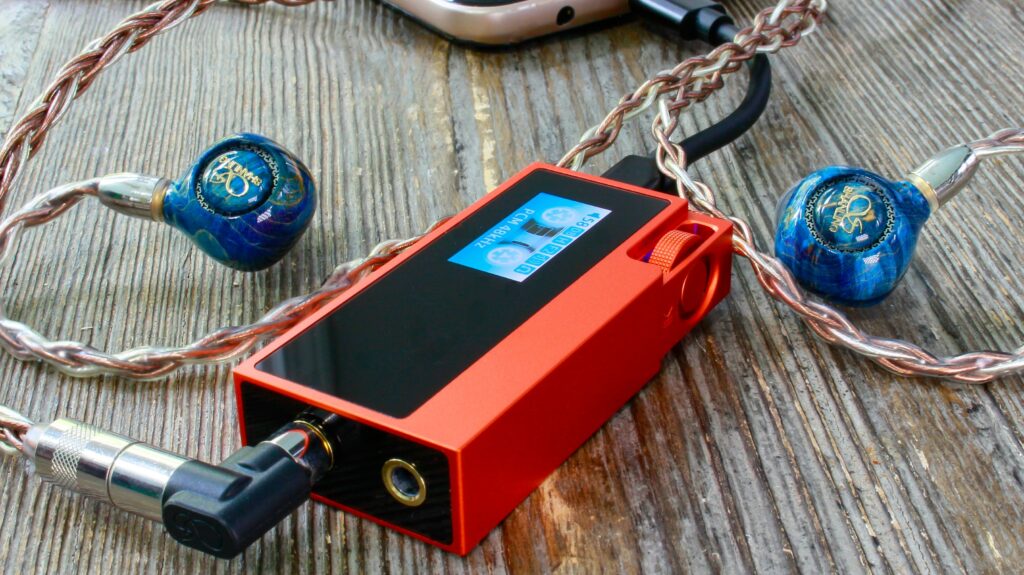
Now, as far as the UA6 II’s sound influence on different iems, I find that most of the real refinement and change comes in the form of dynamics, tight transient attack through decay, some added quick punch impact, and of course… overall clarity. It’s not easy to hear or spot the real “changes” in respect to other dongle dacs, and I say all of this in the same regard that I speak on any source device. It’s taken me so many awesome hours of comparing and just having fun, taking notes, listening to one and then listening to another. After and during all of that, these are some of the ways that the UA6 II kind of distinguishes itself with different transducers from my perspective. The truth is, I find that the UA6 II persuades the sound mostly through the way it helps define notes with its clear atmosphere and it truly does have a black background with sensitive iems, with a vivid and dynamic enough foreground producing a sonic focal point. Add to that it persuades a sound field which feels and sounds more dimensional with a nicely multi-layered character. Especially with sets which already have this character trait. You’d be surprised; I’m talking about you ODA Leviathan T800! Damn do these two sound awesome together. But I digress, I’d say that its (UA6 II) balanced emphasis across the spectrum as well as the UA6 II’s smooth precision really does allow most any timbre, tonality, tonal coloration, cadence or sound signature to simply be what it is. For the most part. Timbre and tonality have a natural balance instead of any aggressive emphasis spikes. Sure, the bass has a touch more impact and robustness, or the mids sound slightly more forward, and the treble keeps a smoother non-fatiguing tone-flow, yet not enough to push or pull the emphasis of my iems with a tangible enough auditory change in that way.
Examples
Sets like the Aful Explorer (I always use for source reviews) which has that straight warm yet highly musical and warm-organic tuning definitely sounds a touch more open, better perceived dimensionality, cleaner between notes. This set was not praised for its colossal stage folks, and the UA6 II doesn’t all of a sudden create a stadium of air. However, I can hear cleaner lines, more condensed punch in the bass, a cleaner foreground in the mids, more presence. Not to the point that it’ll knock your socks off or anything. Well, unless you are easily amused. However, the UA6 II definitely refines the spectrum. Despite that comment, the Explorer won’t magically turn into a detail beast either, it won’t magically develop a less bassy presence, and the Explorer won’t all of a sudden gain treble brilliance. The change is in the intangibles. I chose sets that are clearly lean one side of the tonal aisle of the other for this section. That in mind, take the brighter, cooler, and dryer sounding Sivga Nightingale Pro which is all about that glass DD speed with a technically astute disposition. At no point does the UA6 II increase potential for more glare, shout, sibilance, and at no point did I hear a more authoritative bass. It’s debatable, but I hear a slightly punchier bass. Compared to other dongle dacs in my possession the Nightingale Pro has a less abrasive edge definition to upper range notes, and I most definitely hear a touch better layering front to back. However, tonally not many changes, it lets the Nightingale Pro be what it was tuned to be with a clean background, better control of the spectrum (to an extent) and it does well to uphold the speed of the driver providing a hair faster twitch punch in the bass, midrange air and separation, as well as a very clean treble. I’ll speak much more on different sets and how they sound when paired with the UA6 II when I cover the bass, mids, and treble, but I want to help whoever is thinking about getting this device with what to expect.
Bass Region
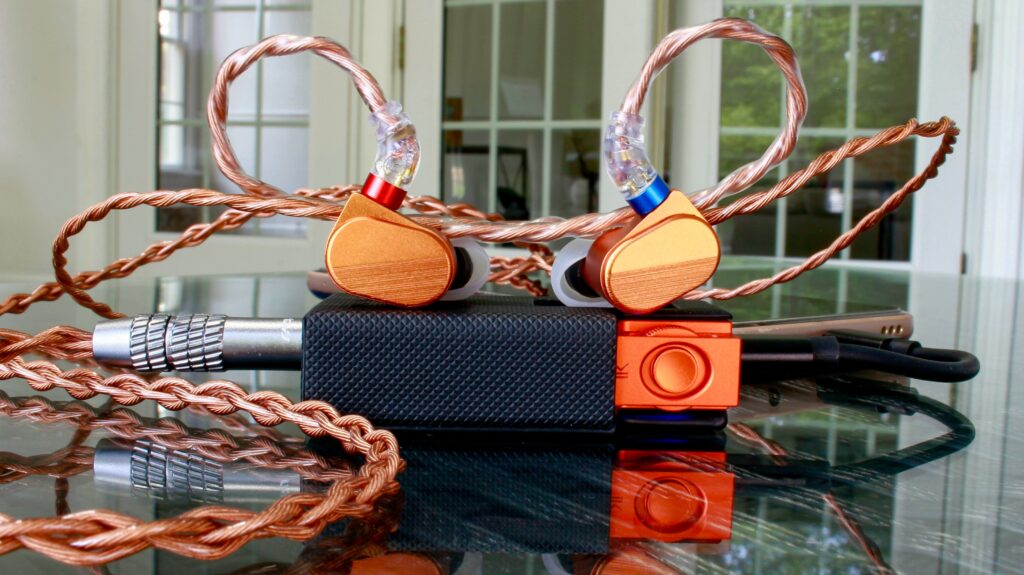
The low-end is one that does have a moderate lift in the bass, meaning it isn’t super well-endowed and won’t push the presence of the bass, but more-so it tightens each note with enough emphasis to sound substantial with the right set listening to the right track. Better said, it shows up when called upon. For instance, listening with the EPZ 550 the bass has some clean-lined rigidity that is very gratifying to my ears. Fast, tightly wound, slightly convex, and always with good edge definition sounding more natural than other dongle dacs. I spent a ton of time between the original UA6 and the UA6 II and what I can say is that this new device sounds more natural, less edgy or digital sounding. I say that and I adore the OG UA6. Anyways, what I hear is enough warmth and weight to fuel an emotional charge in my music and enough to balance-out the technical skills of this 8-dac beast. The sound as a whole is not one to overtly color the transducer, so keep that in mind folks.
Bass Cont…
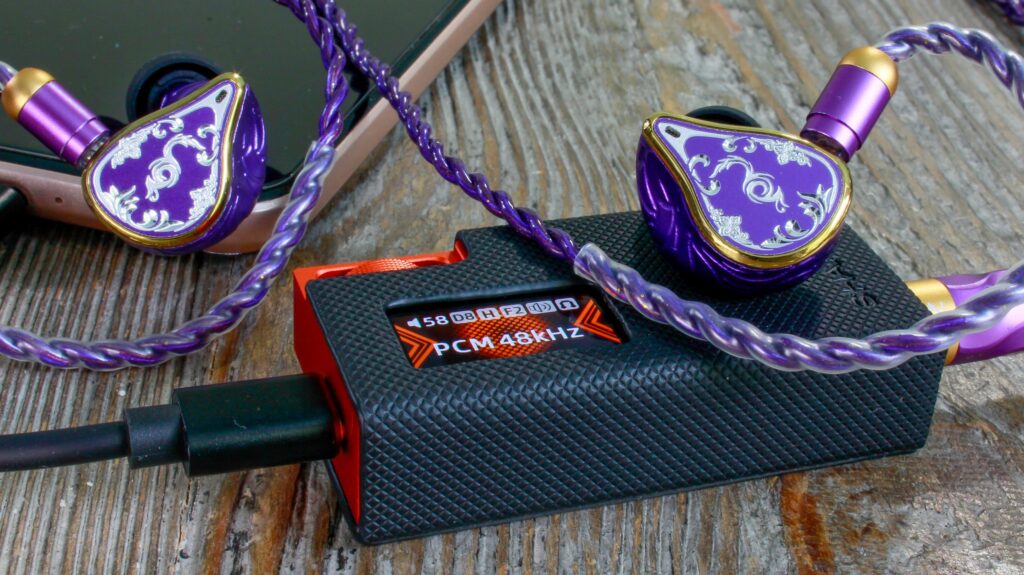
Now, when I say the UA6 II’s bass region is “marginally boosted” in the low-end, I really mean “marginally”. The right amount of dynamic drive and extension to provide some good foundational weight, but not enough low-end to offset tonal balance. Bass heavy sets like the Dunu X-koto Ito come across just as impassioned and bullish in bass weight yet with a clean-lined snap on attack, more compacted punch, more space between notes (generally). I love the Koto-Ito’s nicely defined note contour, harder edges, and a fairly delicate hairline cleanliness which takes advantage of the cleaner background. It won’t turn a moderate bass set into a mega basshead set and conversely won’t diminish the bass either. Having said all of that, I don’t want you to think you are getting the second coming out of the UA6 II. It won’t make your $700 dap obsolete. So, I want to keep my words grounded here. It’s easy for me to get excited while writing. Still, for the cost, and in very generalized terms I feel that the bass region is well done for a dongle dac at its cost.
Bass in the Quad Dac Configuration
In each section I am going to speak very quickly about how the sound changes in this configuration. As far as the bass is concerned, it definitely has a touch more warmth, more weight, but also a touch less defined. It simply has a hair more oomph. I’m not talking enormous emphasis differences either. Truth is in the quad dac setup the highs aren’t as brilliant which obviously draws the more focused bass…forward. Definitely a subtly warmer sound overall and the bass definitely has some influence in that. The sound is a touch richer, a hair more organic, a touch less refined, and it has a hair less separation. Still, if this dongle dac came to market with this quad dac setup, I’d be very happy with it.
Midrange
The first takeaway that I heard with my ears when comparing the UA6 to the UA6 II was that the midrange is not as “in your face” this time around. The placement of the midrange is more naturally conceived. While I adore the UA6 when it is paired right (almost untouchable paired with some sets at under $150) it was also a hair too anterior, forward sitting, and it pushed midrange dynamism into glare at times. The UA6 II fixes that with what I’d call a somewhat forward feel but much more organic and somehow even cleaner. What I hear is a neutral leaning midrange which does better with different tonalities of iems. The emphasis balance and natural timbre levels the vibrant dynamic push within my music while keeping a smoother tone-flow and cadence. To add to that, the UA6 II seems to coax better note separation (generally), provokes a clean-edged midrange note delivery, and creates just enough delicate prominence (which is especially awesome with great vocal sets) of the midrange sound field. I don’t know if it’s the 8 dac chips, or that Shanling took some of the complaints of the OG UA6, but this time around I’m hearing a better midrange. Especially sets which carry those tonally balanced yet forward mids… so good! I spent a crazy amount of time with the Shanling MG600 because the mids are so engaging and enthralling to me. However, I was honestly worried because this set is so very particular in how you pair it. It is so easy to get glare and shout out of those mids unless you have a source with excellent control. When you do, the MG600 is flat-out awesome. In this case the UA6 II was the perfect vehicle to drive that set.
Mids Cont…
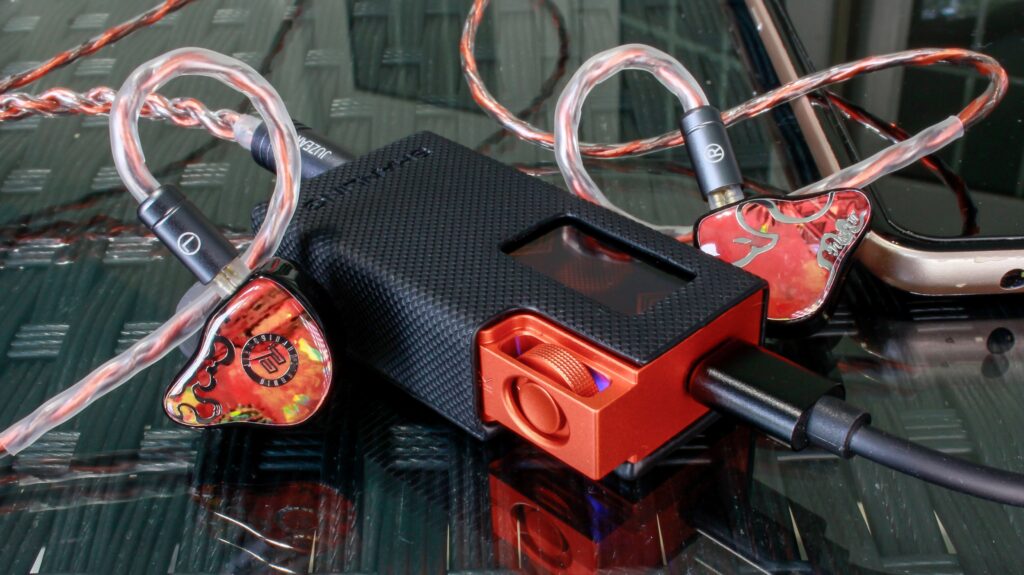
I suppose you should expect a midrange which isn’t overly aggressive, isn’t harsh or glare inducing. I think we’ve established that. But you also should not at all expect a midrange which is dull, bland, or flat. I really want to get this across because so often when people read “not overly aggressive” they translate that to “boring”. Nothing could be further from the truth. In fact, the mids actually influence some very nice tonal and dynamic contrast, more expressive macro-dynamics, and each note feels driven, distinct, and rigid, without any hanging sonic fat. Stuff like weird auditory artifacts, sizzle, grain, hiss, distortion, sibilance, or smear. Nothing but that natural-organic tonal persuasion and that clarity-rich canvas for my iems to paint on.
Midrange in the Quad Dac Configuration
While the octo dac chip setup is easily the more refined and cleaner sounding configuration, I find the quad dac midrange isn’t far off, but is also a touch warmer, less upper end sound influence which creates that warmer and slightly smoother portrayal of my music. The mids are still rather forward and still help many sets to come across musical and melodious. I’d even say that the quad dac setup carries a nicely technical sound. After all, Shanling’s previous OG UA6 had four CS43131 dac chips and it is an extremely well-done dongle dac. However, the Octo chip setup simply has a more multi-layered sound, better dimensionality, and influences the sound to be better detailed. Though, I’m sure there will be folks who’d rather listen to that more organic style of the quad setup.
Treble Region
The upper end of the spectrum keeps a very even keeled approach. Perceivably tuned to sit on an even playing field with the bass & mids and never feels or sounds as though it’s oversaturated, which is nice. Once again, another region which simply lets a set be a set as it doesn’t alter the tuning of my iems, no added lustrous shimmer, no wildly boosted extension either. Just a very clean canvas providing a distinct and lucid influence on the top end. It took going back and forth with the OG UA6, UA7, and a few other dongle dacs to get a good idea of how much sway the UA6 II actually has within the treble. To my ears the treble upholds an organic-ish timbre with a light uplifting luminance which comes across as a light sparkle, and more of a glow (for lack of a better word) than anything else.
Treble Cont…
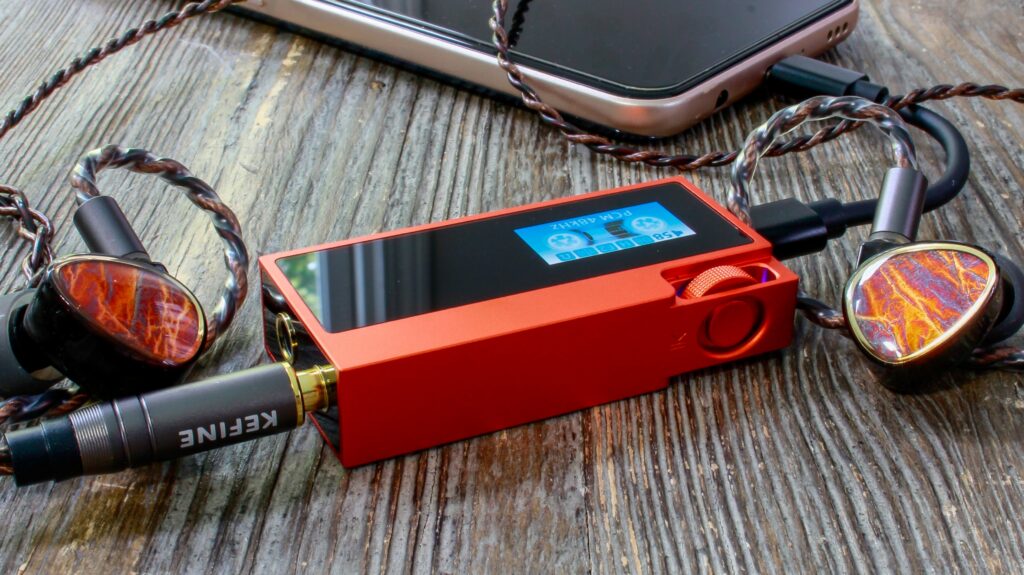
As I said earlier, the treble isn’t going to create treble radiance on the top end of the Aful Explorer (for instance), but it will refine treble notes with better intelligibility than other “lesser” dongle dacs. Once again, the clean background, perceivably tighter transients, and the openness of the top end of the spectrum clears the atmosphere around treble notes with a touch better separation, and a more detailed approach without losing the “organic-ish” timbre I was just talking about. A set like the Simgot EA1000 which has that bright display of the top end is clearly a legend set but is rather loose up top at times. Actually, it’s a great set with a great tuning, however, it’s been known to be somewhat edgy, abrasive, even sharp up top for those sensitive listeners and dare I say, somewhat loose. With the UA6 II the brilliance doesn’t attenuate, or sound less radiant and won’t necessarily “tame” the treble. However, from other dongle dacs I hear better control, with a touch less smearing of brightly recorded and energetic tracks. Also, the EA1000 pairs well with the UA6 II in general. You could say that the UA6 II made an already great set better in comparison to other less expensive dongle dacs.
Treble in the Quad Dac Configuration
The treble in the quad dac setup shows the biggest change in my mind. I feel that I hear less upper end brilliance which does affect the rest of the spectrum. I still hear plenty of good separation, solid detail influence, and good note definition too, but the octo dac chip configuration is clearly the more talented setup up top. The octo setup has more sparkle, more shimmer, and it does illuminate the spectrum a touch more pushing a more neutral profile frequency wide. Whereas the quad setup has less of a radiant gleam, less extended (perceivably), but is also less inducing of glare on already bright/cold iems.
Technicalities
Soundstage
It’s usually so difficult to tell how much difference a source device makes for stuff like soundstage and other technical aspects of listening. Though, like I said, when going back and forth in comparison I found it easier to discern subtle to not-so-subtle differences. Especially in how the sound field comes across. My takeaway is this; the stage is wider than anything with some decent enough added or perceivable depth, though I wouldn’t call the stage “holographic”. In fact, stage width, depth, height, and any 3D elements of the stage usually come much more from the iem or headphones rather than the source. Having said all of that, one clear attribute of the UA6 II’s stage is that it has never felt cramped, narrow, or a 2D flat plane in front of me, no matter the iems or headphones I have attached. Certainly not bad at all. Truthfully, the clarity, the multi-layered approach, the added separation and the black background only add to the perceivable space and openness of most any set that I listen to paired with the UA6 II.
Separation / Imaging
Now, when it comes to note separation, I do feel that the UA6 II provides a more partitioned-off sound field. Especially with sets which already have that clean separation. However, full disclosure, it’s very-very difficult to say that the UA6 II is the main reason for better spacing between notes or even a cleaner note outline. In comparison the musically balanced/analytical UA6 II seems to do a commendable job of feeling like better separation is occurring. The UA6 II is a complete package, all-rounder, and so it offers a much better performance in many ways than other dongles. Despite that, “note separation” isn’t exactly the true marker for a good dongle dac. Certainly, a good asset, but many dongles help with separation. I have $60 dongles which are straight up analytical in tuning which do just as well. What separates the UA6 II is that is does have some clean separation, but it also is dynamic, well controlled, influences detail retrieval, its highly musical, great timbre, and seemingly always rhythmic. Imaging is the same. If anything, the UA6 II helps. In fact, at the very least… it helps with imaging and placement. Still, the main reason for solid imaging will always be due to the iem/headphone, and all the sources can do is provide that canvas for the transducer to paint on. The good thing about the UA6 II is that it’s a very clean canvas. I’m not going to sit here and tell you that “imaging is amazing on this thing!” when that is such an unbelievably nuanced trait. What I can say with absolute assurance is that the UA6 II definitely helps, it carries great clarity and definitely helps refine anything attached to it and it helps with both separation and imaging.
Detail Retrieval
Now, detail retrieval is another character trait that is mostly controlled through the iem/headphones that you choose. Though the UA6 II does seem to do a good job of pulling out low-level textures, cleanliness, clear background, and without any added haze or masking added. Let’s put it this way; the UA6 II has a 133 dB dynamic range, 133 dB SNR, and a 121 dB noise floor which is an excellent foundation and starting point. It’s clean enough that I’d say the UA6 II definitely helps in the area of detail retrieval, which is saying a lot. However, just like “separation” and “imaging” stuff like detail retrieval really isn’t a known ability of source devices. It isn’t one of the criteria for why anyone would purchase it. Let’s put it this way, if you ever hear anyone, any reviewer say that their favorite source device has excellent detail retrieval… you should probably stop reading, watching, or listening to that review. All a source can do is help. Once again, for the hundredth time, what makes the UA6 II special is its overall refinement, quality components (8 dac chips!), its balance in tone, its balance in fluidity and technical acuity, and its controlled dynamic presence.
Comparisons
Shanling UA6 ($159)
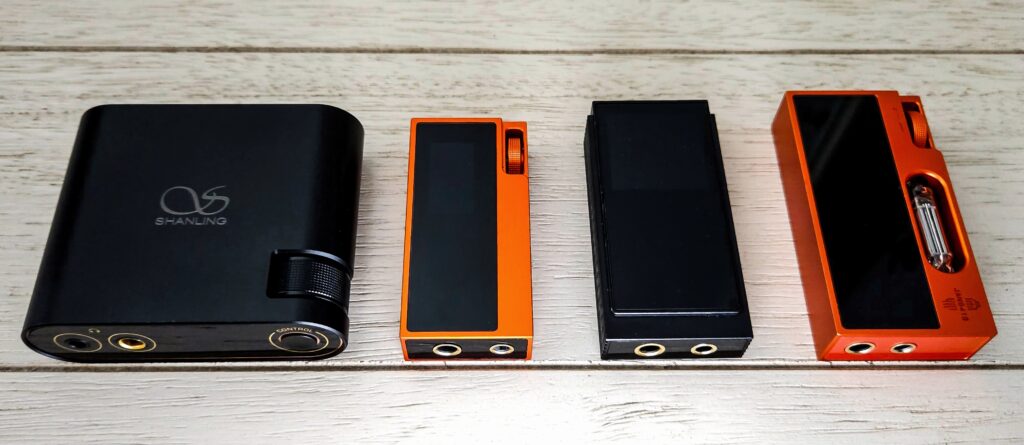
The first comparison for this review is the most obvious and truthfully, I’ve already given you plenty of comparisons between the two throughout this review. However, the UA6 is a fantastic dongle dac and it deserves a richer look into the differences. Now, the Shanling UA6 is a very talented dongle dac carrying four CS43131 dac chips instead of the UA6 II’s eight CS43131 dac chips. It also has a very powerful peak output of 361 mW and many other features which make it a compelling offering at $159.
Non-Sound Stuff
To begin, both devices have around the same unboxing experience. Not much to report there. Though, the build of both devices is different in that the UA6 has all buttons (up, multi-purpose, & down) and no volume wheel, while the UA6 II has a volume wheel and one button. The UA6 has a slightly larger screen (bigger device), not as bright, but very easy to use, similar to the UA6 II. The OG UA6 is larger in all directions (wider, thicker, fatter) and is a touch heavier. Of course, the UA6 actually has a 220 mah battery too. Something I really wish the UA6 II had. Although, I really don’t miss it too much as it wasn’t put there to make battery life better. It is used to regulate power delivery with phones, tablets etc. The newer UA6 II has a hair more max power at 365 mW while the UA6 has 360 and the UA6 II carries 8 CS43131 dac chips to the 4 CS43131 dac chips on the UA6. Dynamic range, SNR, noise floor, and just about every sound metric is better on the UA6 II which coincides with its better component implementation. Both devices carry similar sound filters, and both connect to the Eddi t player app. Lastly, the price difference is semi-significant as the UA6 is right around $159 and the newer UA6 II sits at $209 right now. I think the price is justified, but the $159 UA6 might be the better price-to-performance device.
Sound Differences
To begin, the UA6 II is definitely more balanced, cleaner, easily the more refined of the two in a few different ways. The UA6 has just a hair more bass warmth and oomph with a hair more body. However, the UA6 II’s bass is more dense, less loose, more defined, and punchier. I like the UA6 II’s bass a hair more, but the OG is still very nicely done. The midrange of the UA6 is slightly less controlled and you can hear it in the upper mids region with solid technicals yet not as clean-lined. While the mids of the UA6 II have a cleaner note outline, blacker background, less forward mids but also more appropriately placed in the sound field in my opinion. Midrange vocals and instrumentation come through nicely in both but the more dynamic, layered, separated, and better detailed sound. Now, the treble of the UA6 is a touch less controlled. Just like the bass it just has a less condensed and looser note delivery. Going back and forth you’ll notice the more controlled and nuanced treble out of the UA6 II with a more refined brilliance to it. Technically the UA6 II seems to win out. Just a cleaner (yes, I’ve said “cleaner” a lot) atmosphere with a more dynamic presentation, more dimensional sound field which translates to a more detail-oriented influence. The bonus is that it wins out while not sounding dryer, more clinical, or less musical.
Final Thoughts on This Comparison
You simply cannot go wrong with either device at the cost that Shanling is asking. Really it will come down to what your pocketbook can do. Both are refined per their MSRP, and both clearly perform well against their peers. Like I said earlier the UA6 OG “might” be considered the higher price-to-performance dongle of the two, but that is very easily debatable. Sure, the UA6 II is the more sophisticated device, and it generally carries better control of the spectrum, but I can’t take anything away from the UA6. It paved the way for its successor, the UA6 II and is easily still worth the cost of ownership.
Shanling H0 ($109)
I added the Shanling H0 because I find it to be one of the more sadly underappreciated devices that have come out in the last year or so. I use this thing often and in many reviews. However, I did not get to review it when I got it as I had too large of a backlog. The H0 has been a real treat with a very well done tuning, a ton of power (690 mW), and the Cirrus Logic CS43198 dac chip. Of course, it’s also meant for more purposes than the UA6 II and so whether this is a good comparison might be a stretch. It is small enough to be a large dongle. Dac but it has the capacity to double as a good desktop device too. Still, at $109 you simply cannot go wrong, an absolute steal in my opinion. Somehow it went under the radar and never attracted consumer attention like other devices similar.
Non-Sound Stuff
To begin, both devices are packaged similarly, no surprise there. As far as the build they are also both built out of aluminum, typical awesome Shanling build. That said, the H0 is large (3” x 2 ¼” x ¾”), heavier, and can be used as a dongle (it’s generally how I use it) but also is meant to be a desktop setup. Both devices have volume wheels and one push button, and both wheels are made very well. The H0 does have more ports with a USB Coax/Optical out as a USB Digital interface. It has a bigger wheel, MQA support, and the H0 carries two SGM8262 op amps which gives it double the power of the UA6 II. Both connect to the Eddict Player app. Now, I really like the aesthetic of both but the UA6 II is smaller, easier to handle, and clearly looks better for its purpose. They both have screens with full settings menus, gain settings (UA6 II: 2 gain, H0 3-gain), sound filters, and every other setting although the UA6 II has options to change the screen theme, wheel controls, etc. Also, the UA6 II absolutely has the better, bigger, and less old school digital screen. As far as output power, again the H0 has a lot more of it with a more desktop friendly 690 mW of max output to the UA6 II’s 365 mW. Obviously for higher current headphones the H0 is the better option. Lastly, and perhaps most importantly, the UA6 II has those awesome 8 CS43131 dac chips while the H0 has one Cirrus Logic CS43198 Dac chip. So, maybe the CS43198 chip is the better and more refined between the two but taking on 8 CS43131 chips is not a good battle for the H0. Just being honest.
Sound Differences
In my opinion the H0 gives off a slightly more relaxed and musical vibe, musical, and smoother to an extent. The UA6 II is exactly as I’ve said all review; clean, detail oriented, closer to neutral, yet so pleasing to the ear. The UA6 II bass is definitely the more defined-punchy style with a more condensed rigidity while the H0 has a touch more presence and emphasis but is slightly less articulate. Still great though, especially when paired well. The midrange of the UA6 II is cleaner, more dynamic, more of an expressive macro-dynamic presentation, a touch more brilliance and clearly the more technically inclined of the two. The H0 has a touch smoother of a sounding mids, more relaxed, and while it doesn’t hurt technically in the mids, it also won’t necessarily increase the likelihood of details to emerge either. Just a very musically pleasing sound, great for casual listening. The UA6 II is similar in that it is pleasing yet it is clearly more articulate and nuanced. Now, the treble of the H0 is less brilliant, less open, smoother, more fluid in cadence, and with bright sets it’ll have less likelihood of sounding fatiguing. The treble of the UA6 II has more of a clean edge up top, better extension, and its treble adds more levity frequency-wide. It has tighter transients, influences more of a cleanly defined edge to notes. As far as technical stuff, the UA6 II wins out. Both have solid enough technical presentations, but the UA6 II carries a more persuasive cleanliness which translates to better separation across the spectrum, better definition, tighter transients, and seemingly a more detailed sound.
Final Thoughts on This Comparison
I know, both devices are very different. However, they are also very well qualified for their intended purpose too. Like anything it will always come down to what you enjoy and what you feel is the best device to fit your life. I actually use the H0 far less than the UA6 II which is much more convenient. However, everytime I go back to the H0 I’m reminded just how sweet-toned that device is. Just a pleasing sounding device which sounds even better when it’s pushed a bit. Certainly, one which is more versatile than the UA6 II which doubles as a desktop device but is equally great and just small enough to be used as a dongle dac. I know because I’ve used it countless times. Also, the price is silly low. Obviously the UA6 II is the better dac/amp and yes, it’s more, but I think it has earned that higher cost. No doubt about it. However, the better buy (if money is tight) is definitely the H0 when it comes to price-to-performance. Both seriously great devices.
Shanling UA7 ($269)
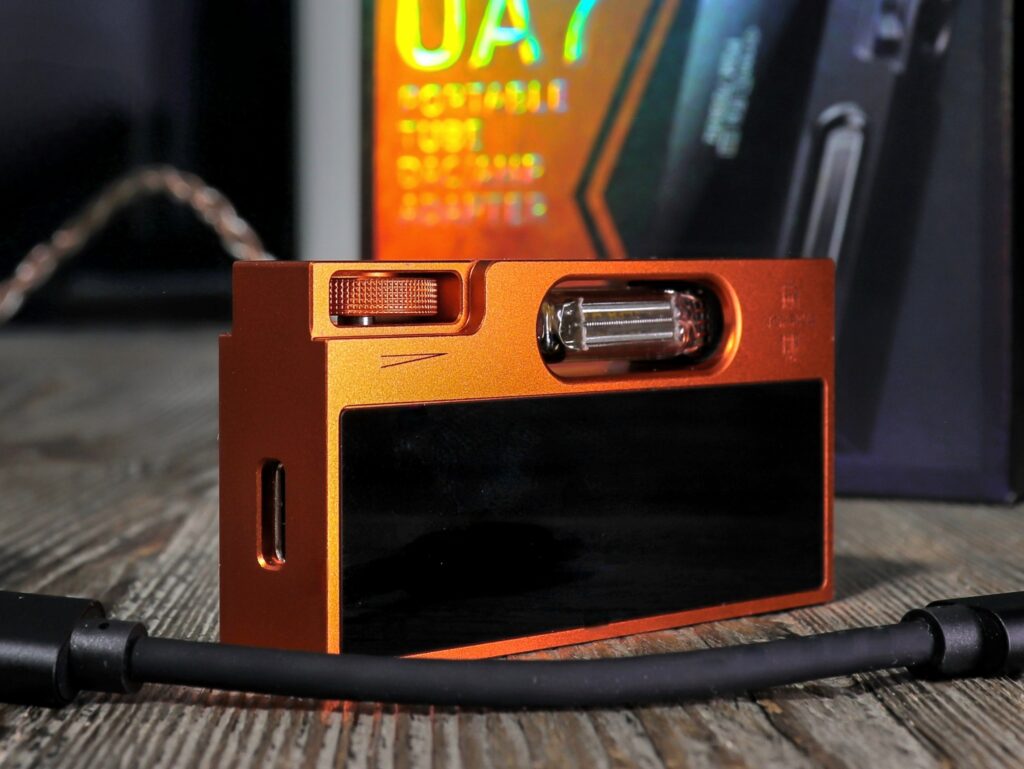
The last and final comparison is with one of my personal favorites, the Shanling UA7. I reviewed the UA7 (UA7 Review) in December of 2025 and was taken aback at just how versatile and refined its sound is. Not just the sound though, the UA7 is a very highly qualified dongle dac which sports dual JAN6418 vacuum tubes, an ESS9069 dac chip, along with Ricore RT6863 op-amps which pump out a max 577 mW of output power. This is a device which can be used in both solid-state mode with the ESS9069 dac chip and the huge output, or it can be used in tube mode with the JAN6418 dual tubes. It is one of the most complete dongle dacs in the market and clearly one of the best that money can buy under $300. It’s actually a bit unfair to compare it with the UA6 II. However, the UA6 II holds its own very-very well. Let’s look at some differences.
Non-Sound Stuff
Once again, the packaging is about the same, no change there. Also, the build is very similar between the two. Granted, the UA7 is much larger and slightly heavier (48.5 grams vs 30.8 grams). Both have that cut away corner which has the volume wheel and button. Both have the front glass panel. Actually, the UA6 II was designed exactly like the UA7 on purpose, just smaller and without vacuum tubes. As far as Internals, the UA7 has a single “high-end” ESS9069 Sabre dac chip to the 8 CS43131 dac chips of the UA6 II. Of course, double that ES9069 high-end chip with dual JAN6418 vacuum tubes and you begin to see which device is the more sophisticated one. Though, 8 chips are still just awesome and actually shows up in many ways to beat out the UA7 in certain areas, but that’s for later. The UA7 definitely beats out the UA6 II with its dual OPA662 op-amps and its dual BUF634A Hi-Speed Buffer IC’s. Those amp sections allow the UA7 195 mW on 3.5 single ended and 577 mW on 4.4 balanced. Which is freaking huge. Obviously more than the UA6 II’s max output of 365 mW. Both devices have a bright, vivid, and easy OLED screen to scroll through settings, sound filters, gain modes, and change themes, etc. They’re basically the same. Both connect to the Eddict Player app (like every comparison today), and both have firmware updates, the whole 9-yards. Both output audio at PCM 32-bit 768khz, DSD512. Another awesome thing, however, the UA7 does have full MQA unfolding. One thing worth considering is that both devices have dual modes. The UA7 can run in Tube Mode or Solid-State Mode (using its awesome ESS9069 dac chip), and the UA6 II can run with either a quad dac configuration or an 8 dac configuration.
Sound Differences
These two are very close in some ways and others (tonally) they can differ. The UA6 II is closer to neutral whereas the UA7 definitely has a slightly warmer character (due to the tubes), I call it warm/neutral. Basically, the UA7 is much closer to the warmer Shanling house sound. The UA7 has more richness and body while the UA6 II carries a more persuasive cleanliness, more precise. Both have a good dynamic balance though the UA7 has a touch less top end brilliance. The bass on the UA7 is punchy, extended, with more rumble and more bass presence/weight/warmth. The UA6 II is similarly punchy, but more concise, speedier, more immediate in its transient performance. The UA6 II midrange is slightly more energetic, more technically tuned, with more levity in the upper end of the mids. While the UA7 has that organic, rich tonality with more natural timbre, perhaps better vocal presence on the UA7 too, but that is wildly debatable. Shoot, I debated it with myself for hours. The treble of the UA6 II has an extended, speedy, rather natural, neutral, and crisper influence on the UA7’s more relaxed, non-fatiguing influence on my iems. Both are definitely clean, both are very vivid, and neither influences any odd timbral moments with my iems. Just two very-very well-tuned flavors. Honestly, it’ll come down to tonal preferences. As far as technicalities, I’d like to say that the UA6 II persuades my iems to be cleaner, more transient tight, more detailed, but the UA7 holds its own very well. As far as soundstage, both endow a larger and more dimensional stage. Of course, the UA7 does have the more tuby sounding 3D sound field with better depth of field. Which should be expected.
Final Thoughts on This Comparison
My two absolute favorite dongle dacs that I owned or have tried personally. I love them both folks. I love them for each one’s particular tuning style influence and I love them for their build, design, and each is very versatile for a dongle dac. Now, the price is a bit different as you are paying $60 more for the UA7 (totally worth it) but I find that both devices absolutely excel against market standards.
Last Words on the Shanling UA6 II
Once again, another Shanling product comes my way and once again I’m sitting here singing its praises. One after the other Shanling seems to craft and create another very relevant and sophisticated price of gear with solid performance for the cost. The Shanling UA6 II is a dead ringer for my everyday rotation and one that will be there for a long time. Right next to the UA6 and UA7. I said somewhere in this review that the UA6 II is without question the best solid-state dongle dac that Shanling have produced up to this point, and I stand by that. Of course, that is a very subjective thing to say, but just in the audio components alone I don’t think it’s a stretch to say that this is easily their most ambitious dongle dac to date… period. That said, you may feel differently which is perfectly understandable. No doubt when you have devices like the truly awesome Shanling UA6 or even the Shanling H0, it isn’t just some open-shut case. The truth is the UA6 II is a seriously sophisticated dac/amp which boasts one of the more impressive feats within this small portable unit with its 8 Cirrus Logic CS43131 dac chips. There’s a reason why this device is the 1st to ever do it inside of a dongle dac… because it’s hard to do. Trust me, if it was easy we’d see every brand coming out with 8, 12, 16 chip arrays. I joke but we all know this hobby and how unrelenting competition is. Basically, it wouldn’t surprise me at all if in 3 months another brand tries the same feat. Friends there are a number of reasons why I feel the UA6 II is worth every penny and one that I genuinely enjoy.
The Why…
Because the Shanling UA6 II is built so very well. Honed out of a single piece of aluminum and is (in my opinion) one of the dopest looking devices of its kind. Especially with that magnetic case. Man, I love that thing! However the design is so streamlined and cool and with the case covering… it just completes the look. I have grown very accustomed to the convenience of the screen and how easy it is to scroll through settings and by the way the Eddict Player companion app is actually helpful too. Also it carries a large 365 mW of output power driving just about anything that I own very well. Still, those eight dac chips truly are a cool thing to see. There’s no doubt that they bring this device to its best sound fidelity. Which brings me to the reason why we get these products in the 1st place, the sound. I greatly enjoy the balanced musical/analytical presentation with just enough bass heft mixed with a dynamically controlled and clean midrange followed by a somewhat sparkly and also non-offensive treble influence. I adore their UA7, I still enjoy the OG UA6, but the UA6 II expound upon all of the knowledge that Shanling has acquired concerning dongle dacs and seemed to truly craft a special device. There are more reasons why I think the UA6 II is one to not miss and a solid purchase, but I think I’ve covered it about as deeply as I could. You get the hint, it’s a solid device. Lastly, the Shanling UA6 II is an easy device to recommend. Worth every penny.
Conclusion
To conclude my full review of the Shanling UA6 II, I first have to thank the good folks over at Shanling for providing the UA6 II and for always being very professional throughout the process. These are pros, they don’t hound me, they don’t beg for a review date either. They respect the craft and patiently give me my time. To any reviewer that is worth its weight in gold. I have so many nagging contacts at other brands who are hoping only for marketing. Not Shanling. They are comfortable in their product, they know what they’ve created, they know it’s a very good dongle dac, and they are just waiting for the rest of us to figure that out. I can certainly agree. Anyway, thank you Shanling. I also need to thank the people who decided to click the link which got them here. Every click is important folks. As always, we are trying to grow and in doing so we try desperately to create content that is useful to the reader. So, every single click which takes you to an MBA review is very important to us. I truly hope this review has helped in one way or another, and I am very thankful to you.
Other Perspectives
So, you’ve read my feature of the Shanling UA6 II, now please go and read, or watch a few more reviews. I think it’s very important that you check out as many differing thoughts as you can to try to establish a firm idea about what the UA6 II could be for you. We want you to get your purchase right folks. Also, we reviewers are all so very different as this hobby is one of the most subjective of hobbies. In truth, every person has the capacity to differ from the person next to them. Shoot, I know reviewers who are seemingly polar opposite to me in almost every regard, and I completely respect these people. One of the most important things to understand is that everyone has different ideas about what good sound is. We all have different likes and dislikes, hearing abilities, music libraries, and a whole host of differences which makes us unique. So I do hope you’ll follow through and learn a bit more. With that said I am definitely done friends. So, please take good care, stay as safe as possible, and always… God Bless!
UA6 II Pros
-Familiar Shanling build, always constructed well
-The UA6 II design/aesthetic is one of my favorites
-Doesn’t seem to really get hot, even under a heavier load
-8 x Cirrus Logic CS43131 dac chips is both silly and awesome
-Screen is vibrant, very easy to use and I can access just about everything from there
-Great drive power with a 365 mW max output
-I adore the quick change option to go with 4 or 8 dac chips, changing sonic characteristics
-Very clean sonic presentation neutral with a hint of warmth, and a strong emphasis on clarity, control, and musicality
-Deep sublevel bass response and a tighter mid-bass influence balances the spectrum very well
-Semi-energetic midrange with great separation, transparency, and a black background helps vocals and instrumentation to stand out well
-Clean and nicely extended treble feels airy, open, with a delicate bite
-Clean separation of notes, tighter transients, while persuading a multi-layered sound field
-High resolution across the board yet rhythmic and tuneful
UA6 II Cons
-No internal battery like we had on the OG UA6
-Slightly higher power draw than most dongles with less dac chip and no screen
-Can be less traditionally musical/warm/organic for some
-Leaner mid-bass then some of the UA6 II’s competition
-Due to the transparency, the UA6 II can expose some lower quality recordings (is this even a con?)
-The treble can feel a hair bright with already bright iems for sensitive listeners


No Comment! Be the first one.