











































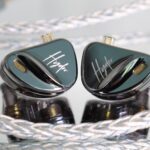

























Twistura WoodNote Review
Intro
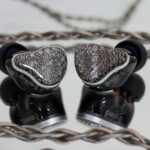
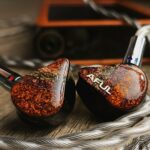
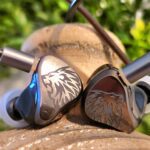
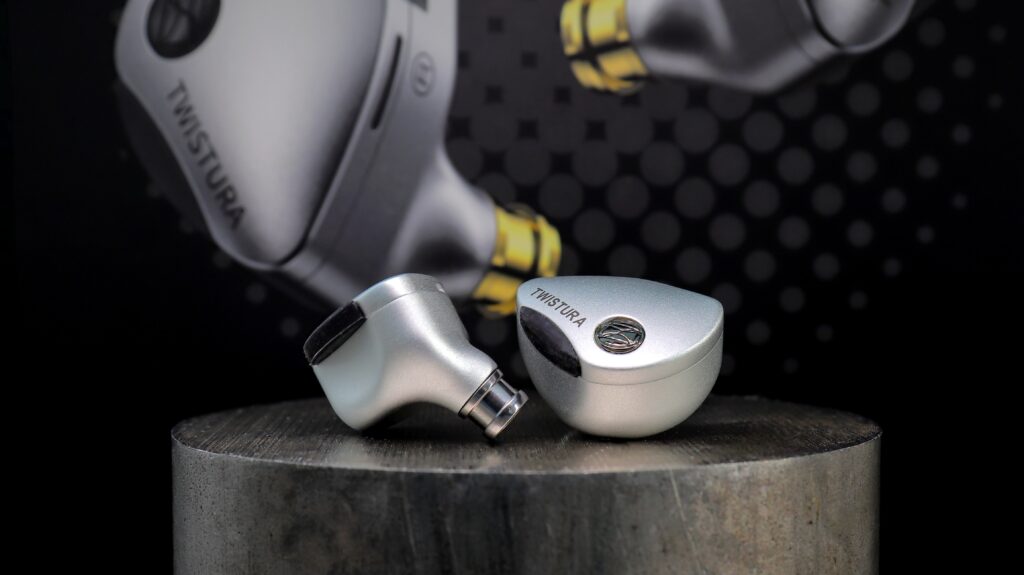
Hello, this review and feature covers the latest from the audio brand Twistura, named the Twistura WoodNote ($151). The WoodNote is actually a single dynamic driver earphone which happens to be made out of pressed repurposed wood fibers promised to provide a more earthy and natural sound due to its rigidity, natural damping, and warmth. This at least kind of makes sense to me. Of course, I am still awaiting the WoodNote which will likely arrive in the next couple days. When it does, it will be the 1st Twistura product that I’ve ever tested or spent time with. So, whether you ever read this or not depends entirely on how good this set is. We shall see.
Table Of Content
- Intro
- Twistura
- The WoodNote has arrived!
- Non-Affiliated Purchasing Links
- WoodNote Pros
- WoodNote Cons
- Gear used for testing
- Packaging / Accessories
- Unboxing
- Eartips
- Carrying Case
- Nozzle Filters
- Vocal Nozzle (Gold)
- Instrumental Nozzle (Light Silver)
- Standard Nozzle (Darker Silver)
- Cable
- Build / Aesthetic / Internals / Fit
- Build Quality
- Aesthetic
- Internals
- Wood-Fiber Diaphragm
- Fitment / Comfort
- Drivability / Pairings
- Sensitivity
- Scalability
- Source Pairing
- Sound Impressions
- What’s it sound like?
- Musical / Analytical
- Sound cont…
- In Good Company!
- Not for everyone
- Bass Region
- Bass Region Intro
- Quality-Over-Quantity, yet w/Good Quantity
- Some juice will open her up
- Sub-Bass
- Mid-Bass
- Downsides to the Bass Region
- Midrange
- Midrange Intro
- Midrange cont…
- Lower-Midrange
- Lower-Midrange cont… (Male lead tracks)
- Upper-Midrange
- Downsides to the Midrange
- Treble Region
- Treble Region Intro
- Very Talented
- Technically Speaking
- Downsides to the Treble Region
- Technicalities
- Soundstage
- Separation / Imaging
- Detail Retrieval
- Comparisons
- NFAcous NA20 ($120)
- Non-Sound Stuff
- Sound Differences
- Between the 20’s
- Final thoughts on this comparison
- Fiio FD15 ($149 – $165)
- Non-sound Stuff
- Sound Differences
- Between the 20’s
- Final thoughts on this comparison
- Hidizs MK12 Turris ($180)
- Non-Sound Stuff
- Sound Differences
- Between the 20’s
- Final thoughts on this comparison
- Last Words on the Twistura WoodNote
- The Why…
- That Sound!
- All rounder?
- Conclusion
- Other Perspectives
Twistura
So, upon doing a little digging I can see that Twistura isn’t just a young brand, they’re actually brand new. Founded as recently as 2024 in China and they already have four distinct iems in their catalog. Those being the Twistura WoodNote, the Twistura D-Minor, Twistura D-Major, and Twistura Sigma. I was actually asked by Twistura which item I’d like to review, which was very curtious of Twistura. I obviously opted for the WoodNote which intrigued me from the jump. However, after looking at the rest of their absolutely beautiful lineup of budget friendly iems, I wish I could feature them all. Really folks, take some time and check out their products, truly gorgeous. At any rate, Twistura is a new brand, and I feel that they are walking into this hobby correctly. They didn’t start out in the business going right to +$1k kilo-buck iems and they didn’t jump out proclaiming outlandish claims about their products either. They let their products do the talking and that is how you gain respect in this audio space. Unless of course your products aren’t any good, but I can tell you that the word in forums, threads, and in groups hasn’t been harsh to Twistura thus far. I don’t know much about Twistura and I don’t think many people do. In that way they are at least somewhat of a mystery. However, in their name alone they subtly spell out their intentions as they began with a vision to blend “Twist” (individuality/innovation) and “Aura” (emotional connection to music). Hence the name “Twistura”.
The WoodNote has arrived!
Okay fellas and females, I am at least marginally surprised by just how well done the packaging is. Not to mention how well built this iem is. The WoodNote stands as Twistura’s highest priced product and clearly their flagship product and for all intents and purposes it plays that role exceptionally well. I honestly am kind of surprised at just how premium the entire experience has been getting to know this set. Please trust me, if it wasn’t a good unboxing I wouldn’t even mention it but create a lackluster “Unboxing” section. Friends, the unboxing looks like it should have been a $200-$300 iem. Nevertheless, more on that later. To me the biggest surprise has been in the sound department. I am very happy with what I’m hearing as the musicality is evident from the moment I hit play with the WoodNote in my ears. I am now putting the WoodNote on the burn-in station, and it will remain there for at least three full days. However, this has me thinking about the other $100 to $150 single DD’s that the WoodNote has to compete against. Sets like the NFAcous NA20, the Fiio FD15, the Hiby Yacht 10, the Hidizs MK12 (around $179), the Sivga Que UTG, and the Dunu Kima 2… among many others. Where exactly does the WoodNote sit against those other enormously popular and well praised sets? What genres best fits the WoodNote’s tonality? I guess I have at least a few weeks to figure that out. So, I suppose I will see you all then. Let’s check out the WoodNote shall we…
Non-Affiliated Purchasing Links:
WoodNote Pros
-Build Quality is premium at every angle you turn this set
-Also, the aesthetic is simply gorgeous
-The unboxing is what you’d find on a $200-$300 set
-Great modular cable
-Working nozzle filters
-Excellent balance of the spectrum w/ the Standard nozzle
-Natural timbre with a great smooth/crisp sound
-Deep and extended bass that isn’t too overwhelming, punchy, defined
-Great vocals from a confident and melodic midrange, beautifully rendered
-Treble is nicely crisp (depending on nozzles), decent extension, detailed
-Decent-to-good technicals (details, separation, Imaging)
-Imaging ability is better than many single DD’s in its range
-Great layering of the sound field
-Stage size has solid depth/height and very immersive
-The WoodNote is what I’d consider an all-rounder set
WoodNote Cons
-Instrumental and Vocal nozzles may be a hair too pronounced in the upper mids
-Treble can be rather bright, dry, slightly grainy with certain nozzles
-Average stage width
-Somewhat source/power and even slightly tip dependant
-As nice as the cable is, it is also very stiff (is this a con for you?)
Gear used for testing
–IBasso DX240 with Amp8 MK2
-Many more sources used including weaker Android 3.5 set phones, iPad, and a few weaker 3.5 se dongles

Packaging / Accessories
Unboxing
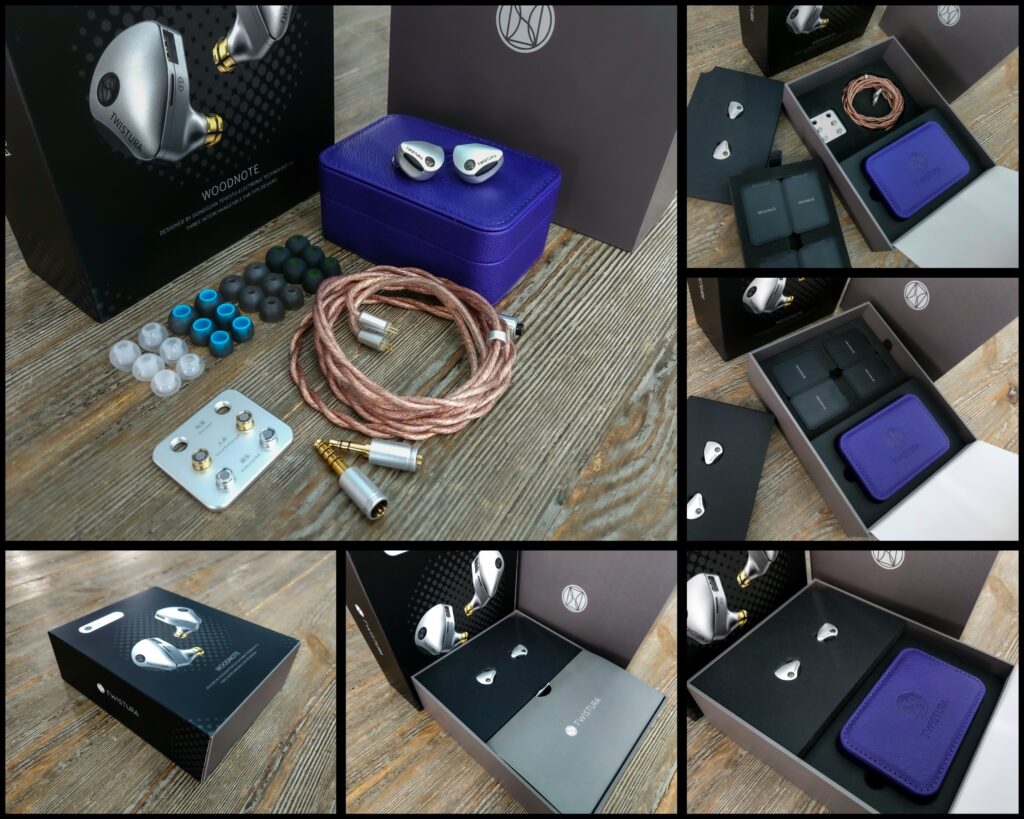
When it comes to the unboxing efforts of Twistura it is clear that they were trying to make a solid 1st impression. Or they just understand us hobbyists. Either way, the unboxing is quite nice. The WoodNote arrived at my home in a fairly large black box (6 ½” x 8” x 2 ½”) with a nice picture of the WoodNote earphones on the cover sleeve along with a frequency response chart and some specs on the back. Once you take the sleeve off, you’ll see a gray box made of hard cardboard with a white Twistura logo in the middle. Very nice looking. Take off the box top and right away you’ll see the beautiful WoodNote earphones sitting beautifully in cut-outs of a large foam piece. Next to the earphones there is a larger box and inside of that box you’ll see the deep purple carrying case (so dope), and inside of the case are the modular cable adapters. Now, take out the earphones foam layer and you’ll find four sets of #3 Pairs of eartips and each set has its own plastic holder. Very cool. Lastly, under that layer of foam you’ll find the tuning nozzle aluminum holder with all three sets of nozzle adapters. Next to the nozzles you’ll see the beautiful cable. Folks, this package was one of the better unboxing presentations that I’ve seen. Also, for as big as this box is, Twistura didn’t waste any of it. Each layer was used well and presented well. I have nothing but glowing words for how Twistura packaged their flagship model. Folks, this unboxing is how a flagship should look.
Eartips
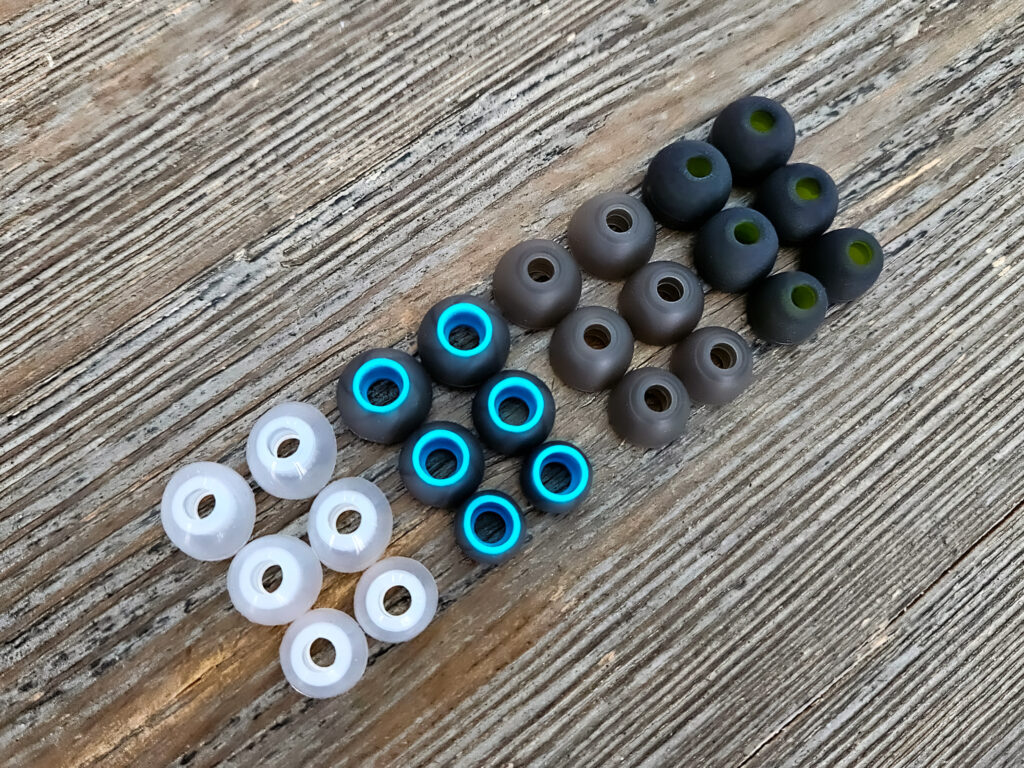
Twistura added in a total of 12 eartips over four sets, and three pairs of eartips in each set (S, M, L). The first set are dark gray silicone tips with a narrow bore, firm flange, and they do well to subtly attenuate the upper mids. The next set of three are dark gray silicone tips with a light blue stem very similar to some of my absolute favorite wide bore tips; the Tenmak Whirlwinds. These tips are shallow fit, wide bore, and they come with spiraled ridges inside of the flange which helps with firmness and rigidity. Great tips when you need them and great for emphasizing the upper-mids/treble regions. The next set is a white/clear silicone tip similar to liquid silicone but not as sticky. Not exactly anyways. Once again, rigid and firm flanges and they come with just under a semi-wide bore. Not quite narrow. These tips seem to enhance the vocals a bit. The last set is the pair that I chose to use for much of my critical listening. These are dark gray silicone tips with a bright green stem that is extremely rigid. The flanges are also the firmest of all of the tips. These tips also have a narrow bore, and they also subtly attenuate the upper-mids as well as boost the mid-bass a hair. Honestly, the tips that were added are all solid tips. Each set is firm, made of decent quality too. The only thing I’d add is that maybe a good set of semi-wide bore tips similar to the KBear 07’s would’ve been good. Other than that, all great inclusions.
Carrying Case
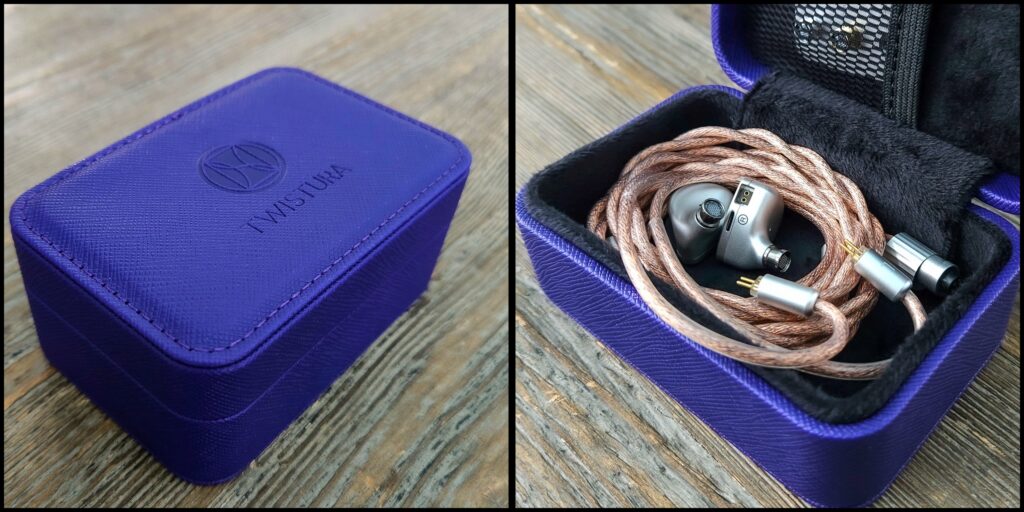
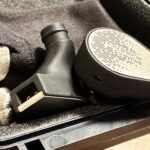
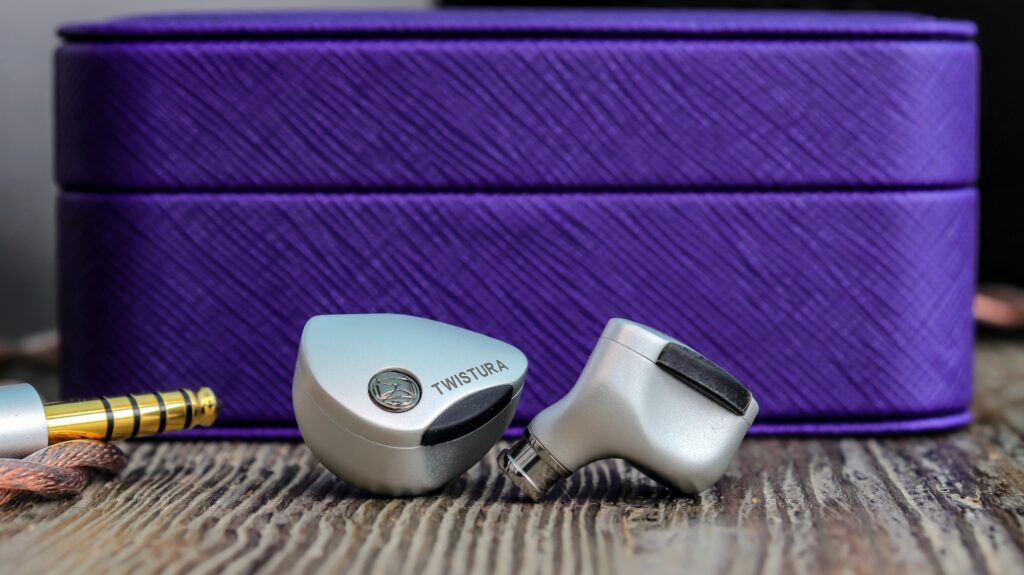
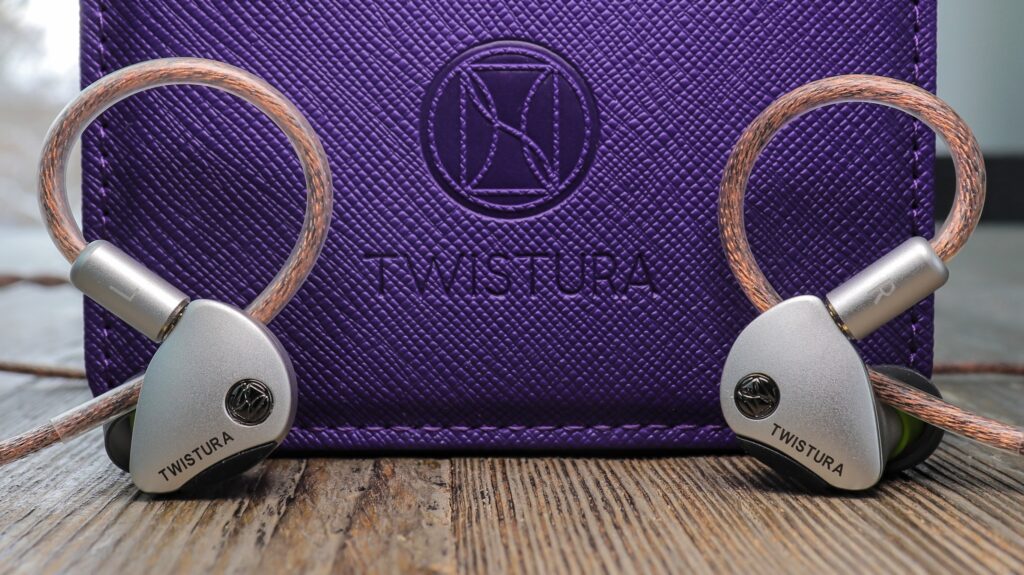
One of the cooler looking inclusions was without question the carrying case. This case is so dope. It’s a very nice looking deep purple colored hard case which is cladded in a faux-leather material and has such a nice textured feel to it. You’ll notice “Twistura” imprinted on the center of the case top as well as nice looking stitching encircling the top. It’s a very nice-looking case. The case top closes shut with a strong magnet. To add to that, it’s also a nicely sized case. Too big to put in a pocket but large enough to fit plenty. I can easily put the earphones, cable, nozzle filters, and the eartips inside as well as a very small dongle dac. The case is a very rough measurement of 4” x 3” x 2”. So, it’s a very good size. Also, it feels durable in hand. As far as carrying cases go; this is a good one.
Nozzle Filters
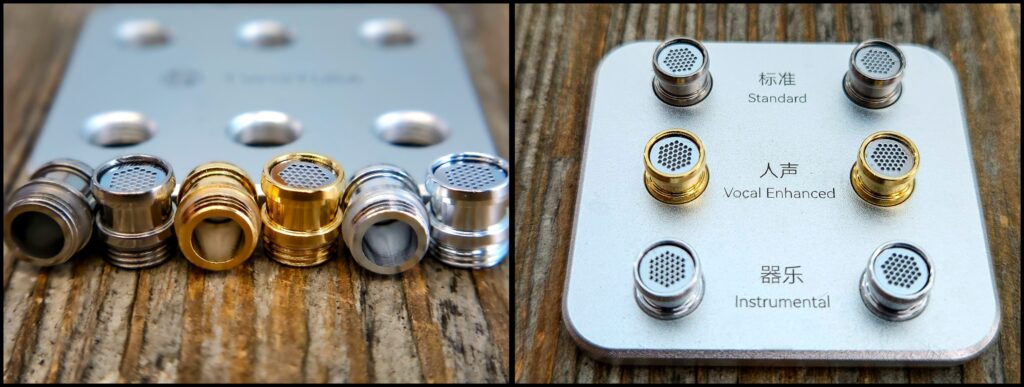
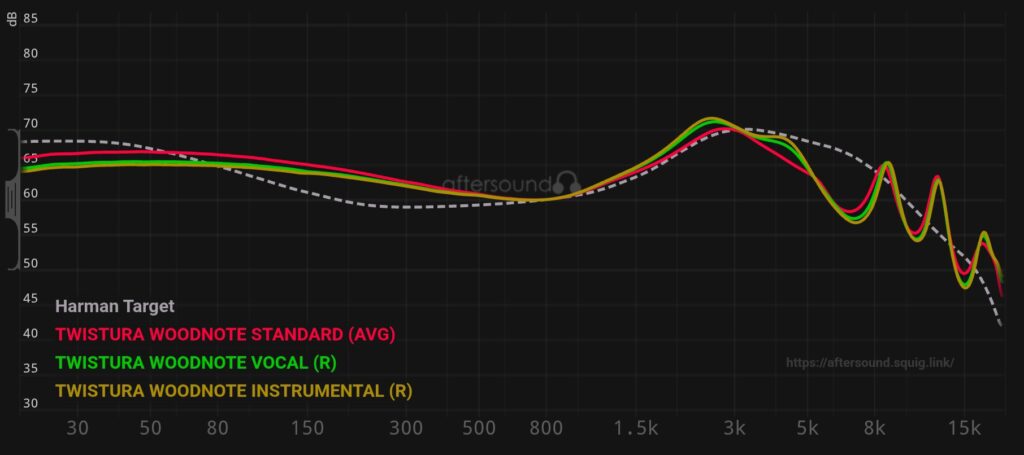
Like I said earlier, one of the benefits of the WoodNote package is the fact that Twistura added in three different tuning nozzles. Each set of tuning nozzles is supposed to change up the sound to a certain degree using different acoustic damping inside of the nozzles which mostly affects the upper-mids and lower treble. However, changing the upper-mids & lower treble also affects how we hear the bass region too. I can tell you that each nozzle does perform exactly what Twistura claims that they do. You see, Twistura named the nozzles “Standard”, “Instrumental”, & “Vocal”, and each one at least somewhat represents their label. Before I go any further, I just want to add that I used the standard nozzle for all critical listening due to its nice balance & warmth coupled with the natural cleanliness of the WoodNote. I did find the other two nozzles to be a hair too pronounced in the upper mids & treble, at times.
Vocal Nozzle (Gold)
The 1st nozzle I will be speaking on is the “Vocal” nozzles which were meant to introduce midrange prominence by a slight degree while dialing back the bass focus as well. Without question female vocals sound more deliberately prominent and male vocals lose a hair of warmth. To my ears I find the upper-mids very nice for my taste, though a hair thinner and more vibrant. No doubt that those who are sensitive to upper-mid glare may find this nozzle to be too much. Though I know plenty of folks who will likely enjoy this nozzle quite a lot too, so, take that for. You get some good sparkle and air in the upper regions. Sure, the mids thin out a hair, but the micro-detail retrieval jumps up a notch, separation too, and imaging is slightly easier to discern. Admittedly, once again, it’s a hair too vivacious when I have the Standard Nozzle waiting for me. If there was no Standard Nozzle and the vocal nozzle was my only choice, I’d be happy with it. Not my perfect preference, but it’s a solid analytical style sound.
Instrumental Nozzle (Light Silver)
Now, the next nozzle I’ll talk about is my last favorite of the three, but it’ll also likely be the favorite of those who enjoy a more treble focused sound. In truth, the difference from this nozzle to the Vocal Nozzle isn’t much. However, a good ear can hear the difference as the Instrumental Nozzle definitely brings a more technical spin to my music. It adds even more sparkle, more air, better note separation, and a more multi-layered sound and brings upon the perception of even less bass weight. Of course, this nozzle also brings a slightly more fatiguing sound when listening to brighter or more energetic recordings. So, it’s certainly the airiest and most enhanced in the treble, but it still isn’t bad by any stretch for the type who really enjoys a gleaming treble with loads of crispness and even some treble bite.
Standard Nozzle (Darker Silver)
Without question the Standard Nozzle is my favorite of the three. The Standard Nozzle is the most natural sounding, has the best balance of the spectrum, has the most perceived bass quantity, and it comes across the smoothest of the three. In my opinion, the Standard Nozzle easily is the easiest on the ears with much less upper-mid shout and treble glare. Using the Standard Nozzle you still have enough treble lift and midrange energy, but you simply won’t have nearly as much brilliance. This nozzle is the most different from the other two and really does provide the biggest departure from the other two tonally. This is the nozzle that made me so thrilled with the sound of the WoodNote and is certainly the nozzle that I will use for most, if not all of my critical listening.
Cable
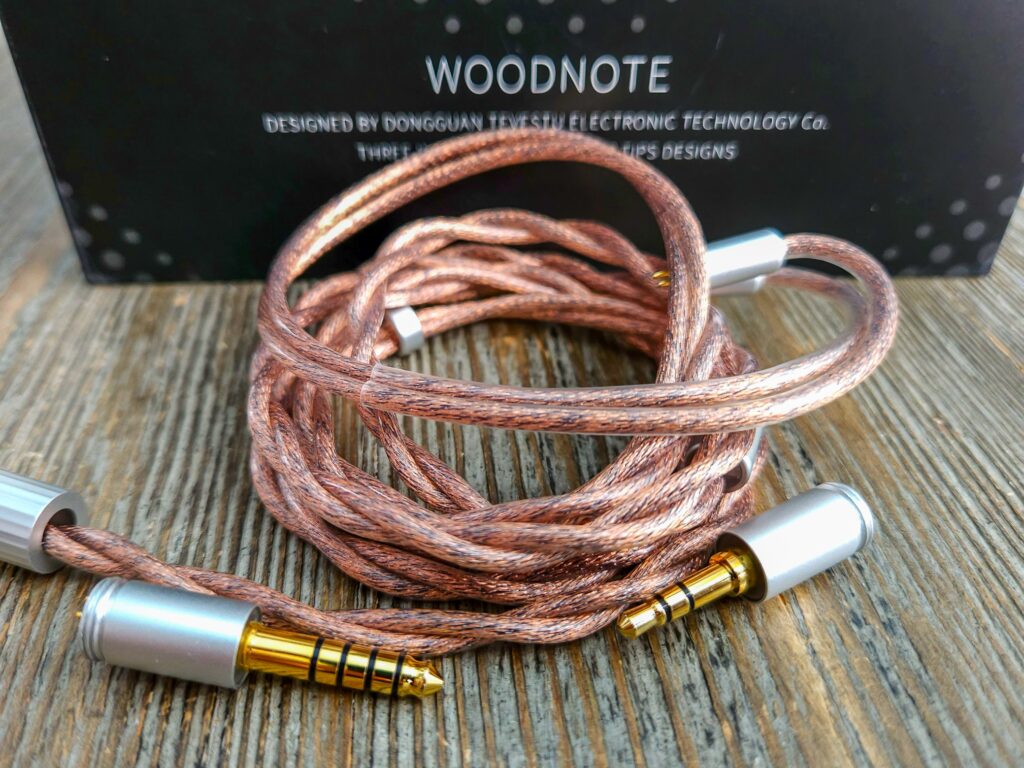
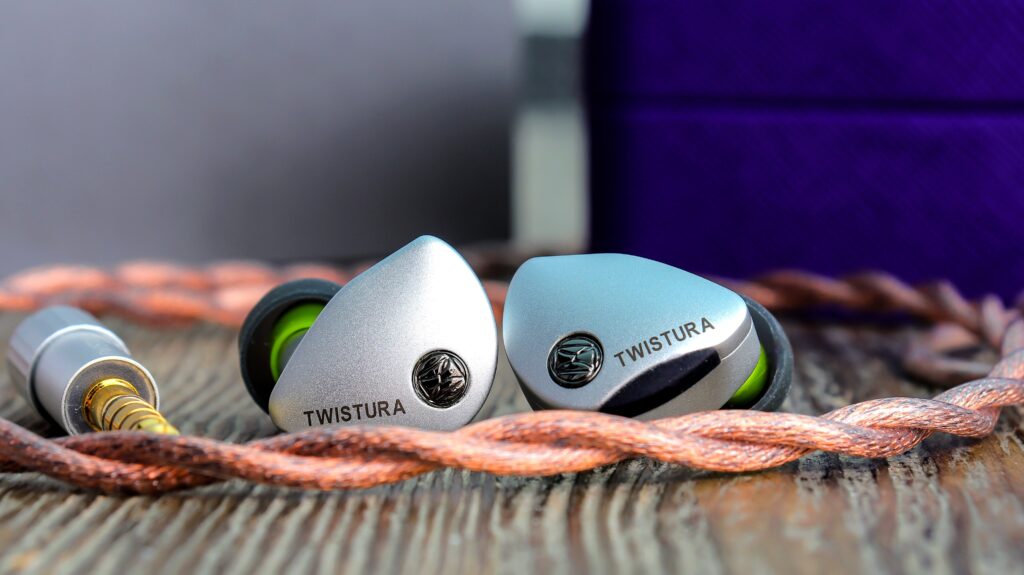
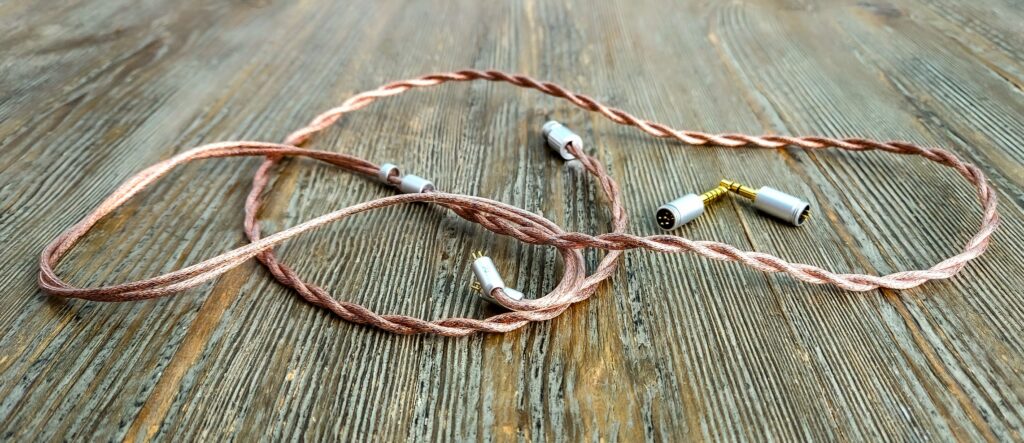
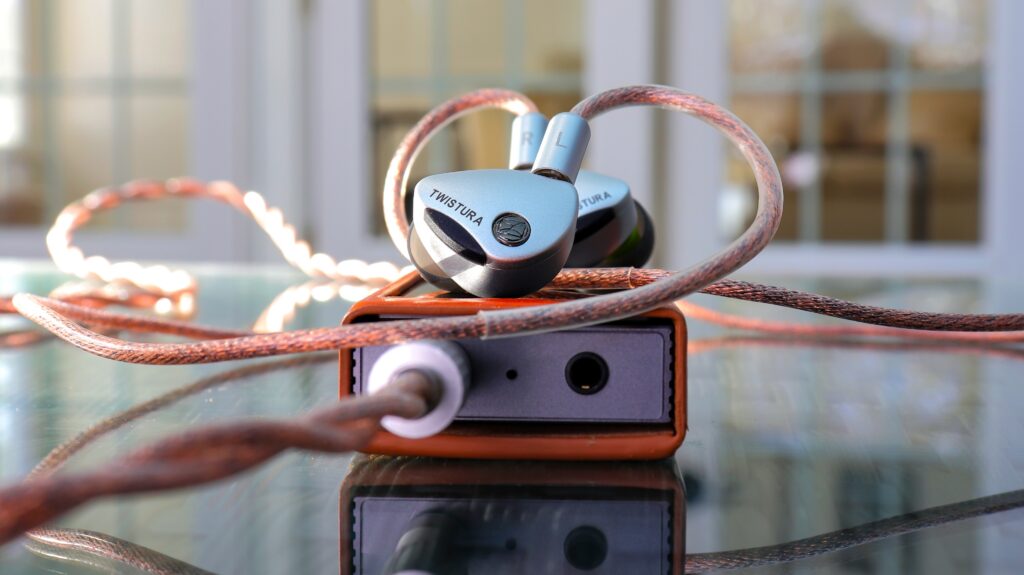
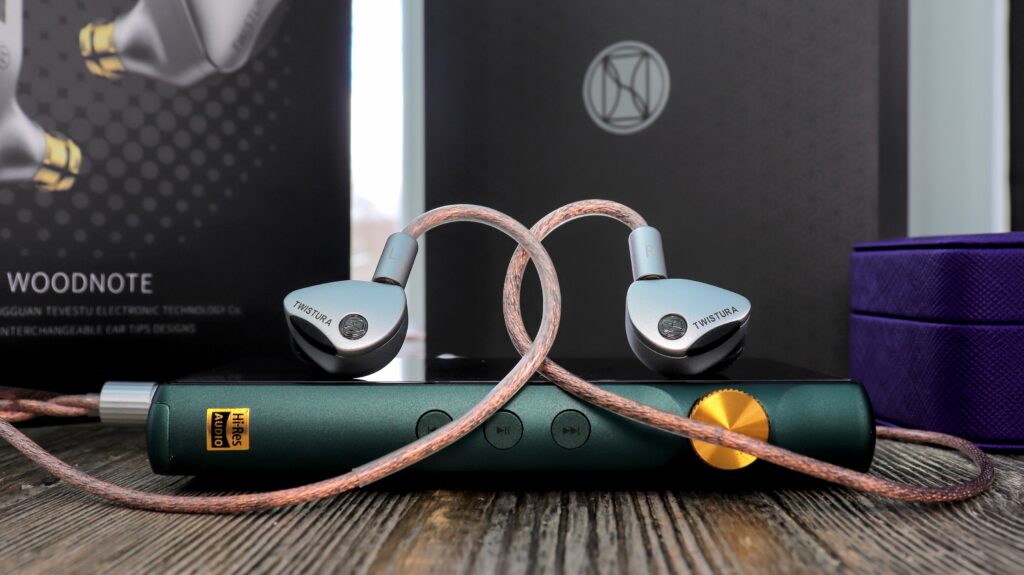
The last accessory added into the packaging is the very nice cable that Twistura added into the experience. I actually found that this cable is very nice alongside the WoodNote and best of all I haven’t thought about cable swapping. Aesthetically this cable is great, and sound wise I have no reason to change the cable. Now, to be exact, the cable provided is a 2-pin modular cable that comes with both 3.5 set and 4.4 balanced adapters. This cable is actually a mix of OFC (oxygen-free-copper), silver/copper alloy, and graphene/copper materials. It’s a 2 braid style with a harder outer sheath (which is a good or bad thing). All of the fittings are made very well (aluminum), like the y-split, terminations, and chin slider. The mechanism to keep the adapters held on is something that we see all the time now and that is a threaded barrel that you screw on and lock the adapter in place, so you won’t have them falling off or becoming loose over time. The cable itself is copper colored which really looks gorgeous paired with this gorgeous iem. The only downside that I see is the cable is a bit stiff. Sometimes when rolling the cable up for storage it can spring apart and become a hair of a problem. Other than that, it’s a dip addition into the packaging.
Build / Aesthetic / Internals / Fit
Build Quality
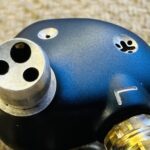
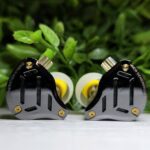
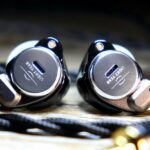
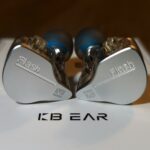
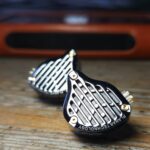
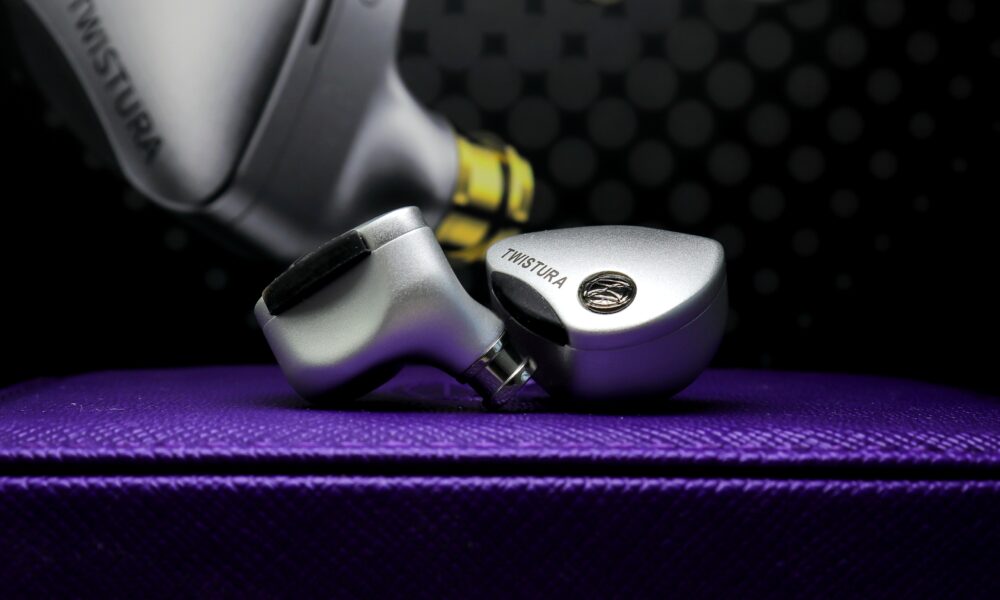
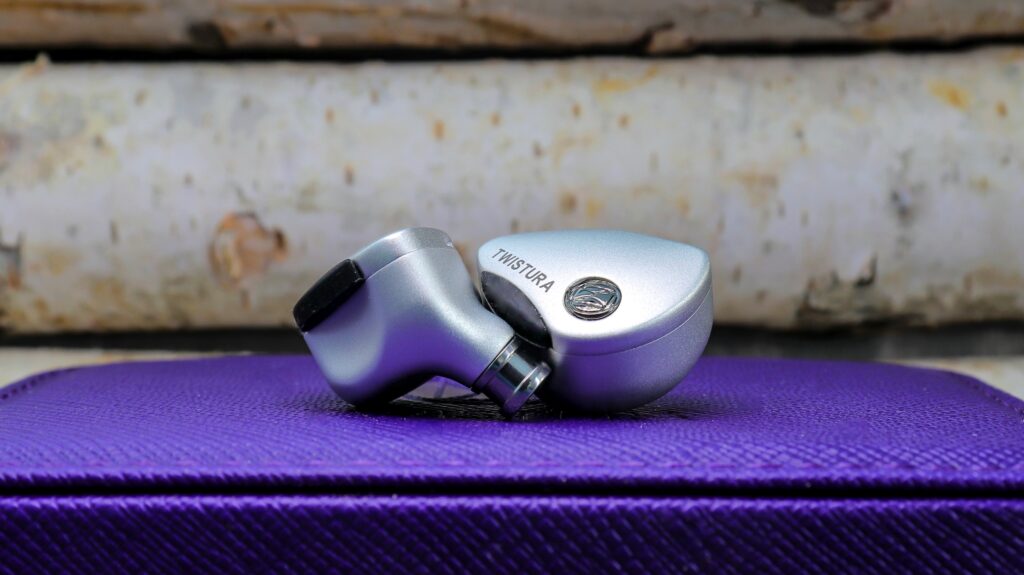
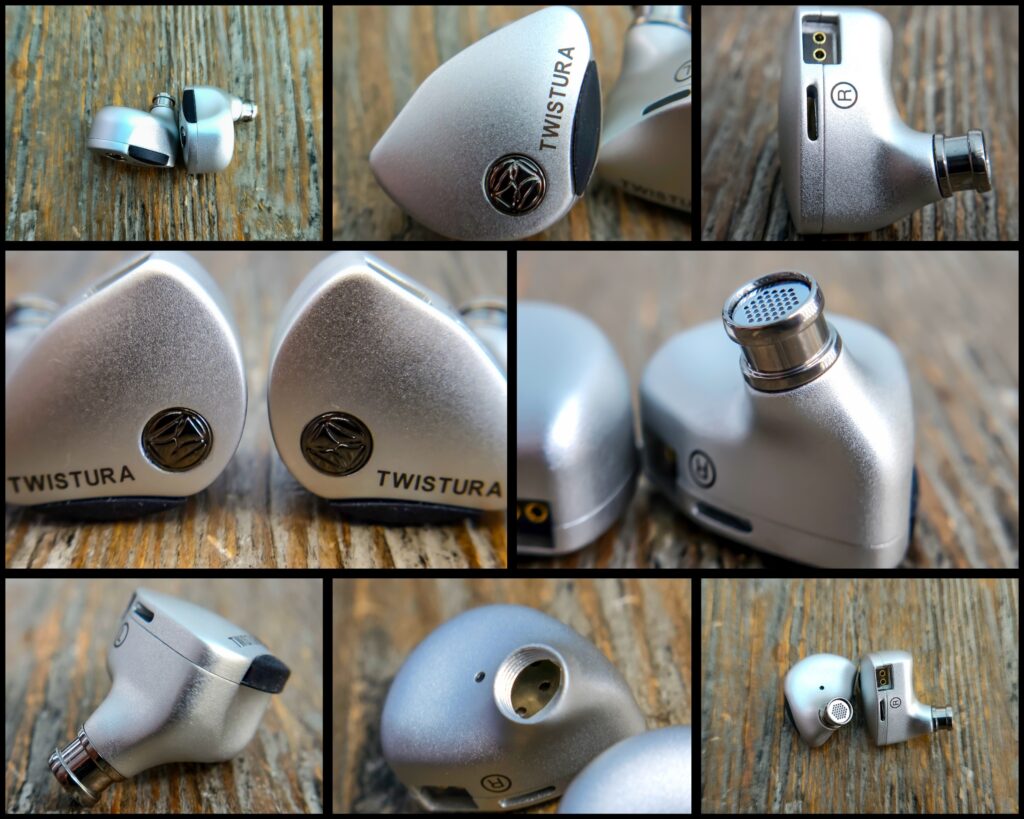
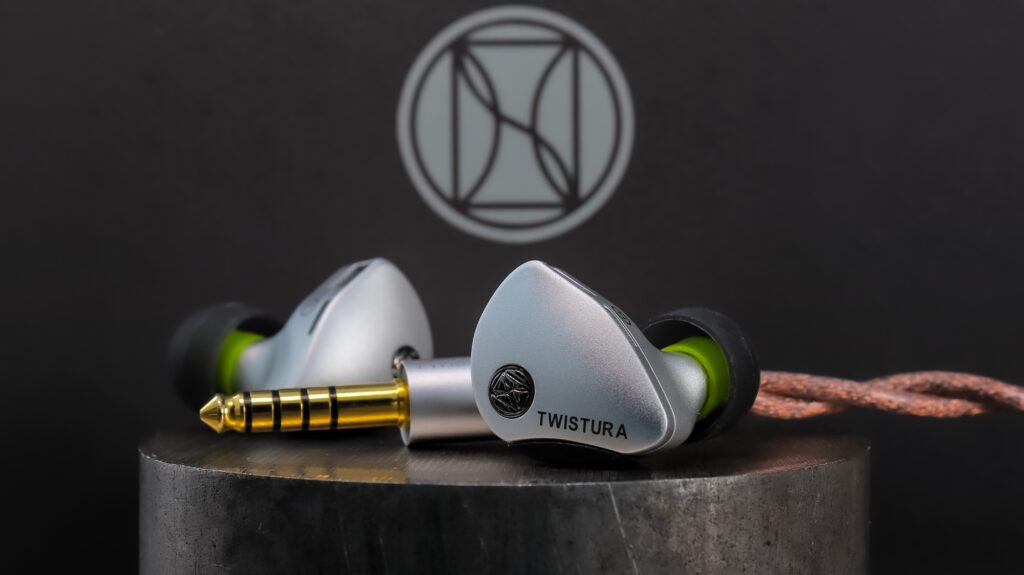
This build is all about beauty, elegance, class, and minimal acoustic resonances. Made entirely from aircraft grade aluminum by way of CNC machining, the build is absolutely substantial. The entire design is seemingly made to be perfectly ergonomic as it fits like a glove, and it isn’t too big nor too small. Granted, there are literally a ton of iems with good ergonomics anymore and so this is not a major thing. However, the fact that the WoodNote feels as durable as it does is still a good thing to mention. The nozzles are right around medium length, which is a completely subjective take from me as I have zero clue what “medium” is. Lol. However, I can say that the nozzles are right around standard at 6mm wide. As far as venting, Twistura needed to vent both the front and back cavities and so there is a small vent near the nozzle area as well as a long vent towards the back side near the 2-pin connectors. I should also note on the bottom of the shells near the faceplate is a long piece of rubber which is placed there to help with wear comfort over longer listening sessions. A very thoughtful decision there as we rarely ever see rubber incorporated into iem design. In all truth, there isn’t a whole lot to say about the build other than it’s clearly obvious that the WoodNote is built very-very well. The aluminum is very lightweight, very durable, corrosion resistant, and holds up much better than most any other material. So, it’s always a good thing to see aviation grade aluminum.
Aesthetic
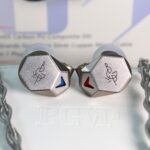
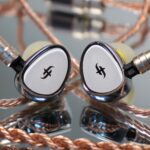
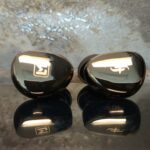
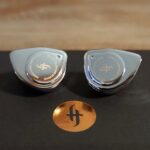
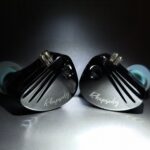
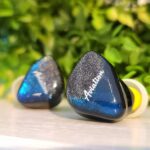
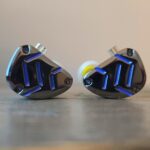
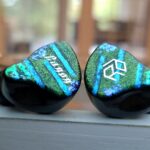
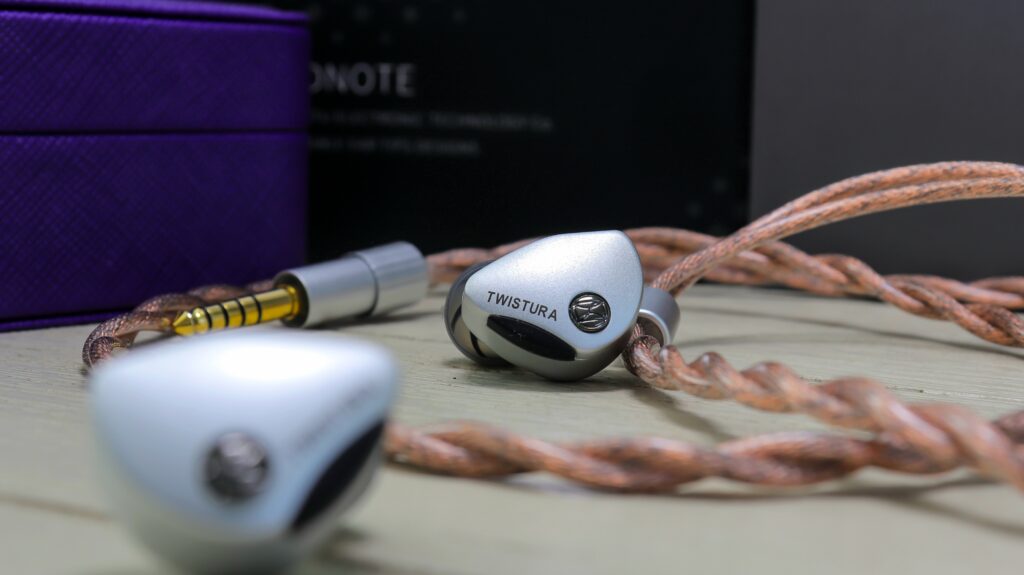
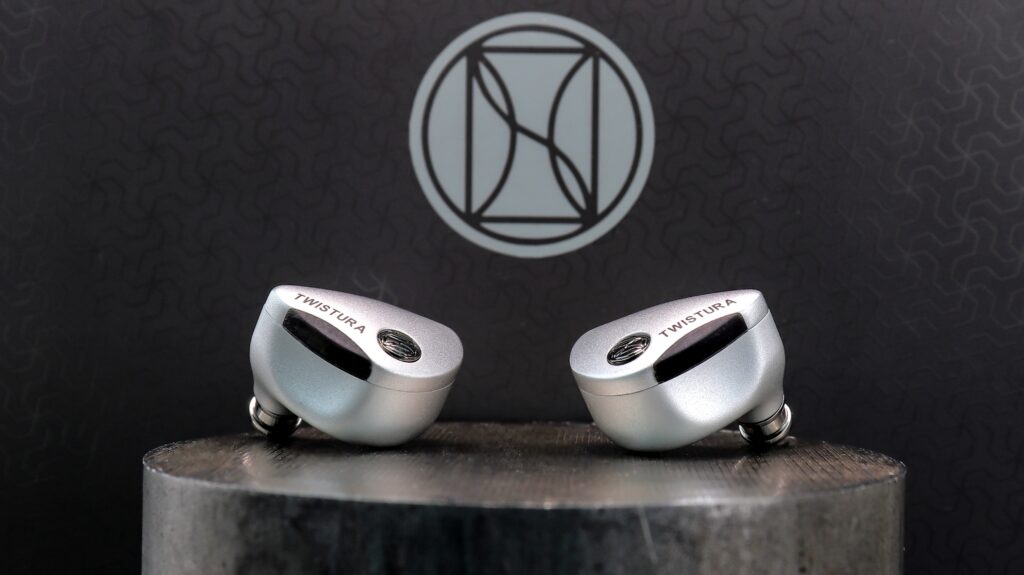
When it comes to the aesthetic and actual design/look of the Twistura WoodNote I have to say that this is such a classy design. I am beyond impressed with every last detail that Twistura added to the appearance of this set. First off, I love the matte silver aluminum look. It’ll always look good, and it certainly looks great on the WoodNote. Next, the design itself simply looks handsome. It’s a very premium looking set of earphones. If you don’t see the matte aluminum then you are looking at shiny aluminum, stainless steel, or brass on the nozzles. I won’t go too long on this, but Twistura obviously has an eye for what appeals to us hobbyists because everyone I’ve talked to about this set says the same thing… “These look dope”! Okay, so beyond the matte aluminum covering the WoodNote shells, you’ll also notice on the faceplates, at the bottom, a small “Twistura” imprinted with black lettering, which is a nice touch. Also, right next to the lettering is a small black Twistura logo. Folks, I rarely like seeing logos or names on my earphones, but somehow the way that Twistura did it looks appealing. It’s a nice and classy look. Twistura did a nice job on this set.
Internals
Okay folks, so now we get to the heart of this set and the reason why it is (in my opinion) one of the better single DD earphones under $175. So, Twistura decided upon a very unique driver material in this single dynamic driver earphone. They actually went with a proprietary dual-cavity, dual-magnet 10mm wood-fiber ball-top composite diaphragm designed and made in-house by Twistura. This is no small thing folks. I see no where where any OEM manufacturer or 3rd party crafted this driver. They make them in house folks! You should be impressed. I love these boutique brands that do the work themselves with a cradle to market product like the WoodNote. The WoodNote also has a dual-cavity, dual rear chamber acoustic cavity which is divided to maximize air flow, driver reflex, and something like this typically minimizes vibration (for obvious reasons), and of course it helps to tighten perceived transients as well. Guided vents are connected to both the front and rear side of the driver balancing internal/external pressure and thus reducing that weird stethoscope effect and even ear fatigue as well. Twistura also used certain damping materials (I don’t know what kind exactly without tearing this set down… not doing that either). Also, the actual aluminum shell itself contributes to the overall sound in a huge way. Materials matter folks. Aluminum does a fantastic job of reducing unwanted vibrations and resonances by reflecting less acoustic energy as aluminum is very stiff, very rigid, and it also has a certain resonant absorption effect as well. As I understand it anyways.
Wood-Fiber Diaphragm
I just wanted to go back to the driver really quickly because I really am impressed with what Twistura has done here folks. The mere fact that Twistura created this driver in-house puts a whole new spin on this set for me. It makes me wonder how they were able to keep the price down so much with all of the R&D that goes into the designing of a driver. Unless they’ve had this driver in stock for quite some time, which probably kept the price low. This is all speculation though. So, from what I’ve learned, they had to actually take raw wood fibers and press them into the ball top form. Add to that they had to use some composite polymers or some other stabilizing material to bond the wood fibers in a rigid form. I’m sure there is quite a bit more that goes into this but I cannot help but praise the work that this young brand has done. I know, I know, there are many brands which do the same. However, those brands are definitely the minority as most brands use off the shelf drivers made from 3rd party manufacturing. Anyways, nice work Twistura.
Fitment / Comfort
I’ve already touched on the fitment, but for me the WoodNote is a very comfortable iem. You probably can’t tell by the pictures, but the WoodNote is not a large set of earphones. For me and my ear shape the WoodNote shells sit perfectly in my ears for a very comfortable experience. Again, this set is very lightweight. Friends, this set totals 14 grams together which means that each side only weighs 7 grams each. Do you know how light that is? Extremely lightweight. Please trust me this set feels like nothing in the ear. Such a great build and such a comfortable build.

Drivability / Pairings
Sensitivity
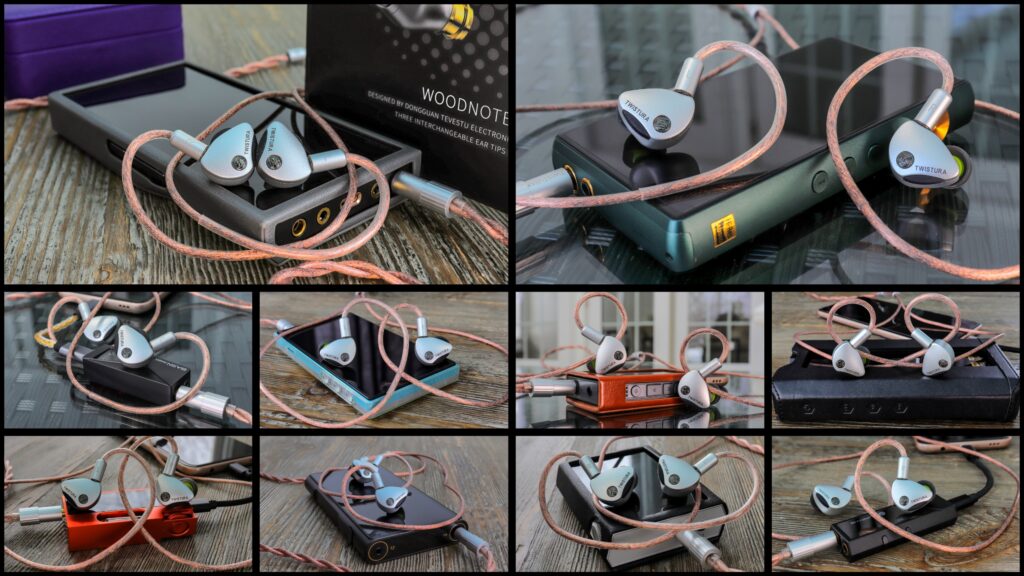
The Twistura WoodNote is listed as having an impedance of only 18 ohms and a sensitivity of around 108 db’s which means that this set is a very sensitive set of iems. I find that the WoodNote can quite literally play well off of most anything. Friends, in every single last review I test every set with every source device that I have. Which is basically anything with at least a 3.5 single ended port. I tested this set briefly with an old Android Samsung phone, my iPad, the KZ AN01 and AZ20 Bluetooth earhook adapters, as well as many super weak 3.5 single ended dongle dacs. Dacs like the Roseselsa RZ-200M, as well as a few super weak Conexant dac chip, no name dongle dacs. Every one of these weaker sources played both loud and dynamic. Obviously, some were better than others tonally, but they all were able to sound energetic and fun. What this means for you is that you truly do not need to worry if you don’t have a powerful source on hand. Go ahead and purchase this set no matter what source you have on hand.
Scalability
Now, just because the WoodNote is able to play loudly and dynamically with weaker sources, doesn’t mean that this is the best way to play this set. Without question the WoodNote scales nicely, to an extent. There is certainly a point where the scaling plateaus and you won’t see a big night and day difference after that point. I find that mid-tier sources with good output power like the Shanling M6 Ultra (my favorite in high gain), Shanling UA6 or Shanling UA7 (this set sounds amazing with the UA7), the EPZ TP50, or any other dongle dac with adequate power and a 4.4 balanced connection will give this set all that it needs. Having said that, just because a device has a powerful 200-600mw of max power doesn’t mean that you are getting the most out of this set. Power isn’t everything. Much more will have to do with the quality of your source, the cleanliness of the amping, and better devices with better circuitry will scale the sound the most. Once again, you don’t need power for this set to sound good, but clean amping power will scale this set with better clarity, tighter transients, better tonal contrast, more expressive macro-dynamics, and a deeper stage.
Source Pairing
To my ears the Twistura WoodNote comes across right around neutral to warm/neutral (depending on the nozzle). Using the standard nozzle it does sound closer to warm/neutral. I always say that warm/neutral is the Goldilocks zone for tonal color and pairing with the most sources. Most would think neutral would pair the best, but I have found that is not true. No sir, it’s warm/neutral. I find that any source tonality which ranges from neutral to warm/neutral is best to use with this set. Definitely a cold or brighter source will emphasize the upper-mids and table a hair too much. Just the same, straight warm sources add a hair too much warmth for me. Now, you may be a warm-head or a treble-head, and you feel differently. I suppose the only reason why I add this section is to give you a somewhat of a guide as to what I feel pairs the best. In no way is what I’m saying “gospel”. You are the final judge with what sounds best for you. Still, in my opinion, the WoodNote does great with many neutral sources (uncolored), energetic sources, smoother sources, and definitely with warm/neutral sources which come across either smooth, laid-back, or energetic. At the end of the day, try to find a decently powerful dongle dac with a warm/neutral to neutral sound color and I think you’ll be good to go. The WoodNote is not picky.
Sound Impressions
*Note: before I dive into the sound of the WoodNote, I first want to add a few things which may or may not help you. First, I did burn in the WoodNote for right around three days. I do feel that this helped relax the driver by tightening up the spectrum and transients. Of course, this isn’t always easy to discern. Also, the difference could probably be found in simply listening to this set over some time. I always burn-in no matter what. Next, I used the Standard Nozzle for almost all of my critical listening. I also used both the included eartips and the included cable for all critical listening. I listen mostly to flac or better files (some MP3) which are stored on my devices. The Android music player of my choice is mainly UAPP (USB Audio Player Pro). Some of my daps use a native Hiby Music Player, and at times I do use Eddict Player. Rarely do I stream my music.
What’s it sound like?
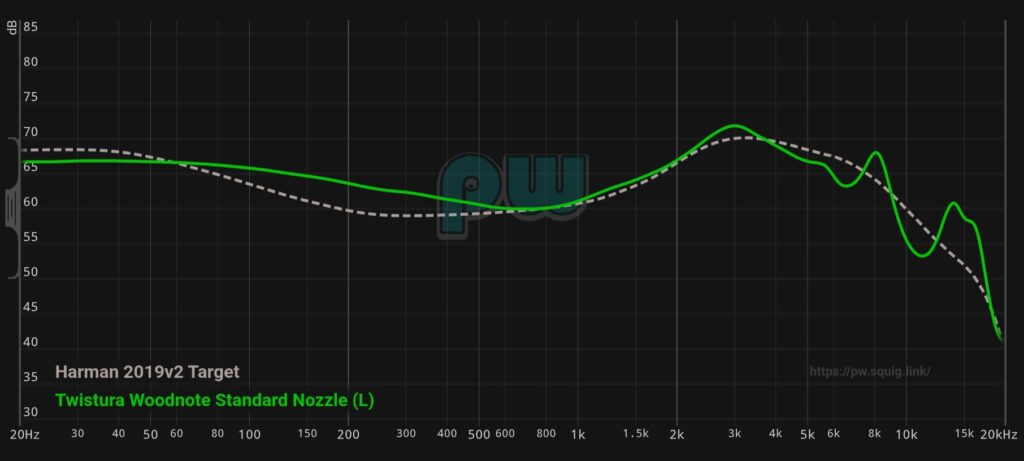
I think I really enjoy wood drivers now. Of course, I say that because the Twistura WoodNote has an unmistakably natural sound with great timbre. I really like the organic style tonality, and the organic style smoother cadence with defined note outlines. If I were to label the WoodNote as anything, I’d say it comes across U-shaped more than anything. I could possibly see how some may say mildly V-shaped, but I simply find the midrange to be forward enough and balanced enough dynamically making it “U-shaped” to my ears. Twistura really did a fine job on this set folks as it has a very nice balance across the board without any one area of the spectrum claiming dominance. What this does is create a very even-keeled sound from the sub-bass to the upper treble as each and every region has its own expression of dynamic energy. What this also does is open the WoodNote to be labeled with the wonderful moniker… “All-Rounder”. I do not find this set to be distinctly better for any certain genre. Of course, it does better with some more than others (I’ll explain that later) but for the most part the WoodNote plays nicely with most genres. To my ears, the WoodNote carries a technically adept sound which comes across nicely layered, fairly well detailed for a single DD with this tuning, and a more holographic style of soundstage.
Musical / Analytical
If you ask me, the Twistura WoodNote does a marvelous job (at the cost of $149) of providing a sound that is both musical/emotional and analytical/technical. I’d probably say the musical/analytical split is right around 60/40 as the WoodNote clearly comes across as very rhythmical and very musically gifted with a fun and mildly dynamic experience. In the same sentence, the WoodNote also carries nice clarity, it’s technically proficient, and has nice detail retrieval, even with the Standard Nozzle. Now, those details and technical abilities only get better when you choose either the Instrumental or Vocal Nozzles. However, the Standard Nozzle clearly is the most balanced and it proves this with its beautifully rendered melodic and mellifluous sound along with its high-resolution playback, transient swiftness, and clean-lined sound. With any of the nozzles I find the WoodNote to have a snappy and tight attack with nice surface textures along with a fairly speedy-to-natural transient decay. Never have I felt that the WoodNote was anything nearing a slow or lagging transient profile. The wonderful thing is that in every area of the mix I hear a smoother cadent flow to the sound. I don’t hear any over-the-top abrasiveness or anything truly knife-edged, too etched, or grainy. Honestly, it is really a nicely tuned iem that manages both types of sound profiles reasonably well. Not really a master of anything, but subjectively solid in just about every pertinent aspect of sound.
Sound cont…
I should also add that I always hear nice note weight, which is closer to natural in body than anything else. So, not necessarily “rich” all the time and not necessarily lush either. Yet also never truly thin, dry, papery, lean. The only instance of any dryness comes in the treble region when not using the Standard Nozzle, at times. So do keep that in mind. Of course, some tracks will replay a hair richer or a hair thinner and go against what I’ve said, but for the most part the WoodNote carries a more natural density and rigidity to my ears resulting in a naturally skewed note body. The WoodNote displays fairly moistened notes with a nicely tactile and textured sound. Smooth when it needs to be smooth and crisp when it needs to be crisp. Furthermore, I’d also say that the WoodNote is generally a fun sounding set. It has very nice vibrance with an energetic disposition and demeanor yet without ever crossing that line between well controlled or too harsh. I feel that Twistura did nothing to push the envelope with this tuning and created a set that many people would likely be able to get behind and enjoy.
In Good Company!
I think that Twistura did a fine job of creating a refined sound out of this set and the more I listened, the more I found the WoodNote to sound “somewhat” similar to many very notable single DD iems. The WoodNote is definitely its own iem, but there are distinct similarities as well as subtle and nuanced differences as well to sets like the Tanchjim Origin, the Simgot EA1000, and the Dunu Kima 2. I think that Twistura followed a smart tuning path and I’d be very surprised if they stumbled into this tuning out of sheer luck. The WoodNote clearly is a strong enough contender to play alongside all three of the sets mentioned above. The only true differences besides lie in texture, coloration, and timbre, as the overall tuning of all of these sets are all cut from the same cloth. I imagine that the WoodNote’s wood-fiber driver has a lot to do with its natural timbre and how using the Standard Nozzle helps this set to not carry as much shout or crisp glare as the EA1000 for example. The WoodNote has a more earthy, more woody sound and less metallic or clinical then these other sets. I only bring this up to provide you with a slight road map as to what to expect. The comparisons that I’m going to complete further in this review highlight single DD iems which are very different from the WoodNote. So, I thought it would be nice to find a few sets that you may know to help explain the WoodNote’s tuning, to a degree. Sure the graphs of these sets are similar, but the end result that hits your ears certainly has some differences.
Not for everyone
Having said all of that, the fact that the WoodNote walks right down the middle of those smooth/crisp, musical/analytical lines also means that straight-up analytical heads are not likely going to perfectly enjoy this set. In the same token, those who deeply desire a warmer, smoother, and robustly rich sound will probably think the WoodNote is too thin and clean for their analog/ lush wishes. As with every set, the WoodNote is obviously not going to appeal to everyone and there will be detractors. No doubt I could see some folks saying that the WoodNote isn’t exciting enough, maybe too laid-back too. Shoot, I could see people claiming it’s too bassy, or too smooth in its rhythmicity. Friends, I say this almost as a disclaimer. Or an overarching caveat to anyone who simply cannot get with the sound of this set. Also, I totally understand too. We like what we like. It is what it is. Let’s check out each 3rd of the mix…
Bass Region
Bass Region Intro
The low-end of the Twistura WoodNote is one of balance, and a hearty punch. It’s high in quality with a robust feel, but also a clean and snappy sound. As a whole I call this bass emphasis “just-above-moderate”, but the WoodNote definitely has a very deep and well-extended sublevel rumble. Great bass vibrance. Also, when a track requires a nice mid-bass slam, the WoodNote definitely steps up and can lay it down reasonably weighty. Just not all-consuming. The most important thing to understand about the bass on this set is that it stays balanced. You won’t hear any part of the bass that seeks to mask other frequencies or overwhelm the mix with murky warmth. That’s not to say there is no bleed either. There’s definitely some smartly tuned bleed. Enough to add body, yet not so much to smoothen any crispness & not enough to steal any clarity. The bass is less of a focus and more of a skilled partner between the bass, mids, and treble regions. Certainly not a low-end that causes veil of any sort. From the jump the WoodNote has been a high-clarity iem, with tighter transients, and the low-end follows suit very well. No doubt the lows have a more focused, very controlled, but also potent authority without ever inducing bloom, or becoming muddy. I hear a nice density down low, nothing pillowy, good snap on attack, and once again, I don’t hear anything overly saturated or overbearing. Twistura obviously went for clarity above all else. Ultimately, the WoodNote carries a very realistic sounding low-end that isn’t too clinical, isn’t too softened, and it isn’t by any stretch of the imagination… weak.
Quality-Over-Quantity, yet w/Good Quantity
These wood-fiber drivers offer a more focused and rigid slam than many single DD sets within this range, and also a nice resonant depth too. Not muddy, no long and lingering decay trails. Again, the bass sounds fairly stout with very nice grip in low-end dynamic shifts, showing off a stop-and-go style which can replay more complicated bass sections pretty nicely for what it is. I’d probably label this a “quality-over-quantity” style bass… yet with the added benefit of not really “lacking” quantity either. Again, not weak, dull, or soft. I hear plenty of authoritative muscle when a track calls for it. Which is a great thing to have if you prioritize clarity and note definition. A little body to go with that definition is always a good thing. Again, transients are generally fairly snappy, whilst also adding enough fullness and weight to carry a full-bodied bass guitar growl. I hear a well enough textured bass to come across realistic with enough tactile snap on attack to initialize those hard snares, and enough to give kick drums that nice and wetted tacky initial hit followed by a solid hollow boom. You can hear this well in “Move Along” by the All American Rejects, “Billie Jean” by Weezer, or “Feelin’ the Miles” by The Wilder Blue. So, the bass has all the fine characteristics to really do well down low. It has great timbre, well defined and well-structured notes, the bass is detailed, isn’t pillowy or weak, and this bass has some speed along with being very punchy. Again, quality-over-quantity without lacking quantity.
Some juice will open her up
One more thing before I break down the bass, giving this set some power definitely adds some bolder emphasis on this set. Hence why I like this bass the best using high gain on my Shanling M6 Ultra and high gain with just about every source that I own. Perhaps this wood-fiber driver comes alive a hair better with some added juice. Like I said in the “Drivability” sections, the WoodNote sounds great with weaker sources but simply sounds better with clean amping.
Sub-Bass
The sublevels seem to have very nice extension into the lowest of lows. Every track that I put on with a deeper register bass comes through very well on the WoodNote. Now, I don’t think the sub-bass has any more actual audible emphasis than the mid-bass, but it does very well at reaching a guttural and very low droning feel to my music. This is a very tastefully tuned sub-bass which offers quite a bit of tactile and palpable physicality without coming across basshead or bass dominant. This is a sub-bass which really does have that foundational and sturdy rumble with a deep and punchy sound, yet also a very disciplined sound too. I really appreciate that Twistura made sure that the sublevels never smear. They never blend or sound one-noted and they always sound controlled. Listening to this set gives me a pretty clear sense of articulation and texture with a fairly well nuanced presentation. I would surely say that there really aren’t many details which come across obscured or less illuminated. That’s the mark of a quality sub-bass, but it’s also a fun sub-bass. Not to the point of basshead levels, but fun, satisfying, robust, and dense in its punch. Again, I hear the vibrational feedback on any good bass-guitar track as well as the instant reward of hard snap on the transient attack of a kick drum.
Mid-Bass
The mid-bass carries the same nice emphasis as the sublevels and remains just as punchy and just as high in quality. This is a mid-bass which can handle those ultra-fast bass passages without much of an issue… ever. Tracks like “Anthem Part 3” by Blink-182 shows this off perfectly as the rapid-fire drums come through at breakneck speeds and the WoodNote doesn’t lose any definition. Notes sound rounded, full bodied, yet they also sound bullish and well separated. The mid-bass isn’t overly warm and doesn’t carry a very wide presence. This set has a more streamlined and punchy style with nice surface textures for an under $175 single DD. At about the minute mark of “Waking Up” by Washed Out the bass kicks in and every note is well accounted for with a very dense, and tactile sound. Or “Für Elise” by Jon Baptiste is another fantastic display of bass speed & controlled execution along with that rigid style note body. Furthermore, the bass also has some great timbre too. Certainly not basshead, and it isn’t going to give you those long resonance trails or atmospheric decay, but the WoodNote’s mid-bass really does have a mature bass that doesn’t forget to be fun.
Downsides to the Bass Region
The biggest downside in my opinion will come from bassheads. I mean, true-blue bass lovers who seriously enjoy a bulbous bass display. These guys and gals could care less about the WoodNote’s speed, or its texture if it doesn’t have the bullish authority that comes from a hugely emphasized bass. I can say this because I understand it well. So often I want to hear that guilty pleasure type of raucous and meaty bass. I’m also in the middle of the Hidizs MK12 DucBloke Edition and it has such a satisfying and grand rumble. I get the joy of it very well. In fact, I started in this hobby as more of a basshead. However, as I have matured and grown in my love for other music, I have found that a presentation like the WoodNote’s is actually even more satisfactory to my ears. Still, I totally understand it if the WoodNote doesn’t do it for you. I still find the WoodNote can playback EDM, warm/smooth R&B, Rap, Hip-Hop, and other bass driven genres fairly well. However, the bass won’t be for everyone and to some folks the WoodNote’s bass is going to be considered a weakness.
Midrange
Midrange Intro
When I think of the midrange on the Twistura WoodNote, I think of the word “natural”. This set is all about the timbre folks. The midrange carries that nice dynamic balance and forward-ish presentation which makes for a very uplifted and pleasant sound. I have actually come to love the mids on this set. Maybe due to its transparent clarity across the board, its immersive sound field. Or, maybe what makes this set a good one for my collection is the WoodNote’s keen ability to draw every ounce of emotion from a track and melodically display that emotion to the listener with its warm/neutral and clarity-rich style. I hear a natural note weight that never sounds dry, thin, or frail. Notes have authentic density (for the most part) to my ears. Of course, I don’t know exactly what “authentic” truly is, but it must sound at least somewhat similar to the WoodNote. The midrange is semi-forward with a semi-rich, natural note body with the transient speed to give those big orchestral swells the resounding precision and presence that they need, as well as the ability to replay the sentiment of any breathy, soft, and feathery female voice without sounding dry. I hear an airy, somewhat energetic, and precise sound and good micro-dynamics in many tracks. In my opinion pits the mids which truly shine the brightest on this set.
Midrange cont…
I’d also say that both macro and micro textures are well presented with a decently detailed approach for a set tuned without any artificial boosting. Same goes for note separation as the sound does carry enough air to add some perceived space between notes. Couple that with the tighter transient display and clean-lined sound and what you get is a solid technical performer in respect to its price and its single DD configuration. The kicker is that the WoodNote really doesn’t have a strong analytical style. It’s just clean and prioritizes organic feel and tunefulness over hyper focused and razor-sharp etching. As I said earlier, the mids offer a smooth take on cadence, on its flow, on its rhythmicity. This is part of what makes this midrange so harmonious and musical. It isn’t an aggressively abrasive sound, isn’t a dry or papery sound, and isn’t so fine-lined and crystalline that its midrange sounds too thin. There’s some actual substance to notes along with good note control and nice control of the imaging placement within the sound field. In the same sentence, this is not a set which will have your mind’s eye constantly focusing on details. You certainly could if you wanted to, but really this is a solid midrange for simple casual listening and soaking in your music. Both dynamic and restrained with capped energy which never takes me past the point of comfort but instead adds just enough excitement and vibrance. It has solid enough tonal contrast, nothing dull, nothing boring, and some expressive macro-dynamics too. It’s definitely nice for anyone who desires what I’ve described thus far.
Lower-Midrange
The lower midrange comes through warmly rendered adding just a touch of warmth infused weight to each note. Like I said earlier, I do not feel that the bass bleed caused any congestion issues, or blunted notes, but instead gives lower-midrange notes some body to go with its clean sound. The low-mids avoid recession and sound authoritative with a solid toned-down vibrance and good presence for male vocalists to come across realistic. Basically, men sound like men. Sure, at times the added reinforcement from the bass may slightly thicken some tracks which in turn won’t come across quite as unblemished as the upper-mids, and I do get an analog sense out of this range. However, the great majority of the time I hear touches of crispness and even some vibrance when a track calls for it, as well as decent enough macro-details and note separation too. Clearly not to the technical superiority of the upper-mids, but very good. Notes are a hair more rounded, and transients don’t come across quite as snappy to my ears. But again, the lower mids are all about timbre, musicality, and smooth authenticity. Especially when it comes to male lead vocal tracks.
Lower-Midrange cont… (Male lead tracks)
For instance, listening to “Appoloosa Bones” by Gregory Alan Isokov shows off just how emotive and stirring the WoodNote can sound as his voice broadly and soothingly meanders across this track with such a sweet-sounding acoustic guitar. The mood is set, the subtle warmth engages, the melody sounds immersive, and his dulcet edgy voice never sounds too edgy or raw. Or a track like “Jake’s Piano” by Zach Bryan is another which seems to stir up the emotion with relative ease. His voice has a forward presence, like it’s on a pedestal carrying a mild and appropriate prominence. Nevertheless, it’s the richer body in conjunction with that prominence and natural timbre that really helps males sound very pleasant as well as very velvety. Baritones also sound reasonably confident and assertive as well. I always test Avi Kaplan tracks like “First Place I Go” and I find the WoodNote has all the feel and bassy depth for his voice to cut through the melody surrounding him. Another is Josh Turner in “Would You Go With Me” and his deep, slightly edged, and foundational resonant voice has such a nice and noble authority with the WoodNote. Granted, there are certainly other sets which specifically target this range and baritone singers better, but All-in-all the WoodNote represents them well. Males in general sound very well-done folks. More-so than many of the less weighted and more recessed single DD sets priced around the WoodNote.
Upper-Midrange
I spoke very highly of the lower midrange. Even though it has some slight qualms that some may have, it doesn’t hold a candle to the upper-mids in my opinion. Folks, it’s the vocal clarity and refined & moistened vibrance of this range that helps the WoodNote to stand very tall against the competition. The upper-mids sound very finessed with that perfect measure of vibrance and shimmer to really display both instruments and female vocalists wonderfully. No doubt they are more forward and intimate than the lower-mids. If you are a fan of female vocals then this is one not to miss in the “under $175” range. I hear nothing metallic, nothing sibilant, and nothing artificial at all with a clean and feathered-in transition from the upper-mids to the treble. This is a very crisp range (even with the Standard Nozzle), with plenty of sparkle and fantastic presence promoting female vocals and instrumentation in a very embossed, pronounced, and striking way. Timbre never loses that organic accentuation, even in more sprightly and energetic female lead tracks. Having said that, the Instrumental Nozzle does add a touch too much raw edge and brilliance for me, but the Standard and Vocal Nozzles seem to do very well. Especially the Standard Nozzle. Females like Norah Jones in “Visions” sound effortlessly velvet with every inflection as her subtle dulcet rasp and stellar voice are so intimate and elegant. Or “Deeper Well” by Kacey Musgraves. Such an awesome performance with the WoodNote in my ears. She sounds at times whisper-soft, and others so soothing with a sweet richness in the most flowery way possible. Without question the WoodNote gives her a canvas to sound emotional, heartfelt, and vulnerable with a fore standing and ethereal resonance.
Downsides to the Midrange
I think that the largest and most noticeable issue with the midrange comes when you use the Instrumental Nozzle as I do hear a too energetic and glaring upper midrange. I’d also say that the Vocal Nozzle can also promote a bit too much vibrance. However, for those who enjoy a more sprightly and brighter sound the Standard Nozzle may actually sound a hair too muted, less crops, and not vibrant enough. It’s great to have options. I’d also say that the lower midrange will not sound quite as resolute or pristine. There is some bass bleed and so anyone who enjoys that untouched and perfectly clear lower midrange display may find the WoodNote’s lower mids clarity less obvious and too smooth, too rich. I happen to find that bleed to be tasteful and it’s what helps males to sound as well as they do, but I’m not you. There really aren’t any other glaring flaws that I hear. Overall, the mids are very nice on this set.
Treble Region
Treble Region Intro
To my ears the treble region on the Twistura WoodNote is one of reserved brilliance, smoothness, control, with a non-offensive peak brilliance with the Standard Nozzle (which I’ll be speaking on here). From my perspective, I feel that the treble is emphasized enough to add levity and a brighter hue across the mix. Emphasized enough to add some air and some sparkle too. That said, I defined that the treble was tuned to promote overall musicality rather than aggressive radiance. I admit that I could use a hair more sparkle and brilliance, but I like how Twistura was able to melt this single dynamic driver treble into the overall character of the WoodNote in such a purposefully rhythmic manner. Stuff like Violin, percussive instruments and guitar still has plenty of clean edge and treble bite to sound satisfying. Using either the Instrumental or Vocal Nozzles will definitely enhance that bite, the energy, and the radiant treble sheen. However, I still feel that the Standard Nozzle really does the best job of depicting the treble region alongside the rest of the mix. This set is such a naturally musical sounding iem and no doubt the treble has a huge part to play in that. Still, it isn’t the most exciting treble and it doesn’t gleam brightly with glittering inflections everywhere and any acute-focused treble punch.
Very Talented
With that slight complaint out of the way let me explain why the treble is very well done. While the treble isn’t the most exciting, it is very talented for a single DD. Talented in its fast transients, great note separation, fine-lined clarity and the entire treble can boast a high-resolution display without needing artificial boosting of the region. Something about this driver really does make stop-and-go dynamics, micro-textures, and detail retrieval very easy to discern without dry etching or any grainy artifacts. Basically, the treble is still smooth. No metallic edge at the crest of notes, nothing too abrasive either. Just as I’ve said for most of this review, the sound is pleasant. To add to that, it’s a high-quality treble when you consider that the WoodNote only has a single dynamic driver and isn’t tuned with loads of emphasis to help resolve better. For what the WoodNote uses inside of its shells… It is pretty nice. It has solid energy, it’s fun enough, has some luminance which uplifts the entire spectrum, good technicals, and isn’t anything near stuffy, with no smearing of treble in complicated tracks (for the most part). The only time I really hear any true technical issue comes from bright energy bursts up top with some of the finer details masked to a degree. Other than that, this is a well-done region.
Technically Speaking
One of the better qualities about this treble region is its nice detail retrieval abilities. One of the reasons why the WoodNote can illuminate some of those details has a lot to do with its transient tight driver. Transients in the treble are perceivably fairly snappy helping to distinctly separate notes in the region. It’s also fairly easy to see that extension into the upper treble is well established. The upper treble comes across rather natural and airy with a nice added spatial depth of field providing some dimensionality to the mix along with some openness. The treble is also pretty speedy. Well, as speedy as a $159 single DD treble can be. I rarely hear complex passages of music come across blended or congested. The WoodNote does a nice job of clearly defining more complex tracks. Like Billy Strings track “Ice Bridges”. This is a track with extremely fast treble play, and the WoodNote really does a great job of resolving every last guitar pluck, and every rapid-fire note. Now, the WoodNote definitely isn’t what I’d refer to as a “technical beast” and it isn’t going to resolve the subtleties as well as many analytically tuned iems under $200, but it carries nice clarity. However, once again, for what it is, the WoodNote performs nicely enough.
Downsides to the Treble Region
This is not a treble-head dream set. I think we’ve established that. However, it also isn’t even close to dark, or rolled-off, and I don’t find it boring at all either. It’s actually quite sparkly with good air. That said, those who desire that hybrid style treble with dedicated treble drivers and loads of clean-edged bite will likely want to move on from the WoodNote. With that said, I do find it hard to criticize this treble. Especially because it is so well rounded and truly works well with most any genre. Vocals and instrumentation sound great and as far as technical stuff, I am really not missing much. The only other type of listener who isn’t going to enjoy the region are those who don’t enjoy any semblance of brilliance at all. There are plenty of folks who are either extremely sensitive or just cannot stand brighter hues. These are the people who want that rolled-off, warm, and rich sound. The WoodNote is certainly going to be too bright for those folks. Especially using the Instrumental or Vocal Nozzles. In truth, Twistura did a fine job folks, and all of these downsides are honestly not downsides at all, but rather simply some subjective issues that certain types of blisters will have. Those certain types are certainly the minority. I truly feel that 90% of hobbyists are going to be very happy with the output here.
Technicalities
Soundstage
One of the technical qualities of the Twistura WoodNote that is better than your average single dynamic driver earphone is its soundstage. Now, I’d probably call the actual stage width… nice. Not enormous or some grand and cavernous chasm, but spacious. Remember, the WoodNote does have good extension both ways; in the sublevels and the upper treble. Granted, having good extensions isn’t some guarantee that the stage will be perceived as large, but the WoodNote sounds pretty full. Now, the width is right around average for a set of single DD iems. Similar to the FD15, similar to the EA1000. However, the height is very nice giving vocals some lift, and cymbals a more expressive quality. Just a more roomy and airy stage above the listener. Lastly, it’s the depth which truly makes the WoodNote’s stage stand out against some of its competitors. I hear very clean and clear front to back layering where lead elements of the stage sit up front at the anterior and rear ground details, instruments, and harmonics fade off into the back well. Now, I wouldn’t call the depth amazing, but the good thing is that it has depth at all. So many sets do not. All things considered, the soundstage of the Twistura WoodNote is pretty darn good.
Separation / Imaging
As far as sound separation is concerned, the Twistura WoodNote does a nice job. I’m not going to tell you that it is the picture of technical bliss, but the WoodNote never truly sounds congested, smeared, veiled, or blended. I’ve tried many chaotic and complex tracks in my “Congested/Complicated” Playlist, and it is very few and far in between that any track becomes an issue. As I said earlier, the only real masking that I hear is in heavy bass tracks which are dominated by huge sublevel rumble, or in high intensity and complicated treble tracks. That’s it. Of course, most every set (excluding super highly analytical technical beasts) will likely give you the same issues. Which to me aren’t issues at all. Chiefly, the WoodNote is a very clean sounding set with tighter transients, a larger stage, nice note contours. Everything sounds tight. Not unnaturally tight, but tight. No doubt this tight delivery does aid in note separation. The same goes for left to right & bottom to top imaging, as well as front to back layering. I find it very easy to hear and place instruments as I pan left to right, and the WoodNote has better than adequate depth of field helping them layer the sound field well.
Detail Retrieval
Twistura made sure to tune the WoodNote with better than average detail retrieval for a musicality-first iem. No, it won’t compete with technically tuned multi-driver iems. Nor should any of you expect any different. Having said that, I think you’ll like what you hear. Detail retrieval is very solid for what the WoodNote is. We have been seeing iems of late with a more musical tuning that can also come across very detailed. It’s happening more and more in the high-budget segment. What helps the WoodNote to stand out is that it carries an authentic timbre and the more rhythmic sound and still has the clean-lined clarity to sound distinct. Macro & micro-details can be very easy to discern on this set. No doubt it all comes down to the track being played, and you cannot have a super heavily flooded bass track as there will be masking occurring. You can’t really get around that. Also, as I said earlier, truly complicated and highly energized treble heavy tracks also do cause some masking too. So use your head and know what to expect, but the WoodNote from Twistura does a very fine job of illuminating the minutiae within my music.
Comparisons
NFAcous NA20 ($120)
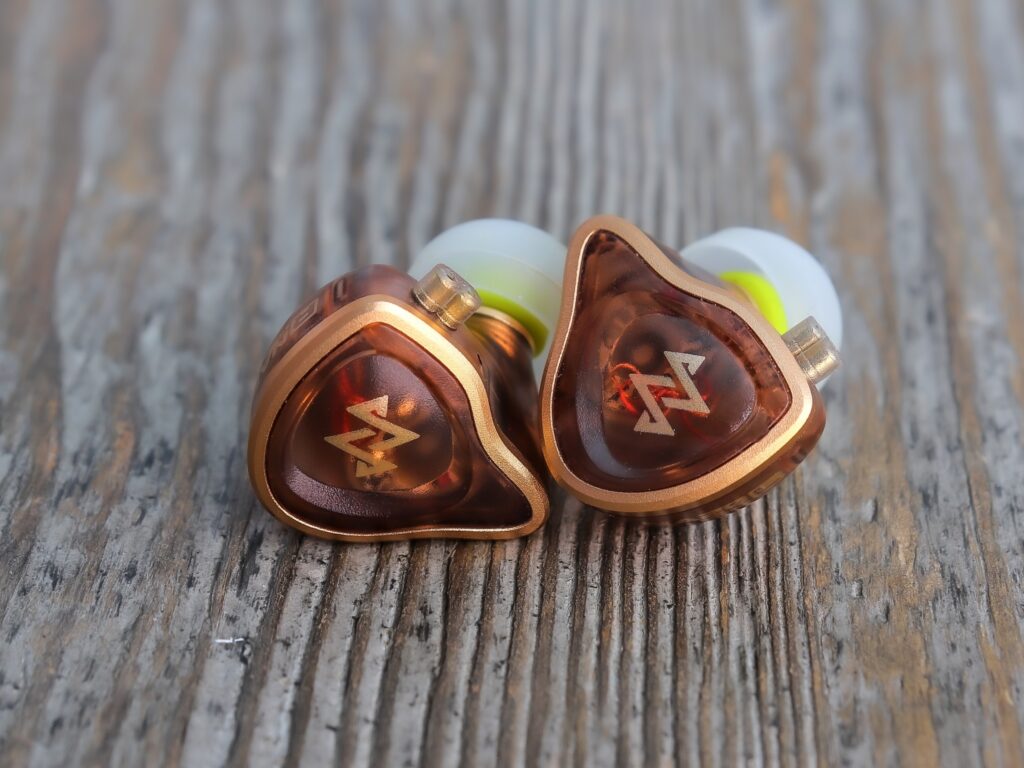
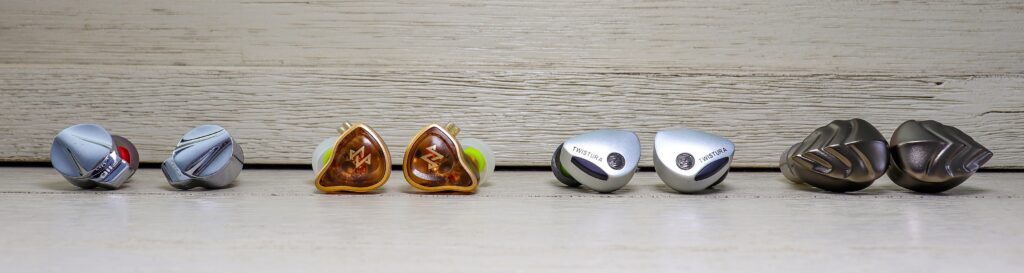
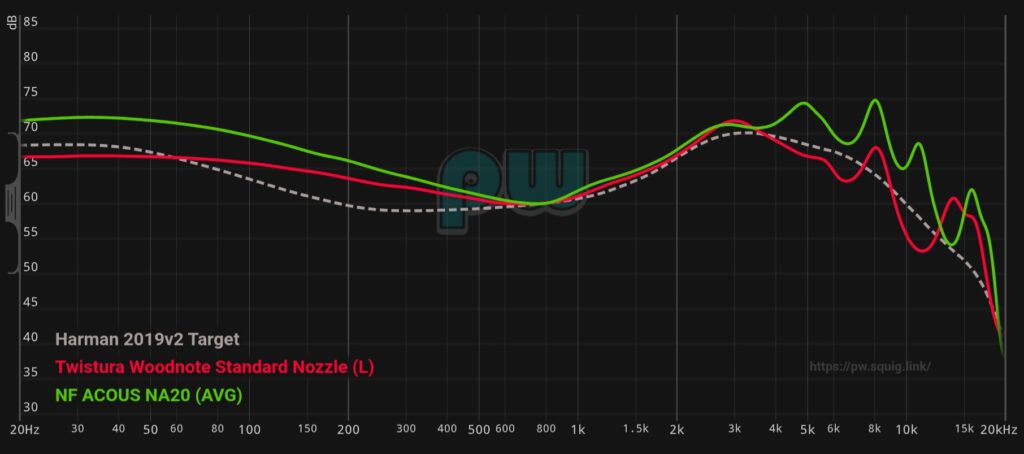
The 1st iem that I figured I’d compare with the WoodNote is one of the most fun ultra V-shaped single dynamic driver earphones under $150 named the NFAcous NA20 (NA20 Review). Friends, this set was praised up and down when it came out in 2025 for its unabashed energetic signature. The NA20 actually houses NFAcous’s brand new driver named the MCL2-100M. That means nothing to you, but to the people at NFAcous it means a lot. It’s actually a 10mm Beryllium-Plated dynamic driver iem and it is very enthusiastic in just about every way. I chose the NA20 simply due to the same driver configuration, both sets are in the $100 to $175 range, and the NA20 was adored by the masses. Plus, it has such a different signature that I felt it’d help to explain the WoodNote nicely. Afterall, that is what this review is about. However, I always look back on my choices for comparison and want to kick myself. Hopefully this wasn’t a terrible choice. Lol. Let’s check out this comparison shall we…
Non-Sound Stuff
To begin, friends, the NFAcous NA20’s unboxing is almost laughable against the beautiful unboxing of the WoodNote’s. It isn’t even comparable. Everything you get with the NA20 is almost afterthought accessories in comparison. WoodNote easily, hands-down wins that one. Much-much better cable, much-much better case, and much-much better eartips, much-much better presentation, and also, the WoodNote comes with three tuning nozzles. Please understand, I am not poking fun at NFAcous either, but this was simply such a stark difference. Next, the build in the WoodNote is also much better as it’s made purely out of aluminum while the NA20 is made entirely of resin. Listen, both are nice. I love the lightweight build of both sets very much. Both are very easy to wear over long periods too. But the WoodNote is clearly better, more unique, and simply more durable. As far as aesthetics goes, I honestly like both designs quite a lot. However, (I hate to do this) the WoodNote is much more stoic, more handsome, less about flash and more about class. Both look dope, but c’mon, the WoodNote wins again. Now, the price difference is substantial as the NA20 goes for around $120 while the WoodNote is listed at anywhere from $149 to $159. So, there is a fairly large difference there. Though, when it comes to sound, I urge you to save up if it means finding the set which will fit you best.
Sound Differences
Okay, let me start by saying that these two are worlds apart sonically. One set (NA20) is clearly and marvelously V-shaped. I mean, V-shaped with a middle finger in the air. If you didn’t know, that means it’s pretty damn V-shaped. While the WoodNote is much closer to balanced, more mature. The NA20 has a neutral signature with a warmth infused sub-bass and a bright treble. The WoodNote is warm/neutral with a much less vibrant sound in all directions. No doubt the NA20 can be fatiguing for some. I’d also add that the WoodNote has better note weight, more realistic with a much more realistic timbre as well.
Between the 20’s
The NA20 has a much deeper, more bulbous bass, more atmospheric, and denser. The WoodNote is far better defined, cleaner, more hard-edged punch, better dynamic contrast, and better separated. Next, the midrange of the WoodNote simply wins. The NA20 is more recessed, less organic in timbre, has some metallic moments, artificial moments too, while the WoodNote is simply beautifully rendered across the midrange. Maybe the NA20 can have a more detailed midrange at times, but that’s up for debate. The treble of the NA20 is much-much brighter, tinselly, with sheets of treble sheen radiating up top. The WoodNote is better balanced, more reserved, but it definitely has better and more mature note structure, less splash, less smearing of treble tizz. Simply a more refined and smoother sound, and much easier on the ears as the NA20 can truly get very bright. Detail retrieval goes to both sets. I feel that the NA20 has a hair more forced resolution while the WoodNote is simply tuned cleaner, cleaner driver, less treble masking and bass masking. However, the brilliance of the NA20 does illuminate many details. Sound separation goes to the WoodNote as well as imaging ability. The WoodNote is also the more layered sounding iem from front to back. I’ll say it again; it is most certainly the more mature sounding set. As far as soundstage goes, the NA20 has an enormously wide stage, very wide, tall too, and so it beats the WoodNote in that axis. However, when it comes to depth the WoodNote has a clear edge. Also, the WoodNote has the more intimate sound field to my ears whereas the NA20 has that stadium-like stage out in front of the listener. Both sets are fantastic for what they are. This is the definition of a “preference battle”.
Final thoughts on this comparison
Let’s face it, this may not have been a good comparison choice. I have so many I could’ve used too. However, I spent the time to complete this and I’m not going back on that now. Over 2.5 hours. Anyways, both sets offer great sonics per their respective sound signatures. The V-shaped NA20 is a bombastic and full throttle style big bass, big treble, hurricane of sound. Then you have the Twistura WoodNote which is so clinical in its musicality rich sound. So well balanced, so well behaved, such a nicely melodic and tuneful iem in every way. The picture of musically rich, technically astute, and wonderfully crafted in one set of earphones. I still love a V-shaped set from time to time, but there is no world where I feel the NA20 is a better iem. Also, sorry folks, I’ll try to do better choosing comparisons in the future… HaHa.
Fiio FD15 ($149 – $165)
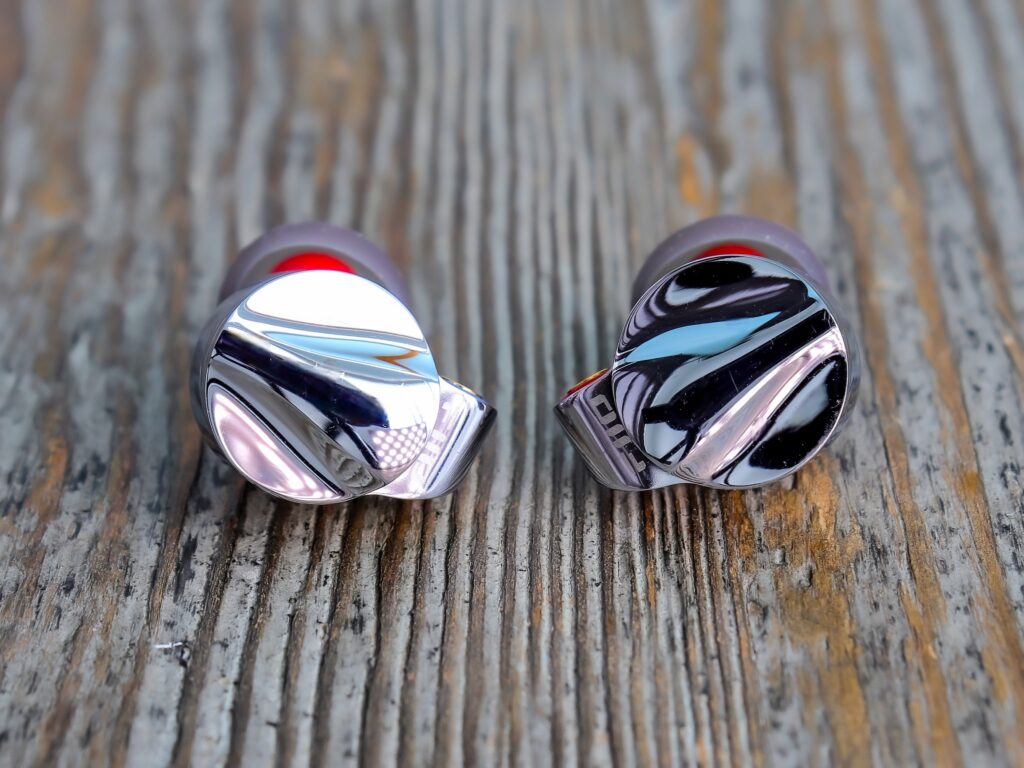
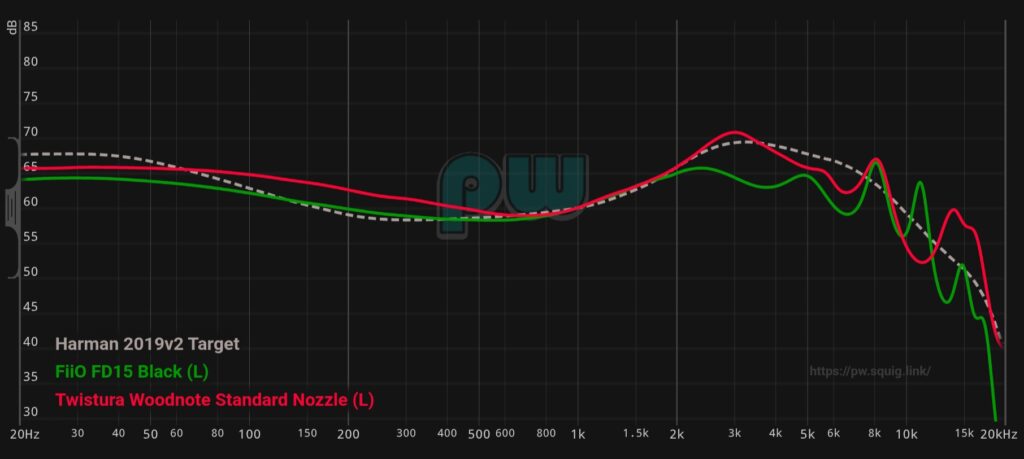
The 2nd iem that I’ve decided to compare against the WoodNote is one of my absolute favorite single DD iems under $175 with the Fiio FD15 (FD15 Review). The FD15 is one of the most surprising and wonderfully tuned single dynamic driver earphones that I’ve heard in its price point. If any set could give the WoodNote a run for its money under $175, it’s the FD15. The FD15 is such an unsung, unheard of, and totally overlooked iem and I have absolutely no idea why. It’s almost a crime. Anyways, I gave this set a huge thumbs up as it has one of the most balanced tunings that I’ve heard with an expertly clean and neural-natural sounds with such a pleasantly easy signature. Again, the FD15 comes with a single dynamic driver. To be exact, it has an enormous 13.8 mm Magnalium (magnesium-aluminum) driver with a DLC gasket. This set can push loads of air, especially when you mod them, but that’s for another day. Plus, I love the out-of-the-box sound. Anyways, this set may be a better choice for comparison, however, not many people have heard of the FD15. Again, a crime. Such a shame because the WoodNote and the FD15 only have small differences, regardless of what the graph says. Let’s check out some similarities and some differences…
Non-sound Stuff
First off, the Twistura WoodNote comes with a slightly better unboxing, more elegant, classier. But the FD15 is the one set that can compare as both sets have a slew of eartips, and a nice modular cable. I happen to feel that the WoodNote has a much better carrying case. As far as build is concerned, both sets are built very well. Though I have to admit that the 316L stainless steel of the FD15 is a bit more luxurious. Both are built great, but the FD15 is simply built like a tank. Now, the actual aesthetic goes to both sets. They are both so dope. I can tell you that the WoodNote is going to fit more people better. Trust me, it usually takes me a minute to get the FD15 and its tiny shells to fit perfectly. Plus, the FD15 is much-much heavier. That’s where the stainless steel becomes a bit of an issue and this is also where you start to see the beauty of the WoodNote’s lightweight aluminum shells. Both sets have tuning nozzles which can be switched out to alter the sound. Both sets also have well working nozzle filters. Lastly, the WoodNote costs about $10 more (at the FD15’s lowest listing) but these prices fluctuate routinely and so you may find either set selling for much less here and there.
Sound Differences
I will keep these impressions quick as my word count is counting. However, the FD15 has a more neutral take on the spectrum whereas the WoodNote is closer to warm/neutral. The WoodNote has more energy, more expressive macro-dynamics and a more exciting sound to a degree. I do find that the FD15 carries the better tonal balance though. Between the two the WoodNote has a slightly richer sound, with a slightly more earthy sound as well. Before I dive into the sound difference between the 20’s, I need to add that I used the Standard nozzle for the WoodNote and the Black nozzle for the FD15.
Between the 20’s
The WoodNote has a more textured and tighter sublevel response, more defined, punchier. The FD15 has a slightly slower bass, more atmospheric. Both are fantastic for what they are. The midrange of the WoodNote and the FD15 are wonderful, and I have zero issues with either, but the WoodNote does have the better vocal delivery for both male and females. Both are natural in timbre, both sound intimate, forward too. The WoodNote has a hair more energy in the upper mids and so perhaps you could say that the FD15 isn’t as offensive. That’s a stretch, but also a difference. Next, the treble on the FD15 is more relaxed, less energized, smoother, easier in the ears over long periods. The WoodNote has better bite, better extension, better detail retrieval, and simply a more composed and cleaner treble. I find both have big stage presentations only the FD15 has a wider soundstage while the WoodNote has the deeper and taller sound field. Imaging is good on both sets but more apparent on the WoodNote and the same goes for layering of the sound field. Detail retrieval is also very solid on both sets but more distinct in the WoodNote. Both are fantastic single DD sets sonically.
Final thoughts on this comparison
I tried as best I could to hurry through this comparison for fear of too many words. Hopefully I got across to you that I like both of these sets quite a lot and for slightly different reasons. If I’m being honest (I always am), I do like the WoodNote a bit more just for its more fun and musically engaging sound. However, I am always happy with the FD15 in my ears. I will say, if any of you really wants to try a huge single DD driver inside of tiny bit beautiful shells carrying a neutral sound and a very melodic sound then the FD15 may be for you. However, the WoodNote is simply a more refined and more fun set. Easily worth the extra $10.
Hidizs MK12 Turris ($180)
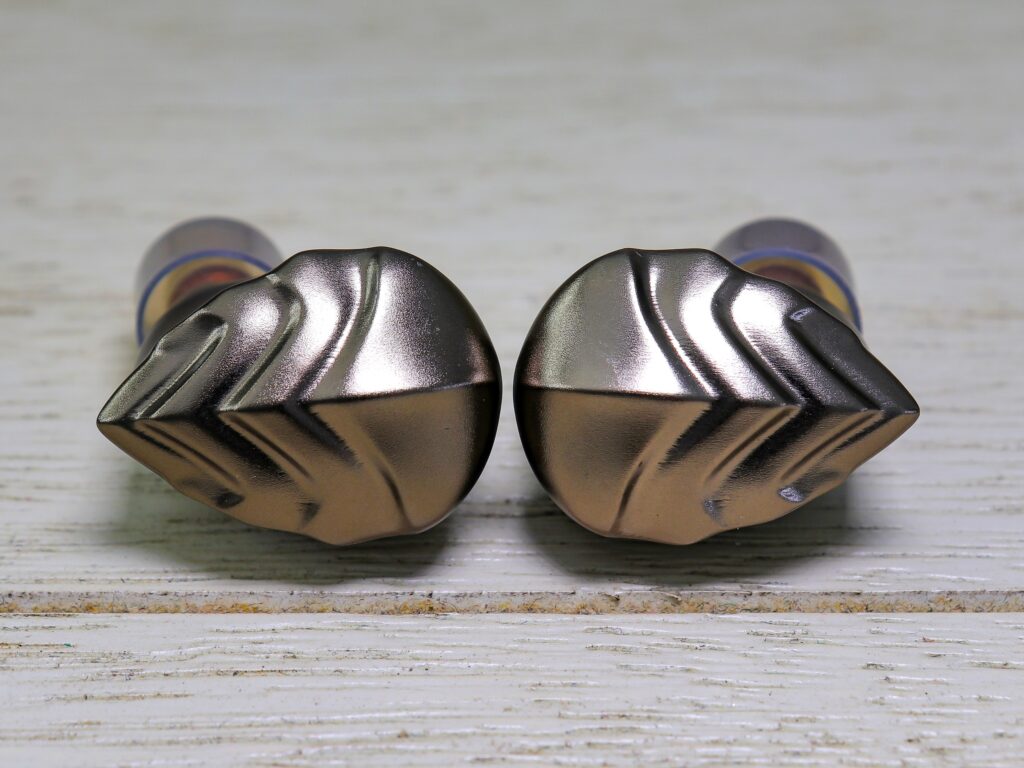
The last set that made perfect sense for me to compare was definitely the Hidizs MK12 Turris (MK12 Turris Review). When it comes to absolutely stellar single dynamic driver earphones, the Hidizs MK12 Turris is one of the best you’ll find under $200. I reviewed the MK12 in June of 2025 and was so taken by its fantastic build, design, & tuning that I labeled it one of, if not thee… best single DD under $250 at the time. Just an amazing sound that will certainly push the WoodNote to the brink of its value per performance. The MK12 is touted as having the world’s first 91% Magnesium dynamic driver. To be exact, it is also a very large 12 mm in size. The eruption of the MK12 Turris into the market was a scene and just like past Hidizs releases it pretty much stole the hobby for a little while. I should also note that I reviewed an even better version of the MK12 in the MK12 Turris Titanium Edition (MK12 TE Review). However, that special edition version cost significantly more at $230. Plus, the OG MK12 is 95% of what the MK12 TE is so… I think I picked the right comparison. So, what are the differences?
Non-Sound Stuff
To start, the Twistura WoodNote certainly has the more robust and premium packaging with a better presentation, better cable (by far), and the WoodNote actually has a carrying case whereas the MK12 only has the typical black Hidizs carrying bag. So that is a huge difference. Not to say the MK12 has a bad unboxing either, but the WoodNote’s is simply better across the board. Between the two, the WoodNote has a much smaller and lighter shells, but both sets offer great comfort. Both are made of alloys, and both are relatively lightweight. Both sets come with tuning nozzles as well and both tuning nozzle setups make a good difference in sound. When it comes to aesthetic design, I find that both sets are very well designed. Now, the MK12 is probably the more intricately crafted of the two with its beautifully rendered shell design, but both sets look great. I do think that the MK12 is likely going to get the most detractors just because the design is so unique. Once again, another big difference is in the driver tech used as both sets have extremely rare materials. The WoodNote uses a pressed wood-fiber dome driver and the MK12 uses a 91% magnesium driver. Both drivers took loads of R&D, creativity, and expertise to create, and neither driver is a simple process. Lastly, the MK12 costs a bit more than the WoodNote as there is about a $20 difference ($159 vs. $180).
Sound Differences
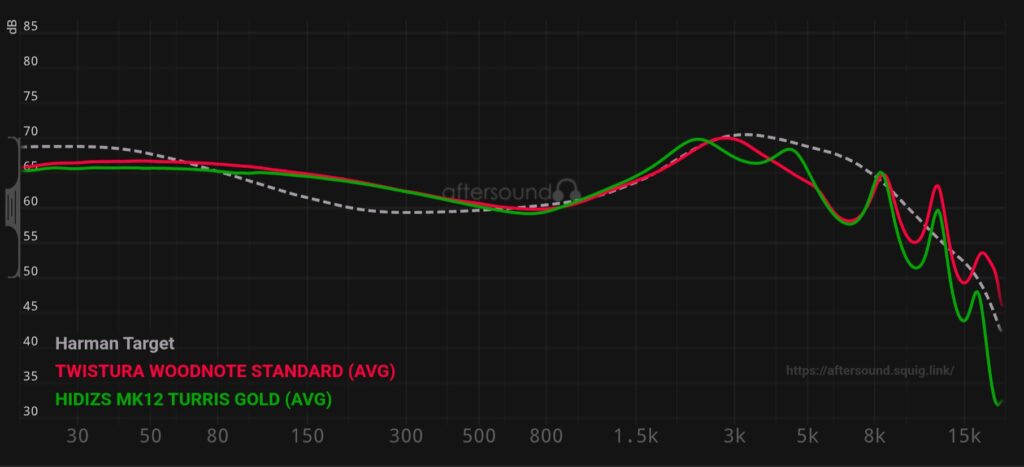
I find that both sets are actually very similar. In fact, these two are tuned to almost the exact same signature in many ways when looking at the graph comparison. However, driver material really does change how we perceive the sound in the end. Both sets hover around warm/neural, both are organic sounding, very natural, and both carry a realistic playback. To add to that, both sets offer great musicality as well as very good technical ability. In my opinion, the MK12 has slightly richer note weight, but man is it close folks. In fact, it’s so close that I don’t even think it makes much sense to speak on it. Before I get into sound between the 20’s, I need to specify that I used the Standard nozzle for the WoodNote, and the Gold nozzle for the MK12. These two are certainly two of the best single dynamic driver earphones that money can buy under $200.
Between the 20’s
To begin, the MK12 has an ever-so-slightly deeper sublevel response. Perhaps due to the bigger driver even though the WoodNote graphs with more weight in this region. However, the MK12 has a wider and slightly looser response as well. The WoodNote is tighter in this range, close in guttural weight, but more defined by a slight margin. Mid-bass punch comes through a hair bolder on the WoodNote, punchier. Still, once again, the WoodNote has a higher quality mid-bass. Both bleed into the mids in an intelligent manner. Now both sets offer a warm/neutral, organic, and very clean midrange. However, the WoodNote has a touch more vibrance, a touch better detail retrieval, and I do find that vocals sound better on the wood-fiber DD of the WoodNote. There’s simply this earthy quality which is unmistakably organic. Please, this takes nothing away from the MK12 and its awesome midrange performance. I should also add that the WoodNote has a more open sound in the mids, with better note separation. Next, the treble region of the WoodNote has a hair more air, better extension, and it carries a hair more bite. Both treble displays are very clean, smooth, detailed well, but the WoodNote simply has a hair more bite. Both sets have solid details, solid note separation, and very good imaging and layering abilities. I do find the WoodNote to edge out the MK12 when it comes to clean-lined layering, but they are very close. Now, the MK12 has the more enormous stage sounding larger from side to side, while they both offer a very deep stage.
Final thoughts on this comparison
This was a very difficult comparison to complete. Mainly because both sets are so close sonically. Yes there are discernable differences, but those differences aren’t night & day with any one area or attribute. I couldn’t choose which knee I actually enjoy better. Sometimes the MK12 for its grander stage presentation and sometimes the WoodNote for its slightly better timbre, and slightly more technically capable sound. You cannot lose with either set. Both are phenomenal for what they are. Take your pick.
Last Words on the Twistura WoodNote
The Twistura WoodNote represents one of the better single dynamic driver iems under $175 and probably under $200. The price to performance is very nice, from my perspective. I’ve reviewed many of the best single DD’s under that $200 mark and I haven’t heard any which are hands-down “better” than the WoodNote, for me. Which is saying a lot, speaking volumes. The WoodNote absolutely came out of left field for me as I had zero idea it was even a set on the market. I knew very-very little about Twistura and I have never spent any time with any of their products prior to the WoodNote. So, to say I was pleasantly surprised is an understatement. It’s always nice to find those unsung iems that seem to punch above their price or at least perform very well to their price point. I do believe that the WoodNote will be that diamond in the rough for many folks. Furthermore, I also believe that the WoodNote fares very well against some of the more legendary single DD sets. Iems like the Simgot EA1000, Tanchjim Origin, the Dunu Falcon series, as well as a handful of other $200 single DD gatekeeper sets. I find the WoodNote’s pricing to be very reasonable, and I really don’t think that you can go wrong at $159. However, you have to enjoy this type of tuning. Which may seem obvious but trust me… it isn’t. If only you could see my messages at times. Still, Twistura is most definitely a player in this game. There’s no question that I feel that WoodNote is a highly qualified iem that is worth every last penny.
The Why…
Because this set comes with one of the best unboxing experiences anywhere near $150. Beautiful modular cable, great deep purple case, a slew of eartips, and the presentation of the packaging is very well done. Thankfully Twistura knows how to create a “wow” effect for the consumer. Maybe I’m just easily amused, but I can’t help but feel the unboxing experience is one of the better that you’ll see around this cost. However, beyond the unboxing, the Twistura WoodNote was built entirely from aircraft grade aluminum and done so in such an ergonomically sound way. It’s very nicely shaped to the human ear, very lightweight too. Nice for long sessions without any wear fatigue whatsoever. Very well designed in an aesthetic manner with a very classy, simple, and minimalistic way, yet also a very handsome and almost elegant way as well. Also, how many wood-fiber drivers have you heard? How cool is it to be able to try out different driver materials? Oh, by the way, Twistura makes this driver in house. That is so cool. Friends, I can’t say enough good things about the driver’s performance. Having said all of those nice things, those are mostly non-sound related. Coincidentally, it’s the sound that makes the WoodNote such a good purchase.
That Sound!
I really enjoy this set sonically. It carries a very nice warm/neutral tonal color with a very balanced approach to the spectrum. It’s also dynamically balanced, balanced between smoothness and crispness, musically gifted and analytically precise. It’s all about balance. Some may say this set is too safe, which I am sure you’ll hear, but I don’t think so, in my opinion. Actually, I hear a deep sublevel rumble, very fun but also very well defined, very dense and meaty. I like the punchy and controlled mid-bass that comes alive in certain genres, certain tracks adding a fun slam along with the perfect amount of warmth bled into the midrange. Which brings me to the midrange; what a lovely tuning for realistic, clarity-rich, but also very organic instruments and vocals. No doubt the WoodNote’s best area is the midrange. Almost mid-centric. Still, male and female vocals are great. Transients are tight, details are easily observable, sound separation is distinct, nice imaging capabilities and front to back layering, and the sound field carries great dimensionality. Also, I hear nothing harsh (using the Standard Nozzle), and nothing piercing either. A very composed midrange. Now, the treble walks the same line where it’s sparkly, nicely detailed, decent note bite and upper treble extension, but it isn’t what I’d call offensive. Twistura adds enough emphasis to sound energetic and fun without crossing the line into harsh territory. A nicely detailed yet fairly smooth take on the treble when listening with this set. Nice details as a whole, instrument separation too, and the WoodNote presents a very nice canvas for those who desire transparency without the dryness of a truly analytical sound. Also, the stage is nice, holographic and with nice depth. This set is an easy rec from me.
All rounder?
Of course, I think the WoodNote is worth every penny, but that won’t be the case for everyone. In fact, not everyone is going to hear exactly what I hear. We are all so very different in so many ways. Now, in my opinion I see the WoodNote as a solid mid-centric all-rounder style set. I really do feel it plays well with most genres, yet it has a penchant, or a bias towards vocals and realistic instruments. Now, I can dig this set with pretty much all genres, but there are a few which are questionable. Like hot and screeching metal/rock, or those brightly mastered pop tracks using the Instrumental or Vocal Nozzles. Even the standard nozzle can take you to the brink of comfort on occasion. On the flip side, there will be those folks who consider the WoodNote too reserved and not energetic enough for those genres. It takes all kinds in this hobby. Also, for many folks the WoodNote is not going to do it for EDM or bass heavy and big bass reliant Hip-Hop/Rap/R&B. Perhaps, the WoodNote may sound a touch under-powered for those chest-hit, big slam moments. The WoodNote is no doubt tuned with deep sublevel rumble and a nice mid-bass boom, but it isn’t an earthquake, rattle your brain style. So again, the WoodNote won’t be for everyone what it is to me. Still, in my opinion this set does fit the “all-rounder” pedigree well and is worth every penny of the $159 that Twistura is asking.
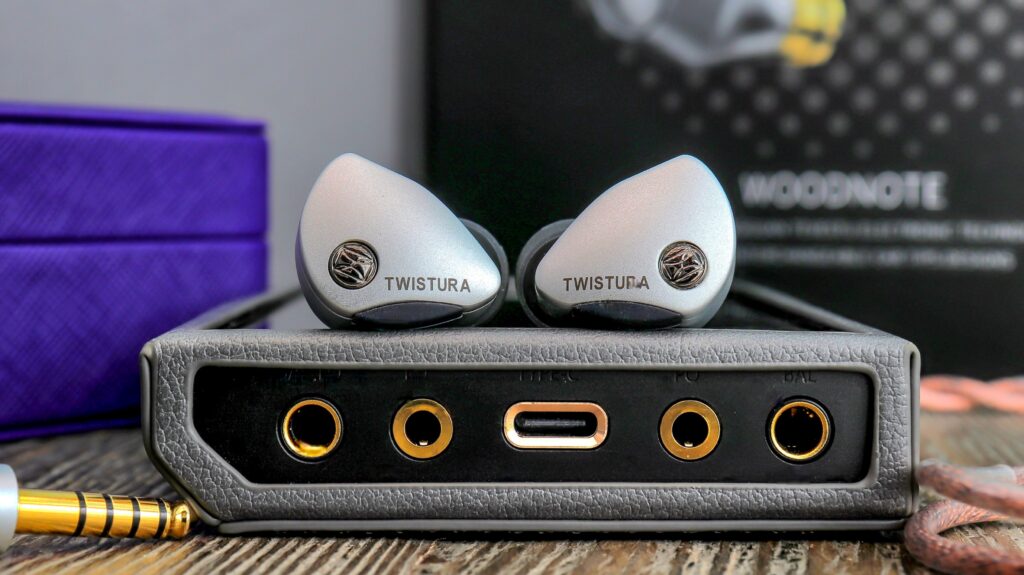
Conclusion
To conclude my full review and feature of the Twistura WoodNote, I first need to thank the good people of Twistura for providing this set. I am very glad to finally hear one of your iems and it has now stoked a fire in me to hear the rest. Very well done. Again, thank you very much. Also, to every reader who spent the time reading this ridiculously long review… I thank you. Every click of the link taking you to mobileaudiophile.com is an important thing for myself and my partners. These reviews are all about you and helping you find your musical zen. Hopefully this review has helped at least a little bit.
Other Perspectives
Now that you’ve read my words I have to ask that you would read somebody else’s words. We all know that this hobby comes with a lot of diversity and a lot of subjectivity. We are all different, we don’t hear the same, we don’t like the same music all the time, we don’t have the same gear, and we simply don’t have the same likes and dislikes when it comes to sound signatures. It’s the differences which make this hobby so amazing, but it’s also the differences in each one of us which forces me to plead with you to check out other reviews. Do not hang on my words. Granted, I will never lie to you and I will always tell you exactly how I feel about any product that I review. That is my promise. My words are my words folks. I don’t use Ai, I don’t cheat, I don’t read other perspectives before I write my own. You are getting my true-blue perspective every single review. However, I am not the next guy, and I am not you. I want you to get your purchase right so that you can enjoy what this hobby is all about… music. So, please make sure to read, watch, or listen to other perspectives and not just mine. With all of that said, it’s time for me to check out. So, please take good care, stay as safe as possible and always… God Bless!!



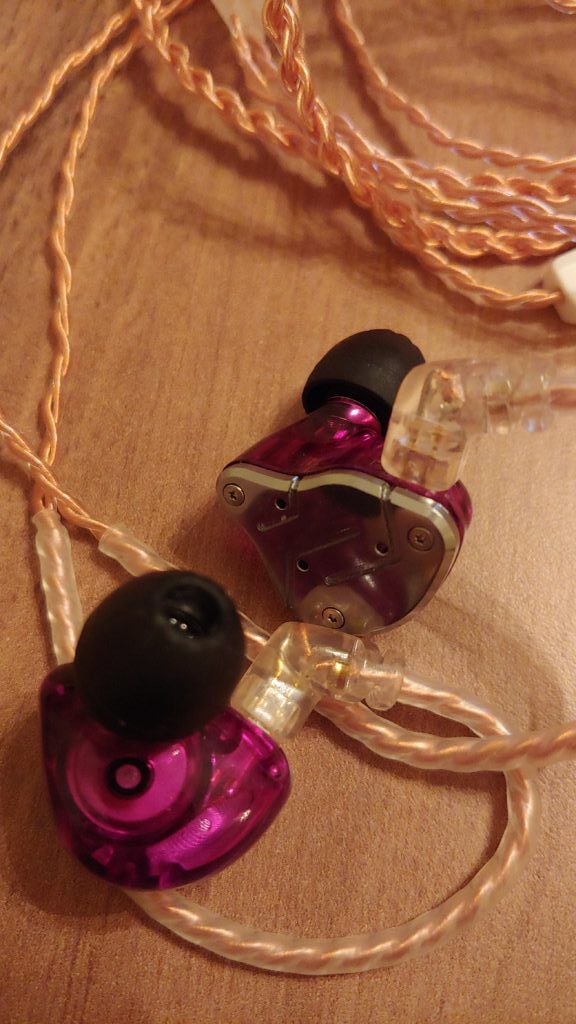

The longest and most detailed review I’ve read about an IEM. Thank you for your time and dedication. Just purchased this beauty based on your review and I have to say I’m very satisfied.