





























































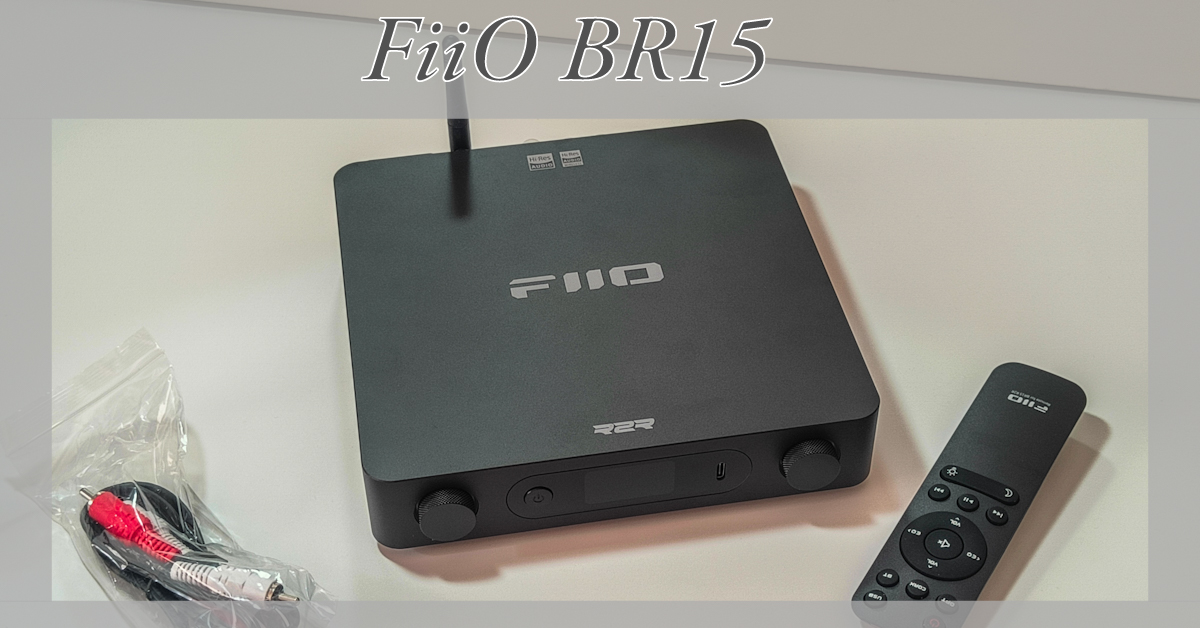
Disclaimer
Hello everyone! Before we begin, I want to let you know that FiiO sent me the BR15 R2R so I could test it, spend some time with it, and share my honest thoughts. I’m not being paid for this review, and FiiO hasn’t asked me to say anything specific, review my draft, or set any publishing deadline.
Table Of Content
- Disclaimer
- Introduction
- Unboxing
- Technical specifications
- General
- Digital processing
- Buttons and ports
- Power supply
- Audio
- Build quality and design
- Connectivity and everyday use
- R2R DAC and internal tech
- Quality of life features
- How it performs
- Background noise and hiss
- Bluetooth performance and codec support
- Controls, EQ, and app experience
- Display and everyday usability
- Quick summary
- Conclusion
- Pros
- Cons
Everything written here is based entirely on my own experience with the BR15 R2R. I always do my best to stay fair and objective, but at the end of the day, this is still one person’s opinion, and we all have different preferences. That’s what makes this hobby so interesting.
Huge thanks to FiiO for giving me the chance to try out the BR15 R2R, and of course, a big thank you to you for taking the time to read my review. Your support truly means a lot to me!
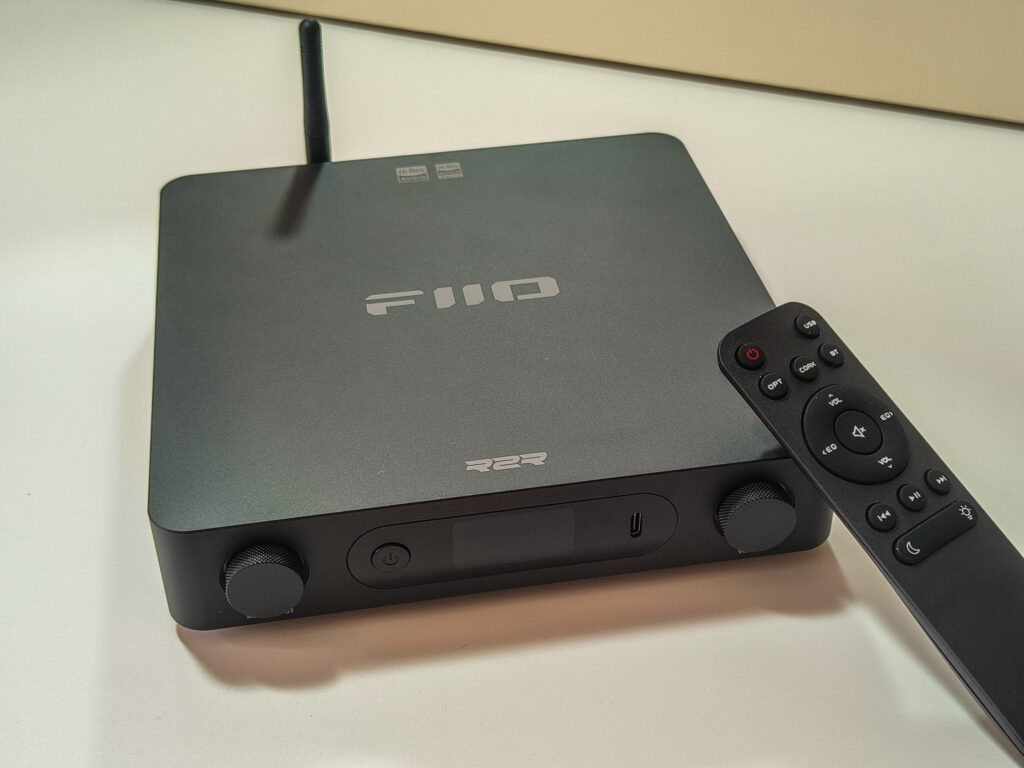
Introduction
FiiO has been building a pretty good line of R2R DACs, and the BR15 R2R comes in as the Bluetooth receiver/DAC+preamp in that family. I already spent quite a bit of time with their K11 R2R and K13 R2R, and I really like how FiiO is taking the resistor ladder tech and putting it into pretty affordable products, as this is a pretty old type of technology and was mostly found with a higher price tag for those who love it.
R2R itself is a resistor ladder way of turning digital into analog. It is an older approach, and if you look at it purely from the technical side, it is not as “advanced” as the modern Delta Sigma chips that you find in most gear today. Delta Sigma DACs usually run quieter, with lower noise and cleaner sound, and some of them are honestly very impressive when the implementation is done right. At the same time, a lot of current Delta Sigma chips have their own small issues and workarounds, and there are still people, including me, who find a proper R2R DAC to be pretty cool to have. Even if you do not fully buy into the “R2R sound”, it is still just fun and kind of cool to have one in the collection.
is designed to be a High resolution Bluetooth audio receiver, which of course can also act as a normal DAC or as a DAC with preamp output feeding powered speakers or a power amp. It has many different inputs and outputs, including a fully balanced output with the XLR outputs, but I will talk more about it later in this review.
In this review I am going to go over the features of the BR15 R2R, talk a bit about how it feels to use in real life, and of course see if I personally think it is worth the 200$ asking price.
Unboxing
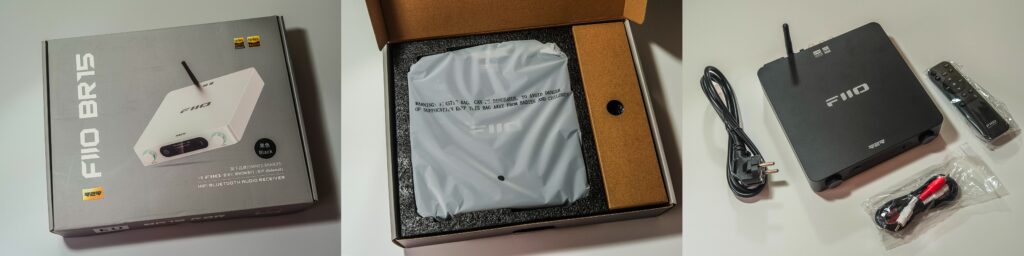
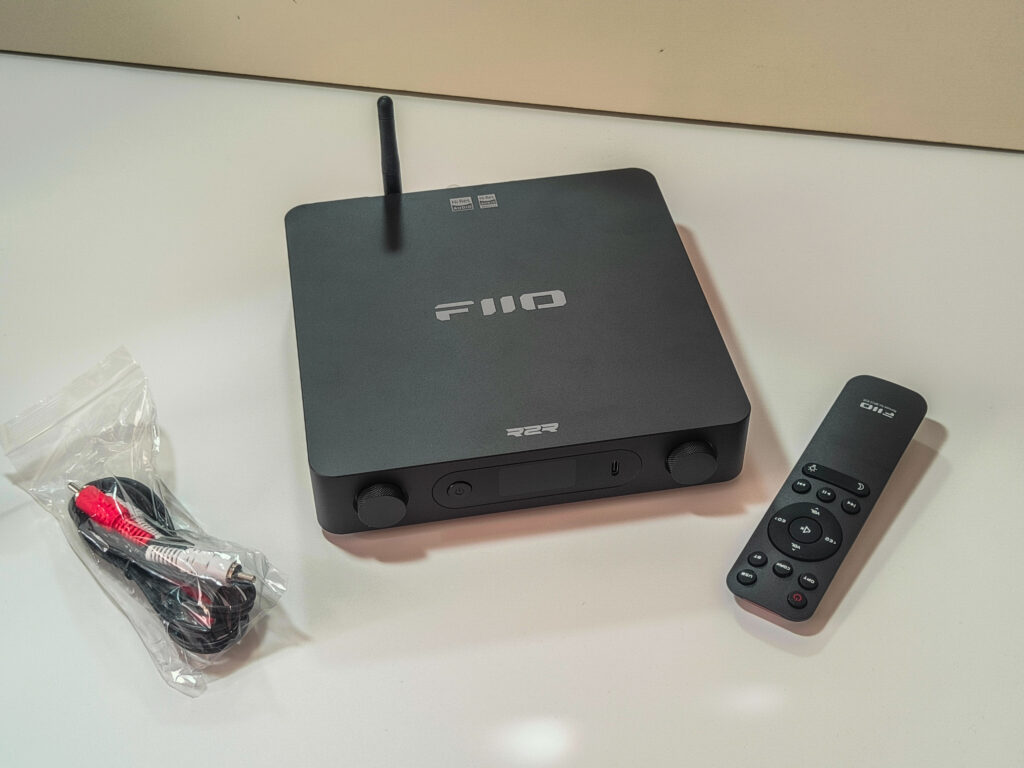
When I got and opened the box of the BR15, the whole unboxing felt pretty simple and straightforward and overall very similar to other FiiO DACs/AMPs that I have reviewed. The unit itself sits in foam and is well protected, so nothing moves around. On the side you have a box with the power cable, a pair of RCA cables, and a remote inside. Under the unit you will have your warranty card and starter guide.
What I still do not like is that, once again, there are no batteries in the box. The remote needs two AAA batteries, and I know there are shipping rules about batteries, but I still expect a product to come ready to use out of the box. Another small thing is that there is no USB cable included, which would have been nice for those who plan to use it mainly as a USB DAC and not just over Bluetooth. Other than that, the unboxing is totally fine, and everything you do get feels well packed and safe.
Technical specifications
General
- Hardware: ESP32 S3 master controller, FiiO proprietary R2R DAC, XMOS XU316 for USB, Qualcomm QCC5181 for Bluetooth decoding
- Working modes: USB DAC, coaxial decoding, optical decoding, Bluetooth receiver
- Colors: Black or Silver
- Weight: about 760 g
- Dimensions: about 210 x 188 x 42 mm (including feet)
- Volume control: front panel knobs and remote control
- Remote: supports IR remote control, only with the bundled remote
- Drive free mode: supported
- FiiO Control app: supported
Digital processing
- Oversampling options: OFF, 96 kHz, 192 kHz, 384 kHz
- Bluetooth version and codecs: Bluetooth 5.4, LC3, SBC, AAC, aptX, aptX HD, aptX Adaptive, LDAC, aptX Lossless
- MQA: full decoding when PEQ is off
- PEQ: 10 band parametric EQ
- Display: 1.47 inch LCD
- Knob ring light: adjustable color and brightness, can be always on or RGB breathing
- Maximum supported sampling rates (with PEQ off):
- USB: up to 384 kHz / 32 bit, DSD256
- Coaxial input: up to 192 kHz / 24 bit, DSD64
- Optical input: up to 192 kHz / 24 bit, DSD64
- Coaxial output: up to 192 kHz / 24 bit, DSD64
- Optical output: up to 192 kHz / 24 bit, DSD64
- Screen information: sampling rate, volume, EQ, Bluetooth codec, working mode, and more
- Firmware updates:
- MCU firmware via front USB C
- XMOS firmware via front or rear USB C
- Bluetooth firmware via FiiO Control app
Buttons and ports
- Knobs: one menu knob with push function, one volume knob with push function
- USB ports: two USB C data ports
- Coaxial input / output: shared RCA jack
- Optical input: optical port
- Optical output: optical port
- Balanced line output: XLR3 balanced pair
- Single ended line outputs: two pairs of RCA line outputs
- Power button: dedicated physical button
Power supply
- Power input: AC 100 to 240 V, 50 or 60 Hz
- DC input: 5 V, at least 2 A
- Power modes: AC or DC, no internal battery
Audio
RCA single ended line out (USB / coaxial / optical, oversampling 192 kHz)
- THD+N: about 0.017 percent (1 kHz, 0 dB, 10 kΩ load)
- SNR: at least 116 dB (A weighted)
- Crosstalk: at least 110 dB
- Noise floor: below 3.3 µV (A weighted)
- Frequency response:
- 20 Hz to 20 kHz, less than 0.2 dB attenuation
- 20 Hz to 65 kHz, less than 2.9 dB attenuation
- Line level: 2.2 Vrms at 1 kHz into 10 kΩ
XLR balanced line out (USB / coaxial / optical, oversampling 192 kHz)
- THD+N: about 0.015 percent (1 kHz, 0 dB, 10 kΩ load)
- SNR: at least 119 dB (A weighted)
- Crosstalk: at least 112 dB
- Noise floor: below 5.1 µV (A weighted)
- Frequency response:
- 20 Hz to 20 kHz, less than 0.2 dB attenuation
- 20 Hz to 65 kHz, less than 2.9 dB attenuation
- Line level: 4.4 Vrms at 1 kHz into 10 kΩ
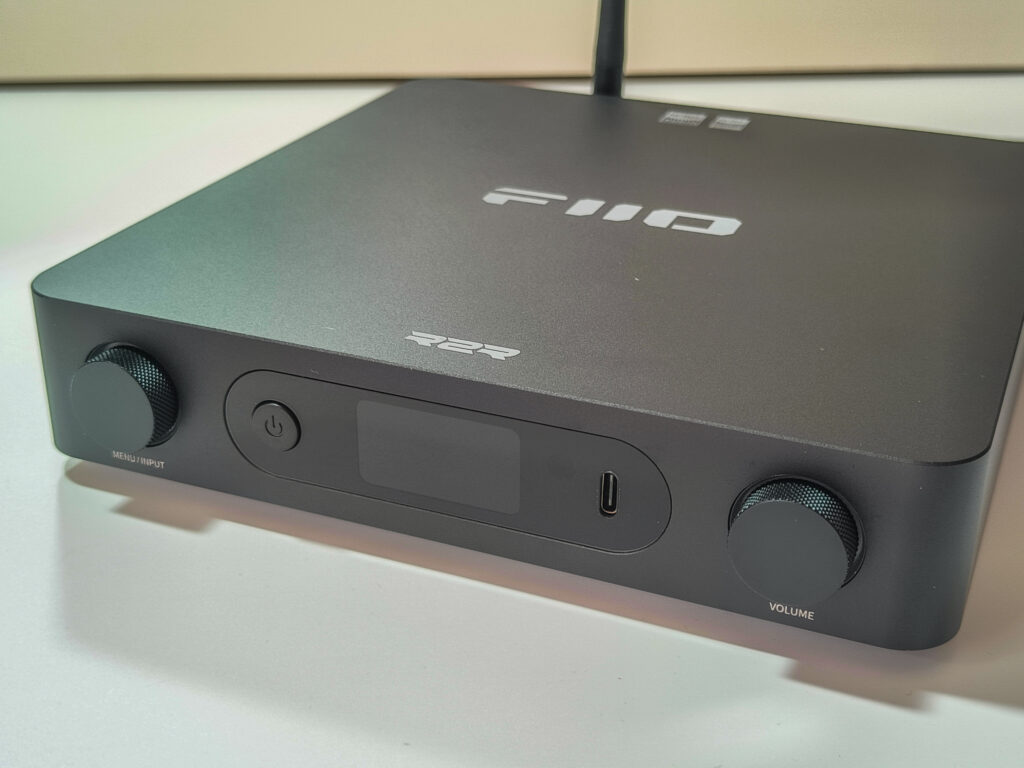
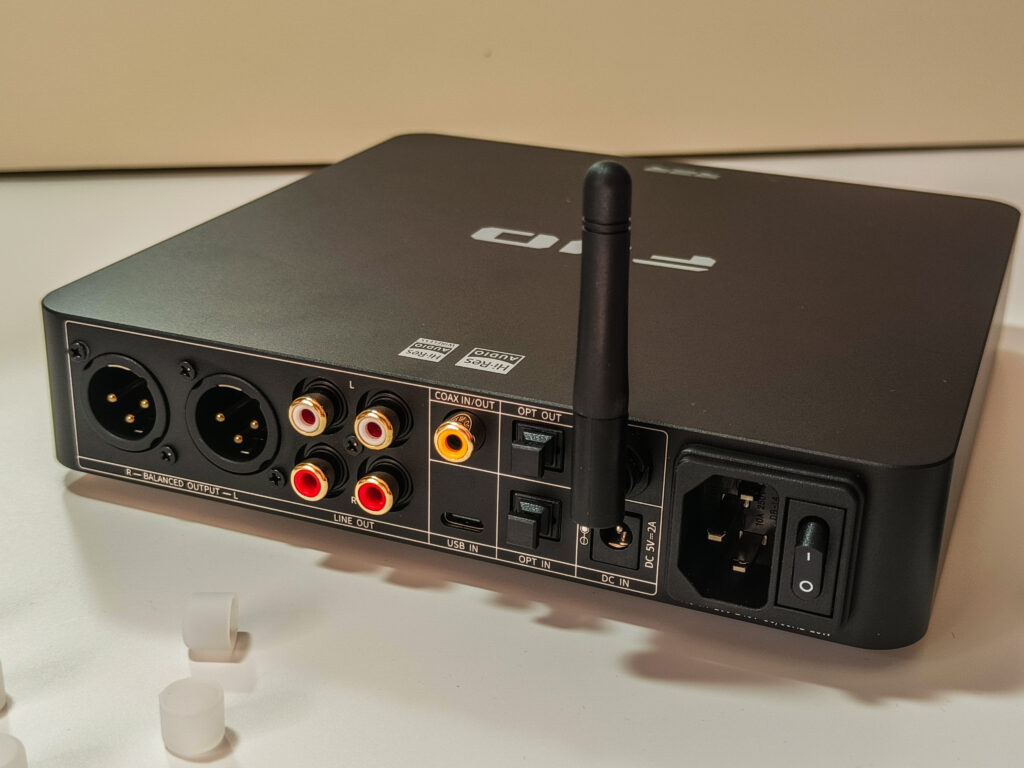
Build quality and design
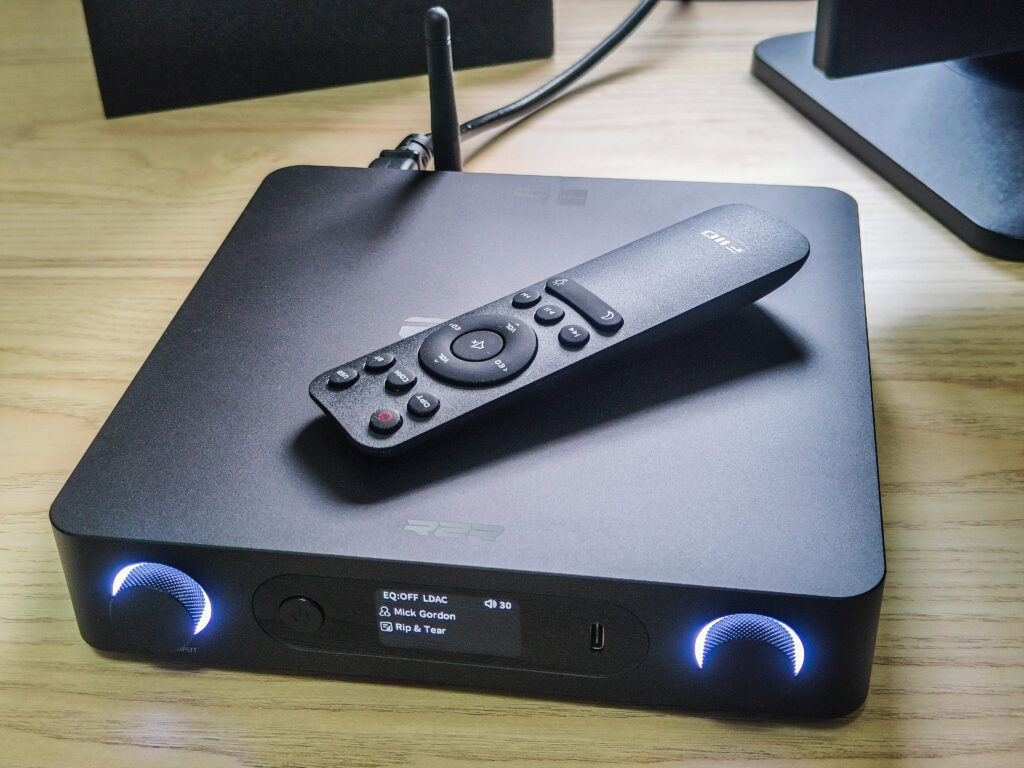
The footprint is pretty small, although it’s a bit big in width and close to the K13 R2R in size. It weighs about 760 grams, and it feels quality and looks very pretty on the desk. The two frontlit knobs give it a very beautiful look that looks minimalistic and also modern, which I personally like, and having both control and volume on physical knobs makes it feel more like a proper source that can be controlled easily whether it’s on the desk next to you or under the TV, using the remote.
Connectivity and everyday use
What I like about the BR15 R2R is that it is clearly built to sit in the middle of a system and just handle everything. You have USB, coaxial, optical, and Bluetooth all going into the same box, and then you can feed almost anything using the simple RCA or the balanced XLR outputs. And on top of that you still get optical and coaxial outputs, so you can even use it as a Bluetooth to digital bridge into another DAC if you really want to. For a device that is marketed as a Bluetooth receiver, this is a lot of flexibility.
R2R DAC and internal tech
Inside, FiiO is using their own R2R ladder DAC with oversampling control, XMOS for USB, and Qualcomm’s QCC5181 for the Bluetooth side. Of course, with support for all the modern codecs, including LDAC and aptX Lossless, plus full MQA decoding when PEQ is off, although MQA is pretty much not relevant nowadays, some people might still use it. The 10 band PEQ is a great addition, which I really appreciate, especially when pairing it with different speakers or amps.
Quality of life features
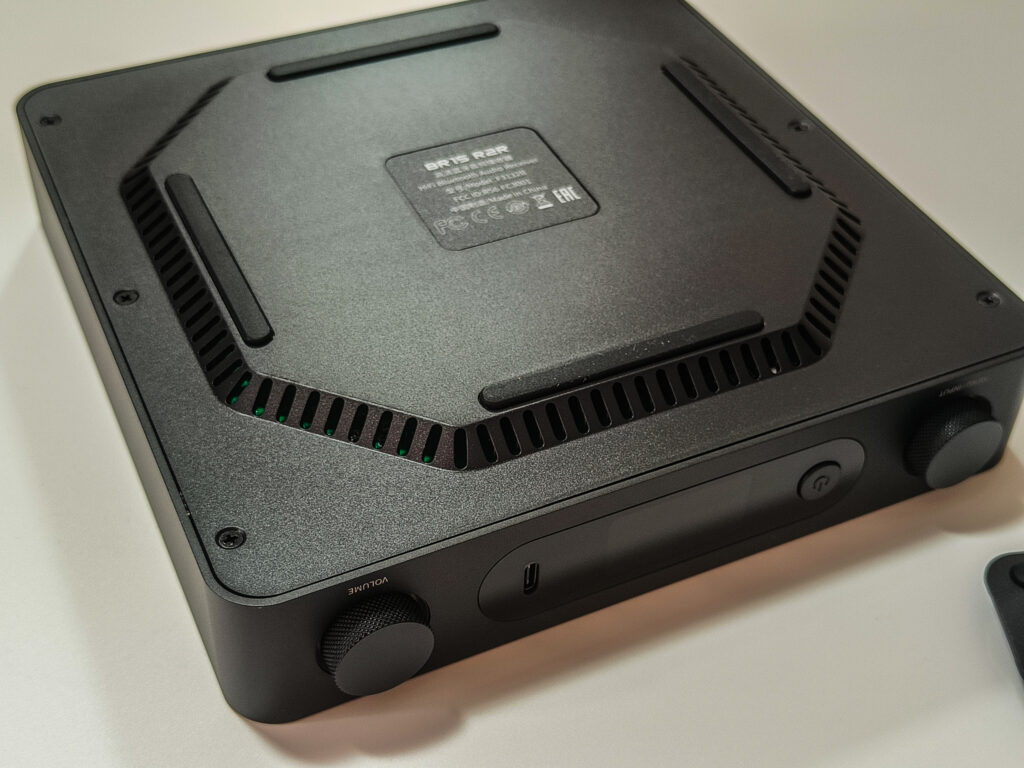
There are a lot of small things here that make the BR15 R2R very convenient in day to day use. The 1.47 inch color screen is very nice and better than the screen in the K11 R2R or K13 R2R, but the purpose is different, so I get it. You have all the information you need and can easily see the codec and mode you are in, so you are not guessing what it is doing at any given moment. Although it’s pretty small, and you will probably not see what is going on if it’s far from you while watching the TV. You also got a USB at the front and also a power button that with a single press turns the screen off and with a long press turns the BR15 R2R off, in addition to the one on the back and the one on the remote.
The ring lights around the knobs can be customized to match the look of the rest of the setup or to dim it down for night listening. Dual power input is also handy, since you can either plug it straight into the wall with AC or feed it from a clean 5 V supply if you want to.
How it performs
I will do things a bit differently here, since the BR15 R2R and the Fosi ZD3, which I already reviewed and I really liked, are both at a very similar price point, and both are desktop DAC plus preamps with Bluetooth. I naturally ended up using them side by side with my monitor speakers. So I decided to start the review with talking about the BR15 R2R while comparing it to the ZD3.
The ZD3 is a bit cheaper at around 180$ and uses an ES9039Q2M Delta Sigma DAC with Bluetooth 5.0 and codecs like SBC, AAC, aptX and aptX HD. The BR15 is a bit more expensive, around 200$, but gives you FiiO’s own R2R ladder DAC plus a much more modern Qualcomm QCC5181 chip with Bluetooth 5.4 and Bluetooth 6 features. It supports SBC, AAC, aptX, aptX HD, aptX Adaptive, aptX Lossless, LDAC, and LC3, so basically every codec you will ever use. Which is absolutely awesome and worked perfectly for me without any issues.
Background noise and hiss
The first thing I checked with both units on my monitors was background noise. Here the ZD3 actually performs better thanks to the good Delta Sigma design. With the speakers being at my usual listening level and no music playing, the ZD3 is simply a bit quieter. If I get a bit closer to the tweeter, I can hear a slightly cleaner background and less hiss compared to the BR15. On paper that also matches its very low noise specs, compared to the BR15 R2R.
In practice, once music is actually playing, the difference is not huge, and the amplifier and the speakers themselves take over as the main noise contributors. So I would not say the BR15 is noisy or problematic, but if you really care about hiss and you use very sensitive speakers or sit close to them, then the ZD3 does give a better performance in this regard.
Bluetooth performance and codec support
As soon as I turned on the Bluetooth and connected my phone to the BR15 R2R, it really started to feel like the more serious and future proof device. The connection is very good, the range is great, and the codec support is on a completely different level. With a phone that supports LDAC or aptX Lossless, the BR15 lets you stream with a quality that does not feel like a big downgrade compared to a wired USB connection.
The ZD3 is limited to Bluetooth 5.0 with SBC, AAC, aptX, and aptX HD, which is still fine, but it’s clearly not as good as what the BR15 gives. If you mainly want a Bluetooth hub for your speakers and you care about getting the best possible quality from wireless, the BR15 is without a doubt much more capable.
Controls, EQ, and app experience
When it comes to controlling the device and playing with settings and EQ, the BR15 also feels more complete. You get two physical knobs on the front, one for volume and one for navigation, both with push actions, so you can do most things without even using the remote. But of course if you are using it with your TV, you will use the remote. On top of that there is the FiiO Control app, where you can change inputs, select Bluetooth codecs, play with the 10 band PEQ, and do the firmware updates.
The ZD3 is also quite easy to control and has its own remote, but it does not go as deep in terms of built in EQ, and there is no equivalent to the FiiO app with that level of control. If you like to play with EQ and change the sound a little to match different speakers or headphones, the BR15 gives you more tools directly inside the device.
Display and everyday usability
The screen on the BR15 really deserves its own attention. As I have mentioned earlier, it is larger than what you get on the K11 R2R or K13 R2R, the resolution is high enough to look sharp, and you can actually see the artist and track name on it when you stream, which is really nice on a desktop or living room setup. You can also switch between different color themes, like white, blue, and orange, so the display does not have to look too out of place with the rest of your gear or the room lighting. I actually like the orange one, as it looks the most soft on the eyes.
All the important information is there, like sample rate, codec, input, volume, EQ, and so on. Combined with the great Bluetooth connection and the wide codec support, the BR15 ends up feeling very convenient in daily use. It is the kind of device you can set up once, connect everything you need, and then just enjoy without thinking too much about it because it gives you so much control.
Quick summary
So if your number one priority is the lowest possible background noise and you mostly use USB or other wired inputs, the Fosi ZD3 does have the edge here in terms of a pure, specific technical point. But if you want a more flexible and modern hub, with better Bluetooth performance, pretty much all the supported codecs you will ever need, app control, EQ, and a nicer screen that actually shows what you are listening to, the BR15 R2R is clearly a great Bluetooth receiver and a DAC+preamp.
Conclusion
After spending a good time with the BR15 R2R, I feel like I understand exactly what FiiO was trying to do with it. It is not meant to be some ultra high end DAC with top of the line technical specs and performance. It is meant to be that one simple device that can easily go into your system and make it many times better and more convenient for day to day use. And in that role, it does a really good job.
What I enjoy most about the BR15 is how easy it makes everything. I can sit at the desk or on my bed, connect my phone by Bluetooth, see all the information I need on that nice screen (although if I’m far from the BR15 R2R, I can’t really see what’s going on in this small screen, but when it’s on my desk, it’s very nice to have), and control EQ and settings from the app. It really feels like a modern hub, not just a generic DAC with a Bluetooth input.
Sound wise, although it’s R2R and objectively has a bit less clean sound, it is clean and controlled enough for normal use with speakers and amps. If I compare it to something like the Fosi ZD3, yes, the ZD3 is a bit quieter in terms of background hiss, and if you are extremely sensitive to that, the ZD3 will make more sense for you. But once I start actually using them in a real setup, the BR15 is just better designed for me because of how much more it offers besides sound quality. It gives me better Bluetooth, more codecs, a nicer screen, proper app control and PEQ, and very flexible inputs and outputs.
It is not perfect. I would still like to see a USB cable and batteries in the box so you can truly start using it right away, and the noise floor could be a bit lower to make it more quiet. But overall, at around 200$, I think FiiO nailed it with the BR15 R2R, and it can easily sit at the center of a desktop or living room system and make it much better. Overall, the BR15 R2R is definitely something I can see myself recommending.
Pros
- Very versatile DAC + preamp with many inputs and outputs.
- Great Bluetooth capabilities with many codecs (LDAC, aptX Lossless, aptX Adaptive, aptX HD, SBC, AAC, LC3).
- R2R DAC is just cool to have, I guess.
- The screen is big enough and clear and shows the artist, track, codec, and sample rate.
- FiiO Control app with 10 band PEQ.
- Nice build and good weight that feels like a premium product.
- Works well as a central hub for powered monitors and speaker or headphone amps or as a Bluetooth receiver.
Cons
- No AAA batteries included for the remote.
- No USB cable in the box for USB DAC use.
- Noise floor is a bit high.
Where to buy:(Non-affiliated! None of my reviews use affiliated links!)




-
Loading...
-
Loading...
-
Loading...
-
Loading...
-
Loading...
-
Loading...
Show CommentsWhen I clicked through to the FiiO AliExpress store just now, it gave e a price of $245 for the BR15. That’s a significantly higher price than the one quoted in the review. The price of the Fosi is also up a bit to $200, but that makes the price delta $45 rather than $20. (Both prices include shipping to the US.)
You only talked about listening through speakers. The higher noise floor of the FiiO might be a bigger issue for headphone listening.
And finally — does R2R actually sound DIFFERENT, aside from the difference in noise floor?
Hi. Maybe the price you see is because of the tariff thing? because for me, its still this price…
about your question about the speakers vs headphones, there is some more audible noise with the R2R for headphones as well, but it also depends of the amplifier that you pair it with.
about the sound differences, yes, it sounds a bit different (most of FiiO DACs/AMPs sound a bit warmer), but nothing too crazy. the biggest difference in sound, is actually the noise… But I guess it still has its “cool” factor, haha. Oh and of course the nice features.
Was researching on BR15. Stumbles upon this review and reads all the way to the bottom. Lots of positive things. Sounds exactly the device I am looking for. Still in doubt. Noticed the last picture. Reviewer used DOOM to test the device. Doubt left. Go to AliExpress. Make the purchase. Now i wait to rip & tear in Hi-Res! 💪🏻
Mine came with batteries. Really enjoying the sound.
Oh, that’s great to hear! Maybe it’s because of some local regulations related to battery shipping.
I have both the Topping E70 Velvet with the AKM AK4499EX DAC as well as the Fiio BR15 R2R. Set the pair up and fed them the same files via USB from my laptop with full rips from CDs. The amp was a simple but very good 3E Audio A7 with a pair of the a pair of the TPA3255 amp chip fed by the 480Watt SiC power brick and short balanced Mogami and SwitchCraft silver XLRs. I used the same pair of JBL 4406 speakers to compare them. From the likes of Massive Attack to the Shins to Wagner, Ella, Nat, Pearl Jam. Bouncing between the pair it was clear that the guys preferred the BR15 over the E70. The differences were not major and the over sampling was on but the BR was just that little bit more. I do like them both and they sound great. I can’t see either one being a wrong choice. I bought them on a lark just to try them both out and to compare. I am not a reviewer or and audiophool. I still have yet to throw my Kyogo Stax SR Lambda Pro headphones on them and have an A/B listen which I suspect will be the real tell. Both are dead quiet as is the amp. For the money, I say it is a serious deal. Presently we are using the BR15 with the A7 amp and a pair of very modified RadioShack Optimus Pro 77 speakers for the sound portion of our portable theater being fed via light pipe from an LG projector. The sound is very good, near field they are even better. As to the lack of batteries, does anyone not have them in the kitchen drawer? And a USB cable? we all have far to many sitting around now and most that come with gear are trash anyway. So not a bug drop to me. Fiio makes sold gear that seems to be well engineered for a reasonable price. We are in a kind of audiophile renaissance and the Chinese are driving it. Frankly, that’s OK with me. Good review.