




























































Disclaimer
Hello everyone! Before we get into it, I want to let you know that Fosi sent me the ZH3 to test, listen to, and share my thoughts on. I’m not being paid for this, and Fosi hasn’t asked me to say anything specific, review my draft before posting, or set any publishing date.
Table Of Content
- Disclaimer
- Introduction
- Unboxing
- Technical specifications
- Specs
- Chips and circuits
- Screen and controls
- Menus and options
- Filters and tone
- Inputs and outputs
- Gain and power
- System integration
- How it performs
- Usability and setup
- Tone and filters
- Gain and volume
- Comparison to the Fosi K7
- Who should pick which
- Conclusion
- Pros
- Cons
Everything you will read this review, I want to say that it is based entirely on my own experience with the ZH3. I always try to keep things fair and objective as possible, but in the end, this is still just one person’s opinion, and we all have different preferences, and ways of judging. That’s what makes this hobby so much fun!
Big thanks to Fosi for giving me the opportunity to review the ZH3, and of course, a huge thank you to you for taking the time to read and support my reviews. It truly means a lot to me!
Introduction
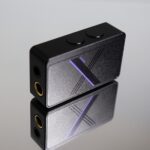
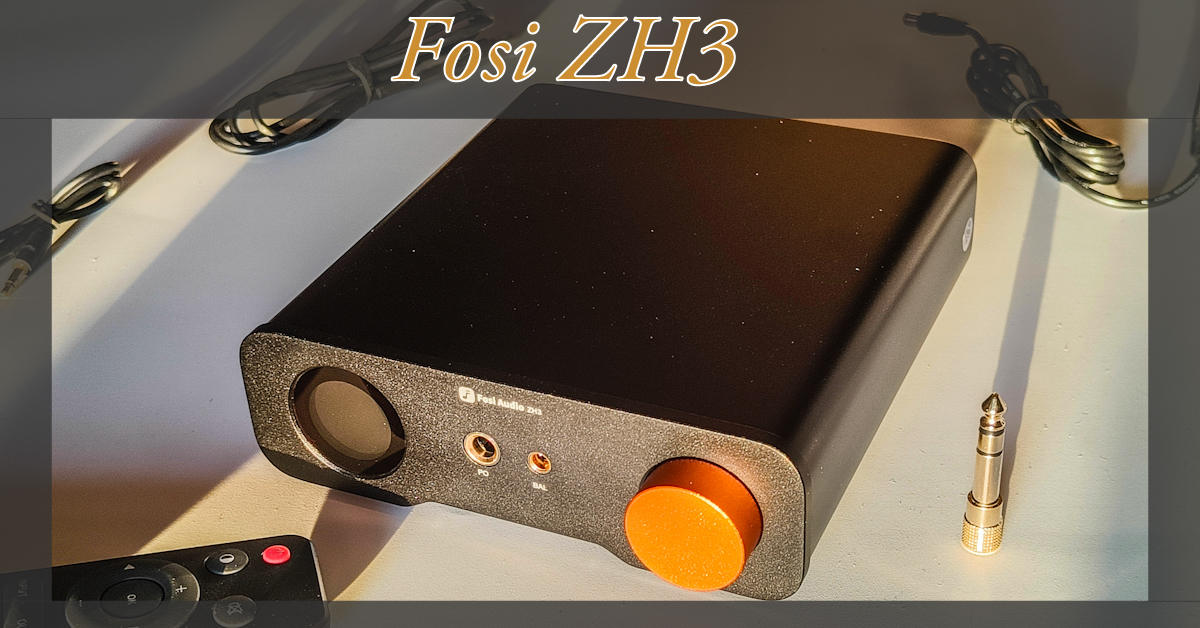
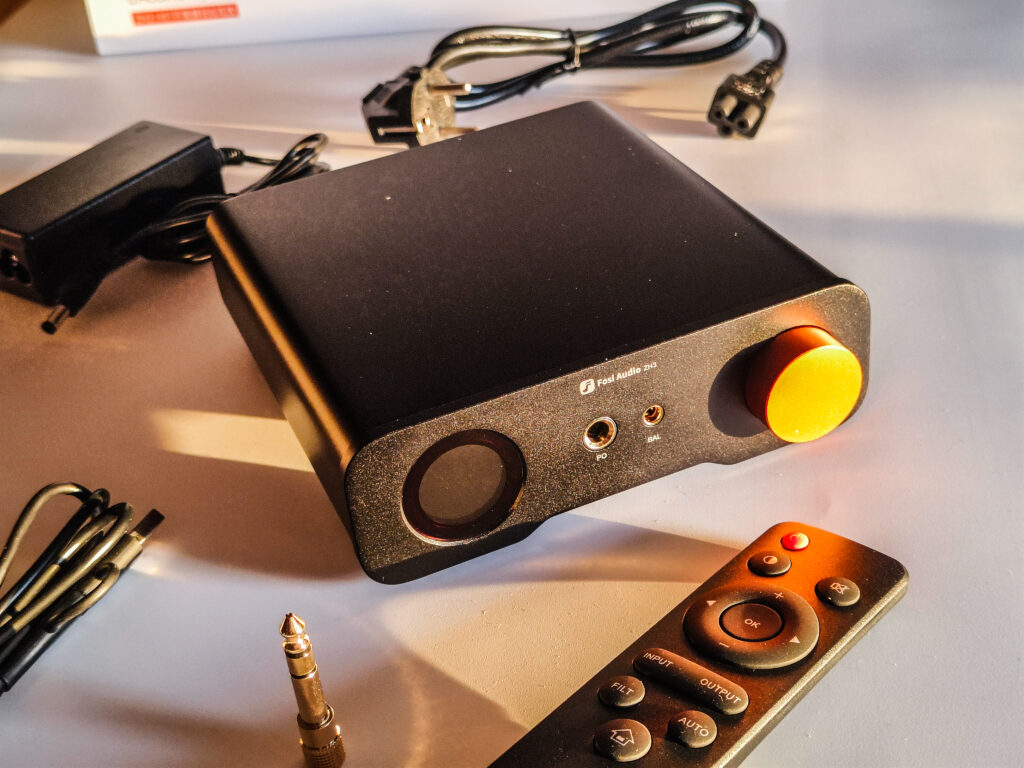
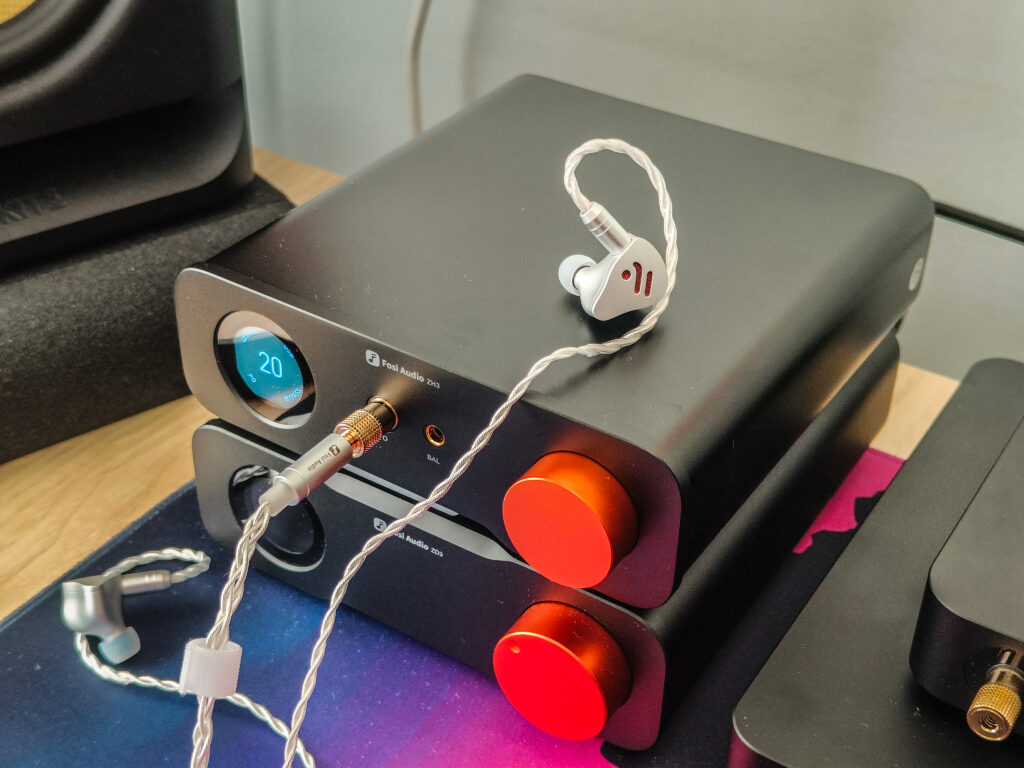
I’ve gotten very excited when I heard about the release of the Fosi ZH3, and now that it’s here at around $199.99, it feels like a very good release, as it’s a great addition to the solid state DAC+AMP family. After the release of the gaming oriented K7, this one is audiophile oriented. The design sits right in the Z family. If you’ve seen the ZD3 DAC, this looks just like that, same clean face, same vibe, just built to run headphones and powered speakers as well.
What gets me excited is the spec sheet. Fosi built this device over a modern DAC, with a properly balanced headphone stage, and the kind of output power that should handle pretty much anything. On paper it looks very promising for the price, so I’m curious to see how it actually sounds and performs.
I’ll also put it next to Fosi’s K7, which, as I’ve already stated, was their earlier headphone DAC and amp aimed more at gamers. That comparison should make it clear who the ZH3 is for and what it does better, and the same goes for the K7, who’s going to benefit from this one better.
Unboxing
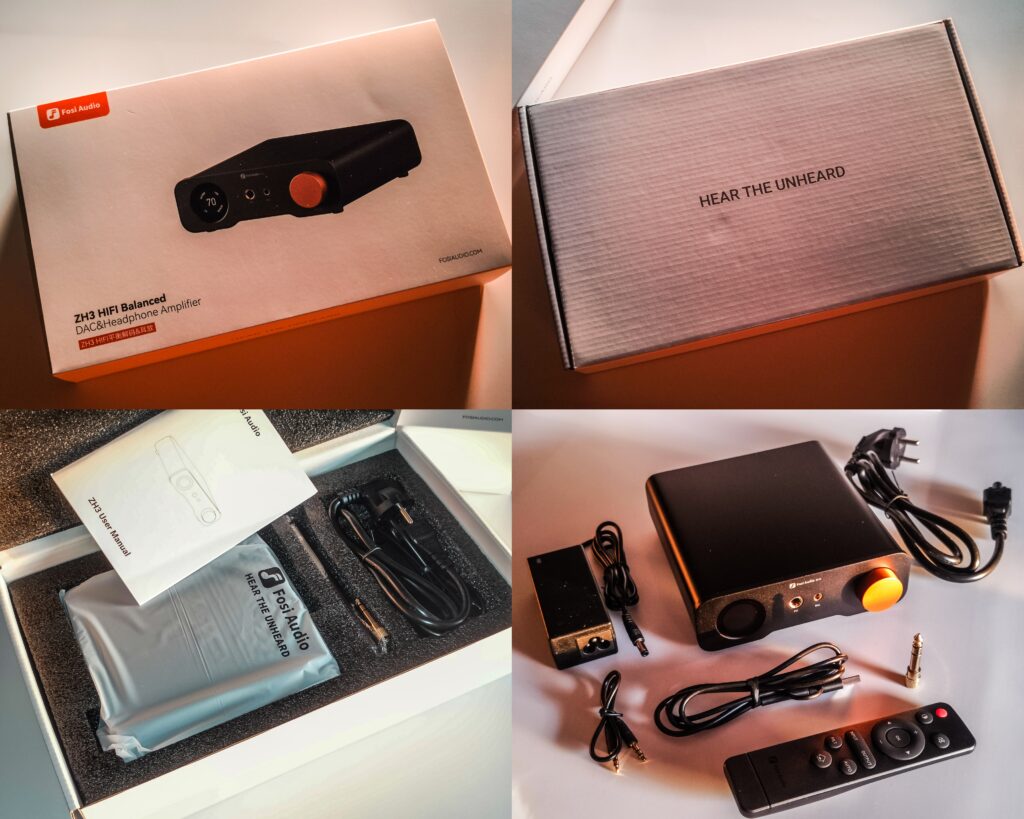
The ZH3 comes in a white box with a big photo on the front. Inside there is an inner box with “HEAR THE UNHEARD” printed on it. Open that, and the whole thing is packed in thick foam, pretty much like all Fosi products. Everything sits in tightly, so nothing slides around during shipping.
Here is everything that is included in the box:
- ZH3 unit
- External power supply and AC cable
- USB C to A
- 3.5 mm to 3.5 mm aux cable for the trigger
- 6.35 mm adapter
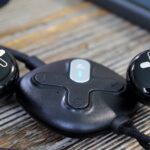
- Remote control
- User manual
The style is the same as other Fosi products I have opened. Clean outer sleeve, simple inner box, and lots of foam. It is not fancy, but it is practical, and it protects the gear well.
I do have one complaint. The remote needs AAA batteries, and there are none in the box. I understand there are battery shipping rules in some regions, but I still believe a new device should include everything I need to use it on day one. I do not want to buy extra parts just to get the thing working.
Technical specifications
Specs
- Chipset: XMOS XU316 + AKM4493SEQ + OPA1612 x4
- Input: Coaxial, Optical, USB-C, RCA
- Output: 4.4mm, 6.35mm, RCA, XLR
- Headphone Impedance: 16–300Ω
- Maximum Sampling Rates:
- USB: PCM 32-bit 768 kHz, DSD512
- Optical: PCM 24-bit 192 kHz
- Coaxial: PCM 24-bit 192 kHz
- Power Input: DC 12 V
- Firmware Upgrade: XMOS firmware upgradable via USB-C
- USB Compatible Devices: Windows 8 or later, macOS X 10.6 or later, Linux
- 4.4mm Balanced Headphone Output (USB)
- Rated Power Output: Low 145 mW x2, Medium 580 mW x2, High 2570 mW x2 at 32Ω, THD+N < 1%
- SNR: ≥ 119 dB (A-Weighting)
- THD+N: ≤ 0.00018% (A-Weighting)
- Dynamic Range: ≥ 119 dB
- Noise Floor: ≤ 4.9 µV (A-Weighting)
- Frequency Response: 10 Hz–20 kHz (±0.1 dB)
- RCA Output (USB)
- Output Level: 2 Vrms
- SNR: ≥ 122 dB (A-Weighting)
- THD+N: ≤ 0.00018% (A-Weighting)
- Dynamic Range: ≥ 122 dB
- Noise Floor: ≤ 1.7 µV (A-Weighting)
- Frequency Response: 20 Hz–20 kHz (±0.1 dB)
- XLR Output (USB)
- Output Level: 4 Vrms
- SNR: ≥ 119 dB (A-Weighting)
- THD+N: ≤ 0.00025% (A-Weighting)
- Dynamic Range: ≥ 120 dB
- Noise Floor: ≤ 4.6 µV (A-Weighting)
- Frequency Response: 20 Hz–20 kHz (±0.1 dB)
- 6.35mm Single-Ended Headphone Output (USB)
- Max Output Power: 640 mW x2 at 32Ω, THD+N < 1%
- SNR: ≥ 121 dB
- Dynamic Range: ≥ 121 dB
- THD: ≤ 0.00024%
- Noise Floor: ≤ 1.9 µV
- 4.4mm Output (RCA 2 V Input)
- Rated Power Output: Low 473 mW x2, High 2100 mW x2 at 32Ω, THD+N < 1%
- SNR: ≥ 125 dB (A-Weighting)
- THD+N: ≤ 0.00019% (A-Weighting)
- Dynamic Range: ≥ 125 dB
- Noise Floor: ≤ 2.2 µV (A-Weighting)
- Frequency Response: 20 Hz–20 kHz (±0.01 dB)
- 6.35mm Output (RCA 2 V Input)
- Rated Power Output: Low 118 mW x2, High 520 mW x2 at 32Ω, THD+N < 1%
- SNR: ≥ 124 dB (A-Weighting)
- THD+N: ≤ 0.00016% (A-Weighting)
- Dynamic Range: ≥ 125 dB
- Noise Floor: ≤ 1.1 µV (A-Weighting)
- Frequency Response: 20 Hz–20 kHz (±0.01 dB)
Chips and circuits
Fosi uses the AKM 4493SEQ DAC with an XMOS XU316 USB controller. The headphone amp is fully balanced and built around OPA1612 op amps. The power section uses low noise regulation to keep the background quiet. On paper this chain should be super clean.
Screen and controls
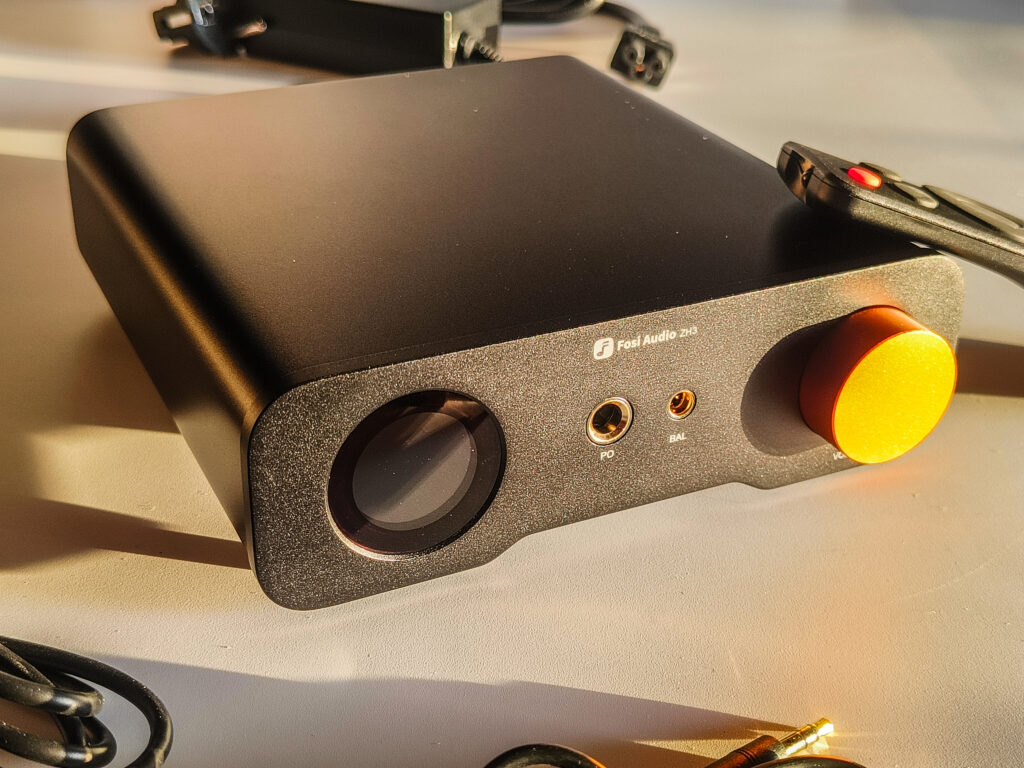
On the front there is a small color screen and one multi function knob. A single press turns it on and confirms menu selections. Long press turns it off. Rotate to change volume. Double press to switch outputs. It is pretty uncomfortable to go through the setting with the knob, although it’s possible, but the big thing that bothered me is that there is no option other than to wait for the screen to go back to the regular screen with the volume. The remote mirrors these actions and adds some more features and also quick keys for inputs, outputs, filters, tone bypass, gain, screen brightness, and auto power off.
Menus and options
From the main screen I can press the knob or OK on the remote to open the submenu. I can scroll to inputs, outputs, gain, UAC mode, tone bypass, bass and treble control, and the digital filter. Some options gray out when they are not available for the current input or output, which makes the settings easier to understand and control.
Filters and tone
There are six digital filters: sharp roll-off, slow roll-off, short-delay sharp, short-delay slow, super slow roll-off, and low-dispersion. Tone gives me bass and treble controls. BYPASS turns the tone circuit off for a straight path.
Inputs and outputs
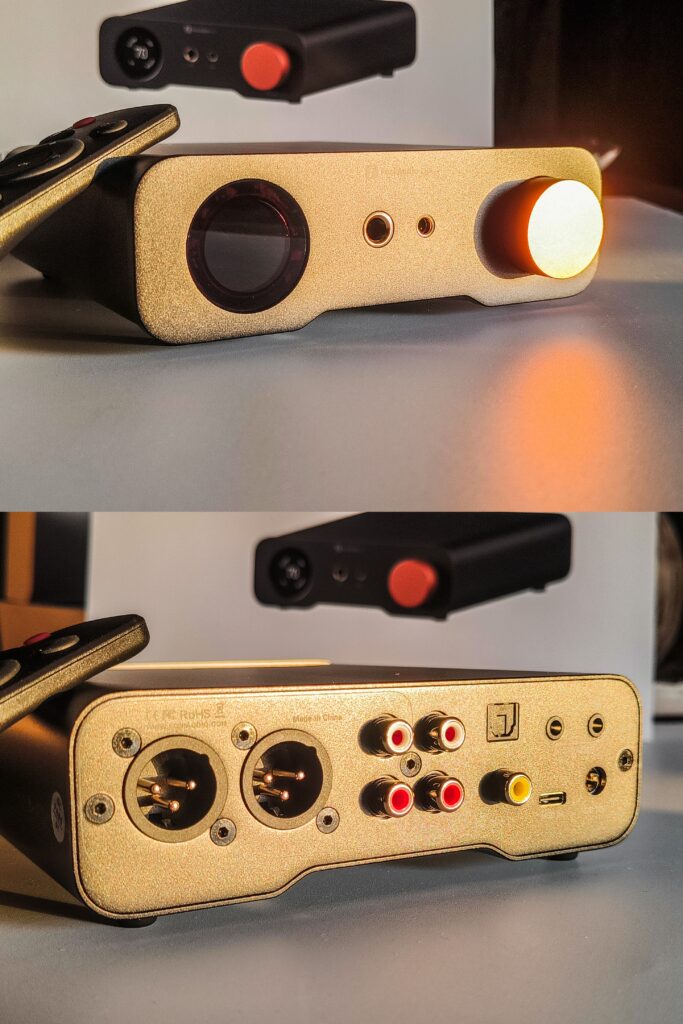
Digital inputs are USB (USB supports UAC 2.0 and UAC 1.0), optical, and coaxial. There is also an analog RCA input for using the ZH3 as a pure headphone amp. Outputs include 6.35 mm single ended and 4.4 mm balanced on the front, plus RCA and XLR line outs on the back. Line out can be set for preamp use or fixed level if you want a pure DAC feed.
Gain and power
Three gain levels make it easy to go from sensitive IEMs to harder to drive full size headphones. The 4.4 mm jack has strong headroom for planars. The 6.35 mm jack can drive most headphones and, of course, IEMs, but if you need the extra power, the 4.4 will give that.
System integration
There are 12 V trigger in and out ports. I can link the ZH3 with other gear like the ZD3 so everything powers on and off together. There is also a separate volume memory for headphones and line out, which is so convenient and prevents surprises when I switch between headphones and speakers.
How it performs
It’s getting harder to hear real differences between DAC+AMPs. Most modern units that come from reputable brands are designed pretty well and end up sounding very close to each other. But I will still start with how it sounds, although it’s not as easy to describe as with headphones themselves. The ZH3 sounds very clean and neutral to me. With my sensitive IEMs there is no hiss, no buzz, or anything like that. With my full size headphones, it stays clear and clean even when I turn it up. I did not hit any clipping or distortion, which makes sense since I am not pushing it anywhere near its rated power. It just gives me a black background and lets the music come through cleanly.
Usability and setup
Where it really showed me its value and won me over is the day to day use. As I usually test devices like that, I plugged it into my TV using the optical input, my powered speakers from the XLR pre outs, and my PC into USB for my headphones. With the remote, I sit back and switch between inputs or outputs in a second. The unit remembers different volumes for headphones and for line out, so I do not get a jump when I move from speakers to IEMs or vice versa. Little things like that matter to me because they make life easier. I finish a movie, tap a button, and I am on headphones. Stuff like that is what matters the most in nowadays equipment. The ease of use, the features it includes, and, of course, the sound.
Tone and filters
I mostly leave Bypass on because I like a straight signal, but I did play with the tone controls and filters. The bass and treble changes are nice to have but mostly gimmicky, I think, because if someone really wants to change the EQ, they will use a PEQ, but still, it’s nice to have if someone wants a quick and easy change. The six digital filters are also nice, but after a short test I picked the neutral one and forgot about it, which is exactly how I prefer it.
Gain and volume
The three gain levels cover pretty much all the gear I have. Low gain is excellent for my IEMs with smooth volume steps that let me set the level precisely. Medium and High give me headroom for harder to drive headphones. I never heard channel imbalance at low levels, and the knob response is quite nice, although sometimes it is just too much, but I do manage to get it to where I want if I do it more slowly.
Comparison to the Fosi K7
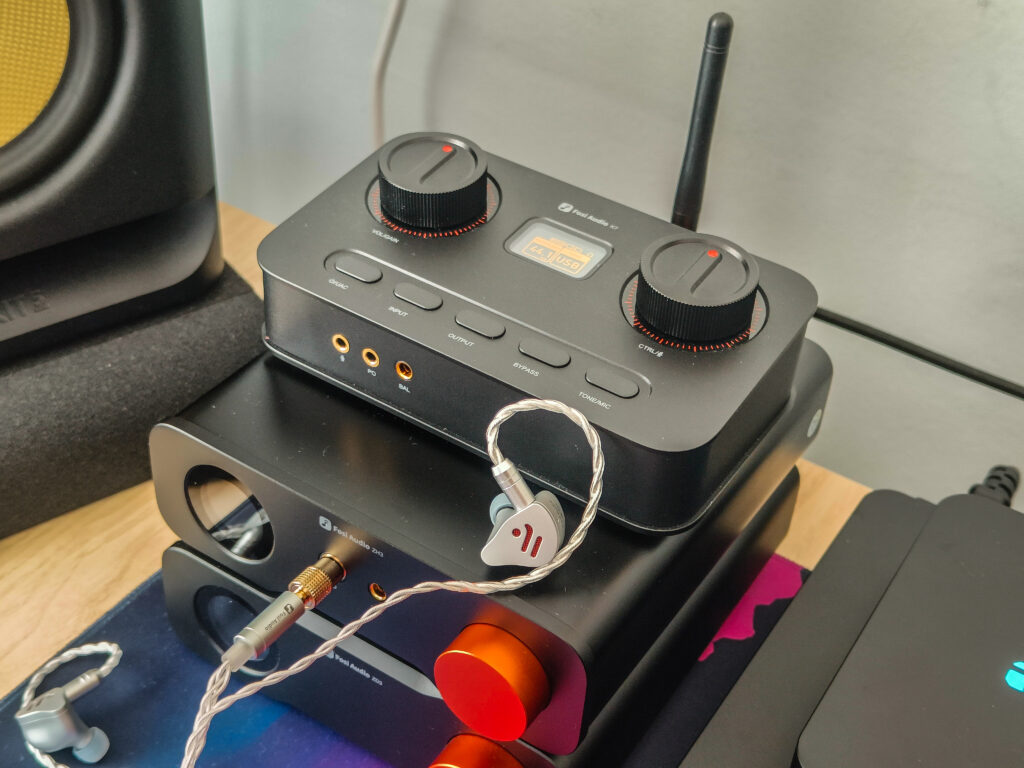
Now the obvious question. How does it compare to the K7? Especially when they are priced the same. To my ears they sound pretty much identical. Both are clean and pretty neutral, which is what I expect from modern DAC and amp combos. The real differences are in how they are built and who they are for. The K7 is aimed at gamers and mixed use. It has Bluetooth for quick phone audio and a microphone input for chat, and the front panel control is much more comfortable and easy to use than the knob on the ZH3. The ZH3 is more for an audiophile desk. It is a bit larger, gives me a fully balanced XLR line out for powered monitors, has an RCA input so I can use only the amp section if I want to use it with the ZD3, and adds a 12 V trigger in and out so I can power the stack together. It also comes with a remote, which makes the whole system feel like a small hub.
Who should pick which
If you need Bluetooth and a mic input for gaming or calls, and you don’t mind doing everything from the front panel, the K7 fits better. If you want a simple desktop center that feeds powered speakers over XLR, takes more devices in and out, and lets you switch inputs and outputs with a click on the remote, the ZH3 is the one I would pick. In sound they are practically indistinguishable, so the choice is really about features and the way you plan to use it every.
Conclusion
After using the ZH3 for a while, I can confidently say that it works, it is a simple and reliable desk hub that does the job. The sound is clean and quiet, even with my sensitive IEMs, and it has more than enough power for my headphones without any hint of clipping or distortion. To be honest, with DAC+AMPs today it is getting harder to hear big differences between good units, and the ZH3 is no exception. It sounds great and has a lot of features and versatility to it, which is exactly what I want from a DAC+AMP.
What really sold me is how easy it is to use day to day. With the remote I can switch between all of the inputs and outputs that I have been using with a couple of clicks, and it just works. No cable swapping, no menu fighting, just tap and go. For me that kind of convenience is a big part of why to spend money on such devices.
Compared to the K7, I honestly do not hear a real difference in sound. Both are clean and pretty neutral to my ears. The differences are in the features. The K7 is built more for gaming and use with Bluetooth and a mic input. The ZH3 feels more like a small audiophile hub, with XLR line out, RCA input, triggers, and a proper remote. One thing I do not like is that the remote needs AAA batteries, and none are included. I understand that there are some restrictions for shipping batteries, but I really wish that everything that is needed to use the device came in the box.
At around 199.99 USD, I see the ZH3 as a very easy recommendation if you want a simple, clean sounding desktop DAC+AMP for headphones and powered speakers, and you like controlling everything from the remote. If you need Bluetooth and a mic input, the K7 will probably make more sense.
Pros
- Clean, neutral sound, with no noises even with sensitive IEMs.
- Plenty of power.
- Remote control makes it very easy to switch between inputs and outputs.
- Balanced XLR line out and RCA input make it a nice little hub for powered speakers and external sources.
- 12 V trigger in and out so it can power on and off together with other gear in a stack.
- Three gain levels and fine volume steps, good for IEMs and full size headphones.
- The design is nice, with a full metal body.
Cons
- The remote needs AAA batteries, and there are none in the box.
- No Bluetooth input if you want to stream directly from your phone.
- Not the most comfortable control with a single knob, and a lot of the comfort comes from using the remote.
Where to buy:(Non-affiliated! None of my reviews use affiliated links!)






Hey. In today’s world, the lack of included batteries should, in my humble opinion, be seen as a big plus.
At home, I try to avoid using disposable batteries altogether – in the spirit of progress, ecology, and simple convenience. For all my battery-powered devices, I’ve bought rechargeable batteries and a charger, and I haven’t bought or used regular batteries for years.
So in my opinion, marking this as a downside because of the batteries is undeserved. For me, it’s actually a big plus that the device doesn’t come with some pointless disposable batteries, and that I can use my own rechargeables instead, without creating unnecessary battery waste.
And apart from that, great review – I’m planning to buy this device. Thanks. 🙂
Best regards.
Hi dimmiu,
Thank you for your comment and your point of view. 😊
I totally understand your reasoning and I can agree to some point.
But if we are talking about rechargeable batteries, maybe they can include them?🤔
I’m just saying it for the people who want to use the device right out of the box, without the need to buy extras.
Anyway, thank you so much for your comment and your kind words!