






































































QOA Martini Review
Intro
Hello, this review and feature covers the latest from the audio brand QOA (Queen of Audio), named the QOA Martini ($599). I was asked if I’d like to check this set out and I instantly obliged. Now, most of you know, but some may not know that QOA is actually a sub-brand of the well-respected audio brand Kinera. I find that both QOA and Kinera walk pretty much hand-in-hand as far as prestige within the community. Both deliver very high quality within the products that they bring to market and that has been proven time and time again. So, when I was asked to review the Martini, it was an easy choice for this guy. Now, the QOA Martini is actually a six-driver tribrid iem consisting of one dynamic driver, four balanced armature drivers, and one bone conduction driver. Once I saw the driver configuration, I was hooked on the idea of this set. Thank you to the good folks at Kinera for providing the Martini. I am actually waiting for the Martini to arrive at the moment. Shipping says they’ll be here in two days… I’m pumped.
Table Of Content
- Intro
- QOA
- Martini
- Long term review, it’s good!
- Non-Affiliated Purchasing Links
- Martini Pros
- Martini Cons
- Gear used for testing
- Packaging / Accessories
- Unboxing
- What’s in the Box?
- Eartips
- What are they?
- Carrying Case
- Cable
- Build / Design / Internals / Fit
- Build Quality
- Design
- Internals
- Fit / Comfort
- Drivability / Pairings
- Sensitivity / Power
- More juice!
- Source Pairing
- Sound Impressions
- What’s it sound like?
- 60/40 split
- Nice timbre, nice cohesion
- Not for everyone
- Bass Region
- Sub-Bass
- Mid-Bass
- Downsides to the Bass Region
- Midrange
- Musically-Technical
- Lower-Midrange
- Men sounding like men
- Upper-Midrange
- Females
- Downsides to the Midrange
- Treble Region
- Non-Fatiguing
- Air
- It’s fast enough, and detailed enough
- Downsides to the Treble Region
- Technicalities
- Soundstage
- Separation / Imaging
- Detail Retrieval
- Final thoughts on the QOA Martini
- Top Shelf
- The Why
- That Sound
- Conclusion
- Other Perspectives
QOA
I truly enjoy this brand. I enjoy the philosophy behind their creations, and I thus far I’ve enjoyed the end product of their hard work. In every review that I’ve conducted from QOA, Kinera, or even their other sub-brand Celest, I am always reminded of the level of creative thought and obvious effort that is bled into each set. I’ve only reviewed a few of QOA products actually. Trust me, I wish that number was much higher. However, I have truly enjoyed the three products that I’ve had the pleasure of spending quality time with. Those sets are definitely unique. The first set was the awesome QOA Aviation (Aviation Review). What a spectacular and totally unsung iem that should’ve been much more beloved in the community. Next was the QOA Adonis New (Adonis New Review) and I gotta tell you all; that set is confoundingly awesome. That beautiful warmth, bulbous and tight bass, caramel mids made for such a charming sound. Lastly, I reviewed the QOA Mimosa (Mimosa Review) a good while after and I gave this set top marks within its price point. QOA did an amazing job of blending a DD and micro-planar in a musically rich yet technically proficient sound. I won’t go through every Kinera and Celest review as well, but I will tell you that the end result for all of these reviews is always the same; unique, beautifully crafted, well accessorized, and high in price to performance. Hence why I couldn’t wait to get my hands on the Martini.
Martini
One thing which all Kinera, QOA, and Celest branded products have in common is that every one of their products are based on themes of some sort. Kinera typically bases all of their sets off of Norse Mythology. They choose a character and tie the character traits into the packaging, design, build, and tuning as well. QOA also does this, but their sets are most always revolving around beverages of the alcoholic variety. I love their theme ideas too. Always ridiculously creative. Oddly enough you can really draw a lot from certain alcoholic drinks. Obviously, the Martini is based off of the drink named “Martini”. Think of alcoholic beverages. Many of the same descriptive ideas concerning these beverages share some similarities with the descriptive words associated with audio products. Using these “themes” is a genius way to build an iem. I have always praised these brands for there thoughtfulness, their ingenuity, their craftiness, as well as their expertise and artistic outlook.
Long term review, it’s good!
Okay friends, the Martini just arrived a few hours ago and I can already tell you that this iem is going to make it to the top of the list on many folks’ shopping carts. What a well-tuned set! Of course, I have yet to burn them in and I haven’t spent nearly enough time to gauge just how good this set is, but I will certainly take my time getting to know this set. In fact, I think I’m going to make this a long-term review. I’m going to stretch this one out folks. I do that for only the better sets. Those sets which truly compete for the “best in class” top five. Take my time, soak in the music, write a million notes, and smile the whole time. Well friends, I’m now going to put the Martini into the burn-in station for about four to five days, and I’ll see you all in about a month or so. So, without further ado, the QOA Martini…
Non-Affiliated Purchasing Links:

Martini Pros
-Another awesome resin build from QOA
-The look is absolutely awesome. This is art folks
-One of the better unboxing experiences in the price point
-Accessories are fantastic (great cable, stellar eartips, nice case)
-Very nice timbre across the board
-QOA created a very cohesive sound, very well balanced
-Semi-rich note weight with very good note density
-That bass response is great. Deep, tight, authoritative, yet never muddy
-Mids are delectable. Beautiful timbre, forward, vocalists sound great
-Treble is non-fatiguing yet crisp, highly detailed, nice extension
-Detail rich sound
-Imaging is top notch
-Deep stage, full stage, and a multi layered sound fields
Martini Cons
-Midrange may be too prominent for some people
-Shells may be too large for small ears
-There’re no other real cons to this set
Gear used for testing
–IBasso DX240 with Amp8 MK2
Packaging / Accessories
Unboxing
If ever there was a brand who understood unboxing experiences better than anyone else, it’s QOA/Kinera. The undisputed King/Queens of unboxing experiences respective to price point. I really do respect how QOA goes over the top and thinks about every square inch of the box, box style, box art, and the layout of the contents of that box. I realize that not many people really care so much that they’d write about it… like I am at the moment. Also, in truth… rarely do I care. However, when I see effort it’s attractive to me. When I see something that takes calculated thought and the abilities of professional people who are doing what they are meant to do, I like it. That’s QOA/Kinera and its QOA who nailed this unboxing experience.
What’s in the Box?
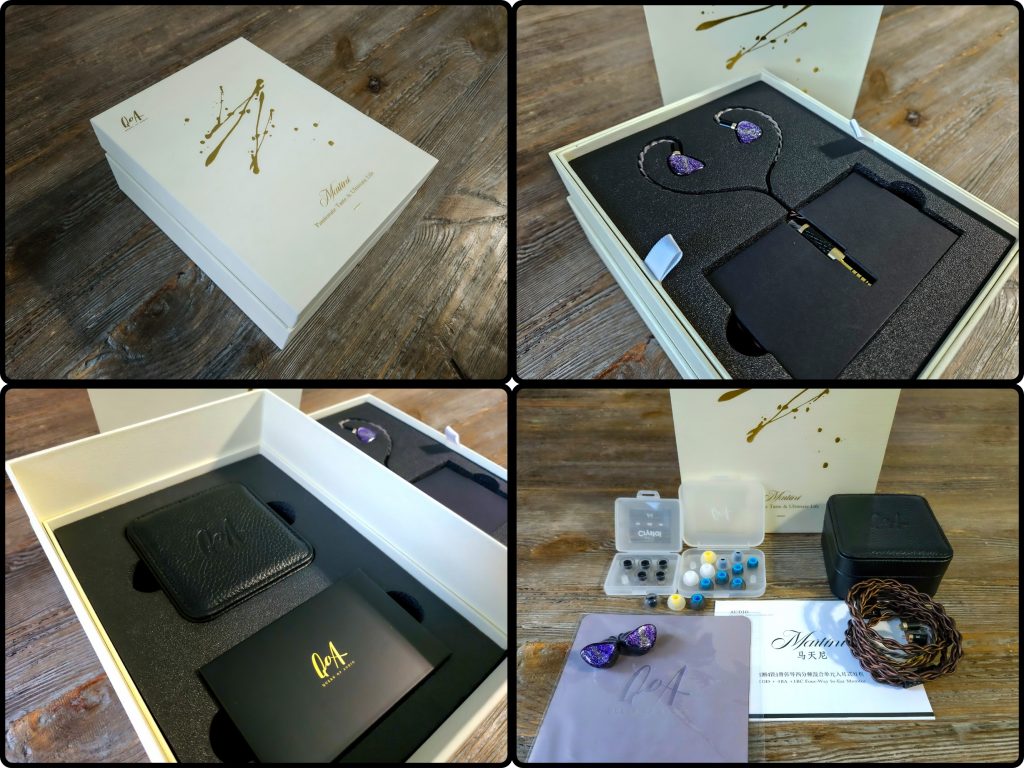
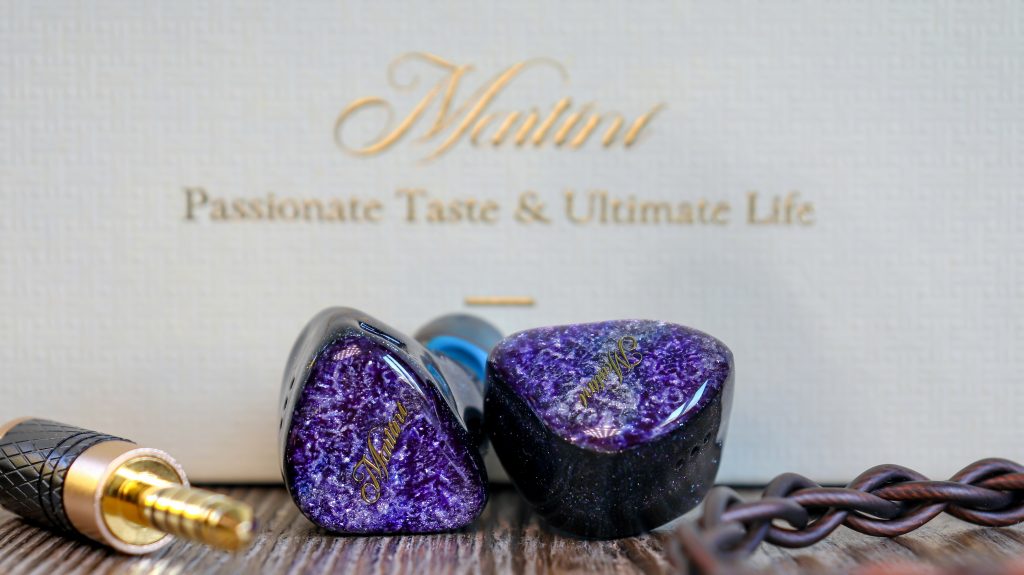
Okay, let’s do a quick and not very detailed rundown of what comes in the package of the Martini. I don’t want to ruin it for you. So, the box which arrived at my home is a pretty large sized cream colored hard cardboard box with an artistic gestural paint design. There’s this paint flicked and splattered abstract look which I’m assuming is supposed to resemble some Martini fizz or bubbles. You’ll also see the name “QOA Martini” embossed on the bottom of the box cover as well as “Passion Taste & Ultimate Life” under the name. It’s so stylish folks. So classy! Anyways, take off the cover and you’ll see an opaque white paper covering the contents. Take that off and the absolutely stunning Martini earphones are sitting in foam cut-outs with the cable attached and wrapped around a black cable holder of sorts. Lift off that layer and you’ll see the awesome looking black carrying case and an accessory box. Inside you’ll also find two small eartips cases holding all of the tips. Really friends, they did an excellent job on this one.
Eartips
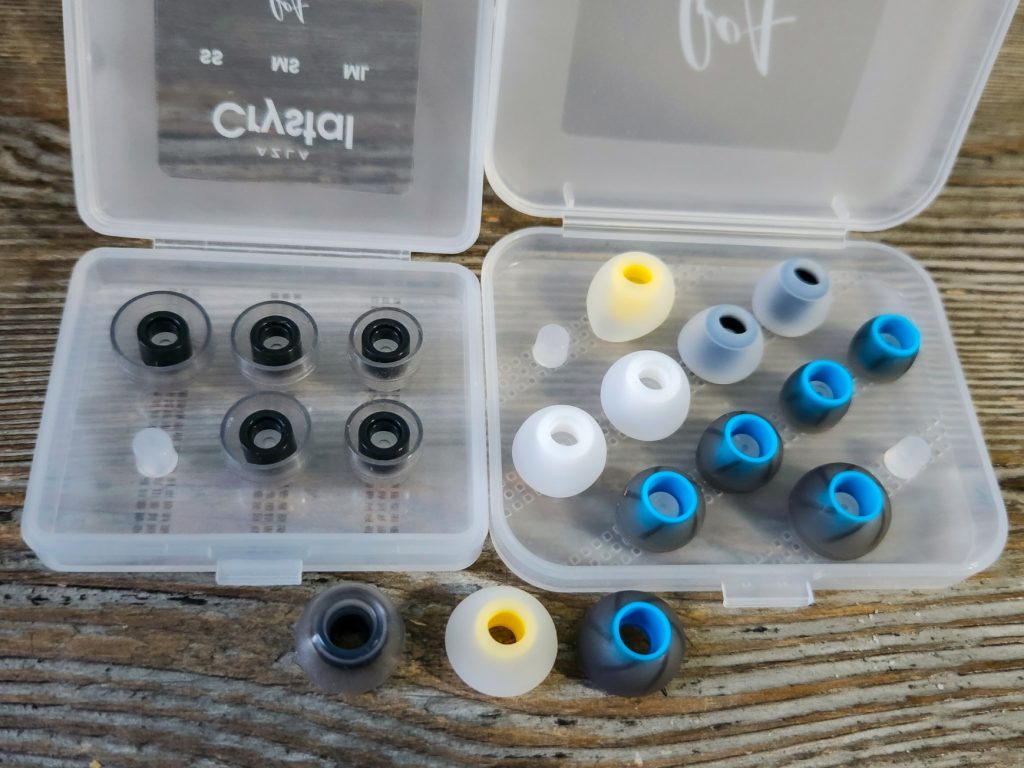
There is bright spot after bright spot with this set folks and the eartips provided are certainly part of that opinion. QOA added in a total of nine pairs of eartips over three totally different styles of tips. Excellent choices too. Way to go QOA! Way to care about the eartips! Thank you. Other brands need to take note! Care about the eartips… other brands! Care about them because it is such a simple, cheap & totally passive way to help the tuning of the earphones that you want people to enjoy. At least that’s what these brands should want. Okay, I got that out of my system. Until the next review where I’ll see some other brand provide pointless cheap eartips which force the listener to tip roll. So, you know, I didn’t need to tip roll with the Martini, because QOA knows what they are doing.
What are they?
So, the first type of eartips that I’ll talk about are basically KBear 07 eartips. Same exact… everything. These tips are three pairs (S, M, L) of silicone tips with a white flanges and different colored stems, semi wide bore, very rigid stem and firm flange. Really awesome tips that I use a lot for reviews. Next are three pairs (S, M, L) of silicone tips which are basically Tenmak Whirlwind tips. By the way, the Whirlwind eartips are drastically unknown, which is a crime because for wide-bore eartips, they are some of the best in the market in my opinion. Now, these tips have a wide-bore, shallow fit, with what looks like twisted half spiral ridges (hence the “whirlwind”) on the inside of the flange adding rigidity which helps a lot for sealing purposes. Lastly, QOA provides three pairs (S, M, L) of Azla Sednafit Crystal silicone eartips. These are basically liquid silicone style tips with the ridiculously tacky flanges. Now, these tips are a wide-bore set of eartips and they have a fairly firm flange and seal perfectly folks. I actually used these tips for some of my critical listening in the medium size, so that I can have a deep fit. For the bone conduction drivers to really work a deeper fit seems to help. However, I mostly used the Whirlwind style wide bore eartips the most. At any rate, the eartips provided are all very nice and great for any collection but most importantly… they actually make sense for use with the QOA Martini. Again, nice work QOA.
Carrying Case
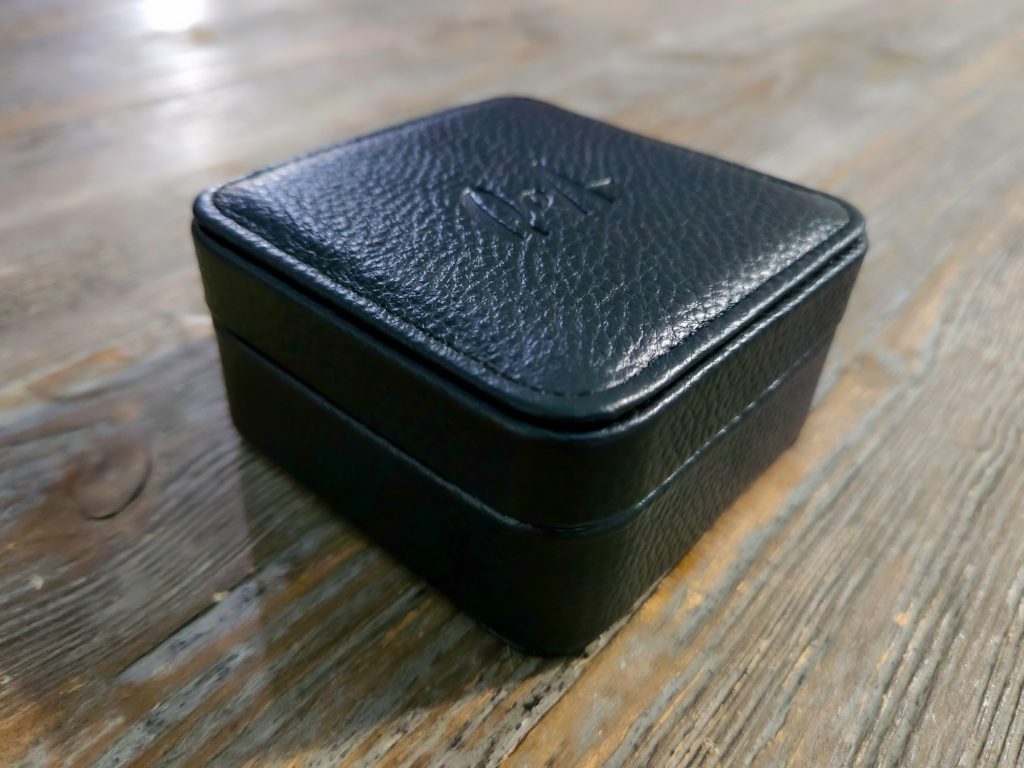
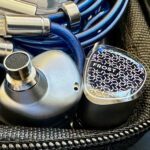
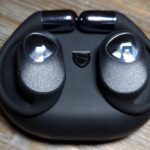
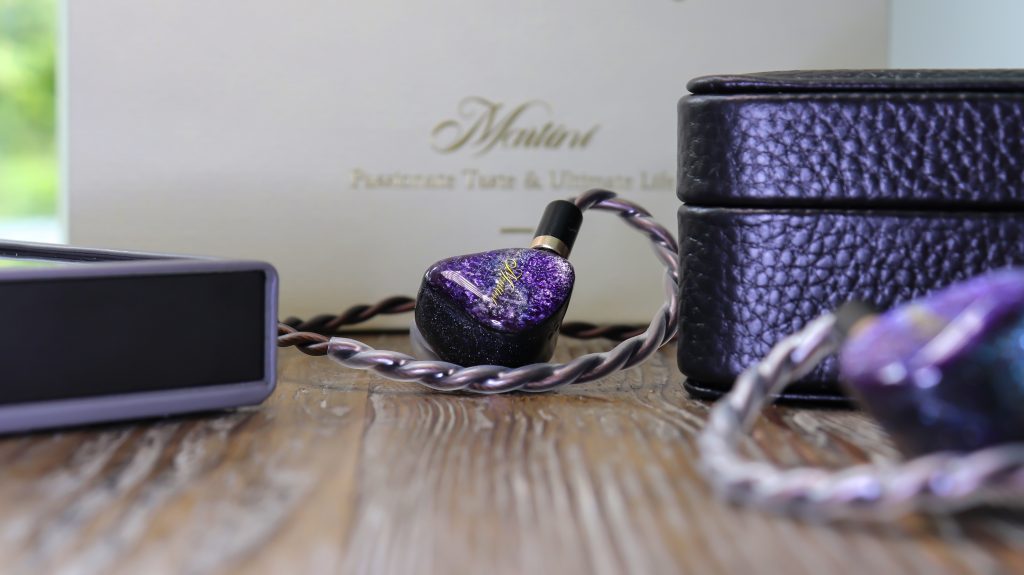
I find that the charging case that comes with the Martini is also a nice addition. I love the idea of a black case with this set. Of course, I know that I’m only talking about a carrying case, but it’s a dope case, nonetheless. So, the case is an all-leather black case, with cool stitching around the top, along with a slick looking QOA logo imprinted on the center of the case top. It’s not an enormous case, but it’s large enough to carry the Martini with the cable, extra tips, and a dongle dac. So, it’s a good size. This is definitely not a pocket friendly case but great for putting into a bag and not having to worry about the Martini getting beat up. Not bad and fitting for a set which costs $599.
Cable
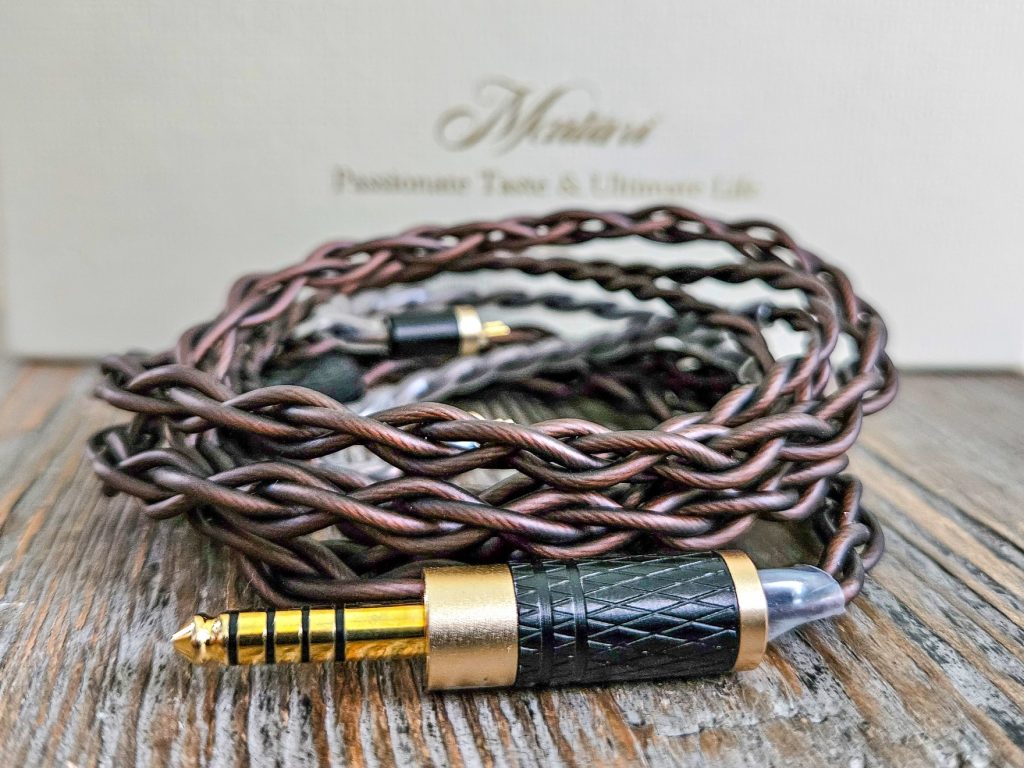
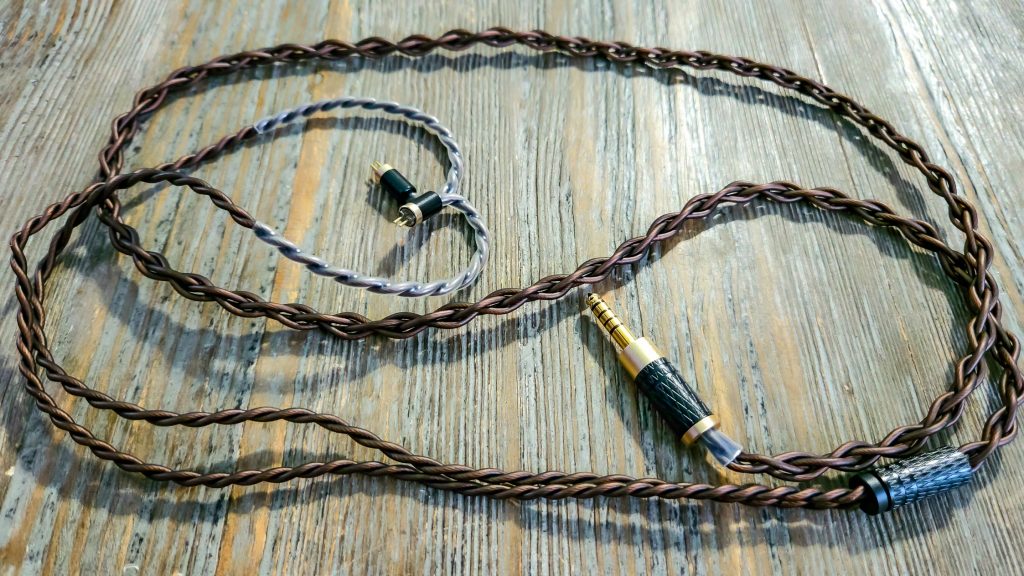
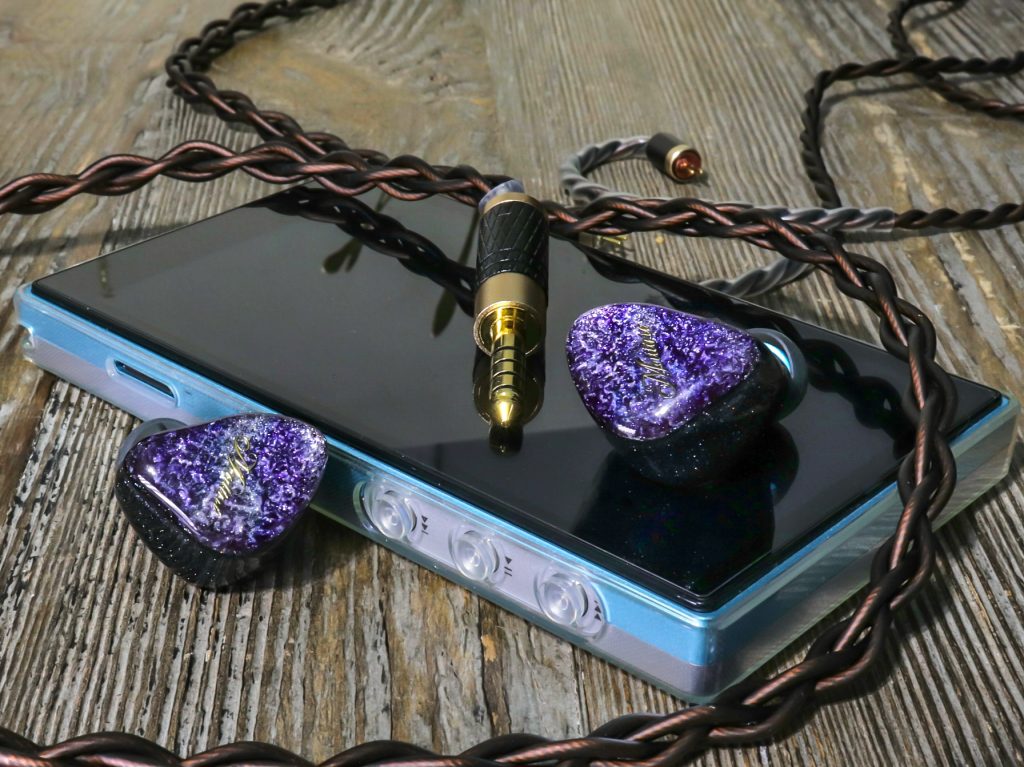
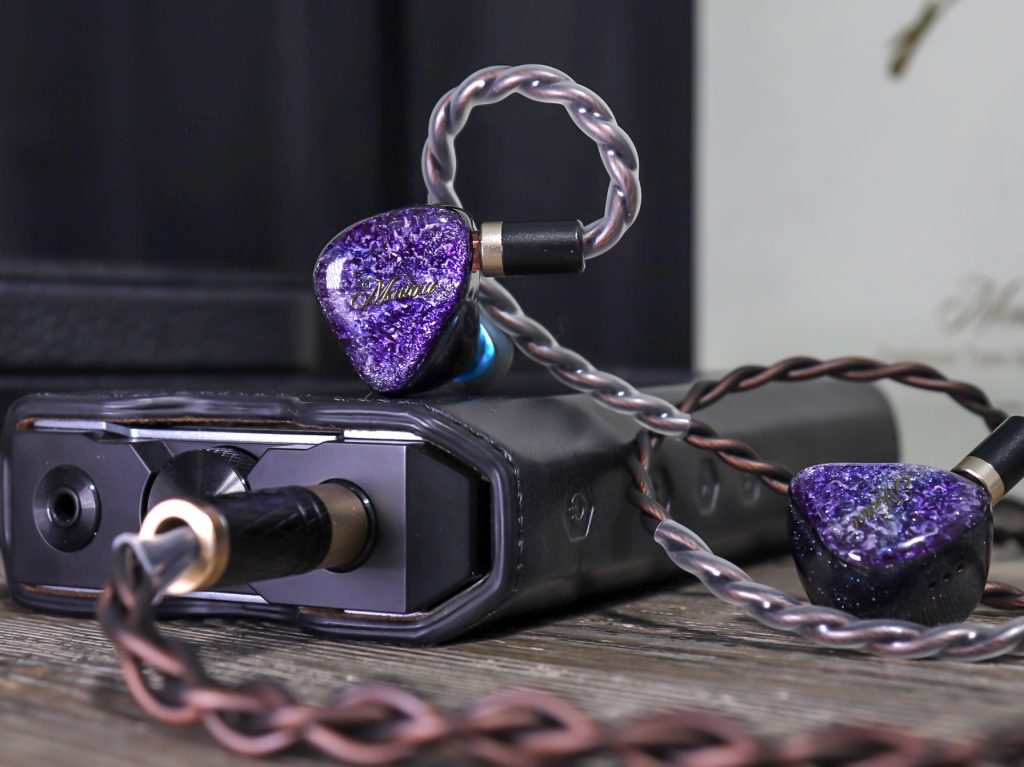
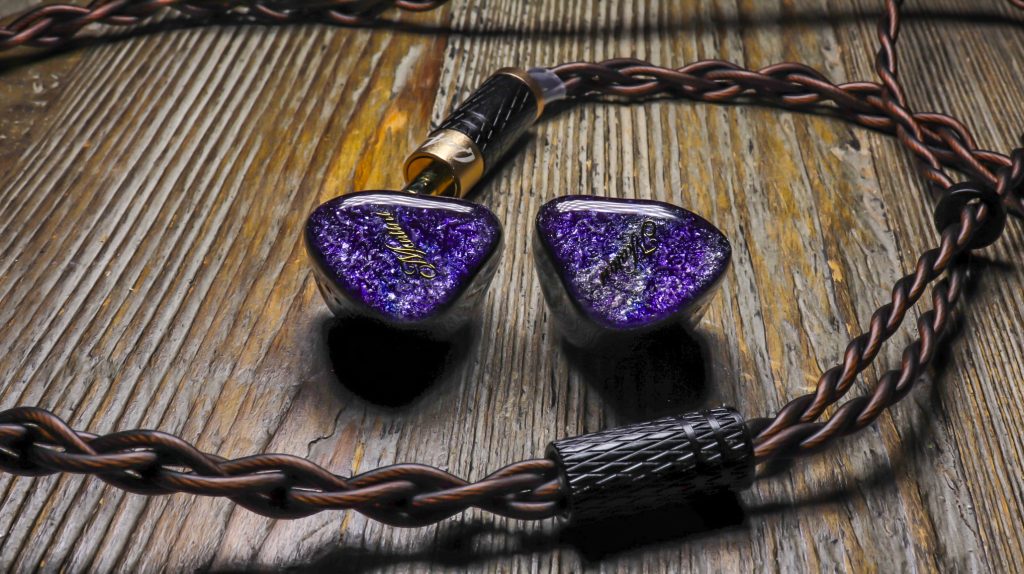
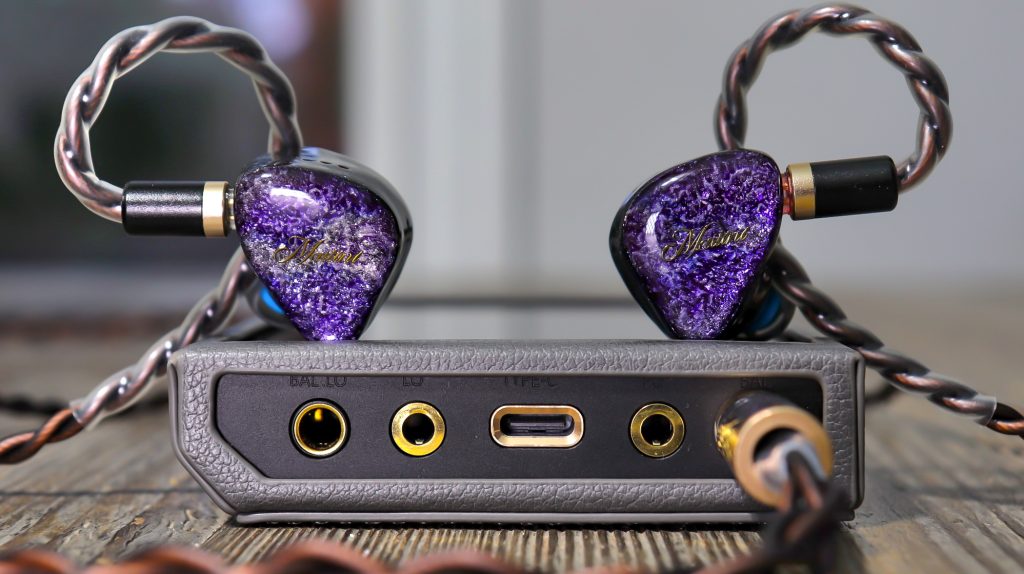
The cable provided is most certainly worthy of the cost as it’s a gorgeous brown colored cable with a nice and fat girth. I am always seeking out good cables to pair with my iems and the cable provided is most definitely a solid pairing. I even did a lot of cable swapping just to see what other cables matched better, and I went back to the included cable. Now, the Effect Audio Eros S ii cable was very nice as well, but I decided to ultimately go with the cable provided. So, the cable within the packaging is actually a 6N OCC (Ohno Continuous Cast) high purity copper wire with a four-strand build and each strand is said to have a total of 7 bundles of 19 wires each. Do the math, that’s a lot. It’s a fatty wire folks, and I love it. This cable comes with a 4.4 gold plated jack and aluminum alloy 2-pin connectors. Oh, I forgot to mention that the Litz structure is also hand braided. All things considered, QOA knows how to pick the right cable for the job. A set like this deserves a great cable that pairs well both aesthetically as well as sonically.
Build / Design / Internals / Fit
Build Quality
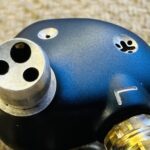
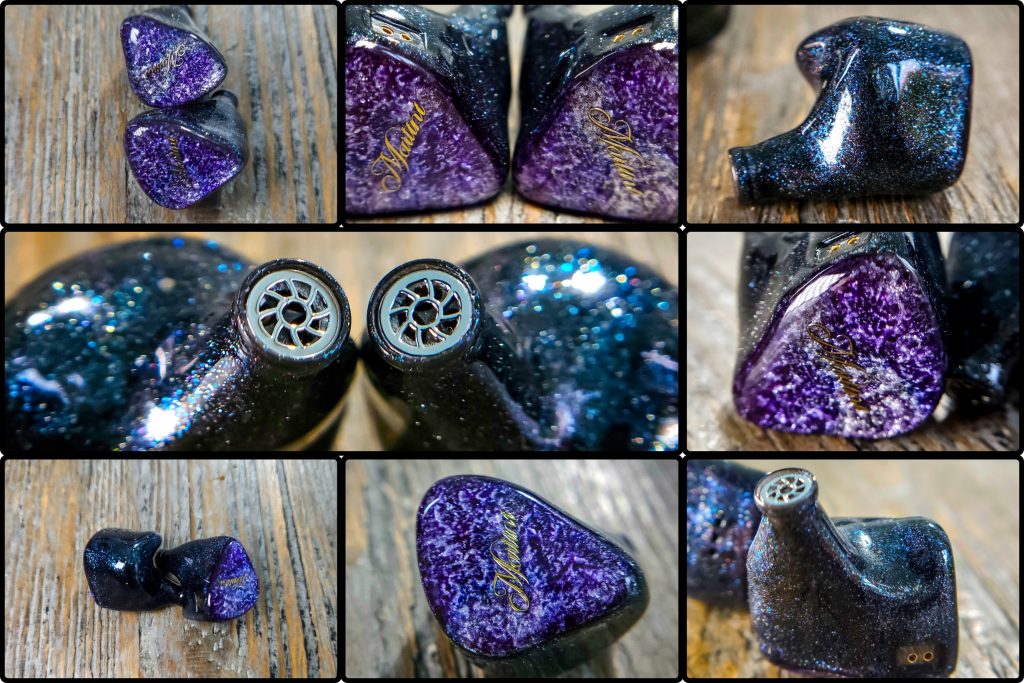
Let’s just get one thing straight; there’s resin made iems, and then there’s premium resin made iems. It’s hard for me to actually vocalize the difference other than the more premium sets simply feel more substantial. That’s how the Martini feels in hand. A very well made set and flawless in its appearance. Now, I’m assuming that the Martini is a 3D printed iem. I say that because the level of skill it would take to form this set would be astronomical. I should also add that the Martini is not a small iem, it is definitely on the larger side of the aisle, so smaller ears should take note. However, I really enjoy how well the Martini sits in my ears. Honestly, it has a very ergonomically correct design of the shell body, and the nozzle takes a natural angle into the ear. I should also add that the nozzles are about medium length and roughly about the standard 6mm in width. Truly a well done set with a very nice build.
Design
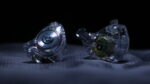
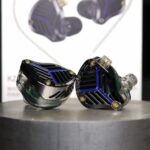
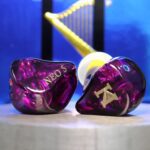
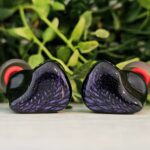
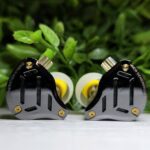
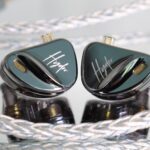
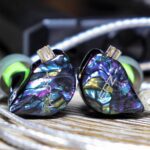
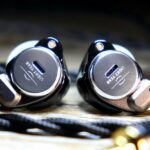
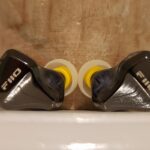
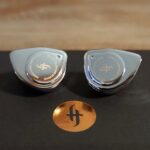
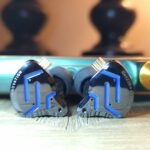
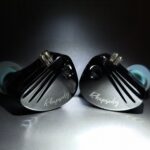
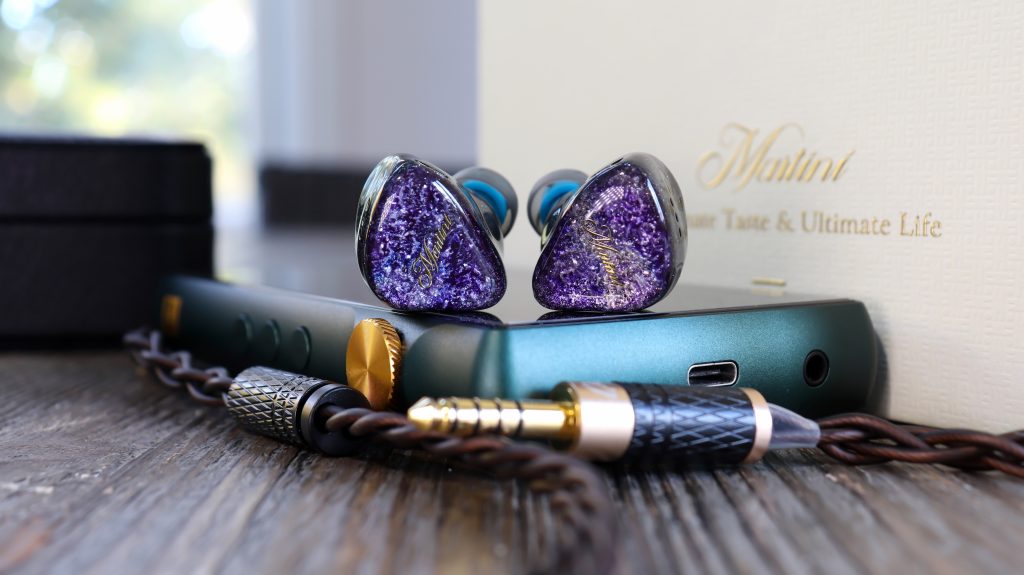
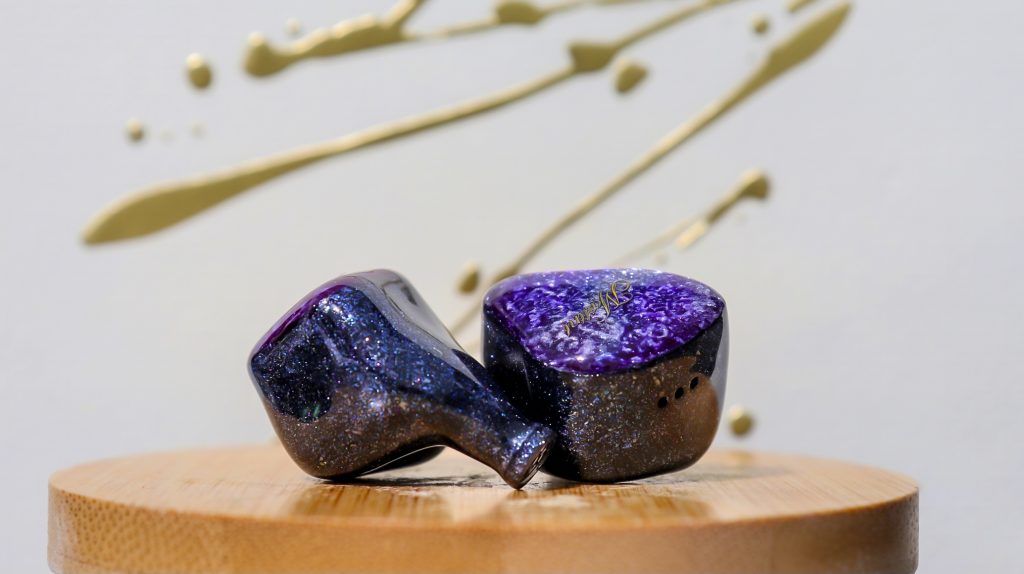
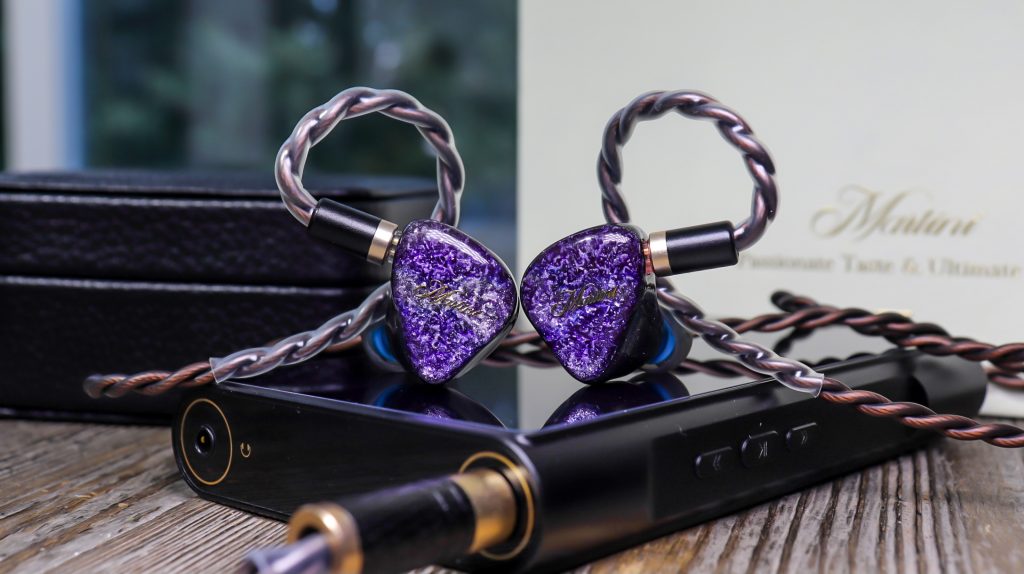
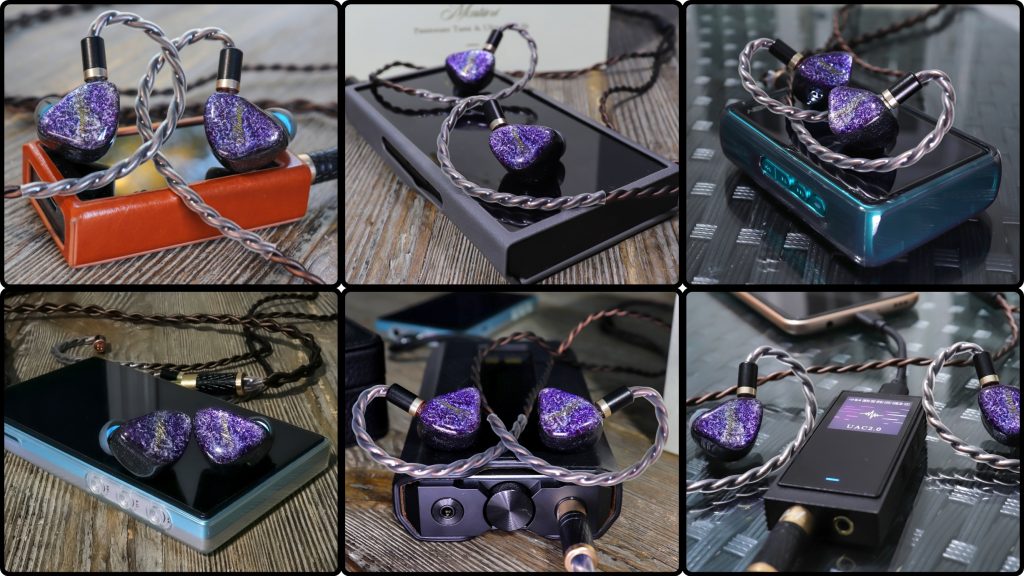
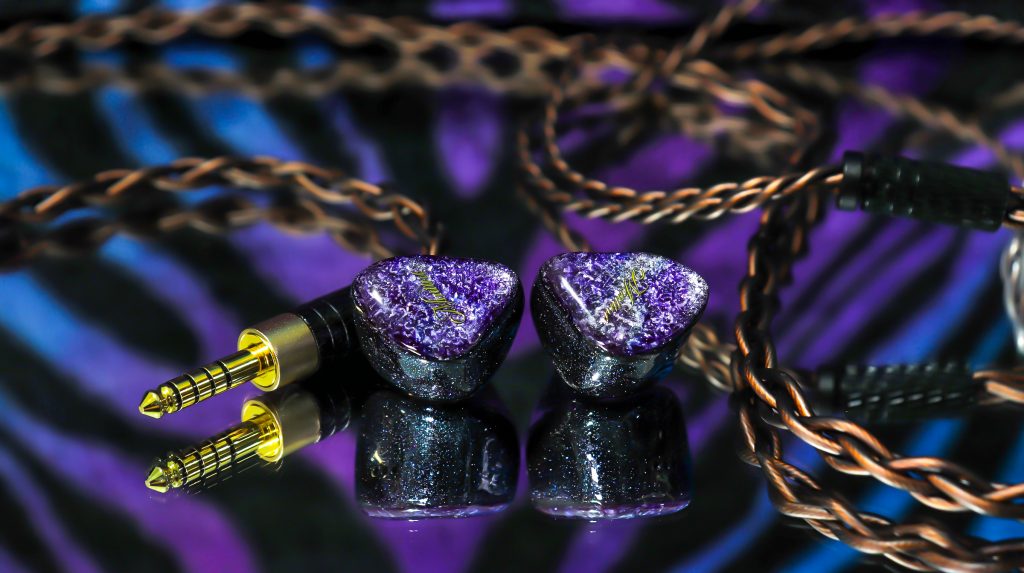
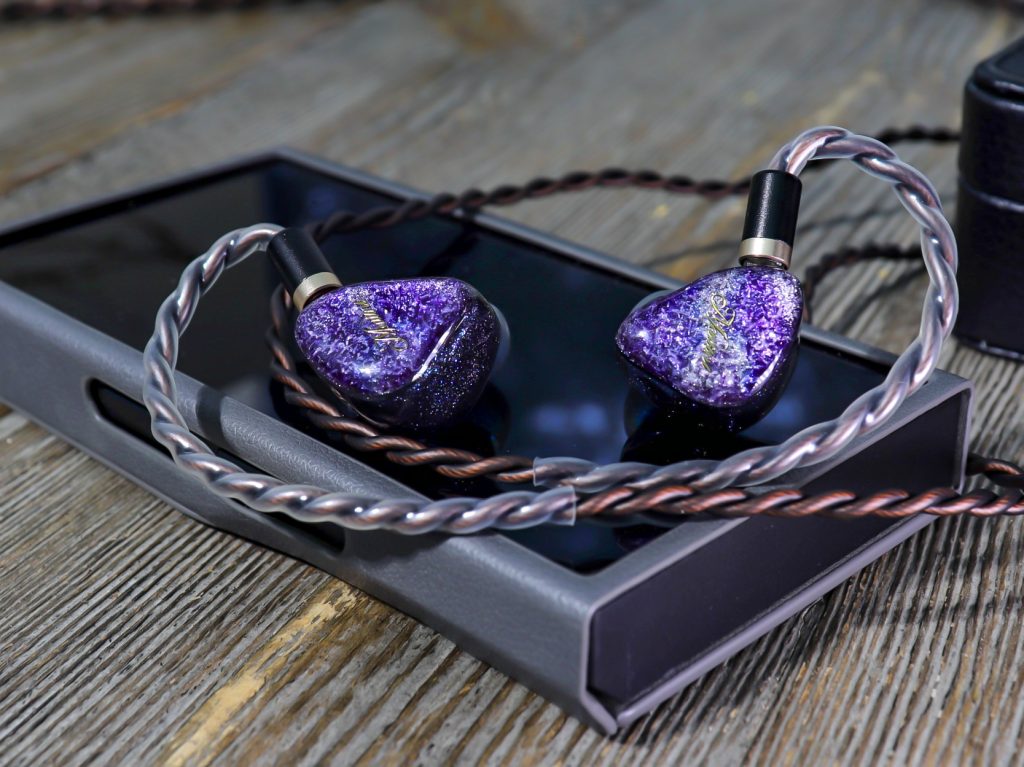
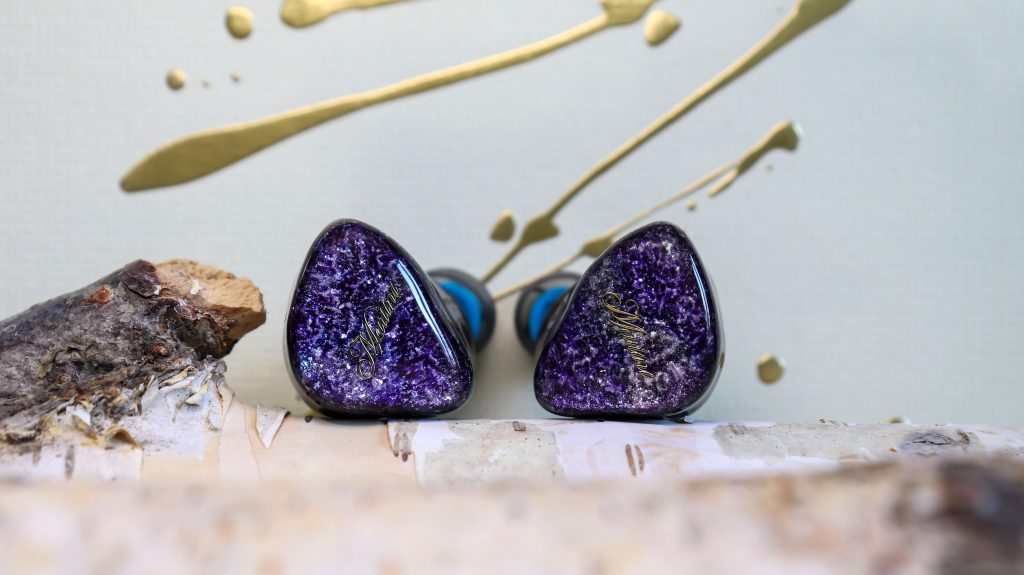
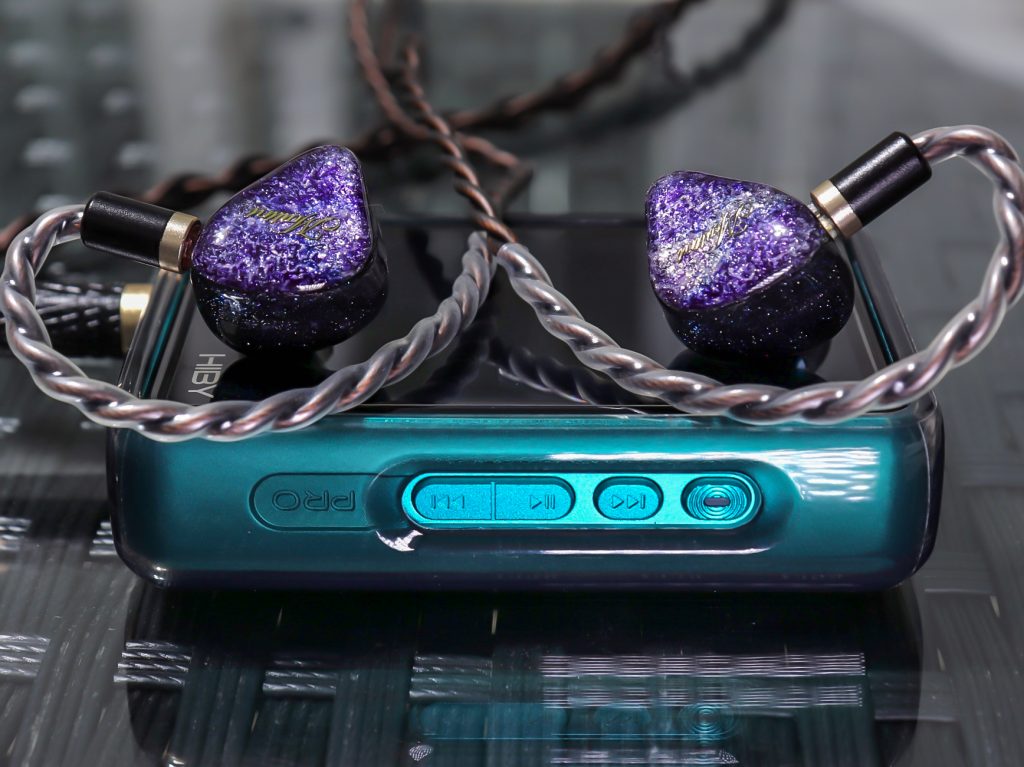
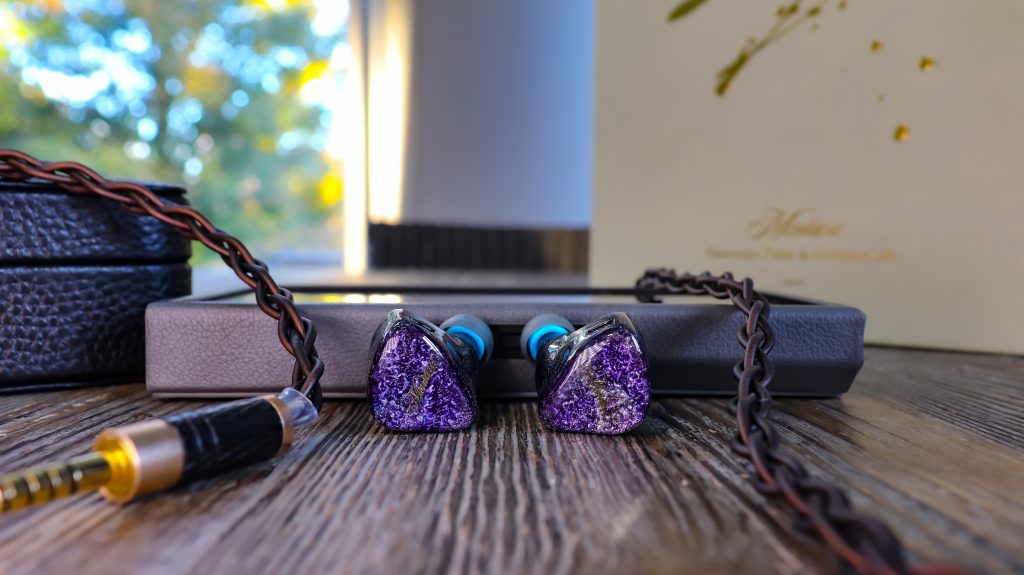
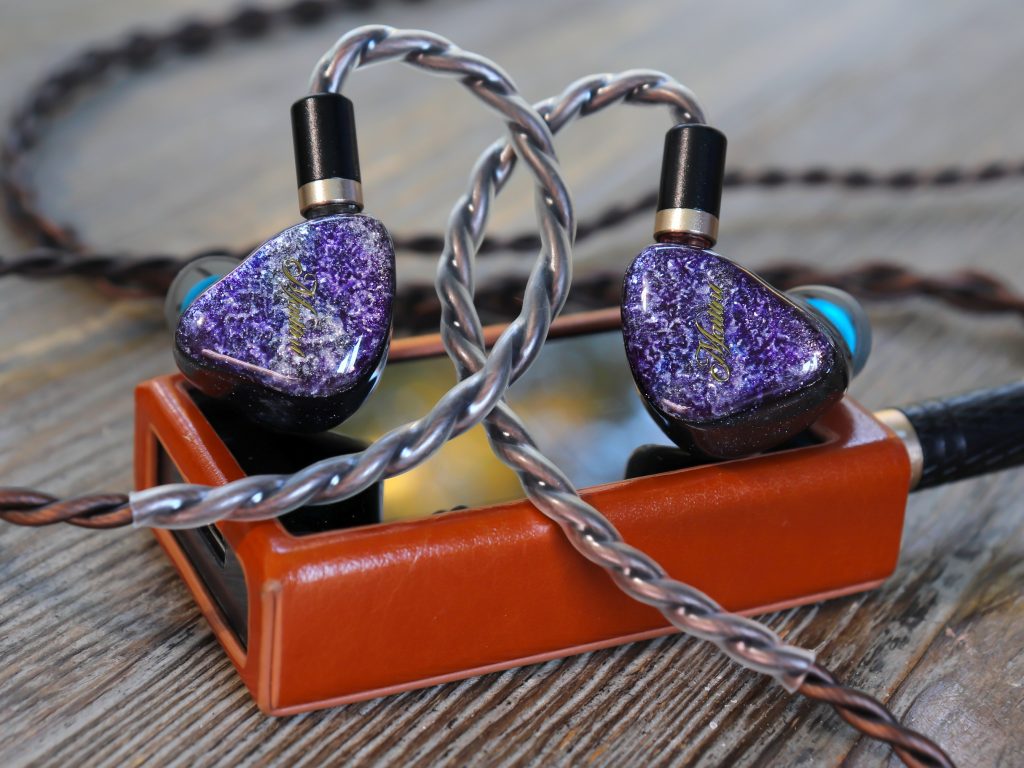
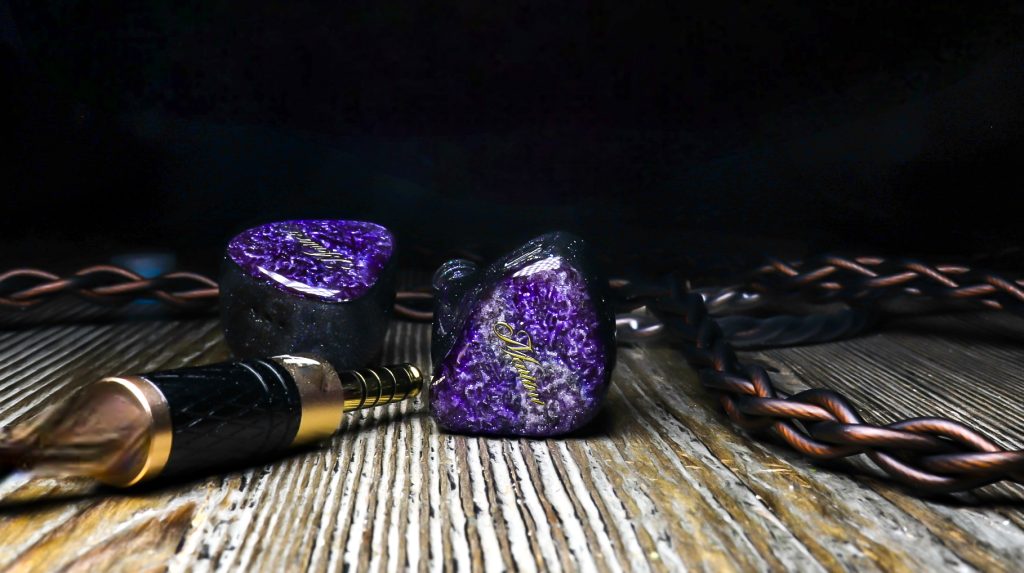
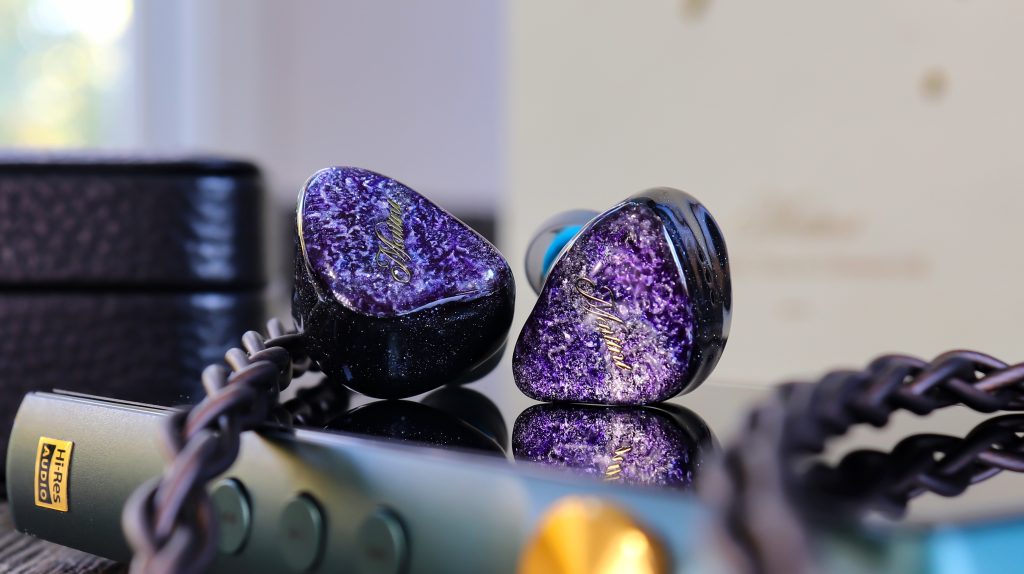
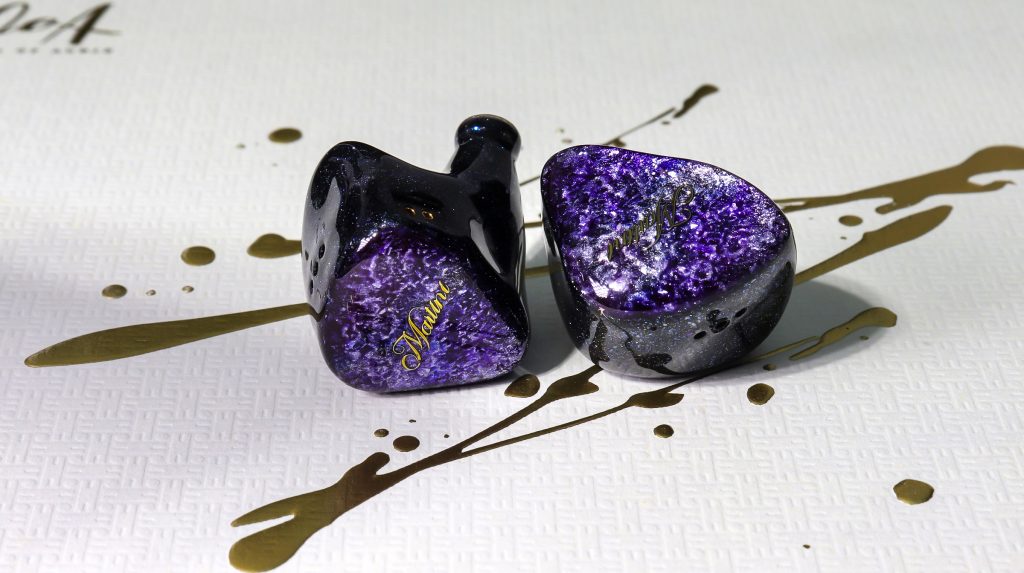
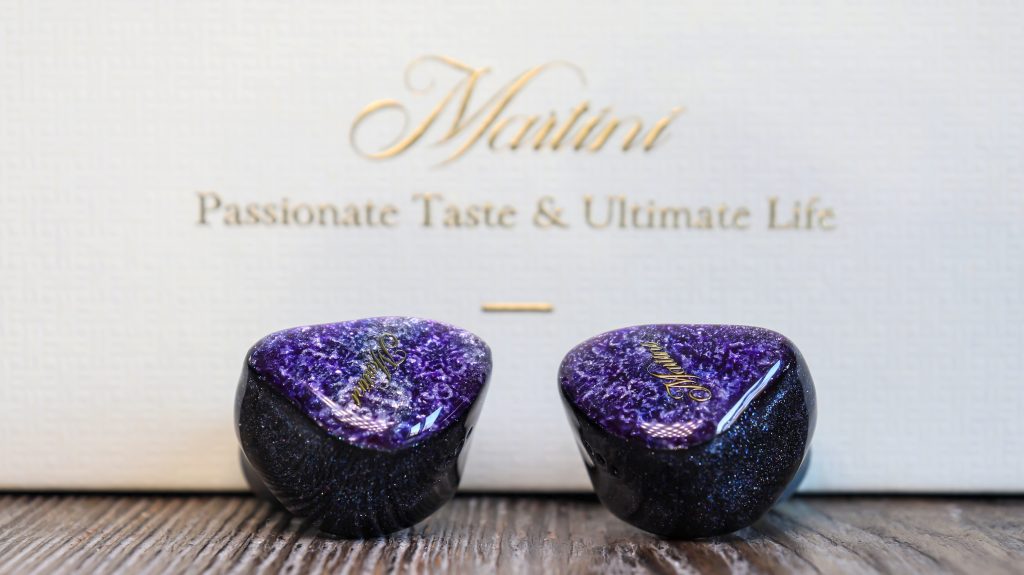
Now, one area where QOA truly shines is in their resin builds. Always gorgeous, always beautiful too. No doubt the Martini is no different folks. This set is definitely a stunner. In fact, you’d be very hard pressed to find a more artistically beautiful iem anywhere near its price point. The base colors are black for the shells while the faceplates have a deep purple color. The black shells are actually littered with glitter which sparkles and changes colors to the light. It’s this wonderful glitter effect which appears almost as a galaxy of stars and covers the entirety of this set. I applaud whoever designed this set. Without the shadow of a doubt, the Martini looks the part. Meaning, it looks as premium as its price tag. This design took time folks. You don’t just knock this out in one sitting. Multiple curing stages along with needing to sand, smooth, and polish the entire shell. I won’t go into the whole process, but it’s a lot. QOA does a masterful job, and the Martini is a perfect testament to that.
Internals
As I said, the QOA Martini is a tribrid (of sorts) with a total of six drivers carefully placed into its shells. That’s one DD, one BC, and four BA’s. QOA actually decided upon an interesting but also completely genius choice for their lows. They used a very small 6mm liquid diaphragm dynamic driver with advanced magnets along with a 10mm bone conduction driver covering the sublevels. This is genius folks. You get the rich sound, the tight delivery, and the clean delivery of the smaller 6mm driver, yet you get the feel and the haptic weight and vibrance of a bone conduction driver. Together they created one awesome bass delivery. Next, they added in two Knowles full-range balanced armature drivers to cover the midrange as well as two custom balanced armature drivers to cover the entire treble region. I love the wonderful cohesion of the sound of these drivers folks. QOA also decided upon a four-way crossover as well to direct the frequencies of each driver. Really, I think the choice of the smaller and more clean-lined, yet punchy 6mm DD coupled with the bone conduction driver is simply awesome. I should also add that the midrange and treble drivers do an awesome job as well.
Fit / Comfort
The QOA Martini is in all honesty one of the best fitting and most comfortable iems that I’ve tried out in some time. Every now and again a set will come along which perfectly molds to my ears. I mean… folks… it’s like these things grew there! Perfect fit. The seal is crazy good, and the Martini are also very lightweight which makes them feel featherlight. It’s just good across the board for me. It really is. As always, I don’t know how your ears will do with this set, but I have to imagine that 99% of people will have a very comfortable feel with the Martini.
Drivability / Pairings
Sensitivity / Power
The QOA Martini is a fairly sensitive iem. Sensitive enough to be driven nicely off of most any source. It’s actually rated with an impedance of around 14 ohms and a sensitivity of 105 db’s. So, smartphones, and weaker sources using 3.5 single ended ports can be used with this set. I always test every set with my weakest sources just to see how well that they come across. One old Android phone with a 3.5 se port, a few different no name Conexant 3.5 se dongle dacs, my iPad, as well as the KZ AN01 which is really not a strong source. However, the Martini sounds just fine on all of them. It gets loud enough, dynamics come out nicely too. Though, the bass control is slightly less defined, and the soundstage is less enhanced. Still, weaker sources sound very nice.
More juice!
Having said all of that, the Martini absolutely comes out of its shell with more juice. Without the shadow of a doubt folks. Those six drivers most certainly sound much more expressive, cleaner, grander, fuller, and simply have a more vivid sound. I’m talking about a decent enough dongle dac at the least. Granted, I’m pretty positive that anyone willing to shell out $599 for a set of earphones most likely already has a decent source on hand. In truth, I liked the Martini best using my Shanling M6 Ultra, Hiby R6 Pro II 2025, Fiio Q15, or my iBasso DX240 on medium gain. I think when you can provide the Martini with adequate power, plus a good clean source then it’ll truly show you its best side. Of course, I used so many sources during this review period that it would be ridiculous trying to list them all out. However, there does seem to be a point where the 6mm DD really wakes up, so to speak. Furthermore, there is a power point where the BC driver becomes more apparent too. The point is that you should try to at least get a reasonably good dongle dac with some output to it.
Source Pairing
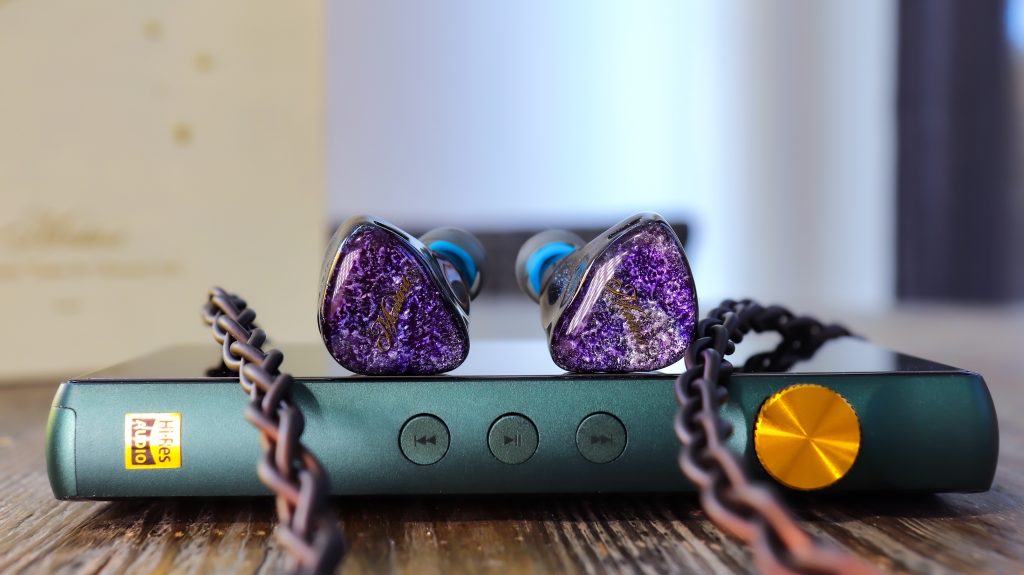
As far as actual tonal Pairings goes, I find the Martini to be warm/neutral yet with a hair more of a tilt towards the warm. Just enough neutrality mixed in to not call it straight up warm. However, what this means in tonal Pairings for my sources is that many different source devices work very well with this set. Of course, that completely depends on your preferences. Still, the Martini sounds very solid on any source from warm/neutral to neutral/bright. In my opinion. Basically, your source has a wide window to be able to bring out the best in the Martini without exaggerating any of its more emphasized regions. Like, the Martini isn’t so warm that a warm source is going to make it sound muddy or too smooth or blunted. On the flip side, the Martini isn’t so neutral or bright that a brighter source is going to all of a sudden make it sound analytical, dry, or harsh. Again, the Martini has a wide window for different source pairings. Now, for me, I find that warm/neutral sources with a punchy or energetic presentation sound best. Like, the Fiio Q15, the Hiby R6 Pro II 2025, the Shanling UA6, the Hiby R3 Pro II, and many more. Yet in the same breath, my neutral sources help to add a touch more vibrance, like the iBasso DX240, the Hidizs AP80 Pro Max, or the EPZ TP50, etc. Either way, this set sounds great with many sources.
Sound Impressions
*Note: before I dive deep into the sound portion of this review, I first want to make a few quick notes which may or may not mean anything to you. First off, I did burn this set in for a total of five full days. To be perfectly honest, I didn’t mean to burn them in that long. I was reviewing another set and may have forgotten it. Lol. I really don’t think that it changed things up for me in a largely noticeable way. I also listen to mostly flac or better files (and some Mp3’s) which are stored in my devices rather than stream my music. The Android music player of my choice is mainly UAPP (USB Audio Player Pro), though I used Hiby Player quite a bit as many of my daps use the HibyOS.
What’s it sound like?
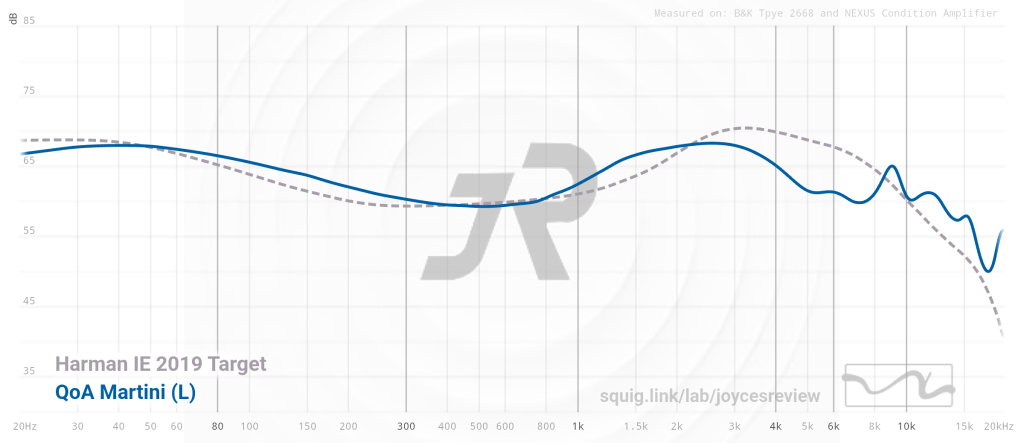
The first thing which comes to mind when listening to the QOA Martini are the words… clean-musicality. So QOA went with a ratio style tuning which was modeled after a 3:5:2 ratio (bass, mids, treble). This ratio was actually inspired by its namesake alcoholic beverage, the “Martini”. I love that QOA went this route folks. First off, they stick to the script and let the theme (Martini Cocktail) decide the overall sound. However, what that translates to concerning its sonic repertoire is that no area of the spectrum is left out and nothing overwhelms the mix either. That’s number one. Every area of the mix has some dynamism, some solid emphasis, and each area of the mix plays a significant role in the overall sound. This ratio also tells me right away that there is a more forward midrange along with a more non-offensive sound. But it also tells me that there’s some warmth too, and there’s a ton which we can deduce because of that. Well, I can tell you that QOA really did nail that ratio. In fact, if I’d call the Martini anything I’d say it’s a warm leaning W-shaped profile with a nice spritz of treble gleam up top, just enough. Certainly, forward in its mids, punchy in its low-end attitude, and a very technically adept treble region.
60/40 split
In my opinion the Martini sits right around a 60/40 musicality/analytical split, and it carries a smoother persona, a very rhythmic formula which doesn’t leave out note defining crispness. Most of my favorite sets carry something akin to a 60/40 split. Though, that is in no way set in stone because I like every sound signature when it comes down to it. Also, 60/40 is 100% a subjectively discerned number, made up by me. So, take that as a grain of salt. But I digress, the QOA Martini carries just enough macro-dynamic energy to feel and sound enthusiastic when it needs to. Yet the Martini also has enough of a smooth character to draw out the emotion within my music when it needs to as well. In truth, the QOA Martini is actually a pretty versatile iem. There’s definitely a certain pedigree on display here. No doubt the sound of the QOA Martini is very refined, nicely textured, technically savvy, with a smooth and fluid style cadence which flows within a fairly deep and wide stage. Musically gifted yet technically inclined. I love that mixture. Come to think of it… I can confidently report that the Martini is right there with the best that I’ve heard throughout its price point for a few different qualities that it has.
Nice timbre, nice cohesion
To my ears the Martini has some nice timbre. The inflections and accentuations of each note, or the tonality of each note is close to natural. What isn’t natural is the quicker than natural transients. This is not a slow set, and these drivers react on a dime folks. So, you won’t have lagging and drawn-out decay. This goes for the BA drivers as well as the 6mm DD. I would also be completely remiss if I didn’t explain that (from my perspective) the sound has fantastic cohesion between drivers. Many times, these hybrid sets will have some subtle phase issues, or speed/timing issues, and issues with drivers simply not sounding aligned. It happens a lot. These hybrids can also have crossovers which aren’t phase aligned which don’t sound homogenized and aligned between drivers & frequency. Folks, I hear none of that with this refined iem. QOA has been at this game for a long-time, and they really do an expert job of blending everything together nicely. So, it’s an easy to listen to mid-fi iem. I hear no real peaks, nothing too abrasive, nothing too edgy to my ears, no real annoying sibilance, and nothing comes through grainy or fuzzy. A very smoothly rendered and completely pleasant listen which I can very easily get lost in for hours at a time.
Not for everyone
Having said all of that, like anything, the QOA Martini is not going to be for everyone. You’ll definitely have those bassheads which won’t find this set up to their standards. Also, you’ll have those treble heads who also won’t totally jive with this set. The Martini doesn’t over saturate any area of the mix and that goes for both the treble and the bass. The sound is very nicely balanced across the mix and once again there’s no area which comes across as the dominant frequency. Maybe the midrange, if anything. That said, I really enjoy the emphasis given to the bass, mids, and treble as each area serves the greater good and melts beautifully into the overall sound. Still, that doesn’t mean that everyone is going to feel the same way. I could also say that those straight-up V-shaped lovers who adore the boosted bass, less enthusiastic midrange, and lifted treble are also not going to be okay with this mid-forward style. Before I get into the meat of the sound portion, I definitely need to confirm that… as for me… I love the sound of the QOA Martini. I find the tuning to be refreshing, very unique, and fantastic for those who like just enough energy, fun, and dynamism, yet who don’t want the harshness, abrasiveness, or pierce. QOA walked a fine line here folks and I’m okay with that.
Bass Region
The low-end of the QOA Martini is one of clean and tight transients, hard-edged attack and a tight decay. Yet also this is a richly rigid bass with a solid note density and a relatively robust and authoritative weight provided to every note. Having said that, I would say that the actual emphasis is just above moderate (8-9 dB bass shelf). Let’s put it this way; there has never been a moment where I felt the bass emphasis was too much or oversaturated down low. Of course, you have to understand that an 8-9 dB bass shelf for a 6mm DD is fairly different from an 8-9 dB bass shelf of a standard 10mm DD. However, the bass can hit folks, and it can hit hard too. I think the addition of the 10mm bone conduction driver really cements this bass, gives it some depth, some real solid texture, some vibrance, and some dimensionality. It’s actually a fantastic combo. To have a very tight, very fast 6mm DD providing those tight dense notes and a well implemented BC driver adding in the haptics feel to that bass really does create a solid low-end. What I tend to enjoy is that the BC doesn’t smear the bass or make it any less coherent. Again, the low-end has very nice note definition, clean dynamics, very well separated, never one noted, and it can reach pretty juddering depths when it needs to.
Sub-Bass
Starting with the sublevels of the low-end, I found that the Martini has the ability to create some deep extension, but that seems to only be when it’s called upon to do so. Basically, the Martini’s sub-bass isn’t going to usurp its will across the mix, it won’t muddy the waters, and it doesn’t ever sound like bass smear. QOA did a nice job adding just enough physicality without that physicality becoming a problem. Without question the sublevels have plenty of low, dense, and concrete-like muscle when a track offers such a thing. Like “Paradigm” by The Head and the Heart. This is a track which goes very deep right away with a very rhythmic and pulsing guttural bassline. Man, the Martini sounds great with this bass! Mainly because it easily reaches deep, dark, and bold, but it also has that abrasive texture and dark vibrant dynamism. The best part is that the bassline masks nothing. The lead’s vocals sit right in front, prominent, clearly heard while the lows grumble underneath. Very nice. The sub-bass has an authority-rich and fairly powerful sublevel muscle with fantastic tactility without becoming too dominant, prominent, or too messy. This is a clean sublevel response folks.
Mid-Bass
The mid-bass is very similar to the sublevels in overall emphasis and authority. Granted, most of the BC driver’s strength is more within the sub-bass, but there is certainly some spill over into the mid-bass as well. Now, to my ears this bass is pretty fast, well textured, it’s agile, very ductile, and it comes across well defined. Nothing pillowy, nothing weak, nothing fuzzy, and you won’t hear any mud. The mid-bass has what I’d call a warm character along with a very punchy nature. That dedicated 6mm DD has that fast twitch response and a nice snap and slam on attack which actually feels textured. Like the electric bass guitar in “Billie Jean” by Weezer, which hits like a bullish, hard, & fast kick drum in successive rapid booms. Man, it sounds great. That ultra tacky initial hit on attack caused by the haptic recognition of the BC driver, followed by quick decay hollow booms sounds flat-out great. Folks, the bass sounds tight, it sounds potent, physical, and pretty aggressive. Another solid track which I use constantly in my reviews is “The Hardest Part” by Washed Out. It has this wavy and rolling chiilwave style synth bass that runs deep, is super full, and it carries weight. A good track to compare sets with. Anyways, the Martini sounds just as I described it; full, and it carries weight. However, the nice thing is that it doesn’t mask any other portion of the melody. I hear no smearing and instead hear clean lines, distinct notes, and tight transients. Again, this mid-bass is very clean. However, there is some spillover into the midrange which gives this set its slightly warmed, smooth, clean, and agile sound within the mids. Very nicely done.
Downsides to the Bass Region
Man, I find it hard to sit here and come up with downsides or issues in this region because QOA did such a nice job with it. However, nothing is perfect. Okay, so, the bass region of the Martini is not going to impress two types of listeners. Those being bassheads, and those allergic to bass. Bassheads, or even moderate big bass lovers will certainly want a heavier rumble and more earthy atmospheric feel to their music. Perhaps even warmer. Again, this is not even close to an overwhelming low-end. It doesn’t usurp its dominance and it’s not even the most emphasized region on this set. It’s a nicely balanced, just-above-moderate bass. It’s meaty… but tight, forceful but refined, full enough yet defined. Then you look at those analytical bass types who do not want anything to do with a bass that has any helping of significance. They want a bass which is rarely heard. These types want nothing to do with a bass which will mask any clarity whatsoever. Give them a neutral bass and they’re happy. Obviously, the QOA Martini’s bass region is not that. It’s big enough to be fun and mature enough to be considered refined.

Midrange
The midrange is what I’d refer to as fairly well balanced against the rest of the mix, yet predominant within the tuning strategy that QOA tuned the Martini to. Both instruments and voices reside slightly closer to the listener without coming across overpowering or overbearing. I said in the beginning of the sound portion of this review that the midrange is certainly forward in its presentation, but not to a fault. In fact, I find that “dynamically” the mids to share the stage very well with the bass and treble. However, it is certainly a more forward sound and definitely not recessed in my opinion. So much so that I called it a warm/neutral W-shaped signature. Shoot, look at QOA’s ratio (3:5:2) and you’ll know where the mids stand in the tuning philosophy of this set. No doubt they’re forward, but they are also very musically rendered with a very smooth overall presentation. Glass-lined in its note texture, clean outlines, and very much unsullied in its note delivery whilst also carrying a very smooth and rhythmical cadence. QOA was able to give the Martini a midrange which carries nice presence, a semi-rich note body, as well as a warm/neutral hue cast across the midrange. I should also note how well the Martini displays a cohesive sound across these drivers. I think I spoke a little bit about this but the way these drivers display the spectrum is a testament to QOA’s abilities.
Musically-Technical
Most of the time when I hear “smooth” “warm” and “semi-rich” describing a set of earphones, I usually wouldn’t assume that it also has a solid technical foundation as well. However, the Martini has a very technically adept sound which handles every undulating and complex track beautifully. Much of the midrange shows this off very well. Always some of my most adored iems are those which are both musically gifted as well as technically inclined. To my ears the Martini’s midrange offers very nice note separation, it’s transparent, and the Martini’s midrange is detail rich, all within a slightly warmer canopy of sound. Not to mention there is an evident smoothness to the timbre which brings on a more organic feel. It’s actually very nice. This range is handled by two Knowles balanced armature drivers. To my ears they were very well tuned, very pleasant sounding with a melodic and natural tone. However, these BA’s are also pretty fast with tight transients, swift attack & a tight decay and a high level of clarity. You’ll hear what I mean when you check this set out. Resolution is very high folks. The Martini has that wonderful cleanliness yet also a slightly warmer atmosphere which is completely enticing. In all honesty, I really enjoy the melodic sound and rhythmic style of this midrange. No doubt it has a very engaging display of the mids. Vocalists sound forward, dead center, and close to what I’d consider “correct” tonally. Albeit, transients are a touch quicker than natural. Still, the mids sound very nice folks.
Lower-Midrange
The lower midrange borrows just a touch of warmth from the bass region. Just enough to add in some rigidity, or some weight to the sound, some richness, and enough body to give males some semblance of authority to their voices. However, it’s the clarity and clean-lined approach that truly helps male vocals to sound almost embossed against the backdrop of a melody. Like Jason Isbell in “Wind Behind the Rain”. His velvet voice sounds very clear and with fantastic presence. There’s almost a vibrance to his vocals on this track and the acoustic guitar which gently strums alongside his voice is very realistic. Every pluck, every finger slide is heard. Or Marcus King in “Blues Worse Than I Ever Had”. His voice goes through progressions, and the raw emotion is felt folks. The Martini does a valid job of providing the canvas for King’s vocals to shine. He has that etchy, raspy, yet totally melodic blues driven soulful voice. I love that the Martini never exaggerates his more edgy moments and gives his vocals enough weight and clean energy to present his voice very well. The timbre in his voice, as well as the instrumentation around his voice is simply great.
Men sounding like men
The lower midrange has decent enough energy as well. Certainly not to the degree of the upper mids, but never boring, dry, or bland either. Like we so often hear with other iems. Now, if there was any portion of the midrange which some may consider slightly (I said “slightly”) recessed, I’d say it would be the low-mids. That said… do I (Chris Love) think this? Absolutely not. I love the low-mid tuning and their placement within the sound field. They aren’t too forward. They generally sit just anterior to the instruments (depending on the track), but the presence and controlled energy that the Martini interprets the low-mids with is fantastic. Just enough. Not too little, not too much. It helps a man’s voice to sound like a man. Somewhat weighted, bodied, but there’s also that subtle spark of vibrance, or dynamism. I’d say that male vocals in general are pretty nice. Having said that, I generally enjoy even more weight to male vocalists. Perhaps a hair more warmth bled into the mids from the bass. I vary by the week, lol. Of course, when I’m actually listening with the Martini in my ears… I am perfectly content with how well QOA tuned this region. The whole of the low-mids have great clarity, nice semi-rich and smooth demeanor, nothing edgy or abrasive. Just a very nice sounding set. I find that most male vocalists’ voices come across very well with this set in my ears and I have countless examples of this. Just a great job.
Upper-Midrange
Now, the upper mids definitely carry the real energy. No doubt this is the case with around 98% of iems that litter the market. Please hear me out now folks. The Martini is not tuned like most iems. No sir. Friends, the Martini is expertly tuned with a nice helping of vibrant energy, analytical precision, and fluid musicality to sound both articulate and nuanced as well as harmonious and tuneful. This is no small feat folks. To be both detailed and smooth is an attestation of the quality of drivers used, the quality of skill in the tuner, and the R&D, patience, and time spent to achieve those results. The upper mids are very-very nice. They sound vivid, present, sprightly, yet they never come across fatiguing, harsh, or edgy. These Knowles BA’s cover this region very well adding a sense of richness to the leaner note profile. There’s some density to a woman’s voice on this set. Again, it’s in the clarity of each note as you can hear every last word with precision and good definition. Also, it’s in the fact that this region doesn’t come across dry. Nothing papery here. There’s a humidity to the energized atmosphere. Also, good clarity has a way of giving a note solid presence, a cleaner note outline if you will. That’s not to say that the Martini cannot at times exhibit some bright hues, but the Martini is tuned in a way which prioritizes engagement, immersion, and the listeners attention, rather than a sterile technicality driven analytical style sound.
Females
I think it’s the female vocalists who drive this point home. Females sound close, forward, intimate, and well-articulated. They can present a breathy voice in such a flowery and lilting manner, or a bold and powerful voice in a very resounding way without causing offense. Now, many sets have this ability and so I don’t want you thinking that you couldn’t pay a whole lot less to get good female vocals. You certainly can. However, there are levels to this game folks. The Martini has a wonderful way of propping up a female voice without exaggerating those bright inflections. Like Caitlyn Smith in the track “High”. I use this track in many reviews because it goes through so many dynamic swings. Her voice is also amazing. That said, her voice also needs a solid set to replay it on a track like this because it can get downright harsh. I really like how well the Martini replays the powerful chorus, the complexity of all the instruments, the chaos, and how well the Martini is able to convey her emotion. This woman is going through something folks, and the Martini is a very good set to display those feelings. Anyways, I won’t go too long on this. Just know this, females generally sound awesome. I’ve proven that to myself in countless tracks.
Downsides to the Midrange
Okay, so I just got done promoting this midrange like crazy, and I did so without regard for those of you who may not enjoy this particular tuning. We all have our own taste in this subjective hobby. So, there are some issues. First off, there will be those who feel that the low-mids are slightly more recessed than they’d like. Once again, I don’t think this is a problem at all, but I’m not “other people”. I’m me. You have the beefy and forward bass and then the slightly less forward low-mids, followed by the forward upper-mids. Some may say it sounds somewhat disjointed. Let me clarify one thing before I commit even more blasphemy; friends, this is so damn picky, that I feel ridiculous even writing it. I find the midrange to be very cohesive, both tonally as well as in its cadence and timing. Okay, another area where I know some of you will feel different than I is in the upper mids. There are so many sensitive listeners who simply cannot deal with a midrange that has any bright hues. Nothing wrong with that. However, the Martini’s upper-mids will take the listener right to the brink of comfort at times. I like this energy, but you may not. Let’s put it this way, the Martini’s upper-mids are brighter than the Aful Explorer, but not as bright as the Simgot EA1000. Actually, that was a terrible example. I give up. Guys and gals, I really like how QOA tuned this midrange. It’s very musical, it’s rich (semi-rich), it’s very well detailed, it has wonderful smoothness with just enough edge defining crispness, it has some air to the sound, and great dimensionality as well. It’s just nice.
Treble Region
This naturally brings us to the treble region. Such a difficult region to really nail down. Brands spend so much money and time trying to get the treble region right. Every driver, every trick, and every material has been used trying to replicate a solid and lifelike treble. QOA went with their own customized balanced armature drivers. That could mean a lot of things. However, what it means to my listening sessions has been one of pleasant surprises and my respect. QOA went with the 3:5:2 ratio which means that the treble is boosted, yet not to oversaturate or mask the other frequencies. This is very accurate. In truth, I think what QOA was going for was a musical, smooth, and inoffensive approach with just enough sparkle lining the crest of each note. The surprise came when I realized that the Martini takes that a bit further and is actually very well composed, well defined, well contoured, and well detailed without the long-listen fatigue.
Non-Fatiguing
The Martini’s treble region completely avoids any harshness or sibilance. Its highs have the keen ability to illuminate most of the micro-details without sounding sharp or piercing to the ear. Basically, there isn’t any forced-resolution on this set. QOA is way too good for that. On the flip side the Martini’s treble isn’t what I’d call rolled-off or dark either. It strikes a very nice balance of crispness and smoothness or of clean edges and fluidity. Sure, it won’t be as exact as a good EST or micro-planar etc. Also, the treble won’t draw out treble heads out of the woodwork either. Furthermore, I like the realistic timbre with adequate body to treble notes, adequate bite on attack, and the quick decay speed that the treble carries. It’s a very talented region, very well composed, yet isn’t in your face, and isn’t too rambunctious. If that makes any sense to you. I’d say it’s definitely smooth-over-crisp, yet not without some crisp treble punch when a track calls for it. All in all, I really enjoy how well the treble blends into the overall sound and how well it uplifts the rest of the spectrum just enough.
Air
One thing that I noted many times was the toned-down upper treble air. What do I mean by “toned-down”? I’m not saying it is without energy. What I am saying is that there is very nice upper treble air without boosting that region to the stars. Overall, I feel that Martini had a nice sense of air. Enough to help in note separation, enough to create a multi-layered experience, enough to create space around instrumentation, enough air to not sound congested. It’s a nice touch actually. Treble heads will likely say that the Martini doesn’t have enough, while I feel that the Martini would sound disjointed with any more emphasis past 8k. What I also like is the timbre for those upper treble harmonics. Stuff like the secondary harmonics or overtones of a cymbal crash. The Martini has a way of making those crashes sound pretty clean (depending on the track), and not tizzy, or splashy, or smeared. Remember, decay is fairly quick and so you won’t have any drawn out harmonics. Notes are fairly tight without sounding dry or clinical. It’s a fine line to walk, in my opinion. So, I’d say that extension is pretty nice. Certainly not the specialty of the Martini, but well able to carry a tune and to do so in a way that uplifts the rest of the spectrum rather than makes it duller or less fun.
It’s fast enough, and detailed enough
Like I said, the Martini’s treble region has a nice layer of crispness to go with that liquid and rhythmic style. I love the homogenized way that QOA melted this dichotomy of crisp and smooth together in such a seamless way. So, the musicality is there, it’s very nice. However, sometimes that smooth musicality can blunt certain edge textures, or micro-details. This is why I’m praising the Martini and the tuning job because the Martini has a nice helping of both attributes. No doubt the treble region is fast enough to keep up with complicated and congested tracks without much of an issue. Also, the treble region is certainly clean enough, resolute enough, and precise enough to illuminate the minutiae within my music very well too. I don’t want to get carried away here as the Martini isn’t going to carry better detail retrieval than a set which is tuned to draw out such things. However, for a set which has a majority musical tuning, it is quite awesome how well the Martini’s treble can maneuver around complex passages and define the subtleties very well.
Downsides to the Treble Region
It’s always all about preferences in such a subjective hobby. It’s why I get messages telling me I’m nuts for giving you my opinion. In the same breath, it’s why some agree with me too. Same set, two entirely different opinions. The same goes for this set. While its effortlessly musical take, non-offensive sound, and clean approach make for a long listening session, it can also turn people off for those same reasons. Again… preferences. First off, the Martini may be great at drawing out the nuances in my music, it isn’t going to be to the level of a fully analytically tuned iem. Some folks may want even more texture, even better resolution for $599. Not everyone wants smooth and cadent. Also, this is not a high-octane treble region with energy for days. In fact, some. May call this treble polite and reserved. Now, I don’t feel that at all, but once again; I’m not you. Lastly, this treble isn’t going to appeal to those real, true-blue-treble-heads. It just won’t. Not brilliant enough, not shimmery enough, not textured enough, and not analytical enough. I think it’s just right. Good job QOA!
Technicalities
Soundstage
To my ears, I think a strong point of the QOA Martini is its ability to sound well layered, expansive, and holographic. Definitely, the stage is considered by me to be above average in every metric. Whether its width, height, or even depth, the Martini’s soundstage feels and sounds immersive. I think a lot has to do with its particular tuning style as you have solid extension both ways, good dynamism, and good front to back discernment. Of course, we are talking about iems here folks. So, don’t expect some out of your head stadium-like experience. When I say large, pertaining to stage size, what I mean is that the Martini is impressive for what it is. I really enjoy its sense of layering of the sound field as well as the wider presentation. That all said, I would also define this stage as being somewhat intimate too as far as forwardness of its midrange and bass. I feel like I’ve written this in many reviews lately, but while. The stage is expansive and deep, it’s also closer to the listener with a very full and vivid sound. Basically, the soundstage takes up all of my perceived head space, and I really like it.
Separation / Imaging
The QOA Martini does many things well. It’s musical, engaging, big stage, clean-lines, black background, etc. etc. However, let me just say that for a warmer and more rhythmical iem I am quite happy with how well the Martini is able to separate elements of a stage. There’re a few really good reasons for this and those reasons are almost hidden in the musical foundation that QOA tuned this set with. Sure, the Martini is a very engaging and a very fun set, but man, it’s a technically sound set too. It has that nice clarity throughout, the sound has some air to it, the stage is big, yet notes generally are very concise, transient quick, and without loads of lingering harmonics blending and smearing sounds. Essentially, the Martini does a solid job at separating elements of an imaginary stage. Obviously not to the degree of a more clinically and analytically tuned set, but very solid. Imaging is even better. I have zero issues placing instruments within the sound field, everything is in its own spot. The nice thing is that there is some very nice depth of field as well which aids the listener in hearing some of those front to back sound relatively easy. Obviously, a lot has to do with what track is being played. Still, QOA managed to give the Martini a very technically adept sound.
Detail Retrieval
This brings us to detail retrieval. Let me just start by saying that no, the QOA Martini doesn’t have top tier levels of details coming out at you from every angle. I’d say it does an above average job illuminating the finer micro-details. However, QOA had a very fine line to walk here. The lifeblood of this set is its musical nature and to neuter this set of that musicality over a few extra details would be terrible. QOA managed to produce a very clean sound, clarity rich, with semi-rich notes, good rigidity, and each note has that lean-density. What does this have to do with details? Because the transients move along swiftly, the note weight isn’t such that it’s clogging up the space between notes, and the sound does have some air and openness to it. These attributes allow those finer elements to rise to the surface a bit better than other sets. Now, in bass heavy tracks there is some masking. This much should be expected. Also, in very complicated or poorly recorded tracks you won’t have those clean details coming through as easily. Obviously. However, in general, the Martini does a solid job of presenting the spectrum in a detail rich way, albeit a very musical way too.
Final thoughts on the QOA Martini
Well, what can I say folks, when it comes to personal and portable audio QOA / Kinera are some of the best in the business. Friends, I’ve had an absolute blast over the past month taking in the sound of this set. I had chosen to complete a long form review where I spent a longer time than usual getting to know them. I find these reviews are always the most complete. In fact, I find that most of my reviews featuring more expensive gear I try to delay the review. After all, it’s about getting the review right, knowing what I feel about the product, and making sure that I can explain the build, packaging, design, and sound to the best of my ability. The Martini was a fun one to write about though. Once again QOA absolutely knocks this one out of the park folks. QOA / Kinera is truly on a roll folks. I actually just reviewed the Kinera Nott Phantom (Nott Phantom Review) and I gave that set exemplary marks, calling it one of the best iems anywhere near $400-$500. Friends, it is flat-out awesome! The Martini is right in line with it. Once again proving that the Kinera Tree is a very talented lineage.
Top Shelf
At any rate, the QOA Martini is truly one of those sets which should make waves in its price point. No doubt it is a set which gives many +$1k kilo-buck iems a serious run for their money. Please trust me, I’ve heard many of the “Kilo-buck” sets and they are incrementally better… at best. The QOA Martini represents value and stands as a price to performance set with flagship sound. Yes, I said it. Basically, QOA pulled out all the stops folks. I just don’t think that is necessary, in all honesty. One of the biggest questions that I had for myself when I went into this review was… “Is the price right”? Well, I’ve heard many of the best in the price point. Anywhere from $400 to $900 and I can confidently report that the Martini is most definitely worth every penny. That said, there are some caveats. Furthermore, as much as I’ve praised this set it doesn’t mean that the person next to me is going to enjoy them as much as I do. I put the Martini ahead of legendary iems like the FH9 (FH9 Review), the Elysian X-Effect Audio Pilgrim Noir (Noir Review), the Penon 10th, the Moritz Dragon (Dragon Review), and even Kinera’s Nott Phantom (Nott Phantom Review) among about fifty other sets which I’ve had in my ears. Now, this could all just be a prisoner of the moment situation, but I don’t think so. The point of this is to try to make the case that the Martini absolutely deserves to be ranked within the tops in its price point. In my opinion. The other point I’m trying to make is that without question the $599 it takes to own this set is a solid price against what is out there.
The Why
Because the QOA Martini is built to the top shelf standards of Kinera / QOA and is one of the most ergonomically correct sets that I’ve had in my ears in some time. Also, the design is simply something to marvel at. Look at the colors, the way light refracts with every turn, the beautiful and artistic faceplates, and then add in the beautiful cable and what you will have is one fine looking set. Of course, the packaging and unboxing experience is certainly up to Kinera’s lofty standards as well. Name another brand who puts as much effort into their package designs, the unboxing experience, and the overall mystique of their iems. Also, who else follows a theme and supports that theme in every single aspect of the iem design, build, packaging, and tuning? In case you were wondering… there’s a few, but Kinera / QOA / Celest have been doing it since day 1. Now, that’s hardly a reason to buy a $600 iem, but it’s just another added feature to the experience. QOA provides a whole experience. From A to Z… they thought of everything. Still, no amount of glittery resin or awesome accessory is going to truly make this set worth the cost. It’s always about the sound…
That Sound
It’s the sound folks. The real reason that $599 is actually a very good price is because I can find sets costing three times as much which don’t sound nearly as good as this set. I stand by that. Do you know how many sets above $1k that I chose not to review because they simply aren’t good for the cost? More than I’m willing to say right now. Anyways, QOA knocked this one out of the park folks as the Martini has a great balance, it’s fun, extremely musical, and it carries great precision. One of the cleaner iems to have such a hefty low-end. The sound comes across with a very nice organic style timbre, great tonality, nothing offensive, nothing harsh, no odd metallic BA timbre, and I’ve yet to hear annoying sibilance. The entire spectrum is under perfect control folks. The sound is simply concise, precise, yet totally rhythmical and fluid. I love the 60/40 split of musical/technical which means you lose almost no details, yet you also have a set which can draw out the emotion from a track very well. The bass hits very deep, extended, yet tight, and hard in attack. The bass also can slam folks. That BC driver adds just enough texture and haptic feel to most tracks which really sounds great. Then the mids are forward, great for vocalists, instruments sound realistic, detail retrieval is better than average, and the midrange has plenty of shimmer and air. Lastly, the treble region has that bite, that punch to it whilst also coming across bodied and smooth. Though it also has very nice upper treble extension. The stage is wide, tall and deep giving the listener a holographic and multi-layered experience. Imaging is spot on, note separation is clean and distinct, and detail retrieval is very nice too. Honestly, I feel like I did a terrible job explaining why this set is worth the cost, but I really truly feel that QOA nailed this sound. This one is an easy rec from me.
Conclusion
To conclude my full review and feature of the QOA Martini, I first have to think the awesome folks over at Kinera for providing the Martini for review. Thank you so much. Thank you for being patient as I take extra time to understand the sound. Also, thank you for never even once asking anything from me. Kinera is a true class act. Thank you. Also, thanks to the reader (you) for taking the time to click on the link and actually read my words. It truly means the world. My partners at Mobileaudiophile.com and I try very hard to make helpful content geared towards helping you find what works for you. Thank you so much.
Other Perspectives
Now that you’ve read my words, I have to ask that you would read somebody else’s words. We all know that this hobby comes with a lot of diversity and a lot of subjectivity. We are all different, we don’t hear the same, we don’t like the same music all the time, we don’t have the same gear, and we simply don’t have the same likes and dislikes when it comes to sound signatures. It’s the differences which make this hobby so amazing, but it’s also the differences in each one of us which forces me to plead with you to check out other reviews. Do not hang on my words. Granted, I will never lie to you and I will always tell you exactly how I feel about any product that I review. That is my promise. My words are my words folks. I don’t use Ai, I don’t cheat, I don’t read other perspectives before I write my own. You are getting my true-blue perspective every single review. However, I am not the next guy, and I am not you. I want you to get your purchase right so that you can enjoy what this hobby is all about… music. And with that said, it’s time for me to check out. So, please take good care, stay as safe as possible and always… God Bless!!





No Comment! Be the first one.