














































Letshuoer Ember Review
Intro
Hello, this review and feature covers the latest from the audio brand Letshuoer named the Letshuoer Ember ($499). The Letshuoer Ember is a planar magnetic driver iem and up to this point it will be their flagship level planar. In fact, it is stated that the Ember will have a limited supply of only 999 units being sold. Similar to what they did with the magnificent Letshuoer S12 2024 Edition. Now, when I was asked to take a look at the Ember, I was immediately curious about a few things. Most notably what sound signature style was Letshuoer going to go with. I don’t know if you’ve paid attention, but Letshuoer has truly done a complete 180° from their 1st planar magnetic earphone, the Letshuoer S12. If you didn’t know, the S12 was and still is a very bright earphone. However, if you’ve watched (listened to) the progression of Letshuoer from planar set to next planar set they have slowly moved from crisp-bright to earthy-organic. So, my real question was “How much warmer is Letshuoer willing to tune the Ember? Then it dawned on me that its name is the… “Ember”, which means, a small piece of burning, or glowing coal or wood in a dying fire. I suppose the name says it all. I’m still awaiting the Ember to arrive but I’m fairly certain that it is going to be even warmer than the Letshuoer S12 Ultra (S12 Ultra Review), or the Letshuoer S15 (S15 Review), which are both very organic sounding sets.
Table Of Content
- Intro
- Best planar yet?
- Letshuoer
- The Ember arrived!
- Non-Affiliated Purchasing Links
- Gear used for testing
- Packaging / Accessories
- Unboxing
- Eartips
- Carrying Case
- Cable
- Build / Aesthetic / Internals / Fit
- Build Quality
- Aesthetic
- Internals
- Fit / Comfort
- Drivability / Pairings
- Sensitivity
- Sensitivity cont…
- Source Pairing
- Sound Impressions
- What’s it sound like?
- Engaging
- Not so technical?
- May take some brain burn
- Not for everyone…
- Bass Region
- Surface texture
- Sub-Bass
- Mid-Bass
- Downsides to the Bass Region
- Midrange
- Lower-Midrange
- Males
- Upper-Midrange
- Females
- Downsides to the Midrange
- Treble Region
- Genres
- Pretty nice, and unique
- Extension
- Downsides to the Treble Region
- Technicalities
- Soundstage
- Separation / Imaging
- Detail Retrieval
- Comparisons
- Letshuoer S15 ($229)
- Non-sound Stuff
- Sound Differences
- Final thoughts on this comparison
- Last Words on the Letshuoer Ember
- Worth every penny?
- The Why…
- That Sound!
- Between the 20’s
- Ember Pros
- Ember Cons
- Genres and People
- What genres work?
- Who is it for?
- What genres won’t work?
- Who isn’t this set for?
- Conclusion
- Other perspectives
Best planar yet?
The next obvious thing that I am curious about is the pricing. The S15 had a retail price of $329 US at launch a couple years ago (the S15 retails for around $200-$250 now). Now, the Ember has an initial MSRP of $499 US. So, the question is, how is Letshuoer going to make a planar set that is equivalent to $160 better then the S15? Letshuoer isn’t the type of brand who simply creates cash grabs. They actually care about what they create and the price to performance of those creations. So, will the Ember be one of the best planar earphones that Letshuoer has created to date? We shall see.
Letshuoer
In every review featuring a brand that I like and respect, you’ll always read a small blurb about them. I may brag on ’em for a little bit. Now, when it comes to Letshuoer, I find it pretty easy to give them their flowers. I honestly feel that everytime they release a set, or any audio product for that matter, it’ll do well and succeed. Lately we’ve seen brands releasing products at a rapid-fire pace, oversaturating the market. Not Letshuoer. Since their genesis back in 2016 (10 years!) Letshuoer has been very careful with their releases. Making sure to gauge market trends, gauge the community, and they do so in a very intelligent way. For many brands throwing spaghetti at a wall to see what sticks works for them because all they care about is the money and the Golden pot. They don’t care as much about their products actually being good. At least not perceptively. Letshuoer is different. Of course, they aren’t alone as there are other brands with integrity. Still, this Shenzen, China company has only had hits folks. Think of some of Letshuoer’s products over the years. The S12 Series! The most popular planar magnetic series of earphones on planet earth. How about their Cadenza series!? The EJ series is another and many others. However, they also have so many successful one-off monster hits within the community as well. It takes a very competent group of people with loads of talent, expertise, and market understanding to always stay at the forefront of the hobbyist’s consciousness. 10 years has been good on this brand, and I’ve only had good experiences with Letshuoer’s products.
I’ve actually reviewed a handful of their products over the years, if you’d like go ahead and check those out below:
Letshuoer S12 Pro Letshuoer DZ4 Letshuoer S15 Letshuoer Cadenza 4, Letshuoer S08 Letshuoer S12 2024 Edition Letshuoer Mystic 8 Letshuoer DX1 Letshuoer Cadenza 12 2024 Letshuoer Ultra
The Ember arrived!
After patiently waiting for what seems like an eternity the Letshuoer Ember has finally arrived. After opening up its very bougie and premium packaging I couldn’t resist and began listening right away. You know that question I had at the beginning of the “Intro”? The one where I was wondering what direction Letshuoer would take this tuning. Well, it took me all of 5 seconds to establish that Letshuoer most certainly went the organic, warm, smooth, and totally musical route. Without question I am going to burn-in the Ember for a very long time, just doing my due diligence. However, even after the 1st listen, I quickly established that this set doesn’t necessarily “need” any burn-in. It took me awhile to understand the sound for appreciation, but I came around and I want to talk about it. Now, there’s no question that the Ember plays into its name with 100% accuracy as there is this pervasive and harmonious warmth which covers every last note. I cannot wait to get to know the Ember better and truly deep dive into its sound. With that said, I think I’m ready to get into this review. So, without further ado, the Letshuoer Ember…
Non-Affiliated Purchasing Links:
Gear used for testing
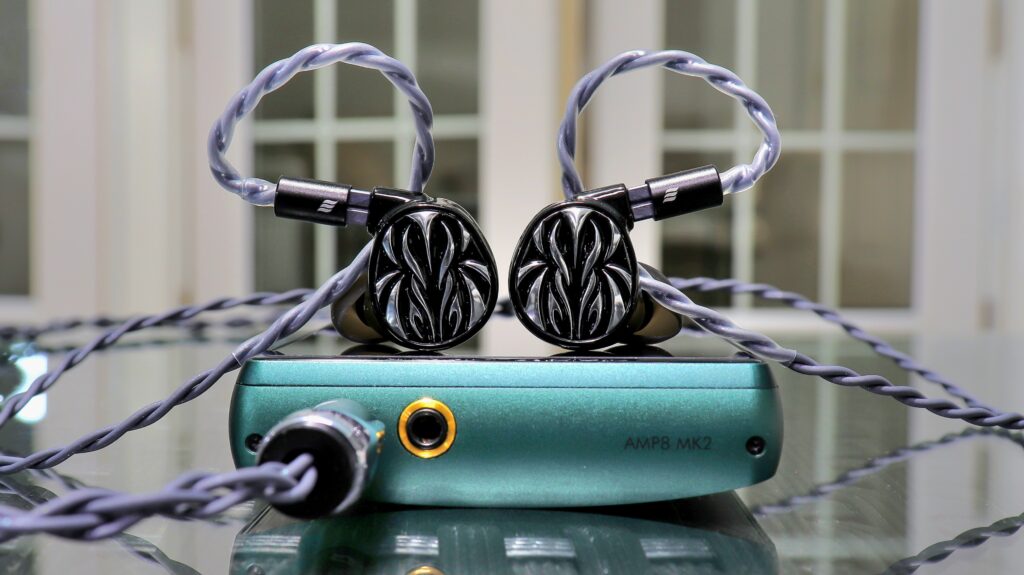
–IBasso DX240 with Amp8 MK2
-Many more sources used including weaker Android 3.5 set phones, iPad, and a few weaker 3.5 se dongles
Packaging / Accessories
Unboxing
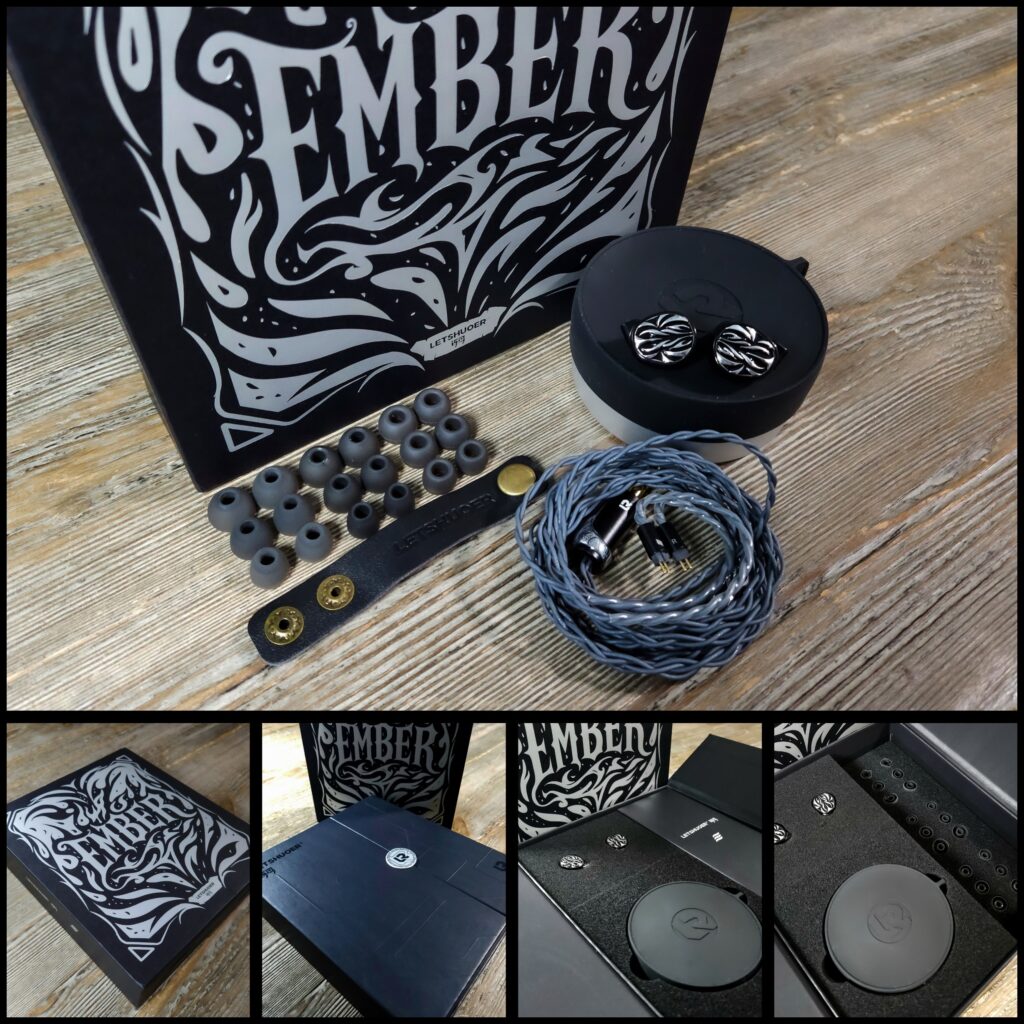
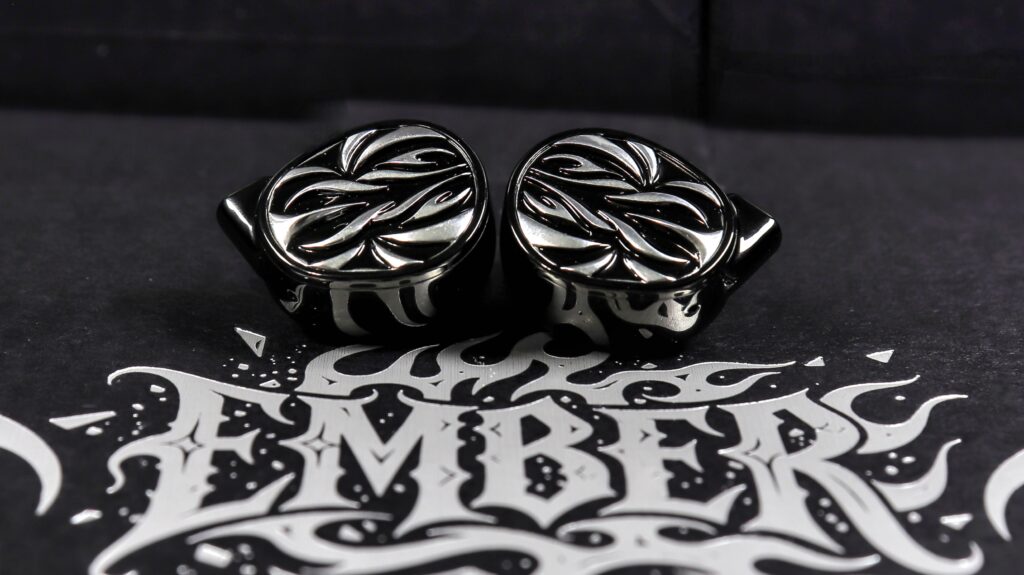
The Letshuoer Ember arrived at my home in a huge cardboard box. Inside of the shipping box is hidden another box, the actual Ember packaging. The Ember package comes with a box inside of a box. The 1st thing you see is the outer box, naturally. Anyways, it has one of the slickest designs that I’ve seen on any product with a black underlying color and what appears to be white flames in a very cool pattern. Very nice artwork. However, it’s what’s inside that matters. Anyways, take the real box out of the cover box and you’ll see a black box with a two-flap top which opens up in the middle and held down by a magnetized seal. Very cool looking. Open the two sides and you’ll uncover the gorgeous Ember earphones sitting in a large cut-out foam piece. To the right is a box containing reading material (manual, warranty card, etc.), and underneath that layer of foam is another layer of foam with 18 cut-outs holding nine pairs of eartips. Also next to the earphones is another chunk of foam which the carrying case sits snugly inside of. Folks, I drastically shortened this unboxing because I do feel that is an experience to get for yourselves, but you get the gist. It’s a very nice unboxing which does feel and look premium.
Eartips
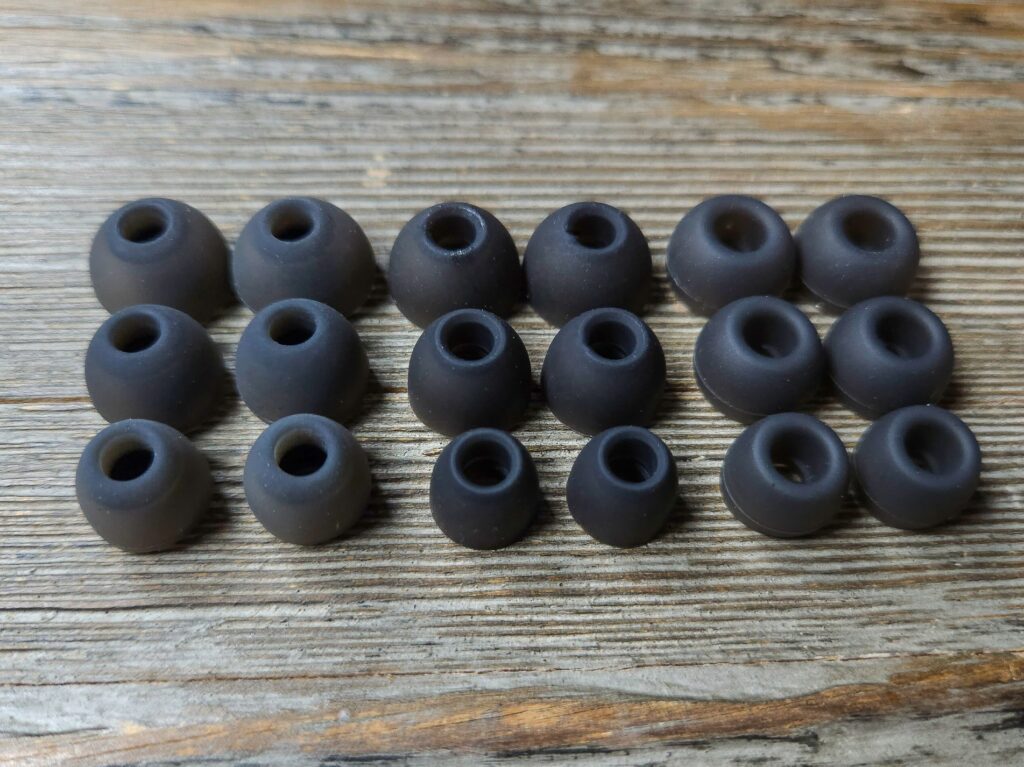
The packaging from Letshuoer comes with a grand total of nine pairs of eartips over three different styles of tips. The first style of eartips is a set of three (S, M, L) dark gray silicone eartips with a narrow bore, they’re pretty long for a deep fit, and they have a firm flange. Pretty basic eartips for sure, but nicely rigid which helps tremendously with sealing. However, in my opinion a narrow bore is not what this set needs. The next set of three (S, M, L) is also a dark gray set of silicone eartips only this set is slightly shorter and has a semi-wide bore, a slightly less firm flange and a fairly rigid stem. These tips simply didn’t seal in my ears. I need firm eartips for my ears and these simply didn’t do the trick. The last set of three (S, M, L) are another set of dark gray silicone eartips, but these are shallow fit and they come with a wide-bore. The bonus is that these are very firm in the flange which really does a good job for sealing in my ears. I actually went on a tip rolling journey with the Ember only to go back to the packaged wide-bore tips for critical listening. For my ears, I find the wide-bore’s are very comfortable and they open the sound up sonically. I do feel that the warmly rendered Ember earphones do much better with a shallow fit and open bore like these have. Not a bad job by Letshuoer.
Carrying Case
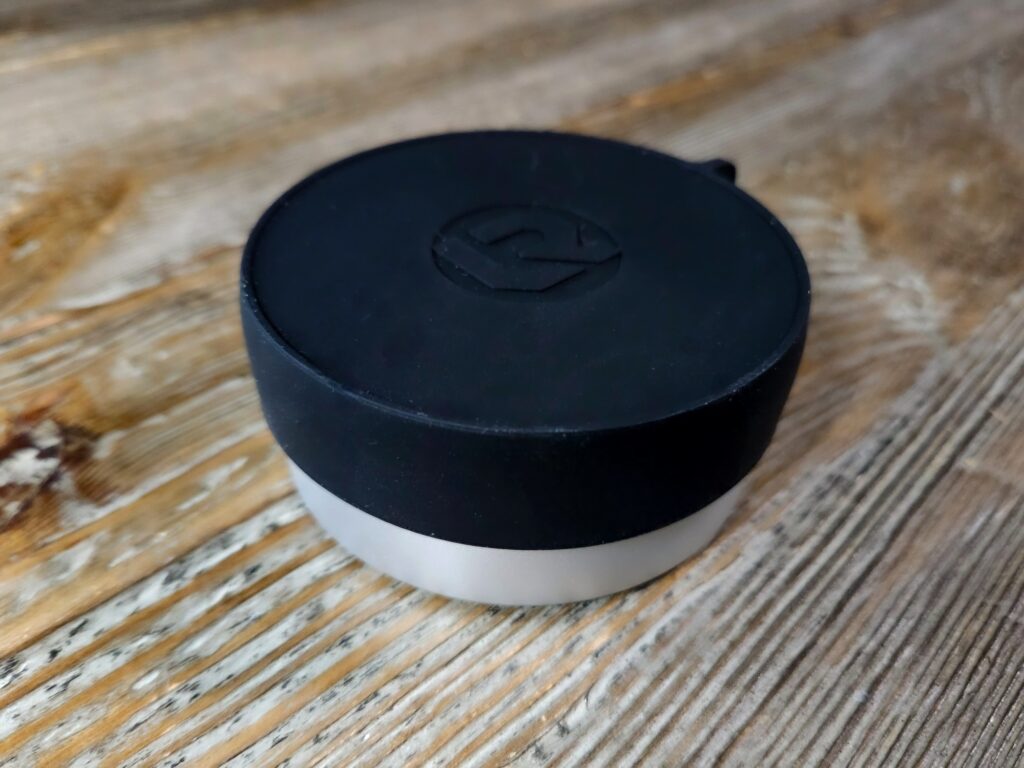
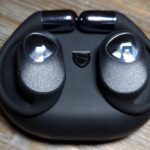
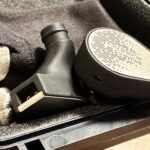
Another high-quality accessory is the carrying case which comes packaged with this set. Now, this particular case has come with a couple other Letshuoer iems, namely the wonderful single DD set, the Letshuoer DX1. It’s actually a wonderful round case. Made entirely out of aluminum with a brushed matte surface texture, silver in color, with a rubber top which stays in place entirely by friction. It is so cool. Inside of the case it is cladded entirely with rubber to protect your precious Ember iems. I actually find the case is fairly large too. Certainly, large enough to fit the earphones, the cable, any adapters, as well as a very small dongle dac. Just watch as you put the rubber top on as the suction is so great that it traps air. So, you must relive the air from the sides. It’s a nice inclusion folks.
Cable
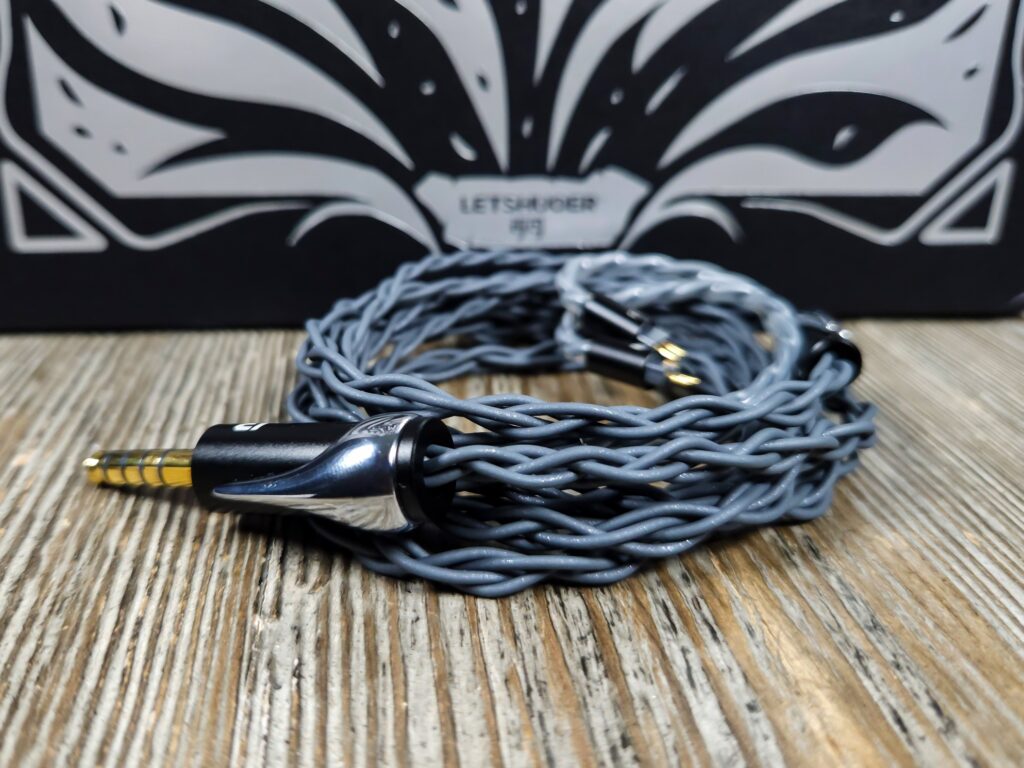
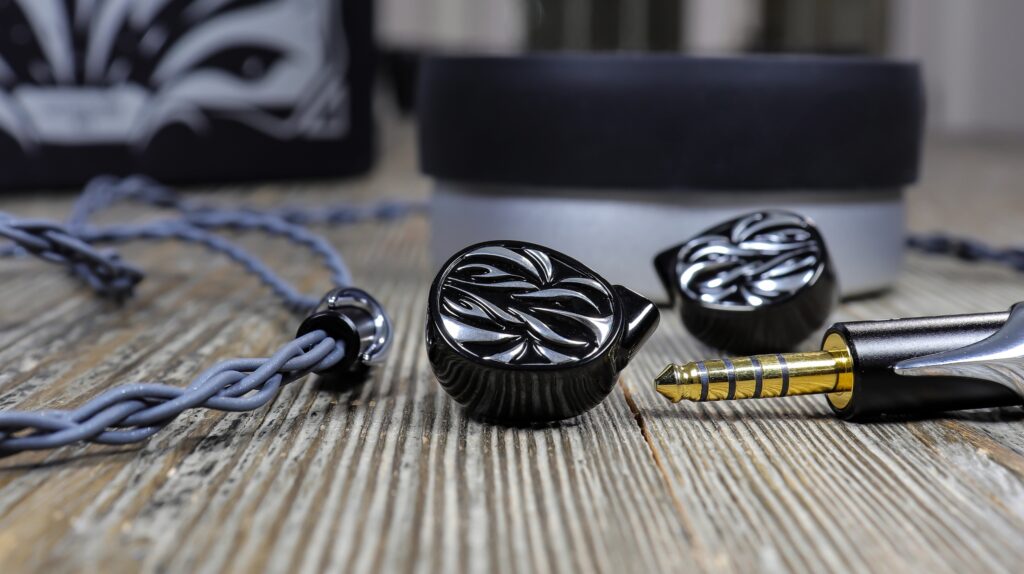
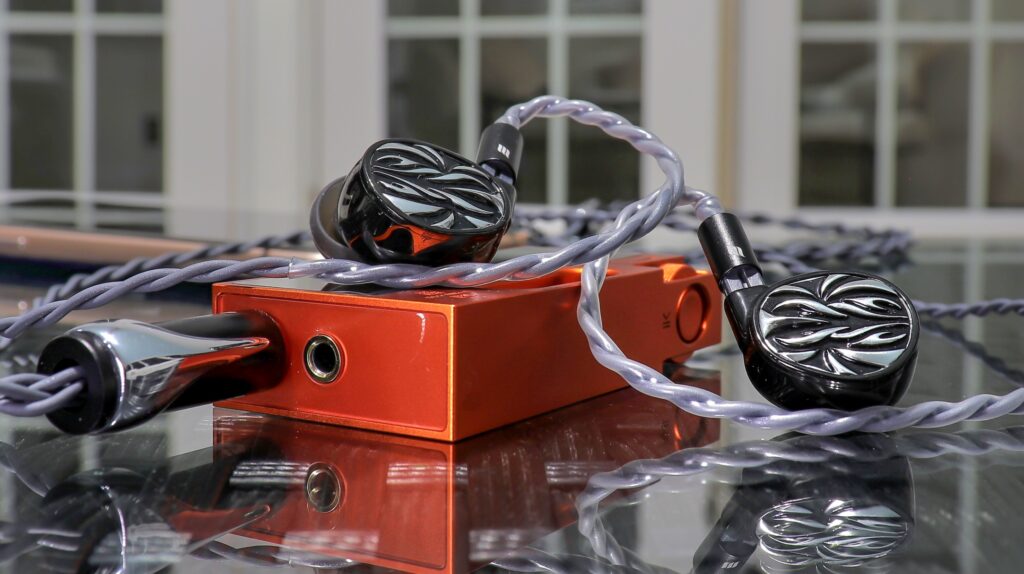
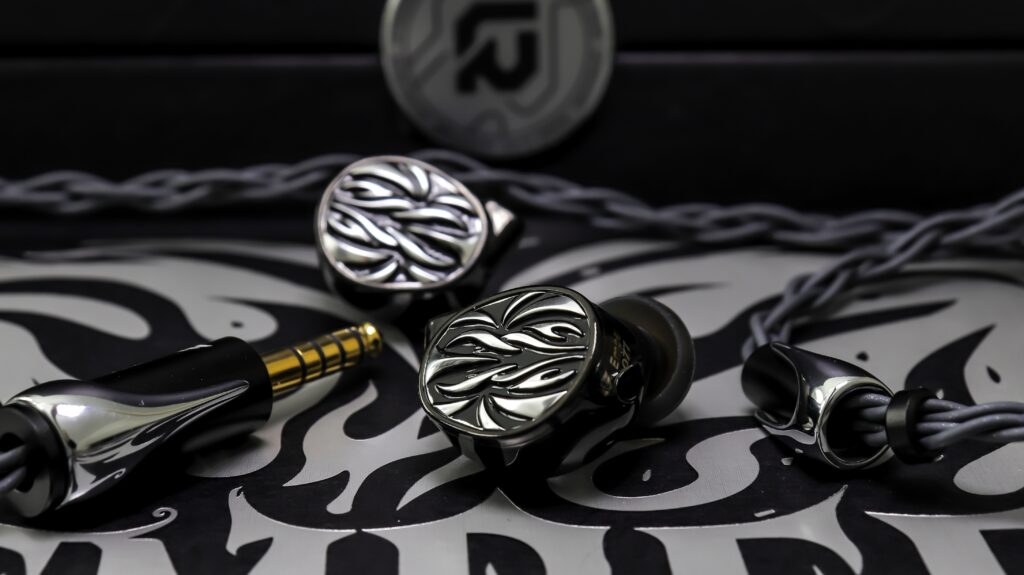
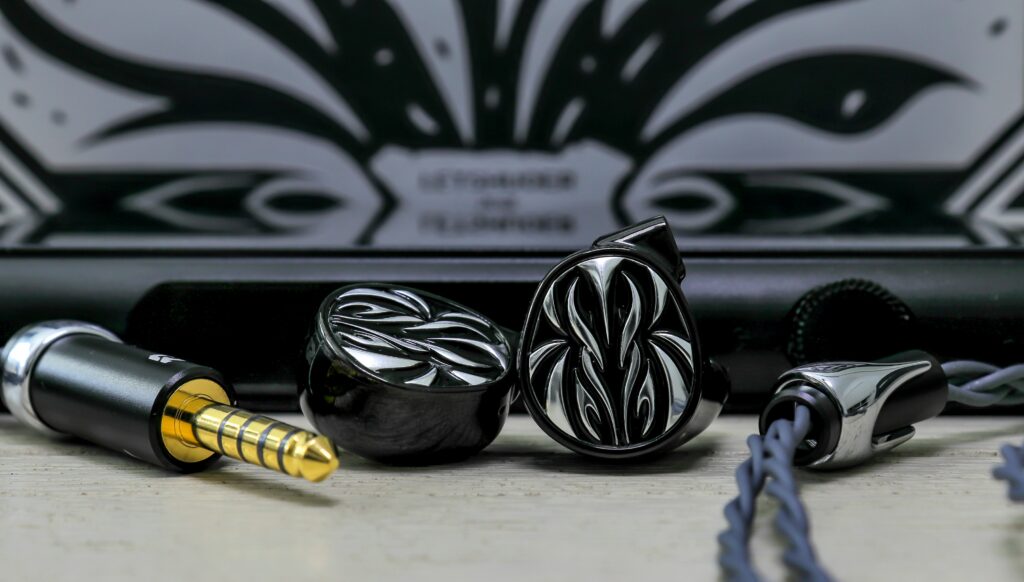
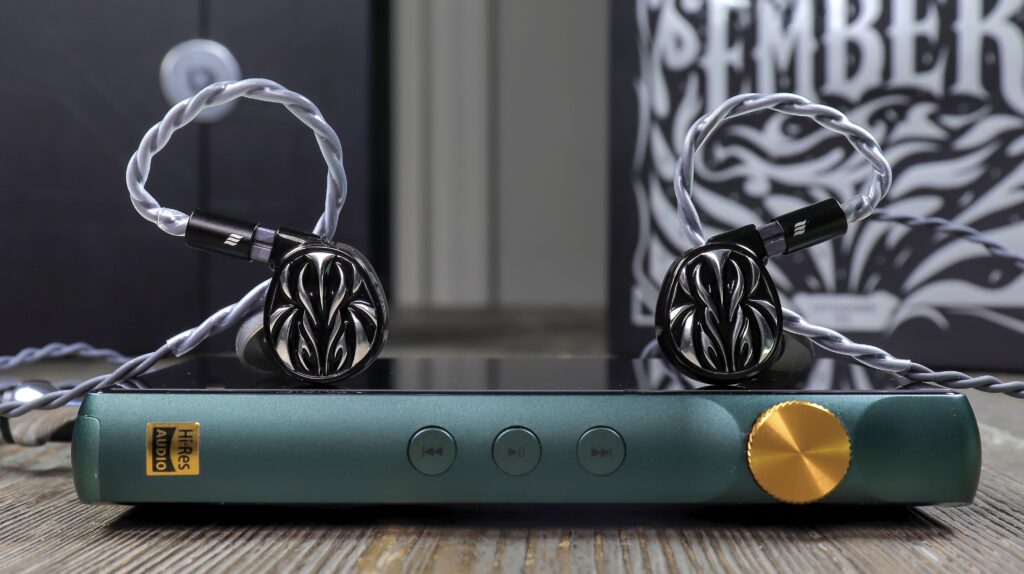
Now we get to one of the best aspects covering this set. That is, the cable. The truth is, the cable which comes packaged is actually a collaborative effort between Letshuoer and Effect Audio. It really is a wonderful cable. Just like other Effect Audio cables, this set also has their revolutionary proprietary ConX fittings. Now, Letshuoer didn’t add in any other fittings with this package, obviously. You would need to buy those separately. But also, the Ember is a 2-pin iem and so there’d be no reason to add in mmcx fittings or anything else for that matter. So, to be exact, the cable is light gray in color with that matte finish and a very nice braid. It looks like a thinner Effect Audio Eros S ii. The cable is actually 26 AWG in thickness along with 4-cores in total made up of UP-OCC Monocrystalline Copper and it is a modular cable as well. However, Letshuoer only added in the 4.4 balanced plug within the packaging. Truly a wonderful cable to include. I love that I have no need to cable swap at all. Nice one Letshuoer!

Build / Aesthetic / Internals / Fit
Build Quality
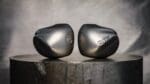
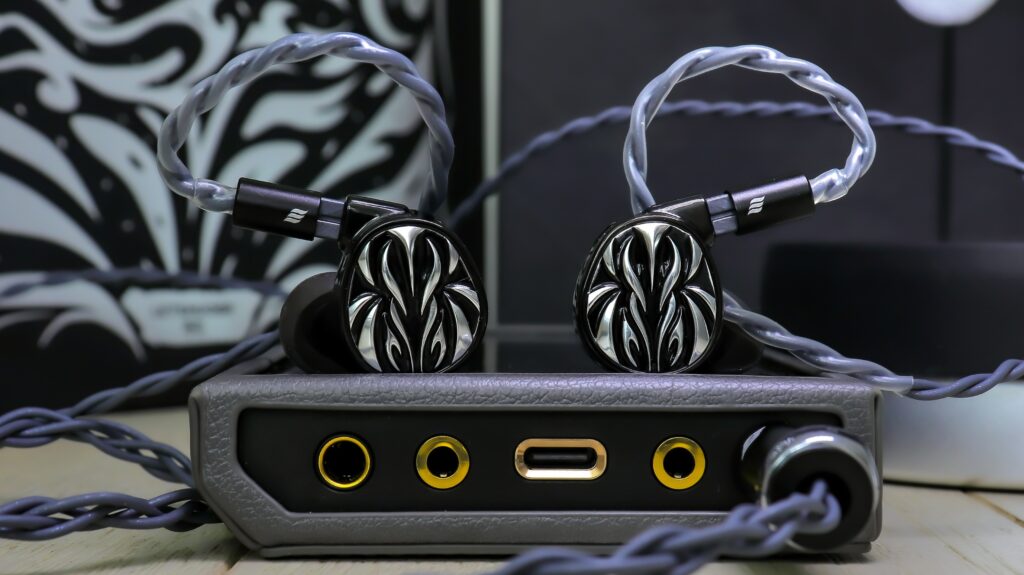
Like I said earlier the Letshuoer Ember is made completely from one of the best alloys that you can choose for a set of earphones, that is… titanium. There are many reasons to go with titanium, but the main reasons are that titanium is very hard, very strong, but also very lightweight. Titanium also has wonderful resonance control too. One of the huge benefits of titanium is its ability to resist corrosion as well. No doubt titanium is a very expensive alloy to use and is also a very difficult alloy to machine as well. To add to that, titanium can actually be made much thinner than resin and much-much harder and rigid with much better strength. There are so many benefits to using this alloy. However, besides the structural integrity being very high on the Ember due to the shell alloy, it’s the acoustic properties of its titanium build which makes some of the biggest differences. Just like the Hidizs MK12 Turris Titanium Edition which has very different sound characteristics from the OG MK12 Turris, so does the Ember against any other material that Letshuoer could’ve used. You see, titanium has a very low internal loss giving the shell a high resonant frequency. Moreover, titanium does a wonderful job of controlling unwanted vibrations internally. There really are so many benefits to using titanium inside of a set of earphones. Honestly, this set is very well-built folks. It’s also very ergonomic and very lightweight too, for a non-aluminum all-alloy iem. Never a problem over long periods of usage. The nozzles are about average width and they aren’t too long, nor too short. Really, I have absolutely nothing bad to say about the build. A+ job from Letshuoer.
Aesthetic
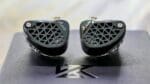
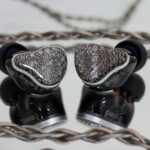
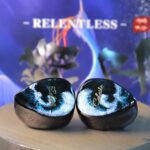
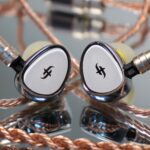
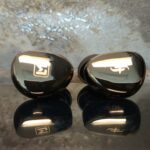
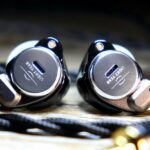
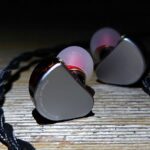
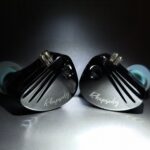
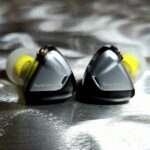
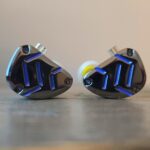
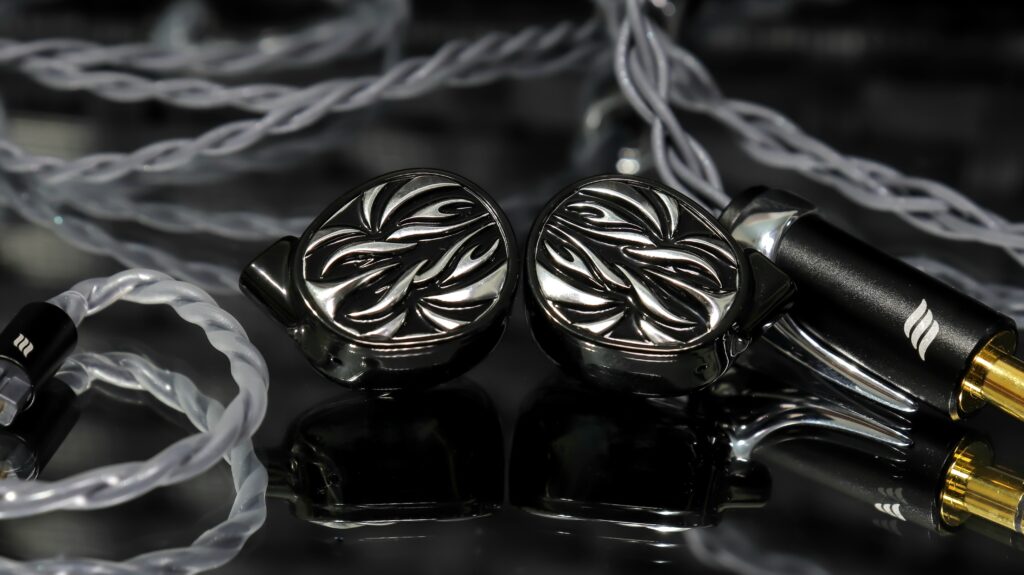
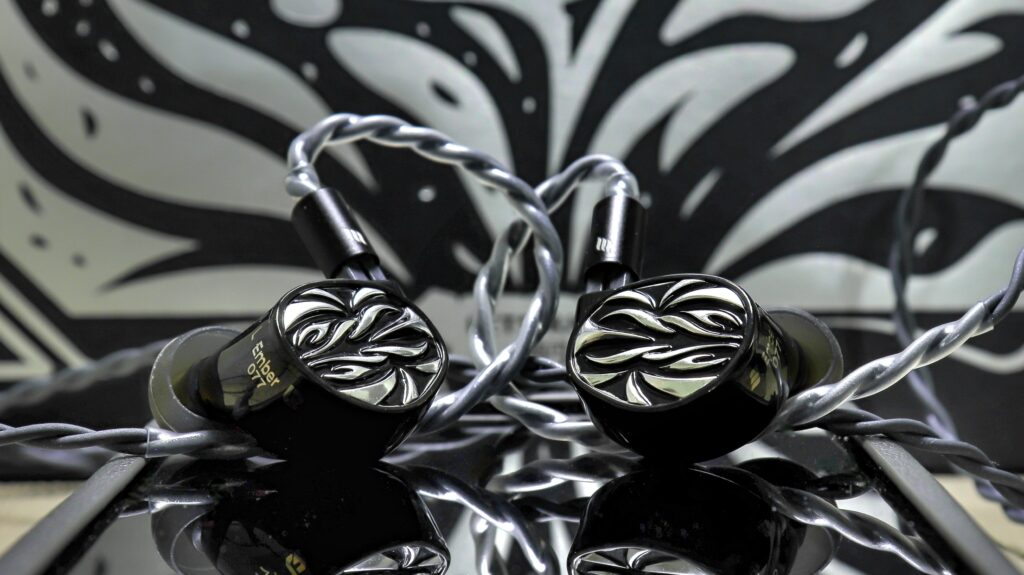
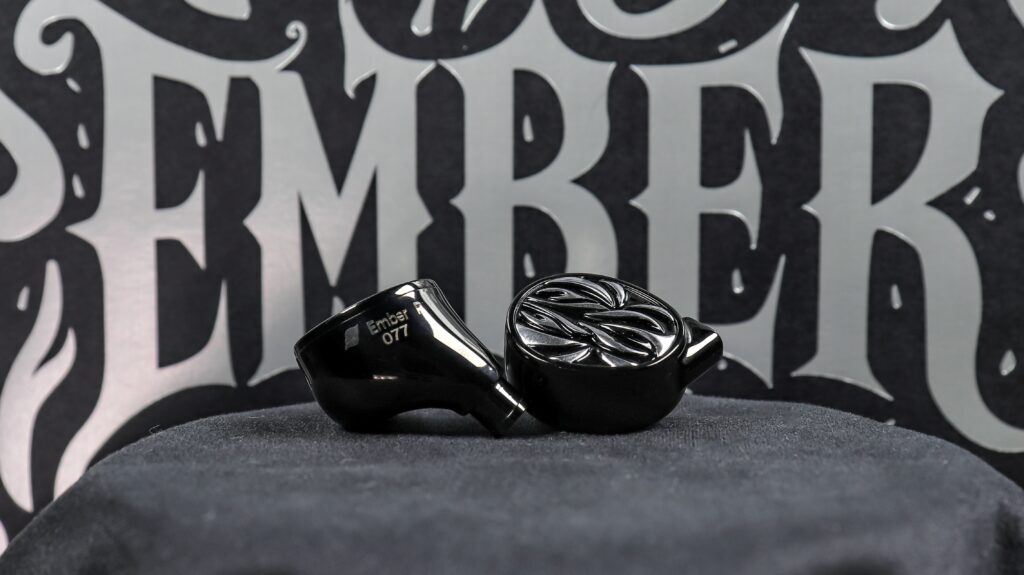
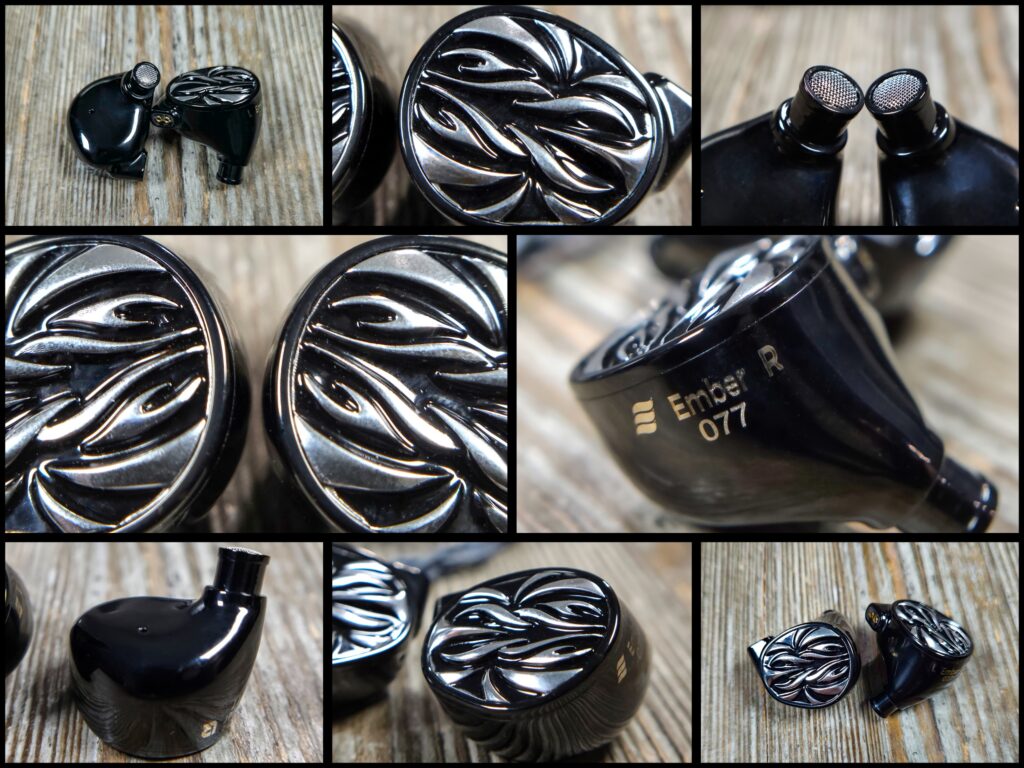
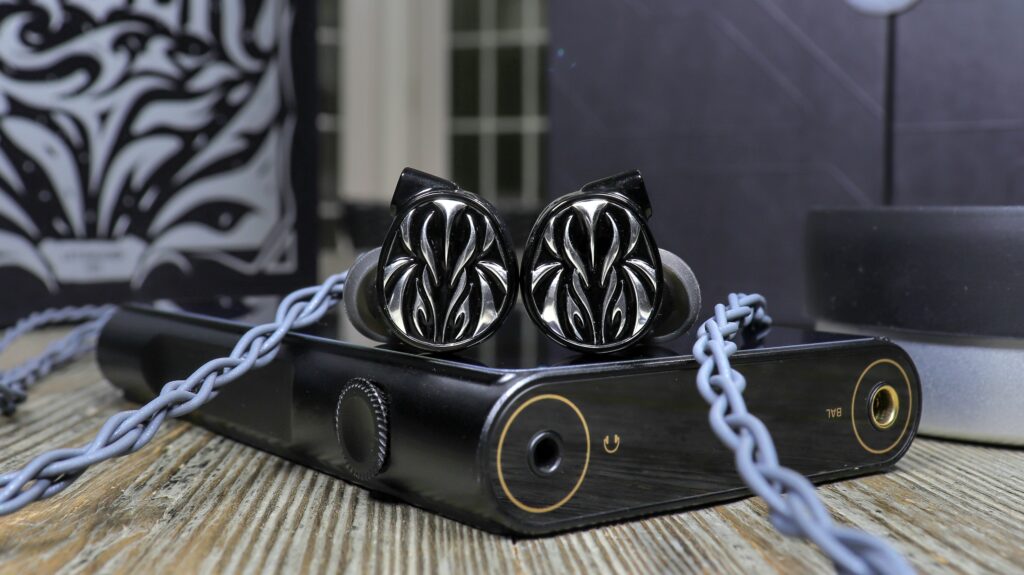
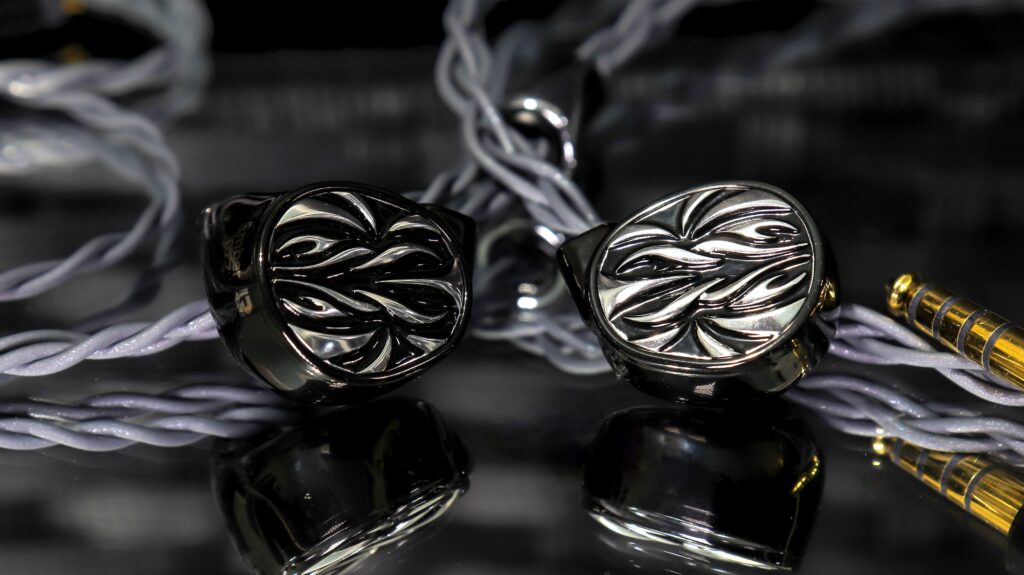
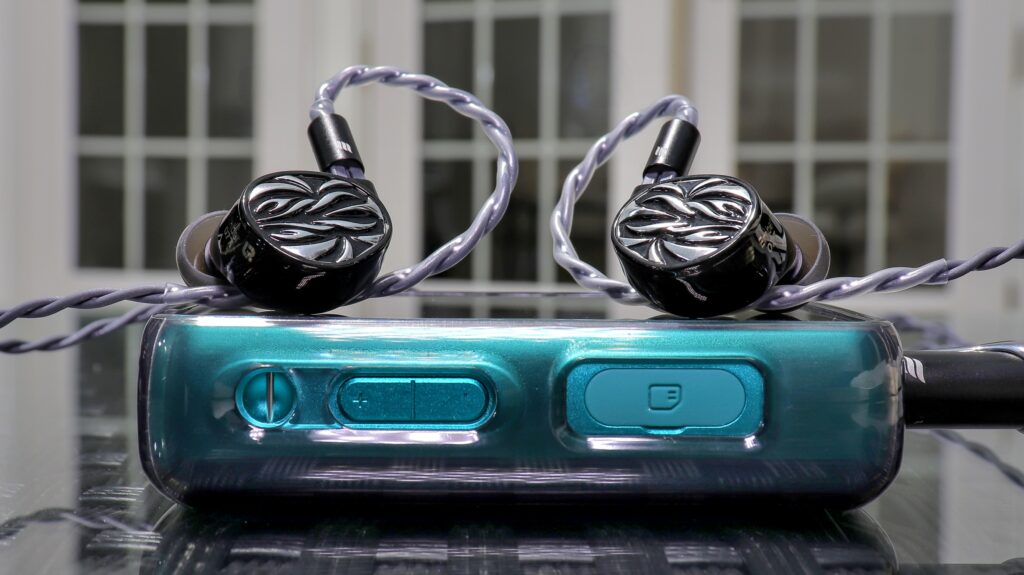
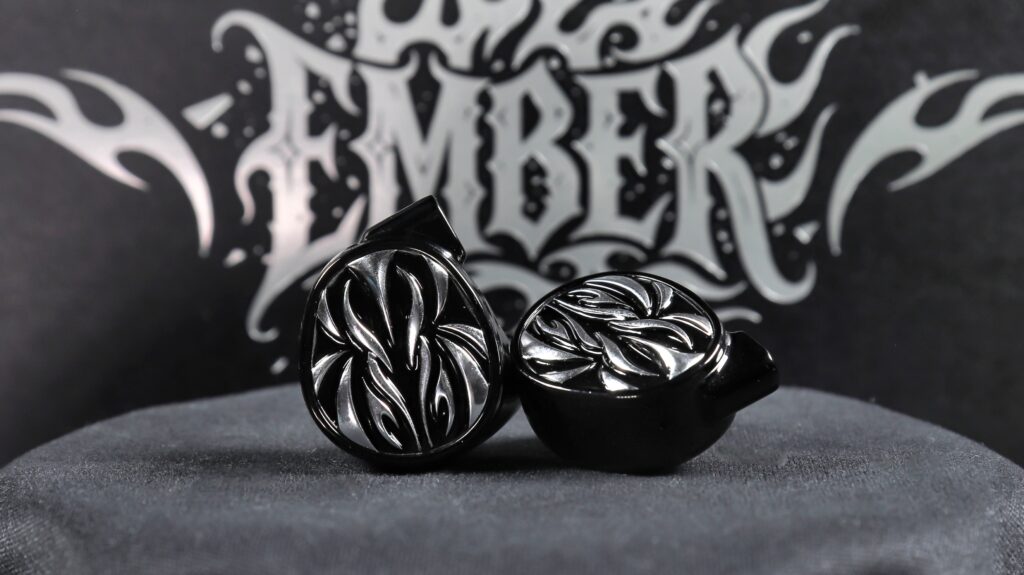
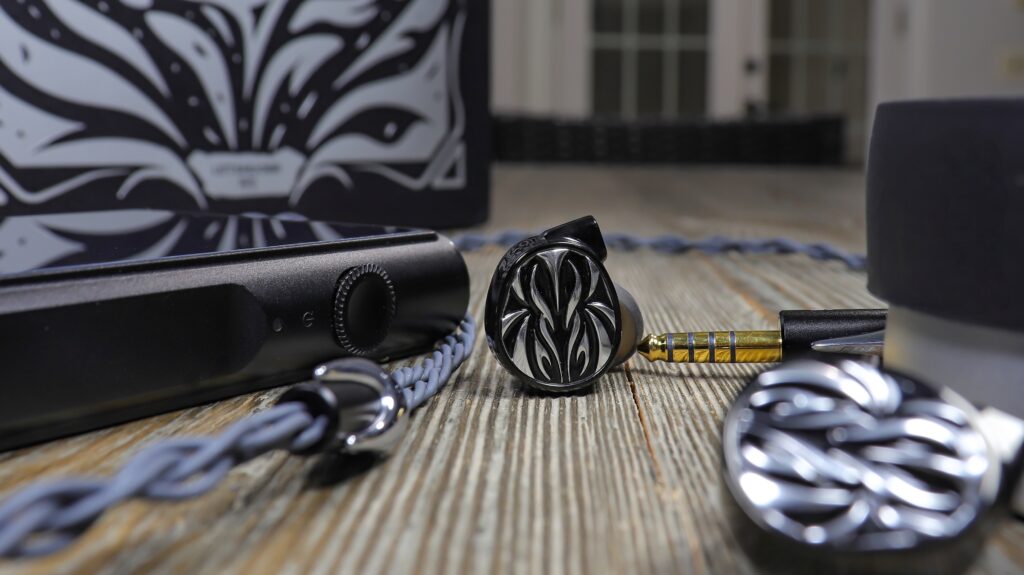
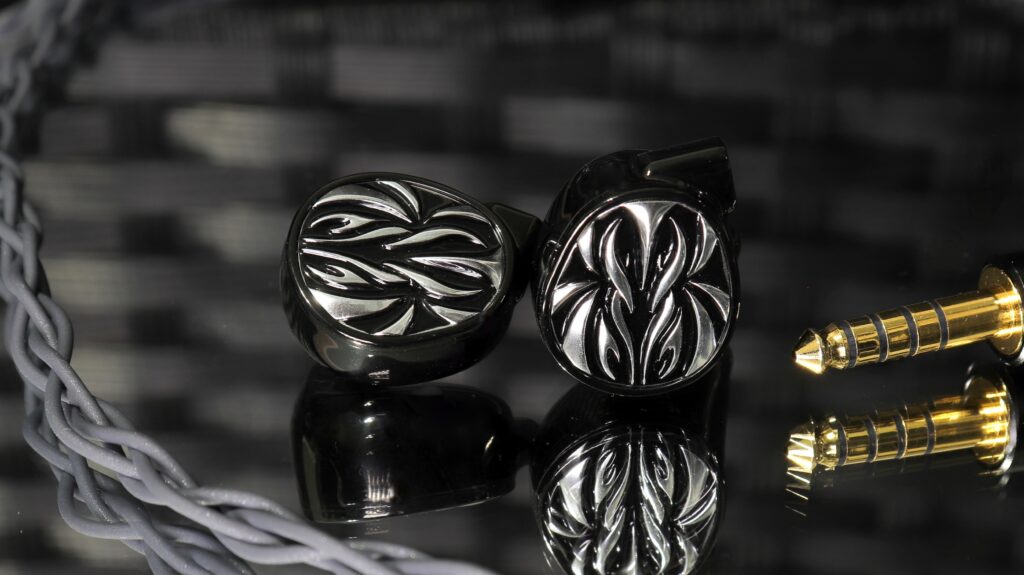
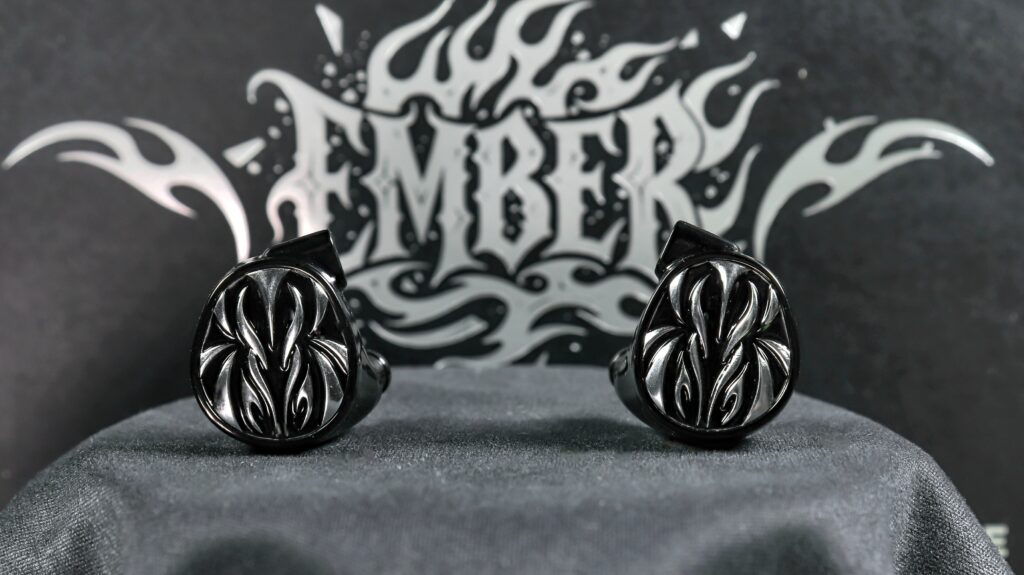
This brings us to the actual design and aesthetic of this set and I gotta say that I am completely impressed with the finished product. Folks, this set is stunningly handsome in so many ways. The entire earphone is covered in a glossy black paint base color, but the faceplates have that stunning pattern on the front which looks like white flames. I adore the look, and the feel of the faceplates as each of the “flames” is raised up off the surface of the faceplates giving it this dope 3D look. I think the Ember is one of the coolest looking sets on the market for sure. Also, I think I can speak for most people when I say that the Ember doesn’t just feel premium, but they look very much like a premium iem in every way that you turn them as well. Letshuoer did a very nice job making a very uniquely designed iem with a completely original appearance from anything that I’ve ever seen in the past. Really a dope set, nice work.
Internals
The Letshuoer Ember comes equipped with a brand new and totally upgraded 14.8 mm planar magnetic driver. From what I was told, the Ember’s planar driver carries a new and improved magnetic array from the Letshuoer S15’s driver. I don’t know how they came up with this, but Letshuoer states that this driver is capable of 20% better performance. Now, I’m sure there are ways to establish these numbers, but 20% is definitely significant. No doubt when you have an even magnetic force across the diaphragm, you’ll have a much easier time tuning a more linear midrange/treble, more natural textures, as well as that effortless smoothness that this set produces. Letshuoer also opted for optimized front and back venting from within the Ember’s CNC machined chassis which helps to meet the target sound that Letshuoer was seeking to get out of the Ember. I don’t know if there is any special acoustic cavity machining which has been done either, but I assume that Letshuoer made sure to optimize the titanium acoustic cavity as well.
Fit / Comfort
I have absolutely zero issues with fit. The Ember fit me like a glove from the first moment I put them into my ears. To add to that, the Ember is ridiculously lightweight and makes for a very easy on the ears listening experience without any wear fatigue at all. Folks, believe it or not, I’ve left these in my ears for most of a day without even thinking about it. Rarely did I take them out when I was off of work during Christmas break. I of course cannot answer whether the Ember is going to fit you as well as they do me, but I have to assume that 99% of you will have zero issues just like me.
Drivability / Pairings
Sensitivity
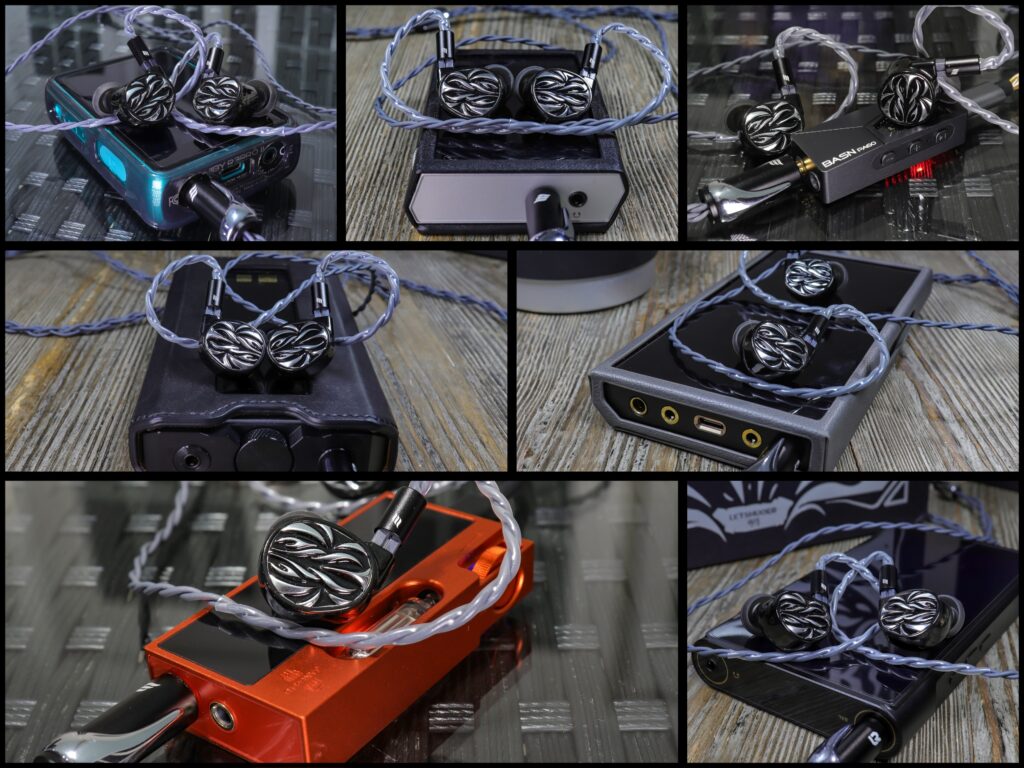
Okay folks, so, I found that the Ember really is an easy set to drive with its 30-ohm impedance and 103 dB sensitivity. I wouldn’t call it the easiest, but it’s easy. However, I really want to preface the rest of this section with this; you should really find a decently powerful source to actually drive this set. I say that because while I can drive the Ember from even a simple smartphone, it doesn’t mean that it sounds anywhere near its best. Of course, I tried everything in my arsenal which includes many weak sources which I always do for you guys. I used my iPad and it’s 3.5 se jack, my older Android smartphone w/3.5 se jack, three super weak 3.5 se dongle dacs too. They all played loud with the Ember. However, it didn’t sound nearly as powerful, clean, and transients were simply sloppier off of weaker sources. Without a question in my mind, you should seek out a decently powerful dongle dac of at least a good 200 mW to drive this planar magnetic driver to its best ability. You will hear people say that this is not needed. Please, I would not lie to you, I’ve tested with so many devices, and the sound is much better with clean amping at least above 150 mW. That’s the low side. My best was in super high gain using the Fiio Q15, the very powerful Shanling M6 Ultra, or the iBasso DX240 with Amp8 MK2 installed. Of course, having better, cleaner source devices with better internal components certainly helps with this set too. Basically, give these planar drivers some juice, open ‘em up, let them do what they were designed to do.
Sensitivity cont…
For the record I do want to state that many dongle dacs play very well on this set. If you saw my list of sources that I used during critical listening just know that this is not an exaggeration. I don’t absent mindedly just list my sources. No, I actually use them all. I do so for a good reason too. In every review I really want to figure out what best suits these products that I’m reviewing. I don’t want to get it wrong for you and I take it personally. Truly. That said, many dongle dacs played extremely well with this set. Like the Shanling UA6 ($149) with its 361 mW max power, or the Shanling UA7 ($269) with its huge 577 mW. Or even lesser powerful devices that really drive it well like the EPZ TP50 ($109) which maxes out at 240 mW. Folks, 240 mW using 4.4 balanced on the TP50 is plenty. Ooh, the BASN PA60 ($99) which also has 240 mW sounded fantastic, or the new Surfans X10 ($79) which carries a huge 522 mW. So what I’m getting at is you don’t need some super expensive dap, or any desktop setup. Granted, they help tremendously, but you don’t need them. Shoot, I used the Hidizs S9 Pro Plus ($65) with its 180 mW max output on high gain which drove the Ember well enough. The point is that power is a big help in getting the best out of your Ember iems, but it doesn’t mean you have to break the bank to get it.
Source Pairing
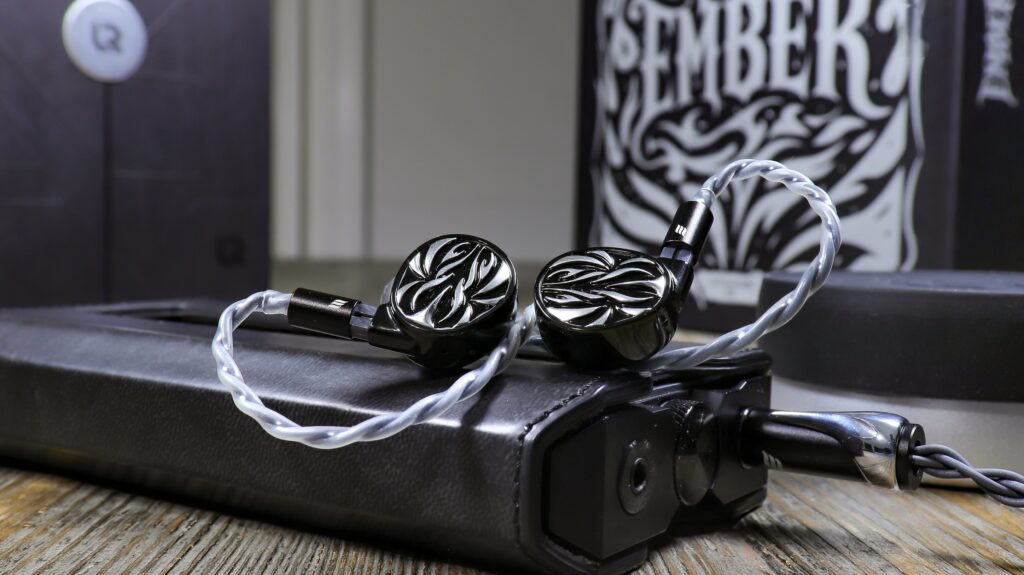
So, one thing to be well aware of before purchasing the Letshuoer Ember is that it is a very warm sounding iem. In my opinion, I feel that most of my sources paired nicely, or, good enough to have a pleasant experience with the Ember. However, to counter the sub-bass lift and to try to retain whatever edge detail the Ember has (not much), along with openness of the sound it would be best to pair with something neutral to brighter in tonal coloration. I say that, but as honest as I can be, the Ember sounds great attached to the Shanling M6 Ultra which is a definite warm leaning device. Still, I do find that the Ember truly comes across at its best with something neutral to bright. For instance, the iBasso DX240 is sublime with this set or the Shanling UA6, the Fiio Q15, the Hiby R3 Pro II, and on and on. I have quite a few neutral tuned sources and they all seem to really do a nice job. Now, warm lovers who cannot get enough warmth, please don’t be afraid to put a warm and energetic source paired with the Ember as it won’t sound as bad as I would typically think. I have a theory about that. I find that since the Ember is a planar with those lightning-fast transients, that the warmth doesn’t affect the Ember nearly as much as a warm DD (for example). However, your mileage may vary, I’m not you so pair with at least some semblance of caution.
Sound Impressions
*Note: just a little note to preface before I dive into this review. I want you to know that I did burn in the Ember for roughly around 4 full days. Also, I want you to know that nothing seemed to change. I don’t know if I was hearing it right, but the sub-bass did seem to have a denser feel after that period, but I cannot say for certain. I burn in every set no matter what but I’m not positive that doing what I did will help this set sound any better. Every track I use for critical listening was a flac or better file (a few MP3’s) which is stored on my devices. The Android player of my choice is mainly UAPP (USB Audio Player Pro). I also use Hiby Music Player with some of my daps as well as Eddict Player. I used the packaged Effect Audio cable as well as the packaged Wide-Bore (shallow fit) eartips for all critical listening.
What’s it sound like?
The Letshuoer Ember is one of those sets which quite literally redefines what a warm set can be. The Ember is without question the warmest and most lush offering of any Letshuoer branded planar magnetic set of earphones. Friends, I thought that the S12 Ultra was warm, organic, and earthy. Little did I know that Letshuoer was about to double down and truly create one of the most musically emotionally enhanced sets with some of the richest timbre that I’ve heard in a while. Without the shadow of a doubt the Ember embodies everything that its name suggests. A smoldering ember, a burning coal. Warm, buttery, and creamy, every note melodically rides a perfectly fluid wave with bodied notes and utterly fantastic rhythmic groove. Now, to flip all of that on its head, the Ember is actually dynamically balanced, in that while there’s a definite sub-bass lift and extension, the Ember also has very solid upper treble extension that adds a “cherry-on-the-top” sparkle of an otherwise bassy and buttery sound. Somehow Letshuoer created a warm sound that also has ample enough sparkle yet in a toned-down form. If that makes sense? If not, I will do my best to explain. The point is that while the Ember is warm, somehow it still has good representation from every area of the mix. So, to break that down, the Ember is very smooth throughout. Every area of the mix is lush, musically intended, very rich, and full-bodied, and the timbre is very much earthy-organic with just enough upper treble subdued sparkle and air to add some expressive toned-down energy to the overall sound.
Engaging
If I were to call the Ember anything, I’d probably call it a U-shaped sound with a sub-bass lift. I’m really not happy with that, but I also don’t want to call this a straight-up L-shaped sound. I really don’t feel it’s all warmth and bass. Yes, it is very much warm, but there is this pervasive and lively toned-down vibrance, almost dark vibrance, as well as plenty of solid energy across the board. Furthermore, I don’t hear a huge recession in the midrange. I don’t know, maybe “warm U-shaped”. I’ve gone back and forth with myself over it, and I haven’t convinced myself of anything. Be that as it may, the Ember has a fairly diverse sound field, even with its warm and smooth tonality. Not a lot of tonal contrast, but plenty of warm & earthy dynamism with a snappy note delivery which adds this non-dull, non-boring, and utterly delicious soundscape. That stems from the Ember’s fast, deep, penetrating bass, its smooth and engaging midrange, and its warmly rendered treble which is capped off by its subtle upper treble shimmer, air and sparkle. What all of this equates to is a warm-organic timbre that remains fairly tight, well controlled, dynamically expressive, but simply not uplifted in luminance or vivacity. I think the word that best describes the sound of the Ember is… Engaging. Its entire tuning is predicated on musicality. It has these undeniable engaging qualities. The Ember’s sound field is both immersive & enveloping with an alluring charm that is hard to pinpoint and define. Believe me, I’m trying. I suppose my greatest proof of this is the hours I’ve had this set in my ears.
Not so technical?
You certainly cannot call this set a detail king, and you won’t hear me saying that it has the best resolution that I’ve ever heard, as it certainly doesn’t. You will hear me praising the Ember up and down at just how melodic, fun it is. Also, oddly enough, you will read me stating just how mature it is for such a sound. I say mature only because the Ember has fantastic note control with very tight transients that stop and go on a dime… at all times. However, those notes which stop on a dime are bodied and overly smoothened which does blunt the edge detail quite a bit. So, while the sound is very impressive in how mature the overall undulating transient dynamic shifts stop and start, you don’t have a crisp and clean-lined attack to outline with enough precision helping define notes inside of those tighter transients. Again, it’s all musicality, all engagement, all immersion, and 100% emotionally charged without regard for every last finite and minute detail. So no, I most certainly wouldn’t say that either detail retrieval, resolution, or edge definition comes through perfectly clear and clean. I’ll touch on this at much greater length later because there’s more to say, but imaging isn’t bad as far as placement goes. However, I don’t find that it is super easy to discern every element of the stage with perfect clarity. Especially in congested tracks. Yes transients are on the more agile and tighter side of the aisle, but the smoothly rendered cadence definitely blends some sounds, to a degree anyways. In truth, everything is much more nuanced than I’m explaining. As always. More on the technicalities later.
May take some brain burn
I should add that there is literally no chance for any shout, any glare, and sibilance, or any true sharpness with this set. One thing that sticks out to me is the enormous stage, the holographic style sound field, and how that sound field wraps the listener in this warmly depicted musical atmosphere. The Ember effortlessly draws out the emotion from any vocalist and the intended sentiment from every instrumentalist with a hard to define expression of mellifluousness that is so addicting if you can wrap your head around it. It may take some brain burn depending on the tunings that you’ve been listening to, but if you are a fan of pure music, I have a feeling that you’ll come around like I did. Everything just sounds big on this set, if that makes sense? Everything on the Ember feels full of that immersiveness that I was trying to describe earlier. I am not altogether happy with how I explained it, but I’m asking you to bear with me and hopefully I can redeem myself as I go through every area of the mix (bass, mids, treble) in greater detail.
Not for everyone…
Before I do, I should also add the obvious. That is, this set is absolutely not going to be for everyone and most certainly it is a polarizing tuning. Any set tuned so one sided in tonal coloration is going to be a gamble. Let’s face it, not every genre is going to work perfectly for the Ember. This is not what I’d call an all-rounder style set. Also, anyone who prioritizes detail hunting, instrument tracing, or anyone who seeks out perfect clarity… is likely not going to be a fan. No set fits everyone, but I like the gamble that Letshuoer took with this set. As I said earlier, the S12 Ultra and the S15 truly were some of the more warmly rendered tunings that they’ve created. In fact, they’ve been going this route for quite some time. Starting with the S15 two years ago, then the S08, then the S12 2024 Edition, followed by the S12 Ultra, and finally the Ember. We’ve seen they’re planar sets giving precedence to warmth and musicality and extinguishing any semblance of planar timbre. Almost as though Letshuoer is out to prove that they can create the organic feel of a dynamic driver yet with the skill and speed of a planar. It was a gamble. Once again, they even named this set with a word which literally describes warmth and heat using a name which defines a slow smoldering fire, and I absolutely love it.
Bass Region
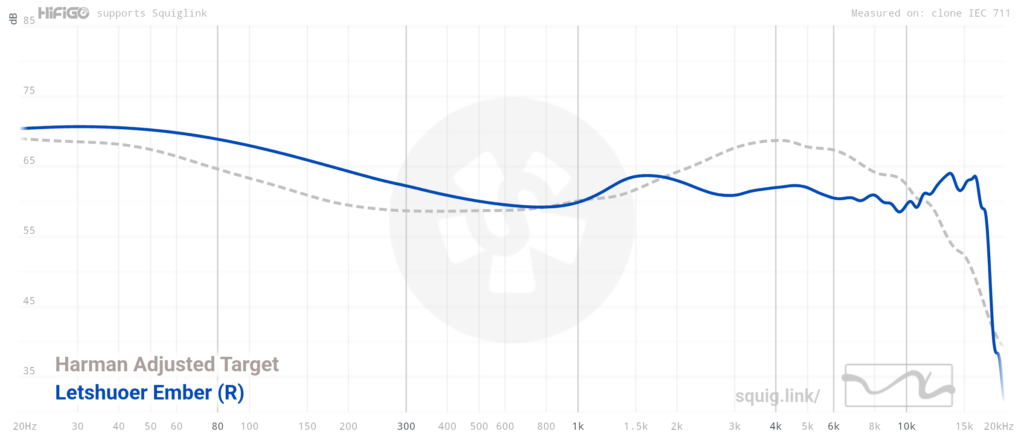
The low end of the Ember is undoubtedly the most exuberant and forward aspect of this tuning. The Ember has what I’d call a sub-bass focused bass region which is characterized by a very full-bodied and dense feel with plenty of forceful punch along with a transient tight and agile note delivery. It’s a “quality-meets-quantity” type of low-end which is neither sloppy nor weak. This is the type of low-end which can bullishly depict any hard-lined bass drop with unabashed physicality and rigid force. Beyond straight power and force, the Ember also has an awesome knack for being able to maneuver around even complicated bass passages without breaking a sweat. This is the beauty of a well done planar magnetic driver tuned by a brand who specializes in the driver tech. So, it truly is a high-quality bass yet with plenty of emphasis making the bass region very fun and very skilled. You could call it musically gifted but disciplined. Almost guilty pleasure style fun but not quite basshead. From the graphs that I’ve seen the bass shelf is somewhere around 10 db’s in lift. So, definitely not to basshead standards, but the Ember really packs a visceral and tactile punch. Without question the talented planar driver that Letshuoer uses inside of the Ember carries that very haptic, very physical, and very authoritative style rumble and boom which typically is reserved for dynamic drivers. To my ears the Ember is the closest planar set that I’ve heard to a DD low-end in depth, weight, and overall timbre.
Surface texture
However, in my opinion, the bass region is not the most hyper focused on the micro-technical aspect of the bass, even with its fast transients. It’s a bass which certainly prioritizes musical engagement over clinical hyper-resolution. Meaning, the actual bass texture and micro textures aren’t quite as evident. From a macro lense the bass is prolific, clean, very precise, and extremely fast too which is especially fantastic with its robust emphasis. However, when it comes to actual surface textures, the low-end is a hair less refined in that way. I am perfectly happy about that. I say that because the bass region is all about drawing the listener in with its ridiculously enticing presence, with its ultra clean and smooth cadence, and with its keen ability to add a palpable sense of feel to every note. I’m telling you, the low-end’s rigid and rapid recovery demeanor is so very satisfying as it is seamlessly feathered into a smoother overall tuning. Such a magnetic style allure which lends fullness and body to bass guitars, along with weighted and bullish punches to drive kick drums, followed by a quick recoil showing off its planar strengths. This is a bass which always sounds assertive, always with nice grip, yet also a slightly less tacky attack. I hope you can picture what I’m describing. The bass simply doesn’t have the fine-lined textures and surface abrasion that many ultra analytical and more resolving sets will have. All things considered, the bass is flat-out awesome!
Sub-Bass
The sublevels own the greatest portion of the low-end emphasis, by a slight margin and come through as robust and deep pitched, but also sensibly emphasized against the rest of the mix. It may be deep, rigid, and visceral, but it isn’t all consuming or oversaturated. Conclusively, the sub-bass has some fairly deep and juddering extension coming across very dense with a corporeal and haptic feel down low. No doubt about it, this is a sub-bass made to be felt with a satisfying weight as well as a very controlled guttural growl. One of the better features of this sublevel rumble is the fact that nothing ever sounds smeared, blurred, or blended, even in more complex passages. Again, very well controlled with a nicely contoured note structure, depending on the track. This clean note control scales even more when you add some good and clean amping pushing that 14.8 mm planar driver. Transients attack less hard edged as some sets, but they decay rapidly, and every fundamental note has that earthy mass and density to them. Truly a fun sound that is very highly skilled. Without exaggeration, more so than most any planar that I’ve had the pleasure of listening to. Stuff like synth bass generally has that strong fullness and tactile grip, like the deep 808 thump resonantly pulsing away and the layered synth playback on “Starboy” by The Weeknd which features Daft Punk. Friends, the subs are so taut, every boom and thump is so rigid and so clean. It’s just wonderful. Or that fully elastic growl present in “Moon Man” by Young Thug. Once again, super deep, tight, excellently controlled, and with physical weight and no bloat. In my opinion the Ember’s sub-bass has the perfect measure of emphasis for this tuning.
Mid-Bass
The mid-bass of the Letshuoer Ember is anything but analytical as every last note is carried through with a nicely weighted authority and fluid flow. As I said earlier, the sublevels do have the majority share of emphasis, but the mid-bass is no slouch whatsoever. This mid-bass is all about bulbous weight and planar speed, full-bodied slam and planar precision. I notice stuff like kick drums, bass guitars and other rhythmic elements within my music come through with a fairly textured and tactile sound whilst never muddying the waters, so to speak. Once again, transients are tight, with a fast recovery. Like a fast twitch muscle reflex the mid-bass tackles any complex track with relative ease. “Anthem Part 3” by Blink-182 is nothing to this set. Those lightning-fast drums are very distinct listening with the Ember whilst also coming through with that tacky and decently textured impact. Not elite level texture or anything, but every drum not only sounds, but also feels legit. Again, there’s this macro texture and clarity which really help drums to stand out well adding energy and warmth without any mud or cloudiness. I should also add that there is a very well calculated and obviously deliberate bass bleed which brings some of that clean warmth into the midrange helping to provide weight, body, and that smoothness which is so enthralling for me. I do want to add that warmer sources will slightly soften those textures even further as well as softening transients, but once you find the right source this set will absolutely reward you.
Downsides to the Bass Region
Okay folks, I’m going to get really picky to come up with adequate “downsides” here. Also, “adequate” is a wholly subjective determination that may not mean the same thing for you. At any rate, the first thing I’d say is that the Ember is not going to appease bassheads. The Ember does not have that kind of emphasis. Yes, it’s big, robust, and bullish, but it isn’t a basshead caliber low-end. The only other thing that I can cite as a possible issue would be that the Ember doesn’t have top tier texture and it isn’t nearly as defined down low as other sets. However, note definition isn’t what makes this bass stand out. You aren’t going to hear top shelf details either in this region. No doubt the Ember’s bass region is one tuned for control and clean weighted thumps, but it is not a super lean-snappy style set with perfectly layered notes and perfectly clean lined outlines. Again, the Ember is a hair softened around the edges, wider in presence too. Just enough to ever-so-slightly soften those micro surface textures at times. Folks, I cannot begin to tell you how picky I am being right now. Bass lovers will absolutely enjoy this set. Perhaps not for straight-up bassheads, but it’s hard to be so picky. Especially when I am in love with this bass replay. In fact, I’m done, this bass is great.
Midrange
The midrange is one of warm timbre, bass colored warmth, it’s very earthy, very organic and very refined in its lush and smooth demeanor. From my perspective, the midrange on the Ember is likely the smoothest portion of this tuning. It’s hard for me to explain something so smooth while also coming across so clean, but here I go. First off, there is an evident bass bleed into the midrange which flattens out around 600-800hz which means that a lot of warmth is cast upon the mids. Well, when you have warmth added to a midrange you typically also have an uptick in perceived note body, timbre becomes thickened and notes eventually begin to converge. Which I can attest, the Ember is all about buttery smooth richness with forward-ish notes that sound emboldened, embossed, and velvet in their texture, but they don’t sound blurred, mashed-together, or blended. I think that micro resolution takes a small hit due to the tuning, though the tighter and more cleanly rendered transients do help out a lot creating very clear intelligibility. Basically, I hear nothing that is a muddy mess and even with the slightly lesser resolution, there is still very solid colored clarity across the midrange. It is such a juicy and musically gratifying presentation on the Ember as the smoothly rendered warmer notes seem to enhance emotionality and induce that zen state fairly easily. There isn’t a thin note throughout the region, nothing shouty (in the slightest), no glare, not even a hint of planar timbre, and as far as emphasis, tonality, and timbre are concerned… the Ember’s midrange is nothing but pleasant. This is where I insert the small but fairly important caveat; but it won’t be for everyone.
Lower-Midrange
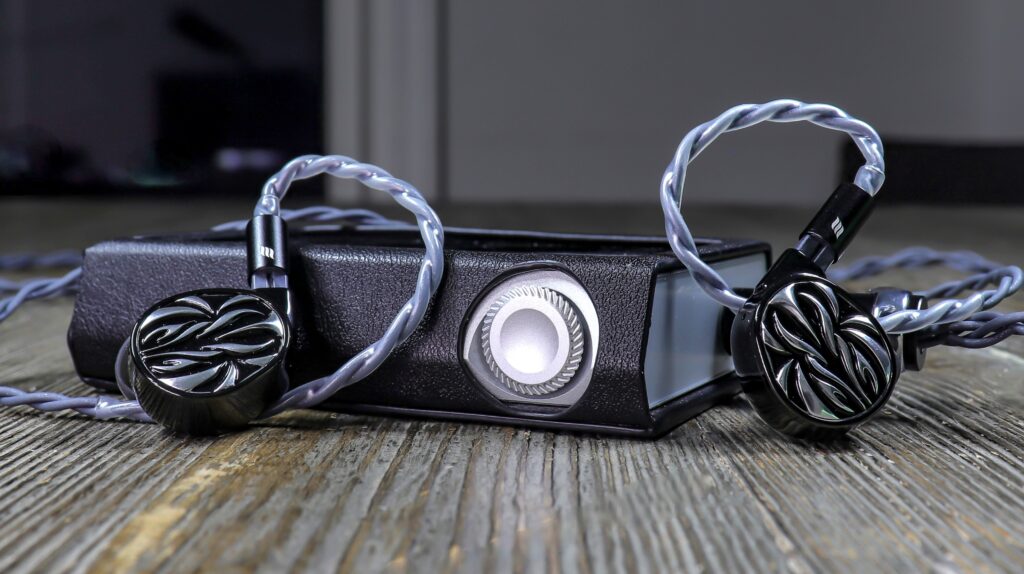
The lower midrange is one of solid note body brought on from the bass bleed adding a subtle warmth. Gently warmed, you could say. The transition from bass to upper mids involves the linear lower midrange acting as a perfectly smooth bridge. This region has a very chesty presence, very fleshy, without sounding overly thickened. While this area has the warmth, and the weight, it never sounds so swelled in density of warmth that it smothers all the precise articulations, or totally sands down all note edges. While it is most certainly smooth, I still hear plenty of cleanly outlined notes with just enough edge to them. However, this region is all about male vocals. Men sound anchored in the mix, they sound forward-ish and robust without sounding too blended or dull. Again, chesty, but also very well behaved, along with plenty of meat to male vocals. Textures within this region certainly don’t jump out at you. There’s nothing granular, dry, or etched. Every note flows with fluidity. Letshuoer did a solid job with this tuning creating a lower midrange which doesn’t try to highlight every micro texture, and it won’t magnify every micro-ridge of note outlines. That said, notes still have some contour, good enough clarity, and always a very clean velvet tone as it flows with a smooth cadence at all times. I feel that this greatly helps males to sound pronounced and authoritative while both baritones and tenors avoid any graininess, and thinness, with enough note body to sound convincing.
Males
“Hallelujah” by Jeff Buckley is a perfect example of his vocals coming through with relaxed clarity while the acoustic guitar strums away with solid articulation and just-passing detail. Nothing dry or etched at all and there’s no upper mid rise to make vocals come across nasally or abrasive at all. Another track is “The Sound of Silence” by David Draimen of Disturbed. This track sounds great because David’s masterful vocals sound great. Like all males his voice has that centerpiece positioning that isn’t recessed at all. However, it’s David’s emotive baritone moments which show off the range along with those breathy nuances and the clean warm and sturdy inflections to his voice. He really sounds fantastic. Of course, this is the story with too many male lead tracks to list here. I have a list of tracks, and rarely did I hear anything that didn’t take advantage of the smooth, rhythmic, cadence and robust note body. Males definitely come through very well.
Upper-Midrange
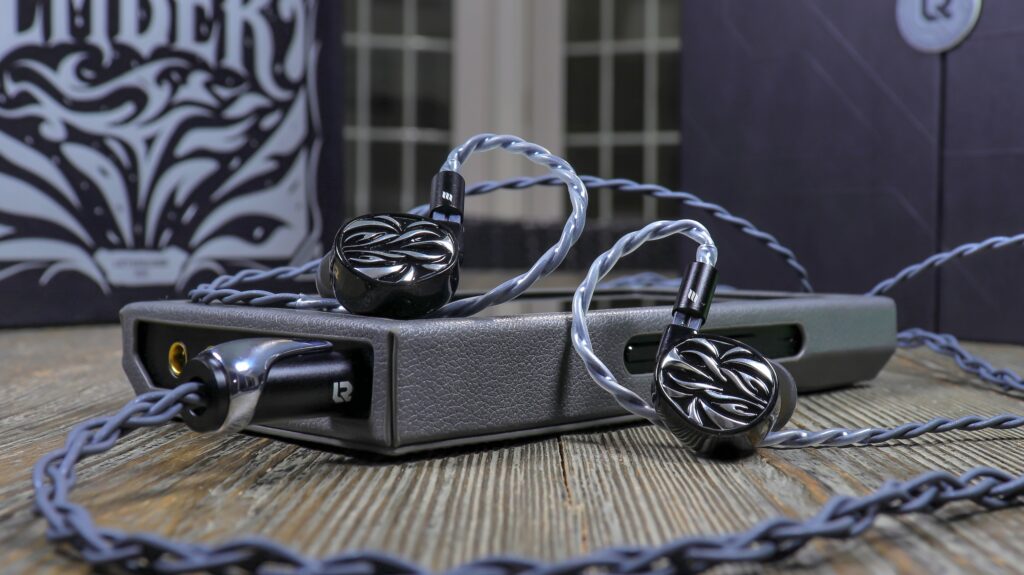
Now, the upper midrange is one that isn’t pushed too far and does a good job at keeping some linearity without ever sounding harsh or too sharp. In fact, there is barely even a noticeable pinna gain at all. Just enough of a rise to bring upon some pleasantly restrained energy with a very full-bodied note weight to all females and instruments. The upper mids actually track closer to warm/neutral and linear with absolutely zero pronounced peaks or sprightly vibrance. This will either be a good thing, or not so good to many of you upon hearing. I can tell you with complete assurance that the Ember pulls it off wonderfully. Believe me folks, there are so many sets that I chose to not review over the years which have had similar signatures, but the Ember has this awesome way of utilizing those fast transients and warm dynamic energy to offer female vocals which are forward, rich, warmed, flowery, and oddly enough… effervescent. Again, smooth throughout with that buttery style of fast note impulse speed as transient attack feels slightly softened, even plush, but also decays rapidly with a very clean release. You can hear this on many tracks. Now, the upper midrange certainly has a hair more energy than its lower-mid counterpart, and it does come across slightly less profuse and less husky in its weight, but man do females come across very well for a warmer signature. Beyond that, there’s this wide-open space created in the upper mids which actually has perceived air to the sound for females and instruments to play around in. Something you rarely hear folks. Most always “air” is the result of boosted highs, well, not on this set. The stage opens up in the mids feeling very spread-out, vast, and separated. I also hear much better texture out of the upper mids, slightly higher resolution too.
Females
However, to my ears it’s the females which mostly win my heart on this set because of the natural and realistic way in which they come through. They sound textured, smooth, very warmly colored and they have this very profound way of sounding engaging within that immersive sound field I was talking about. Females generally sit forward in the mix, yet atop the bass region and partitioned off separation as the bass rarely masks this region in a detrimental way. The speed of this planar doesn’t let that happen. Vocals and instruments get an open and weighted lift as the warmth from below feeds the upper mid air creating a unique sound. Definitely lower in pitch than most will be used to, and not quite natural, but very wholesome and fleshy. Females like Norah Jones in “Don’t Know Why” are flat out sultry, soothing, and so gratifying to the ear as there’s so much emotional presence being transferred to the listener. The stage size plays into the overall sound as well making her voice (and really any female) sound very immersive in a way that I haven’t heard in a planar set. Another track is “More Hearts Than Mine” by Ingrid Andreas who has this voice which seems to bring out planar timbre. There’s some sonic reaction which occurs and you can just hear the planar timbre come out of the shadows. Her voice has that sizzly edge to it yet is so very dulcet in every way. The beautiful thing is that the Ember doesn’t have any sign of that timbre. Actually, I love how the Ember plays her voice. In truth, every female sounds great. True they aren’t as vibrant or luminant and they don’t have that radiant energy, but females truly sound luscious, prominent, and they have more energy then you may think.
Downsides to the Midrange
The biggest issues with the midrange will come from those who deeply desire that crystalline and crystal-clear sound with plenty of brilliant energy out of this region. The Ember is most certainly toned-down in its brilliance, though it makes up for that in the speed of its transients, the grandness of the stage, and the richer note body. I suppose those detail hunters seeking out every last subtlety within their music probably won’t find the Ember too appealing. Let’s face it, the Letshuoer Ember is not exactly a “detail monster”. Also, resolution is about average in my eyes too, so, those who crave clarity above all else will probably want to keep on looking. Let’s see, I could also say that those folks who don’t care as much about details but truly want a mid-centric or vocal-centric sound which specializes in midrange vocal delivery treating the bass as a supporting actor. Those folks likely won’t be too attracted to this set right away. However, I challenge some of those vocal lovers to give this slightly different take on the midrange a try. The Ember has a certain charm to it friends. At any rate, I like what Letshuoer did here as the mids are clearly one of the Ember’s best qualities.
Treble Region
When I first heard the treble region and actually paid attention to it, I thought that it sounded kind of dark. In fact, it is dark. But I don’t feel about the Ember how I usually feel when I hear a dark treble. To my ears the treble region is 100% fatigue free. I mean, there is no way anyone on planet earth could tell me that they get fatigued from this treble. It’s dark folks, rolled-off, and even sort of dull until you reach that upper treble and find out it actually has some legit sparkle and very good treble extension. It is such a strange dichotomy with a warmer tonality yet tinsley and glittery sparkles that add that cherry-on-the-top brilliant chime to the top end. However, the emphasis isn’t very enforced here as Letshuoer did everything in their power to make sure that the treble carried a very smooth transition, a very smooth cadence, and a very smooth gliding politeness that would never cancel out any of the Ember’s remarkable musicality. When I can tell you that even the treble evokes that feeling of emotional draw then you know you are hearing a pretty unique and pretty special planar magnetic set of earphones.
Genres
Having said that, attack lead is certainly softer which can be a problem for some types of music. If you want to hear some of the speedier treble presentations like metal, prog metal, electric guitars speedily blaring with multiple instruments, or any high intensity genres then I probably wouldn’t reach for this set. The treble simply doesn’t have that clean snap and bite like I typically enjoy and it definitely would be better for certain genres. Genres like speedcore style EDM, again metal, even some more intensive rock, or bright pop style tracks. Anything which needs that illuminated and closer to natural sounding treble will not sound quite as good on the Ember. However, Orchestral music plays well enough as woodwinds extend rather smoothly, gently, with that big hall type stage presence which sounds immersive on the Ember. Singer-songwriter stuff, Soul. Stuff like Acoustic Jazz, Classic Rock, where anything that lets the timbre shine through without the need for speedy and clean-lined dynamics. The Ember’s treble also does best with genres and tracks that thrive in natural shimmer and luminance which don’t need that heightened sparkle, or hyper-etched note contours. Let’s just get one thing clear, as speedy as these planars are, they also aren’t aggressively detailed. For what the treble is (warm, smooth, & polite) it’s very good, but that doesn’t mean the Ember is perfect for everything.
Pretty nice, and unique
So, let me tell you why the treble bucks the trend of warm and polite treble presentations and actually comes across fairly talented, with a bit of context. It’s all about the lightning-fast transients, naturally bodied notes, and the Ember’s keen ability to sound vast in stage presence. Just like the bass and the mids, the treble also carries transients which attack with speed, with this realistic tone-down crispness which truly helps cymbals, strings, etc. to sound somewhat “top end” shimmery. But also, the decay is just as rapid as the attack and so you have this softly layered dense energy moving very fast. It’s quite nice if you can wrap your brain around it. The Ember simply doesn’t have the heightened and forced brilliance that so many ChiFi sets have nowadays. Having said all of that, I promise you that not everyone is going to enjoy almost zero brilliant energy. Still, the Ember’s treble notes are very rich and smooth, they’re soft-contoured by clean planar speed, they’re airy for a darker sound, and actually uphold musicality very-very well. However, they do not have luminant energy. So that is something that all hobbyists will have to ask themselves before they take the dive in this set.
Extension
Like I said earlier, extension into the upper treble is actually quite great, which is not something that I ever expected to hear. It’s odd hearing a warmer treble have actual shimmer and sparkle up top. This extension does a few things psycho-acoustically to give the soundstage its vast width and air by simulating more acoustic space. Almost like the lateral left to right boundaries are feathered into the ether providing that open feeling. Of course, having such awesome extension down low also adds a more perceptively wide stage too. Having this type of controlled extension almost avoids any forwardness or anterior presence which ultimately helps the stage to sound less narrow as well. Beyond that, the extension into the upper treble is not splashy, it isn’t full of treble tizz, and it doesn’t sound smeared at all. Again, it may be darker as a whole but that doesn’t mean that it’s a sloppy treble. It’s actually quite well controlled.
Downsides to the Treble Region
Treble heads will despise this set and those neutral heads who enjoy the neutral natural treble with adequate shimmer and sprightly treble bite will also find this treble display to be nowhere near good enough. I can promise that. Like I said a bunch of times this treble is dark folks. It’s dark and smooth. Yes, it has some nice upper treble air and sparkle, but that hardly makes up for how warm it is as a whole for those people. Also, analytical heads will not like this treble at all as the Ember is not exactly detailed. This is not a high resolution iem with a clean-cut note display. To add to that, even with the speed of the planar and its uncanny ability to keep notes separated, they don’t create distinct notes. You really have to pay attention to hear minute details. So, there’s definitely some issues with the treble, unless of course warm and dark with good extension is your cup-of-tea. As I’ve said countless times in my reviews; I love all types of sound signatures so long as they are good at what they were tuned to be. I’ve grown to become very fond of the way that Letshuoer tuned the Ember in its particular style. Perhaps it’s an acquired taste, but once you wrap your head around it… the Ember is nice.
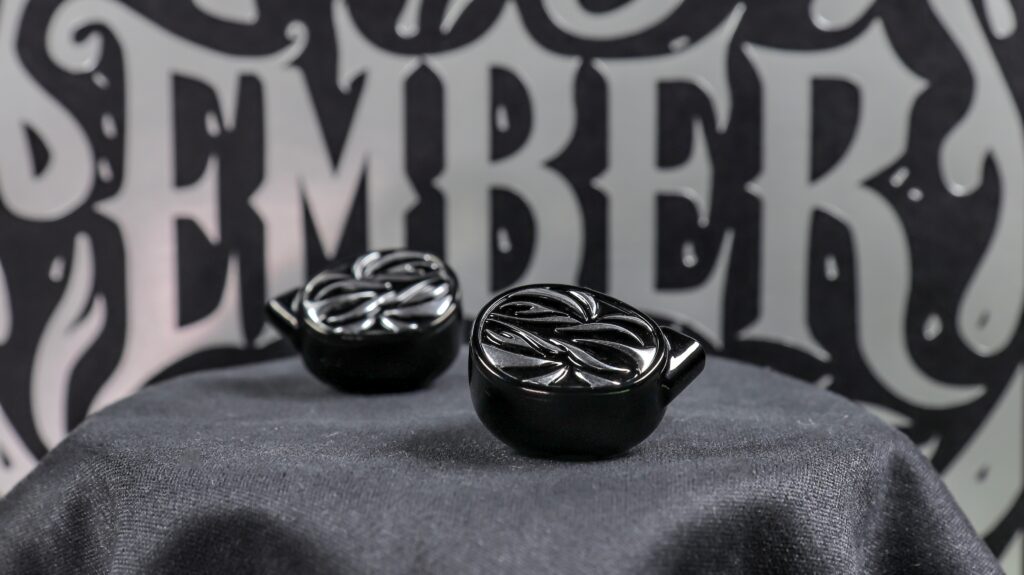
Technicalities
Soundstage
As I’ve said multiple times throughout this review, the soundstage of the Letshuoer Ember is definitely on the vaster side. Most certainly above what I’d call “average” and certainly in the top of its class for sheer width. Again, the Ember has fantastic extension both ways, in the sub-bass and the upper treble areas which does add a more spread out and grand sound field. Again, the transient speed in the middle (well, the whole spectrum) is fast and not congested whilst the midrange is not shouty and it isn’t in your face. To add to that, while the bass bleeds into the mids, it also doesn’t smear the midrange. Add all of this up and what you get is the illusion of a wider sound field. Without question the stage width and height is one of the grander within its price point. Also, the depth is pretty darn nice as well. You see, the planar used in this set is rapid fire fast folks. Nothing sounds congested. It really does help the front to back instruments come through more easily. I wouldn’t call the Ember tops-in-class for depth, but it’s definitely very good and easy to hear the obvious layering happening.
Separation / Imaging
One of the central tenets of a planar driver is its speed. Rarely will you hear a planar driver that has an issue with sound separation. Having said that, typically when you have such a warm sound (such as the Ember) you’d think that at least a little bit of smearing would take place on the regular. However, that is not the case. I’m telling you driver control is at a premium in this set folks. The speed of the Ember’s driver is quite impressive. It’s remarkable actually, to have such a smooth sound, softened in attack lead, less exact and less snap, less bite, to have such distinct note outlines and clear space between elements of the stage. I freaking love it! Now, Imaging is a bit less coherent but very on point. Meaning, elements of the stage are in their precise locations with central elements like vocals plastered dead center. But the smooth timbre doesn’t help the Ember’s imaging to sound quite as distinct as other sets. Mostly only in congested tracks. So, I’m not saying that imaging is bad by any stretch, but I am saying that sometimes it is harder to clearly and coherently perceive. Having said that, if you have a less congested track… I have zero issues hearing a well imaged stage. Not top tier, but decent, average, average is good.
Detail Retrieval
Okay folks, this is one area that I don’t feel is all that great. Detail retrieval is probably a hair less than average. You have to understand that the Ember is so unbelievably smooth, like butter everywhere, refined to the maximum, every sharp corner and every crisp angle is sanded down and polished. You have a deep and big bass presence, and you don’t have a very brilliant sound up top and so you won’t hear those illuminated subtleties coming through as easily. Also, micro-dynamics and micro-textures are almost non-existent in congested tracks, and hazy in uncomplicated tracks. While the planar driver has the speed to highlight every detail, I’m afraid that the overall picture comes through less resolutely. This set is a pure musicality-first iem with almost no room for anything analytical to creep in. It’s an emotionally charged and totally creamy sound which isn’t worried about showing off details. To the Ember, details are pesky annoyances which get in the way of its smooth and luxurious mellifluousness. It has no time for details.
Comparisons
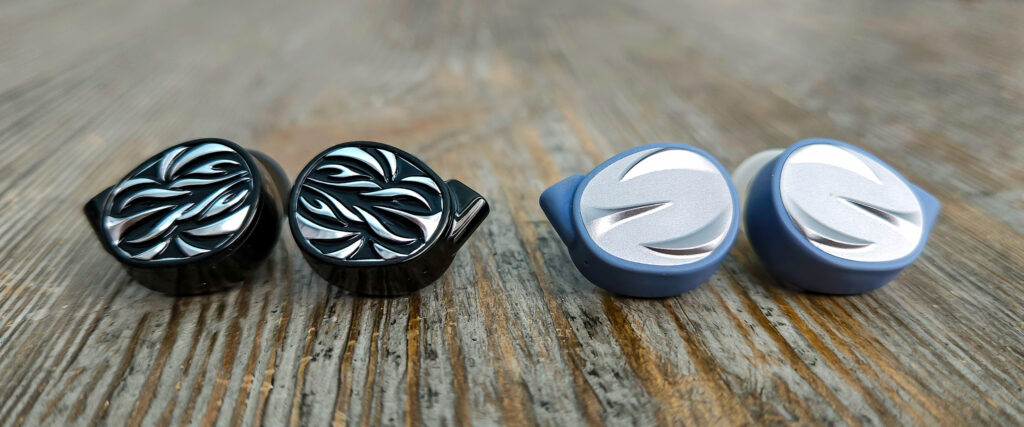
Letshuoer S15 ($229)
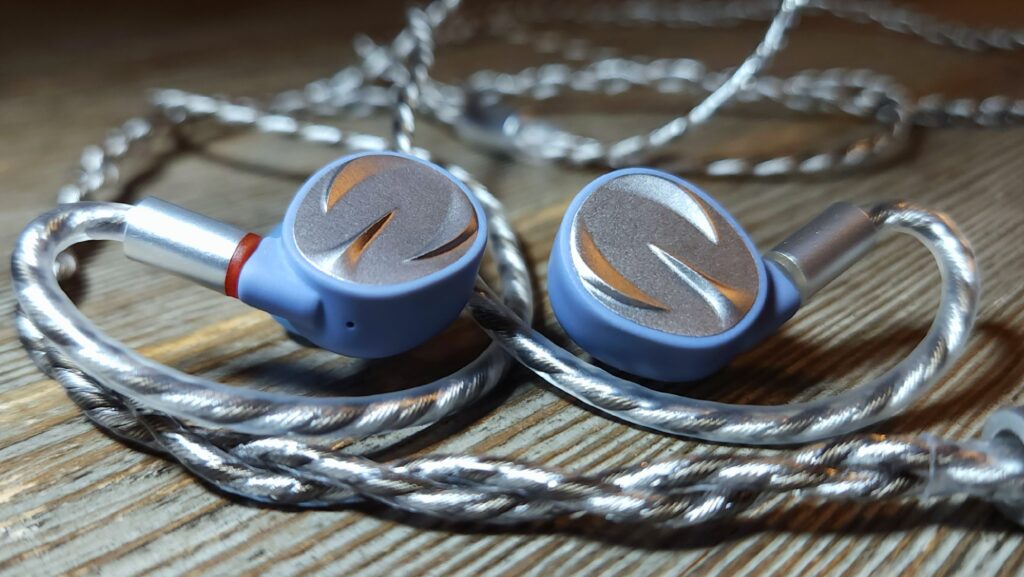
The Letshuoer S15 was one of the 1st planar magnetic earphones which actually had organic timbre. I actually reviewed the S15 right around two years ago (S15 Review) and I hailed it as the best planar on the market for my taste at the time. The market wasn’t graced with the Letshuoer S12 2024 Edition yet, or the Ultra, and a few other planars which really performed well. However, the S15 has so many great qualities and is very good at such a low price anymore. Especially since its original MSRP was around $330. At any rate, once again the S15 is also a planar magnetic earphone by the same brand Letshuoer, and it comes with a large 14.8 mm 3rd Gen driver as well as a 6mm passive filter module as well. I was quite pleased with the S15 and sang its praises for quite some time. To the point that maybe I should’ve gotten some sort of commission from Letshuoer. While I don’t think it’s the best all-rounder planar out there, it is still very well-tuned and holds up very well for being two years old.
Non-sound Stuff
Both sets are packaged very well and both come with what I’d consider solid unboxing experiences for their price point. I honestly think the S15 has the cooler unboxing as Letshuoer made the box with drawers that open up to see the contents inside. However, when it comes to actual accessories the Ember wins out here. Far-far-far better Effect Audio cable, better case, more eartips too. The Effect Audio cable alone probably adds a cool $100 to $120 to the cost. So, it’s much better. Both sets are not huge, though the Ember is slightly heavier. Of course, both sets are very comfortable. As far as build is concerned, the S15 has that HeyGears matte resin build, 3D printed, while the Ember has that gorgeous titanium build, durable, premium. Obviously, the Ember has the better build quality, though the S15’s HeyGears made shells are extremely lightweight. I don’t know what’s more important to you. Both sets offer their own rewards when it comes to build and non-sound attributes. I happen to think the Ember is clearly the better iem in this regard though. As far as drivers, both have a 14.8 mm planar driver though the Ember’s driver is the evolution of Letshuoer’s experience with the tech. Fully evolved you could say. The S15 also has an extra 6mm passive filter module which controls unwanted resonances.
Sound Differences
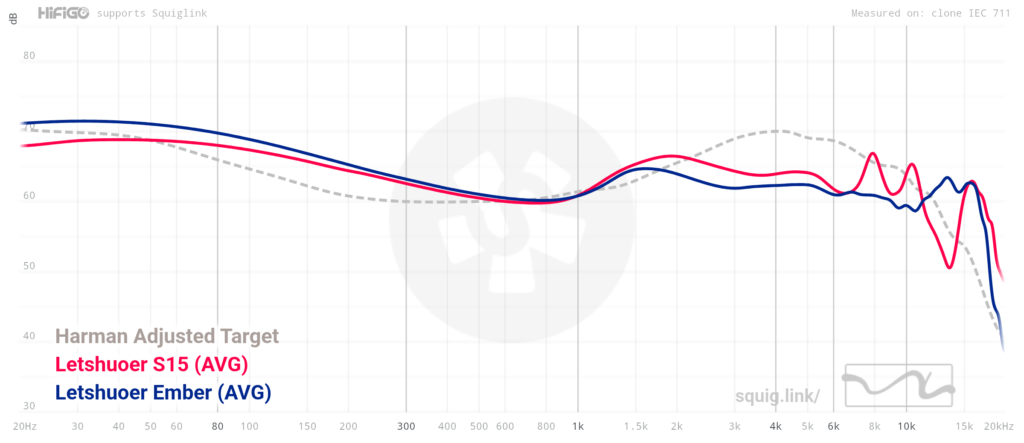
I won’t go long here folks. These two have enough differences that it won’t take long explaining. To start, both sets are warmly rendered, organic, and musicality-first, though the Ember is all of these things on steroids. Clearly the Ember is warmer, even smoother, less precise, bassier too. There are ways that the S15 is clearly better. When seeking out details, hearing the minutiae in your music, sound imaging. However, the Ember’s bass is of higher quality, deeper, heavier, cleaner, faster transients yet with meatier density. It’s a cool mixture and very satisfying. The midrange of the Ember is less analytical, more tunefully mastered with its ultra musical presentation. However, I do think the actual timbre and tonal coloration of the S15 is closer to realistic, slightly brighter, closer to balanced. The Ember is simply too colored to sound perfectly organic and natural. The treble has more sparkle on the S15, slightly more brilliance contrasted with less bass emphasis which makes the overall resolution much better on the S15. More bite, more snap, but less note control. Wrap your mind around that. Also, extension into the upper treble is better on the Ember. Extended further, and more sparkly without the splash. Furthermore, the S15 was subject to some sibilance whereas the Ember had absolutely zero signs of that. Transients are tight on both sets. Again, both very melodic, very nice and emotionally gratifying too. I like them both quite a lot, but they do have vast enough differences that I could almost call this a preference battle.
Final thoughts on this comparison
Again, I personally enjoy both iems and both are solid for their current price points, but the Ember is simply too unique folks. It’s too good for what it is and what it was tuned to be. I will say that the Ember is going to be more of an acquired taste, it is less of an all-rounder and the S15 will likely suit more people right away. Though, I also think that more people will likely end up enjoying the Ember more when they wrap their brains around its unique and totally awesome sound. Both are well tuned and both were at one point flagship level planar magnetic earphones. For me and my pallet the Ember is better. For the wallet or pocketbook, the S15 is better. Also, for anyone who would much rather have an all-rounder, the S15 is clearly better. However, for anyone who desperately enjoys musicality and richness, the Ember is 100% the better and more refined set. Also, it probably takes a refined pallet to enjoy.
Last Words on the Letshuoer Ember
What can I say, once again Letshuoer completely out duels themselves by creating another wonderfully made, wonderfully designed, wonderfully accessorized, and wonderfully tuned planar iem. Folks, when I first heard the Ember, I was almost in shock at how warm it was. I almost thought about not reviewing. You have to understand that I went from the Twistura WoodNote, and the Intuaura Impact prior to reviewing the Ember. Much more brilliant sets. This was without question a moment where I had to listen intently for hours to wrap my mind around what Letshuoer had created. I didn’t judge too quickly like so many do. I gave it time folks. Let the sound sink in. I needed to see where Letshuoer was going with this tuning, to understand their angle, and I needed to try to understand the beauty of this tuning. Well, it didn’t take long. Maybe a couple hours at most. I remember sitting in my favorite chair in my sunroom (the place I take most of my pictures) and I remember specifically hearing “Africa” by Weezer. Ya know, the amazing cover track that they did a handful of years ago. By the way, that whole album is ridiculously awesome for testing. You can thank me later, go listen to it. Anyways, the chorus of that track is always so bright. On most every set. Well, I never needed to turn down the Ember. The sound was so musically inviting folks. It absolutely sucked me in. The stage wrapped all the way around me! That unmistakably musical sound absolutely enveloped me in a canopy of warmly rendered tunefulness and completely changed my perspective on this set. Without hesitation I went from track to track with my newfound understanding of the Ember. Suddenly I could care less about details or precision. Who needs details? Give me musicality! Folks, I began to adore the sound. Hearing my music in a different way, in a different light. This “moment” imprinted on me and I won’t let it go. I know the beauty of this set friends. The Letshuoer Ember has a sound that is all its own and it will either be adored, loved, and enjoyed, or it will be complained-about, put-down, and disliked. No in between.
Worth every penny?
Having said that I can certainly say with complete and total confidence that there are very few iems which can do what the Ember does and to the ability, or to the proficiency that the Ember does it. When it comes to warmly rendered, bass focused, and totally musical sounding iems, the Ember takes the cake. I’ve never heard a set which so closely aligns with its name. It is an ember or sound, warm, cozy, and so very inviting. It sucks you in. After hours with this set, I forgot about neutral-natural, I forgot about crispness and clean edges, I forgot about brilliance. I didn’t need it anymore (until my next review). Again, I love all signatures and can find love for them all relatively quickly… so long as they are good. If it sucks, then I won’t review it. Plain and simple. I don’t have time for something which sucks. The Ember is as unique in its sound as a rare stone. There’s a reason that it costs almost $500. Now, is that a fair price? I mean, it depends on who you ask, but I think it is fair. Let’s put it this way, if I had spent time with this set and it was going to be taken away, would I purchase the Ember on my own for $499? Yes, I would. To have this type of signature in my daily rotation is worth it to me. But I’m a lover of all styles and I can easily find love and enjoyment in something such as the Ember. Can you? If you say no to anything that you’ve read, then the Ember will be far overpriced. So again, it all depends on you. To me $500 works. Also, it’s an easy rec for anyone who can get with its tuning.
The Why…
Because the Ember comes in a premium packaging with premium accessories. Shoot, this set comes packaged with a true-blue ConX ready Effect Audio cable. Like the little brother to the Effect Audio Eros S ii. Also, the case, the eartips, all solid. Next, the Ember is crafted out of titanium folks! This is no small task. Forming anything in titanium is very difficult. Trust me, as I know all too well. However, titanium is extremely durable, corrosion resistant, lightweight, and it attenuates unwanted resonances better than most any material. Also, the Ember is very comfortable and ergonomically sound. This is a set which fit me perfect right away. No issues. Having said that, did you look at this iem? Is it not the most rad looking set! My word! Who has the artistic audacity to try to CNC carve and form the flames on the faceplates?!! Out of titanium? Good lord are these people talented! Most of you will overlook that stuff, but not me. Letshuoer did a marvelous job making a beautiful, handsome, and totally dope looking iem. Just like the beautiful Mystic 8 that I reviewed earlier this year I can say once again that Letshuoer outdid themselves.
That Sound!
However, it’s the sound which separates the Ember from other sets. I’d say it is the sound which will bring people in, and it’s the sound which will push people away. Without question the Letshuoer Ember has a very-very bold tuning which comes across as extremely polarizing to the community. I gotta hand it to Letshuoer for taking such a strong stance towards musicality and emotional gratification in their products. The Ember is once again very warm; it is a musically focused planar iem with a strong bass first presentation that has a solid dynamic balance across the mix. Having said that, there is nothing natural or analytical about this set. It is 100% skewed towards organic and earthy timbre with some of the smoothest cadence that I’ve heard. The Ember has a very vast holographic style stage with warmth that envelopes the listener wrapping them up in this large dome of sound.
Between the 20’s
The Ember has a very deep, very palpable, and very fast bass which hits with superior authority and does so much in the vein of how a dynamic driver may represent the bass. The only difference is that the Ember does so with tight notes, quick decay, nothing muddy, nothing overtly veiled either. The bass is hands-down awesome! Next, the mids are creamy, buttery, rich, but also very tightly rendered with transients that attack and decay on a dime whilst still having such a weighted and dense note body. It really is something cool. The mids are completely non-fatiguing, relaxed, organic, very warm, and there’s not a chance for shout or planar timbre anywhere. Just a musically gifted midrange which evokes emotion in any track that was recorded with it. The treble keeps to itself, it’s polite, it’s very tame, and it also has nothing offensive or artificial about it. Just very melodic from the low-treble to the high-highs helping the listener to focus only on how tuneful a track can be rather than every last detail. Furthermore, extension into the upper treble is awesome. The upper treble provides that last twinkling of sparkle and shimmer which really is a profound thing to hear for a warmer, even darker treble. Details are an afterthought, sound separation is pretty good, and imaging isn’t laser focused. However, that stage is enormous, holographic and all consuming. No doubt this sound is not going to be loved by all who hear it. That said, it will be utterly adored by those who can wrap their minds around it.
Ember Pros
-Titanium shells offer such a wonderful build, durability
-Very lightweight, very ergonomic, no wear fatigue at all
-The aesthetic appeal of this set is through-the-roof… Awesome
-Unboxing is fitting of a flagship (great cable, great case, many eartips)
-The Effect Audio collab cable was sweet icing on the cake (great cable)
-Stellar warm and engaging sound, emotionally gratifying sound
-Rich, very much velvet organic timbre. Warmly colored
-Absolutely zero listening fatigue. A melodically enjoyable siganture
-Deep & penetrating bass with nice sublevel extension
-Typical planar speed makes the bass hard hitting and fast
-Lush and alluring vocals for both male & females
-Treble is non-offensive yet has plenty of sparkles and solid note presence
-Soundstage is very open, with a grand width
Ember Cons
-Warmth may turn away some listeners
-Not the most precise sound, the Ember is all about musical engagement
-I found that resolution suffers (to an extent)
-Bass presence may be too focused and bold for some
-Yes the sound is great, the package is fantastic, but you’ll pay for it… $500
-Analytical lovers, don’t even worry about reading this review
-Detail retrieval is subtly sanded down with this smooth tuning
-Resolution won’t win any awards
Genres and People
What genres work?
The Letshuoer Ember will work perfect for anyone or any genre which prioritizes musical flow, dense yet controlled energy, as well as organic timbre and warmth. As I said earlier, that would likely be stuff like Acoustic style Jazz, definitely Classic Rock, Orchestral music is wonderful on this set. Blues is another genre which works along with R&B, Soul, even some Hip-Hop and Rap music. I also surprisingly have more than a few Ambient tracks which absolutely sound spellbindingly good with the Ember. Electronic music works like a charm too. So, there’s many genres which do well, but not an all-rounder at all.
Who is it for?
Honestly, people who simply enjoy a musical presentation and desperately don’t want to sit there and detail focus. Meaning, they don’t want to track details unknowingly. It’s for fans of the planar tech who enjoy an organic sound without any hints of planar timbre. Those who enjoy the benefits of this speedy driver tech yet hate the metallic tinge applied to the surface texture of some notes. Also, anyone who is a true fan of solid bass will like this set. No doubt it isn’t for everyone, but again, who this set is for will be in love.
What genres won’t work?
A set this polarizing is going to have those who love and those who don’t, genres which work, and others which don’t. So, in my opinion, and based off of my real world listening and my many pages of notes I have some genres which do not work as well. Keep in mind that this isn’t every track and these are extremely broad and vague notes that I made. So, not every track is going to have the same effect basically. Anyways, without question any aggressive Metal or Thrash Metal where the smoother highs of the Ember is going to soften the intensity along with blending the sound. Or those super detailed Techno banger tracks where speed and snappiness is needed. Yes, the Ember’s driver and bass speed is exemplary, but it isn’t snappy and clean-lined. Again, Speedcore style tracks where control and cleanliness are needed. Also, in my notes I have a huge “no-no” on brighter Pop tracks or the forensic style detail needed for those fast EDM tracks. Again, not that the Ember can’t do a good job on some of these genres, but generally it won’t perform better than many other sets.
Who isn’t this set for?
I’d say first off, the Ember is most certainly not for treble heads. My word, has there ever been a set that will be unliked more than the Ember by treble heads? Others who won’t enjoy this set are those chasing that neutral-natural sounding timbre with less coloration, more of a frequency balance. The Ember is all color folks. I adore a neutral-natural sound too, so I get it. This set will absolutely NOT be for any analytical lover who loves to sit in their favorite chair and pick out every last detail. Friends, detail hunters will not enjoy this set, and it will not be for them. Lastly, any true high-resolution fan will probably not enjoy this set. It’s a great iem for what it is, but it won’t be lived by everyone.
Conclusion
To conclude my full review and feature of the Letshuoer Ember, I absolutely need to thank the truly awesome folks over at Letshuoer for providing me the Ember for review. Thank you so very much. I’ve had endless hours of fun listening to Letshuoer products, and you’ve always been so very helpful and kind. I appreciate you all. Also, I need to thank the reader. Friends, my reviews are long, tedious, and they go on and on. But I put everything into them trying to get across my opinion. I want them to help you more than anything. It’s you that matters and it’s you that I care about. Yes, these reviews are cathartic for me and a great creative release for me, but it’s always for you. It’s the reader that I picture in my mind with every word that I write. Thank you for clicking the link and I hope this has helped you.
Other perspectives
Finally, please check out other reviews. I am so late to the party with this set and I’m sure by now there are a multitude of reviews captured about the Ember. It can only help you in making an educated decision. Please don’t read this review and then hit the “buy now” button. Please take in other perspectives, please read, watch, or listen to other opinions. We are all very different folks. Each one of us have different likes and dislikes, different abilities to even hear the music, different music libraries, and we all haven’t been down the same journey through audio. This makes an enormous difference in how we each perceive music through devices. Some have a lot less experience, and some reviewers have been doing this forever. Each is a valid and useful perspective. Also, there are so many ridiculously talented reviewers out there. So many smart and witty reviewers, and so many who will help you to understand the Ember in possibly a different light. Anyways, with that said, I think I’m done. Please take good care, stay as safe as possible and always… God Bless!!





No Comment! Be the first one.