








































































































The Neuroscience of Music: What Happens in Your Brain During a Great Listening Session
Table Of Content
Music is the only stimulus that reliably activates the brain’s reward circuitry without involving any direct biological need — no food, no sex, no survival threat. Just organized sound. Neuroscientists have been puzzling over this for decades, and the research that’s accumulated gives a surprisingly clear picture of what’s actually happening during a good listening session.

For audiophiles specifically, some of this research maps onto the hobby in ways that explain things most of us have noticed but never had language for.
The dopamine loop
The nucleus accumbens — the region most associated with reward and motivation — releases dopamine in response to music. This has been confirmed through PET imaging and pharmacological studies. Block the dopamine receptors and music becomes significantly less pleasurable. Let them run and the response to anticipated musical passages is measurable and repeatable.

What’s interesting is the timing. Dopamine release peaks not just at the moment of a musical climax but in the seconds before it — during the buildup, the anticipation. The brain is predicting, modeling what’s about to happen based on pattern and expectation, and the reward comes from that predictive process. This is why familiarity doesn’t kill musical pleasure for most people; the anticipation of a known moment you love is itself rewarding.
It also explains something audiophiles know intuitively: that hearing a familiar recording on genuinely better equipment produces a distinct response. The prediction model hasn’t changed, but the resolution of the incoming signal has. Your brain is comparing what it expected against what it received, and the mismatch — in a positive direction — generates its own reward. You’re not just hearing more; you’re getting a small dopamine hit from the upgrade in information quality.
Frisson: what it is and who gets it
About two-thirds of people report experiencing frisson — the involuntary shiver, goosebumps, or chill that some musical passages produce. For the third who don’t, it can seem like something people are exaggerating. It isn’t. It’s a genuine physiological response: pilomotor reflex triggered by a brain state similar to what occurs during social bonding, unexpected reward, or intense emotion.
The passages that reliably produce frisson tend to share structural features: sudden dynamic shifts, entry of a new voice or instrument, unexpected harmonic movement, a voice cracking with apparent emotion. The brain’s threat-detection circuitry is involved — the amygdala briefly flags the unexpected event, and the chills are partly an arousal response to that surprise. This is why frisson is more common with first listens or with music that still feels novel, and why it can return to familiar music after a long absence.
Research published in the last decade has found that people who experience frisson frequently score higher on openness to experience — a personality trait associated with imaginative engagement, curiosity, and aesthetic sensitivity. They also show higher connectivity between the auditory cortex and the regions that process emotion. This isn’t a compliment to audiophiles specifically; it’s a descriptor of a population that tends toward intense aesthetic engagement generally. But it does suggest that the people drawn to this hobby may be neurologically primed for it.
Active vs. passive listening: what the difference looks like
Passive listening — music as background while you do something else — activates the auditory cortex and some limbic structures. It’s comfortable and not trivial, but it’s a limited engagement.
Active, analytical listening — the kind audiophiles do when evaluating soundstage, tracking instrument separation, noticing the decay of a note — lights up considerably more. The prefrontal cortex (executive function, attention), the cerebellum (timing and motor prediction), Broca’s area (originally associated with language but involved in processing hierarchical, rule-based sequences — music qualifies), and the motor system all come online more significantly. There’s evidence that musicians and trained listeners show stronger activation and greater cross-regional connectivity during analytical listening than casual listeners. But training isn’t entirely the variable; intent is also a factor. Deliberately paying attention changes the neural picture. Used quite often across MBA writing reviews.
This matters practically because it means that a focused listening session is cognitively demanding in a way that background music isn’t. It also means it has more of the cognitive benefits associated with demanding tasks — better retention, more intense emotional encoding, stronger memory formation. The albums you’ve listened to analytically are neurologically encoded differently from the ones you had on while cooking.
The default mode network and why listening to music feels like a break
The default mode network is the set of brain regions that activate when you’re not doing anything in particular — daydreaming, mind-wandering, processing recent events. It’s associated with self-referential thought and mental integration. When you’re focused on a demanding task, it typically goes quiet.
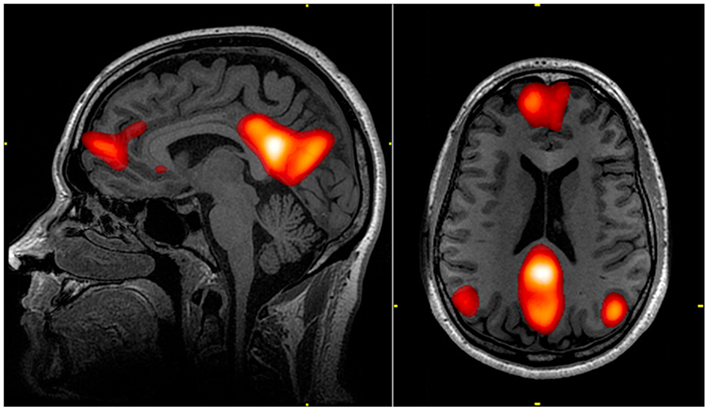
Music does something unusual here. It can simultaneously engage focused attention (auditory cortex, analytical regions) while allowing the default mode network to stay partially active. The result is a state that doesn’t fit neatly into “focused” or “resting” — something closer to absorbed. Meditators describe a similar state. Flow states in creative work share some features. It’s why a good listening session can feel restorative even though your brain is doing real work.
For audiophiles who listen at the end of a work day, this might explain why it actually helps. It’s not escape or numbing. It’s a different mode of engagement that uses different cognitive resources than the day’s demands did.
Auditory memory and why your gear sounds better after a break
The brain’s auditory memory — its internal model of how a recording sounds — is less stable than most people assume. It updates on exposure and degrades with time. This is why returning to a system after a few weeks away from it often produces a stronger impression — the comparison is happening against a reference that’s partially faded, and the incoming signal wins more clearly. It’s also why critical listening fatigues: the more recently you’ve heard something, the more accurate your internal reference is, and the smaller the margin of difference you’re evaluating against.
Understanding this The Neuroscience of Music: What Happens in Your Brain During a Great Listening Session doesn’t require any gear changes. But it does suggest that structured rest periods between critical sessions aren’t just good for your ears — they’re good for your listening resolution.
If you want the full picture on how listening habits affect your health, the Sound & Health guide covers all of this in one place.






No Comment! Be the first one.