


















































































Table Of Content
Hidizs MK12 x DucBloke Edition Review
A warmer sidegrade built around musical ease
Hidizs has been taking a deliberately scattered approach lately, releasing in-ear monitors across different price ranges and tuning philosophies rather than sticking to a single sonic identity. The MK10 leaned into a more rigid, technical direction with its SiC diaphragm, while the MK12 introduced a softer, more flexible foundation through a pure magnesium diaphragm.
The Hidizs MK12 x DucBloke Edition does not attempt to replace the original MK12. Instead, it positions itself as a sidegrade—an alternative interpretation rather than an outright upgrade. From the moment you open the box, that intention feels clear.
Build, Design & Accessories
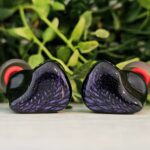
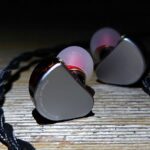
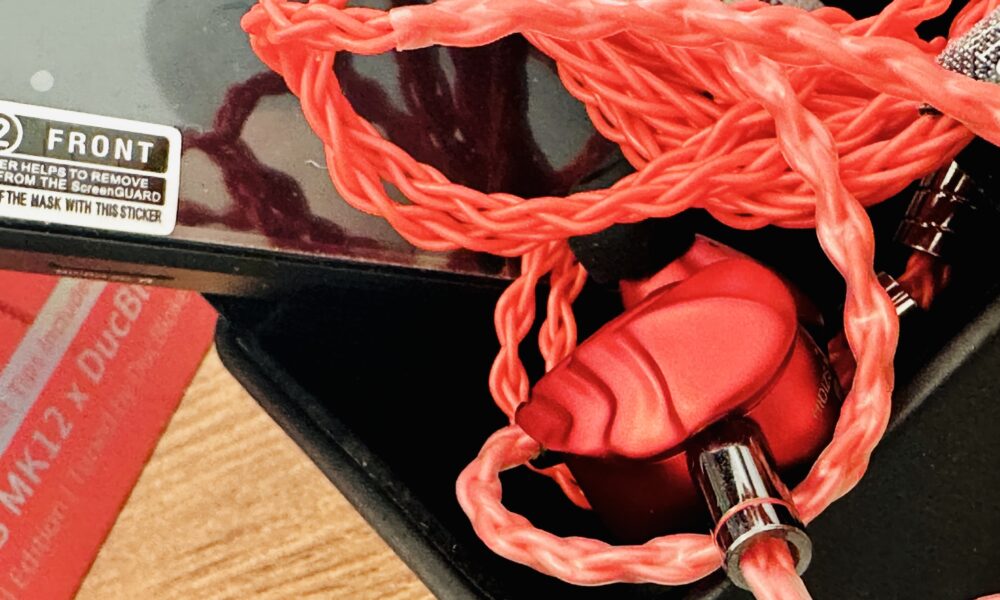
The visual identity immediately separates this version from the standard MK12. Both the cable and the drivers are finished in a deep red tone—noticeable, but not flashy. This isn’t cosmetic excess; it’s a quiet marker that you’re dealing with a different take.
Termination is 4.4mm balanced (bal), and the box includes five pairs of Divinus Velvet eartips. That choice alone hints strongly at the tuning direction. Hidizs isn’t pretending this is a neutral reference monitor. The intention is comfort, smoothness, and a softer interaction with the ear.


Build quality is solid, the shells are lightweight despite the bulky look, and the cable remains flexible with minimal microphonics. Ergonomically, it’s an easy fit that doesn’t call attention to itself during long sessions.
Source & Listening Setup
For this review, the source was the Hidizs AP80 Pro Max.
- Offline listening
- Fresh out of the box
- Medium-size Divinus Velvet tips
- Full library on shuffle
This wasn’t a track-by-track stress test. The goal was to live with the MK12 x DucBloke Edition as it would be used day to day, letting different genres come and go naturally.
General Sound Character
The defining trait here is softness, but not in a dull or veiled sense. The sound doesn’t rush forward, and it doesn’t harden around edges. There’s no immediate “look at me” moment. Instead, the MK12 x DucBloke settles in and lets the music unfold at its own pace.
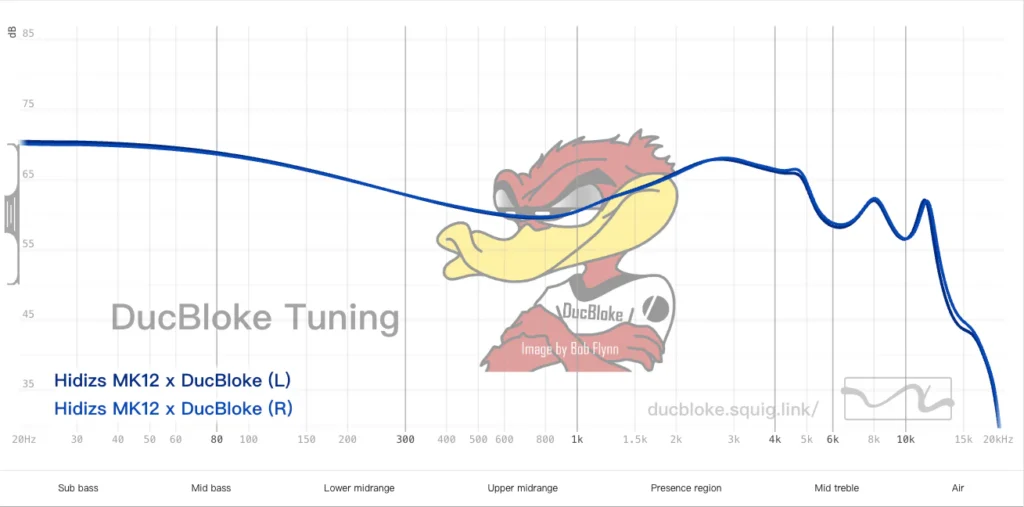
Compared to the standard MK12, the low end is clearly more present. Bass arrives earlier, stays longer, and carries more weight. This isn’t accidental—it’s a core part of the tuning. Yet thanks to the magnesium diaphragm, that added body doesn’t turn into blunt force. There’s mass, but also air.

Soundstage, Separation & Technicalities
Soundstage favors depth over exaggerated width. Instruments aren’t pushed far left or right, but they’re given enough breathing room to avoid congestion. Separation is respectable for the price range, especially considering the warmer tuning.
With complex genres like math rock—often unforgiving for relaxed tunings—the MK12 x DucBloke Edition holds together better than expected. It’s not a technical monster, but it doesn’t collapse under rhythmic complexity either. The balance between fun and control feels intentional rather than compromised.

Comfort & Daily Use
Lightweight shells and a pressure-free fit make this an easy IEM to wear for extended periods. There’s no hot spot buildup, and isolation is adequate for everyday listening. This is a set you forget you’re wearing—and that’s a compliment.
Bass Performance
Bass is the structural backbone of this tuning. Mid-bass is warm and full, giving kick drums and bass guitars a rounded, physical presence. Sub-bass extension is there, but it doesn’t dominate. Instead of chasing rumble, the MK12 x DucBloke Edition prioritizes body and texture.
In electronic music, this makes the presentation engaging and grounded. In rock and alternative genres, it gives instruments a sense of weight without dragging the tempo down. At times, the low end can feel slightly inflated, but it rarely crosses into distraction. This is bass as character, not spectacle.
Midrange
The midrange is where the magnesium diaphragm quietly proves its value. Vocals sit naturally in the mix—neither pushed forward nor recessed. Male vocals benefit from the added warmth, while female vocals retain clarity without tipping into sharpness.
Detail retrieval is handled with restraint. Micro-details don’t announce themselves; they’re simply present when you focus on them. This makes long listening sessions comfortable and fatigue-free, even at moderate volumes.
Treble
Treble is controlled and intentionally safe. Those looking for sparkle-first tuning might find it slightly reserved, but there’s a reason for that restraint. There’s no sharpness, no brittle edges, and no sudden glare.
Cymbals extend smoothly, decay feels natural, and the overall top end remains polite without sounding muted. The Divinus tips clearly play a role here, softening the attack just enough to keep the presentation relaxed.

Pros & Cons
Pros
- Warm, smooth, and fatigue-free tuning suitable for long listening sessions
- Fuller and more present low-end compared to the standard MK12
- Magnezium diaphragm delivers natural timbre without harshness
- Controlled treble with no sharp peaks or glare
- Handles complex genres better than expected for a warm tuning
- Lightweight shells with excellent comfort and fit
- 4.4mm balanced (bal) termination included out of the box
- Divinus Velvet tips complement the tuning well
Cons
- Not a technical reference or detail-forward tuning
- Bass can feel slightly inflated depending on genre and source
- Treble may sound too reserved for listeners seeking sparkle
- Soundstage prioritizes depth over width, which may feel limited to some
- As a sidegrade, it doesn’t replace the original MK12—it complements it
Conclusion Of Hidizs MK12 DucBloke Edition Review
The Hidizs MK12 x DucBloke Edition isn’t here to outperform the original MK12. It’s here to sit beside it.
This is a warmer, softer, more low-end-focused interpretation built around musical ease rather than technical bravado. It doesn’t rush to impress, doesn’t exaggerate details, and doesn’t demand analytical attention. Instead, it rewards time spent listening.
As a sidegrade, it makes sense.
As a standalone tuning, it feels honest.
Who is it for?
For listeners who enjoyed the MK12 but wanted a touch more warmth and weight, this edition offers a genuinely different perspective—without losing the natural flow that made the original appealing.
Who isn’t this for?
Listeners who want neutrality and no bass color.







No Comment! Be the first one.