
































































































Preface
For some time I had been looking for a versatile device to drive a pair of active desktop speakers. I wanted to avoid the usual chain of separate components spread across the desk, preamp, DAC, power supplies, transformers, and all the cables that come with it, which often take more space than the speakers themselves.
Table Of Content
- Preface
- A small desktop audio hub
- First impressions
- Ergonomics and desktop use
- Packaging and accessories
- Technical specifications
- Design, ideas and choices
- Versatility and sound control
- Connections and controls
- Rear connections
- Sound signature
- Pure mode and tone controls
- Bass
- Midrange
- Treble
- Soundstage and imaging
- Power
- Comparison with SMSL SU-1
- Comparison with FiiO K5 Pro
- Final thoughts
- A small desktop audio hub
- Who is it really for
- VOTE
- 🟢 PRO
- 🔴 CONS
- Q/A
- Can the K5 drive high impedance headphones?
- Do you need drivers on Mac?
- Can it be used as a DAC for an external amplifier?
- Can it work with a TV or console?
- Is it only for headphones or also for speakers?
- Acknowledgements and personal note
The idea was simple. Find a compact solution that could handle everything without making the setup more complex.
So I started looking for an all in one device with three clear requirements. A built in DAC, a headphone amplifier, and a pre out to drive active speakers directly.
The choice fell on the Douk Audio K5. On paper, it has everything needed for this role. The real question is simple. Beyond the specifications, will it actually deliver where it matters most, in real listening.

A small desktop audio hub
The Douk Audio K5 is built around a very clear idea: to offer a complete system that combines DAC, headphone amplifier and preamp in a compact and accessible form.
It sits in an interesting spot in the market. On one side there are small USB dongles, practical but often limited in power and connectivity. On the other side, traditional desktop DACs, more capable but also larger and more expensive.
The K5 positions itself right in the middle. It offers more power than a dongle, more connections to handle different sources, and direct control over the sound, all in a device designed to stay on a desk without turning it into a mess of gear.
The goal is quite clear: to improve desktop audio in a real and practical way, without stepping into the territory of much more expensive DACs.
First impressions
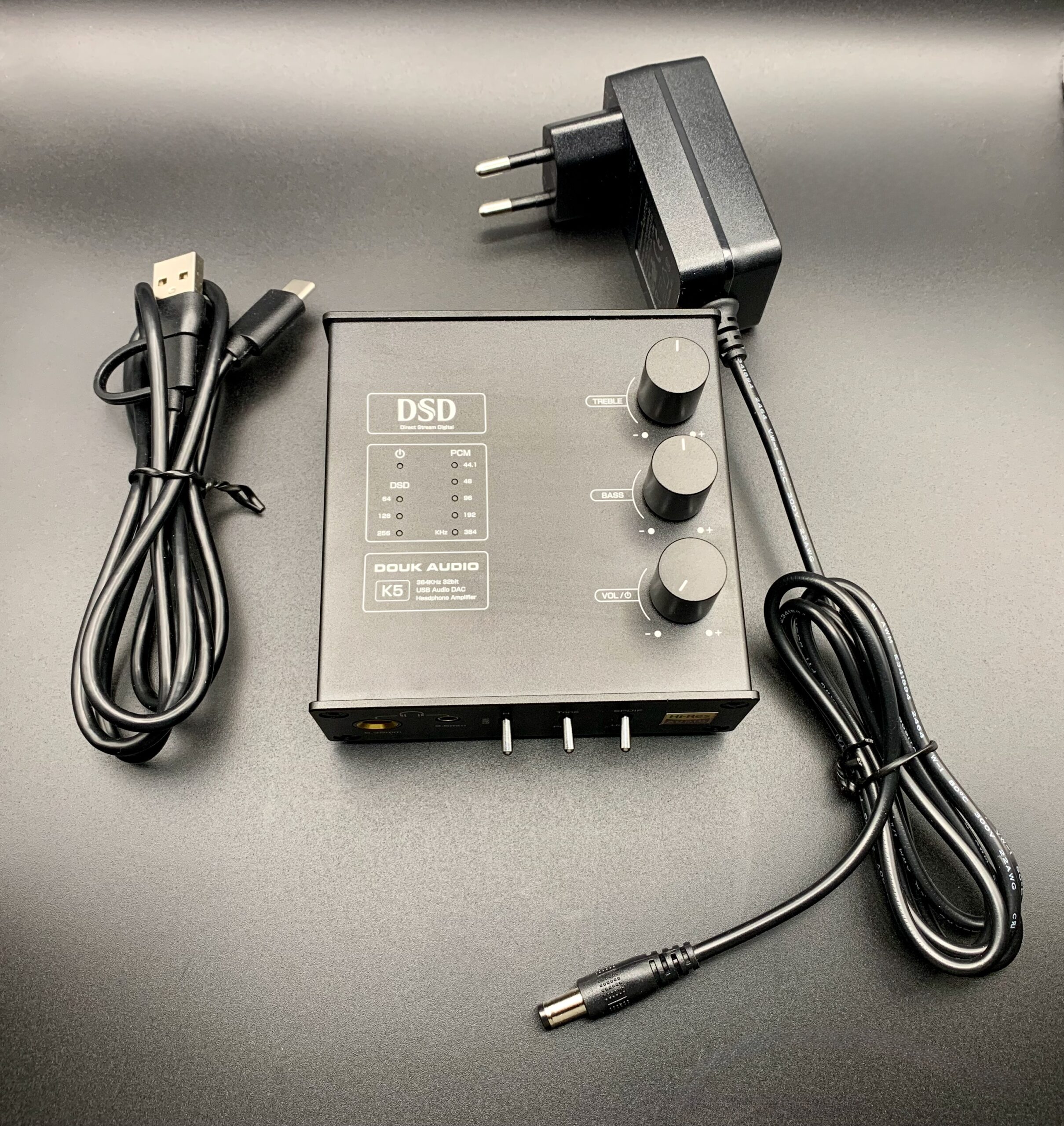
The first contact with the K5 gives a very clear impression: compactness. It does not try to do everything perfectly, but it does everything well enough. that It does not try to do everything perfectly, but it does everything well. that take very little space on the desk and blend in without creating clutter. For anyone looking for a clean and organized desktop setup, this is already a strong point.
The chassis is made of aluminum and gives a good sense of rigidity. It is not a heavy, high end piece of gear, but it does not feel fragile or cheap. The shell is solid, surfaces are well finished, and the overall construction shows a decent level of care.
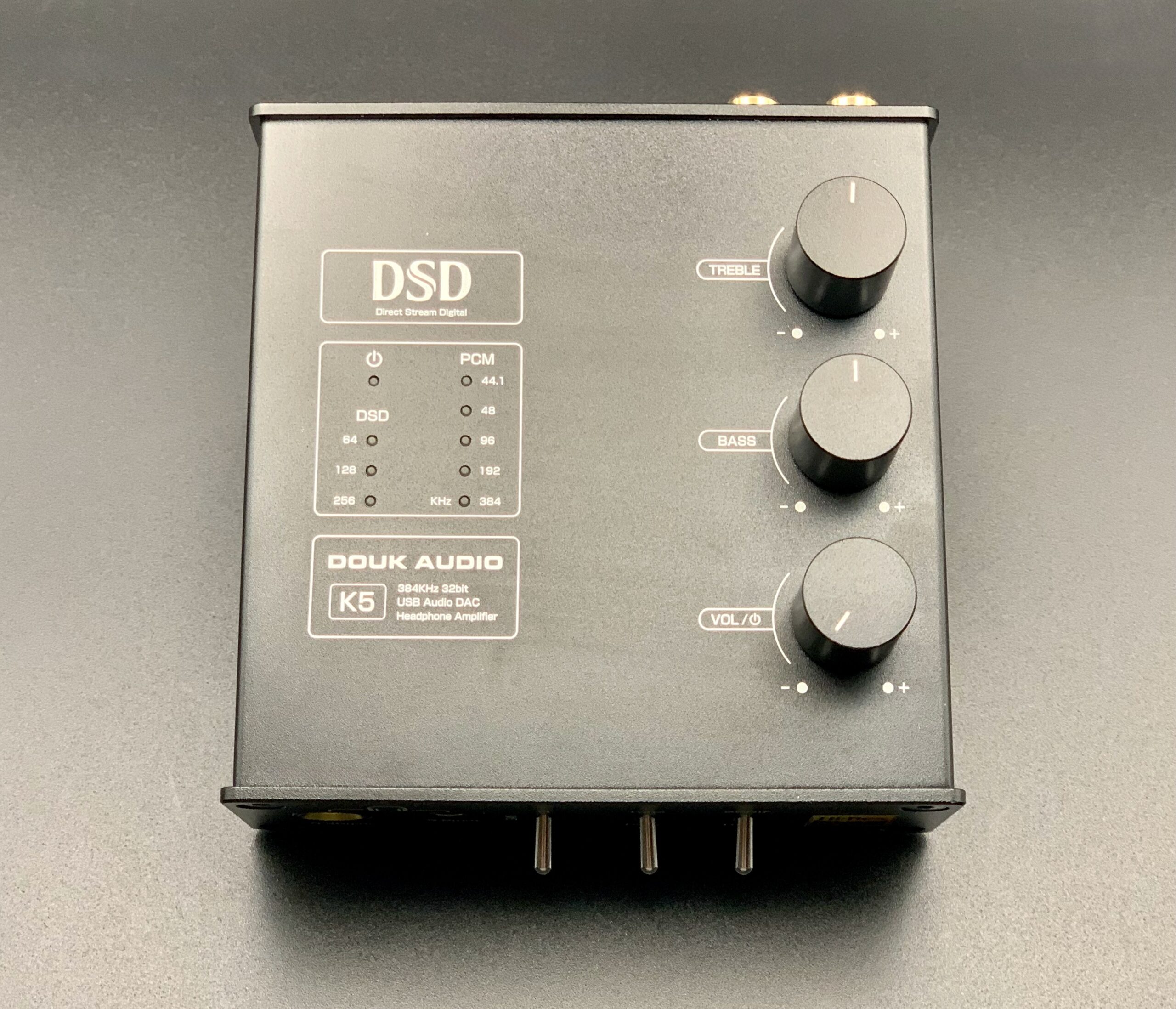
The design follows a very simple philosophy. Clean lines, no unnecessary elements, and a focus more on functionality than aesthetics. Controls are few and logically arranged. The LED indicators, showing sample rate and power status, are essential and provide only the information that actually matters, without distractions.
Ergonomics and desktop use
This is where the K5 really starts to make sense. Once placed on a desk, the design shows exactly what it was built for. The control knobs are positioned on the top panel, together with the LED indicators, making interaction much more natural when the unit sits near a keyboard or between speakers.
The compact size, around 10 × 10 cm, makes placement very easy. It can sit next to a computer, close to the keyboard, or between monitor and active speakers without creating visual clutter. It does not take over the desk and stays always within reach, which in daily use makes a real difference.
Having all controls on the top makes everything immediate. Volume can be adjusted quickly, all functions are visible, and there is no need to search for hidden or awkward buttons. The device gives a clear sense of operational simplicity.
It is the kind of product that takes a few minutes to set up and then just works. In a desktop system, this kind of immediacy becomes a real advantage, allowing focus on listening rather than on managing the hardware.
Packaging and accessories
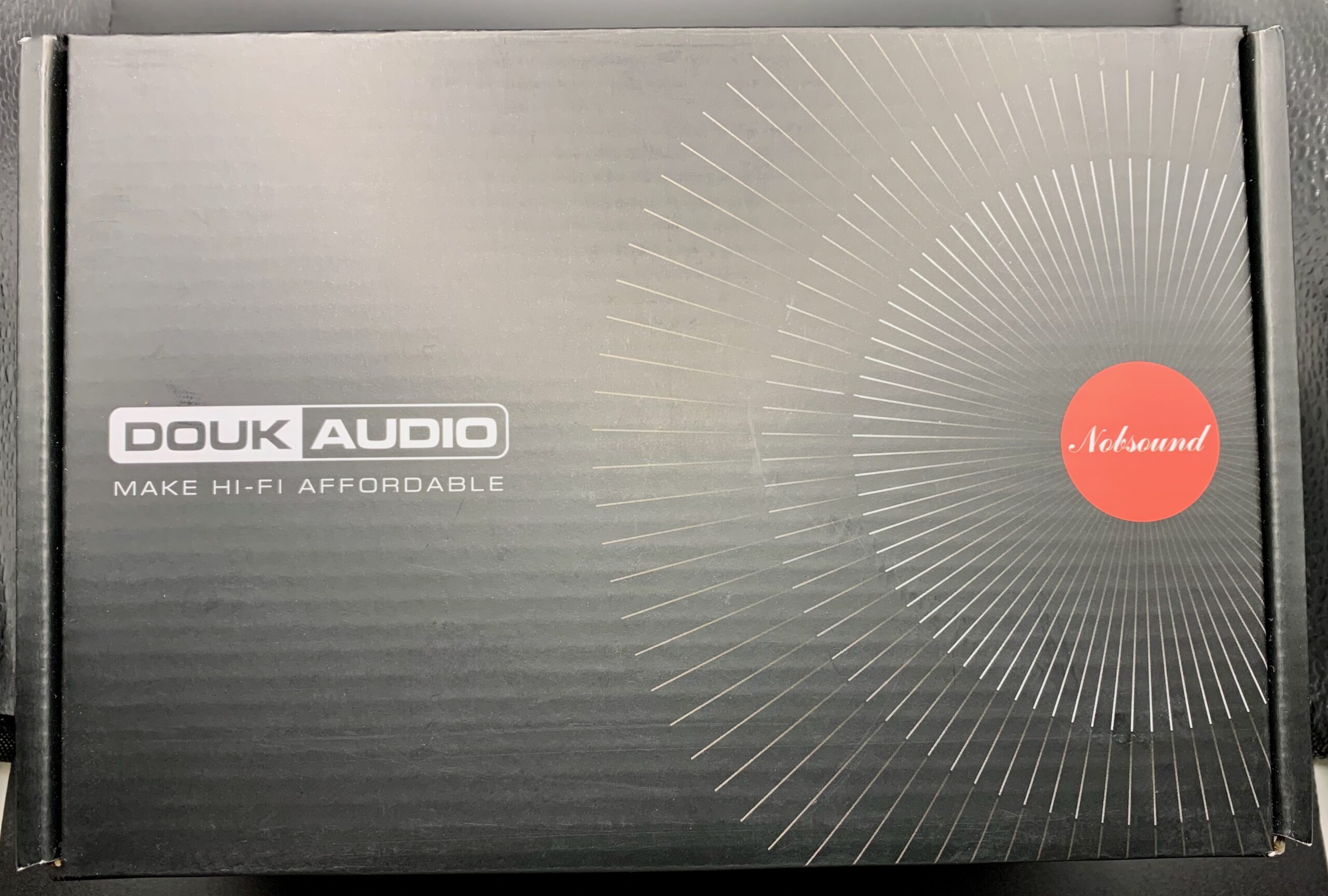
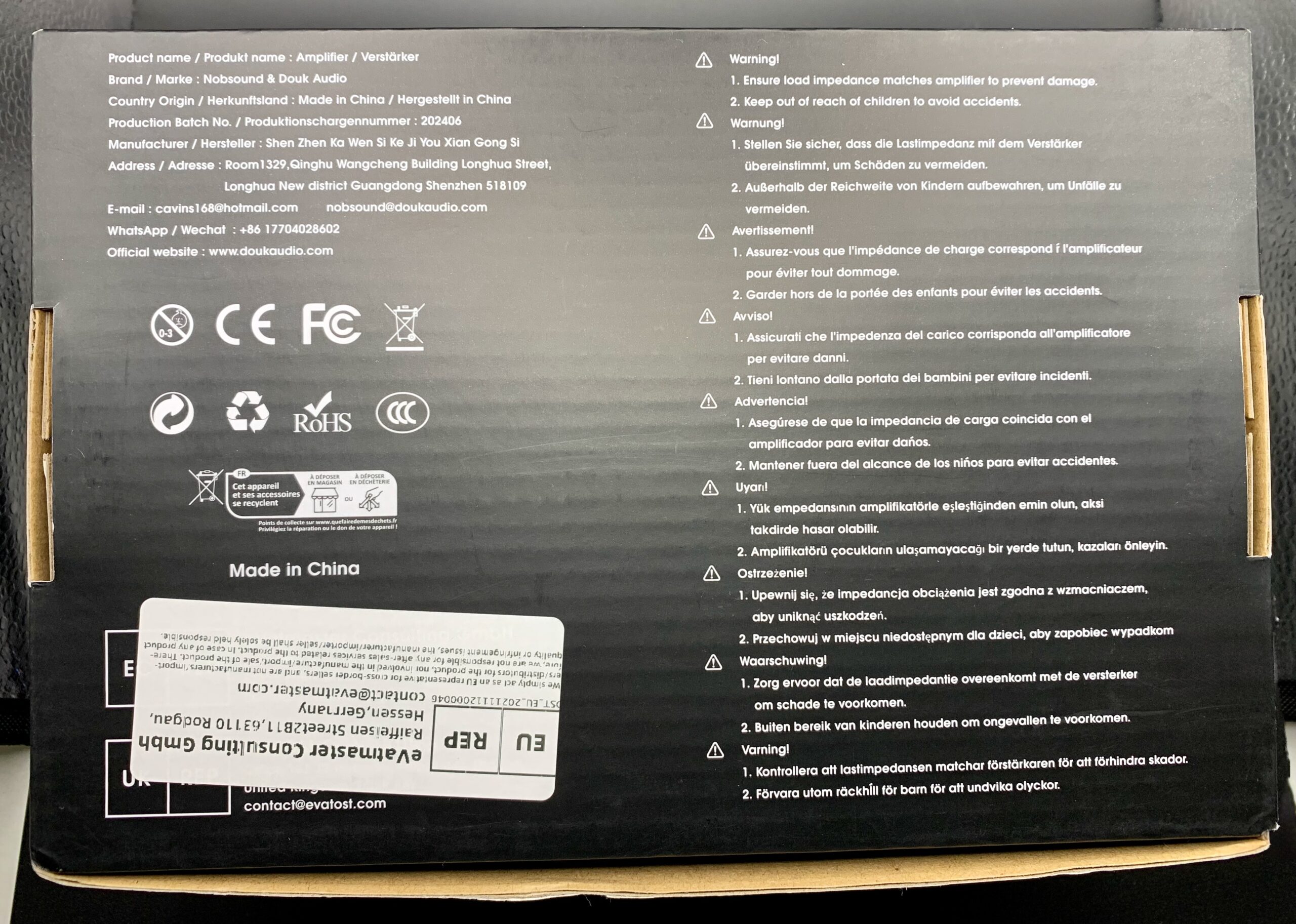
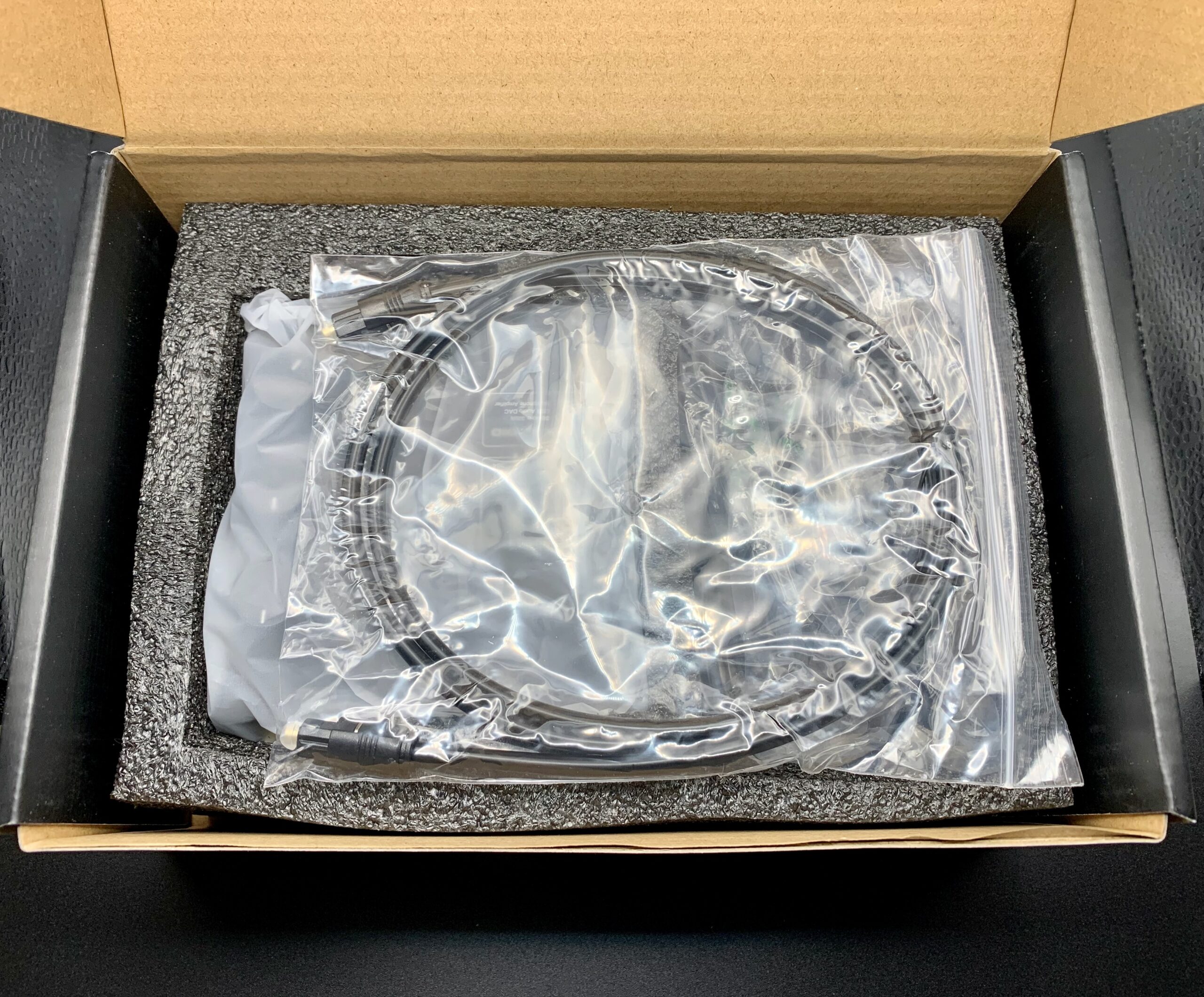
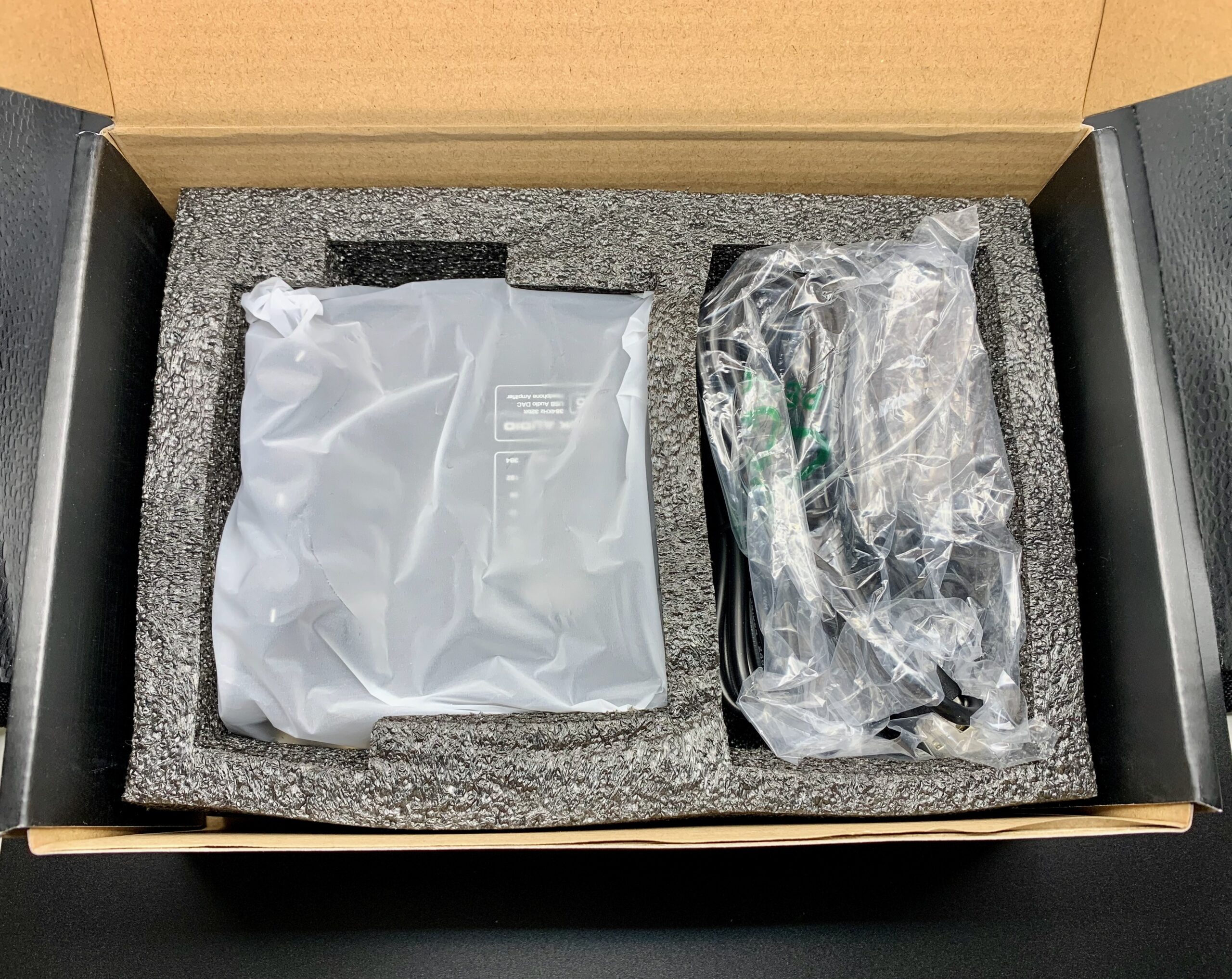
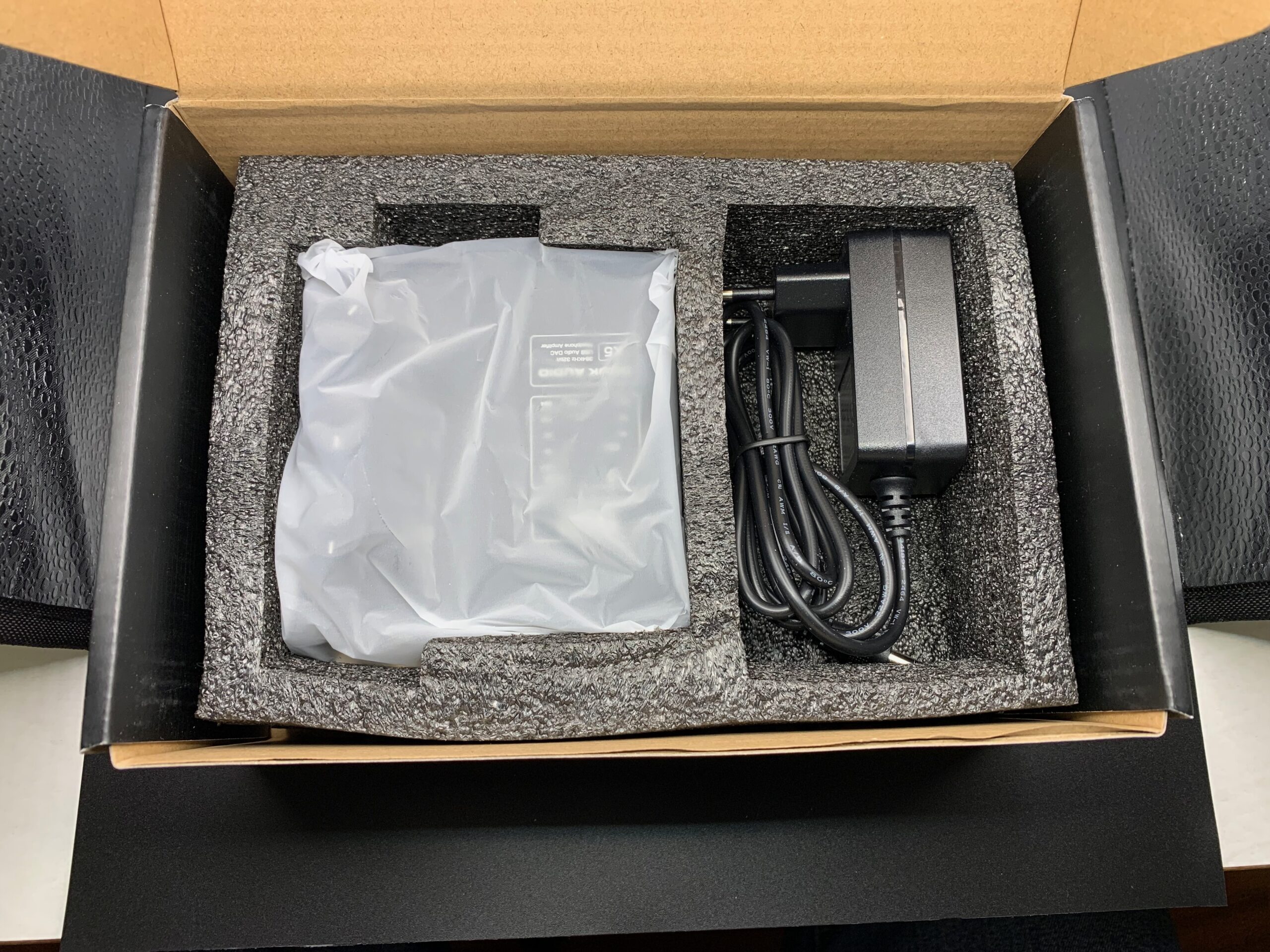
The packaging follows the same philosophy as the device: simple, essential, and without unnecessary elements. This is not the kind of box designed to impress or create a premium unboxing experience, but rather something functional that goes straight to the point.
Inside, everything needed to get started is included, with no need to look for extra cables or power supplies.
The package includes:
• Douk Audio K5 DAC and amplifier
• 5V power supply
• USB cable
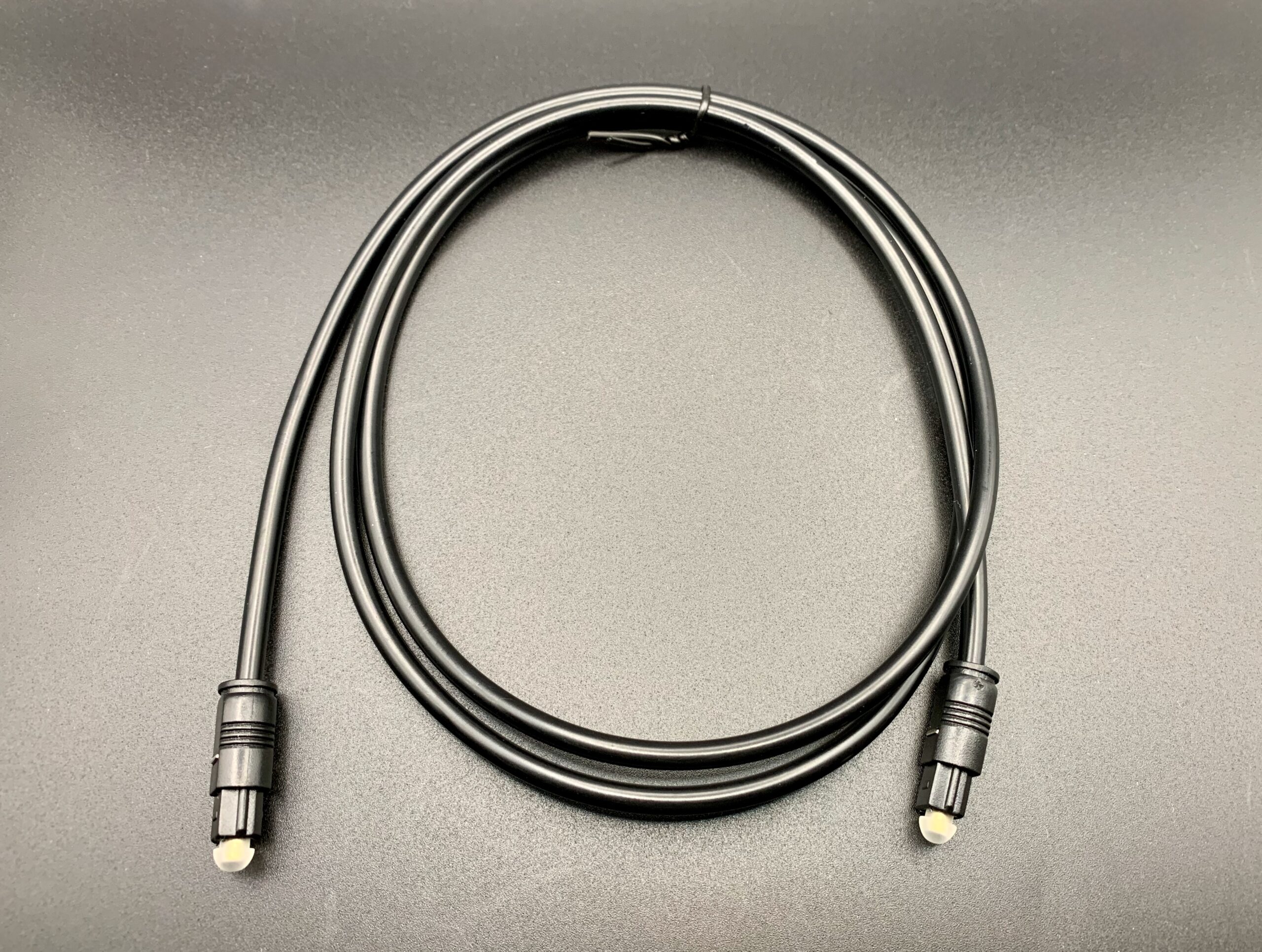
• optical cable
• user manual
The approach is very practical. The dedicated power supply ensures stable operation, while the USB cable allows immediate connection to a computer or compatible digital source. The cable also includes a built in USB A adapter, so both USB C and USB A can be used without additional accessories.
The presence of the optical cable is a nice addition. It allows immediate use with TVs, consoles, or digital sources without needing to purchase anything extra, which fits well with the all in one philosophy of the device.
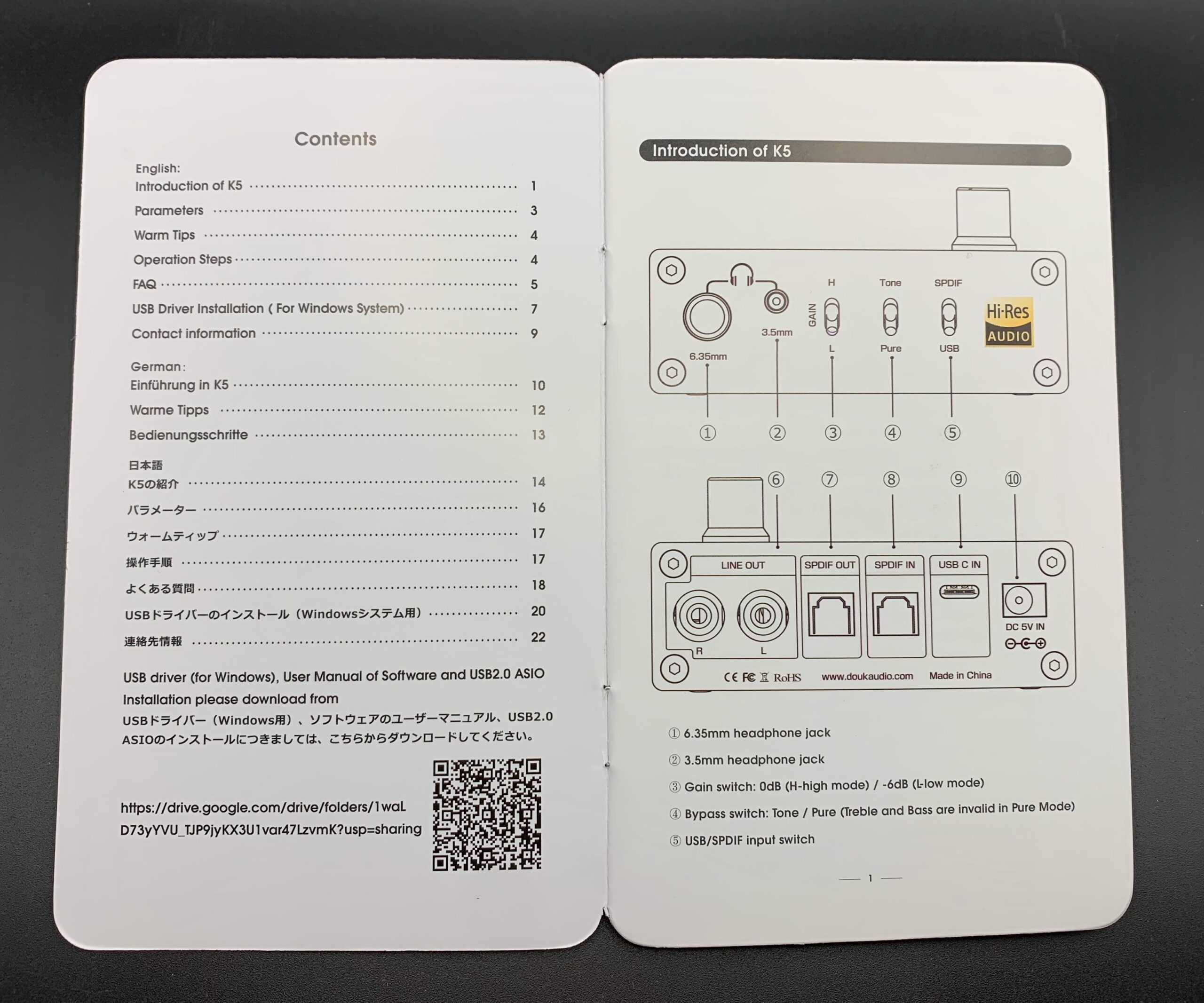
The manual is simple but sufficient to understand the main functions and connections. The K5 itself is not a complex device, and its use feels quite intuitive from the very beginning.
Those used to higher end gear might expect more accessories, but the minimal approach is fully consistent with the product’s philosophy. The focus here is not on the unboxing experience, but on getting everything up and running in a few minutes.
Open the box, connect the USB cable or the optical input, power the unit, and it is ready to start listening. In a desktop setup, this kind of immediacy often matters more than a more elaborate presentation.
Technical specifications
Before getting into the numbers, a quick note is needed. Specifications matter, but they do not tell the whole story. In audio it is easy to focus on figures or on the DAC chip itself, but the reality is more complex.
The DAC chip alone does not define how a device sounds. What matters much more is how it is implemented, the power supply, the analog stage, clock management, component choices, and the overall design. Two devices using the same chip can sound very different.
The same applies to values like THD, SNR, or supported resolution. They help to understand the potential of the project, but they do not replace real listening. The real test always comes from actual use, with music, headphones, and a real system.
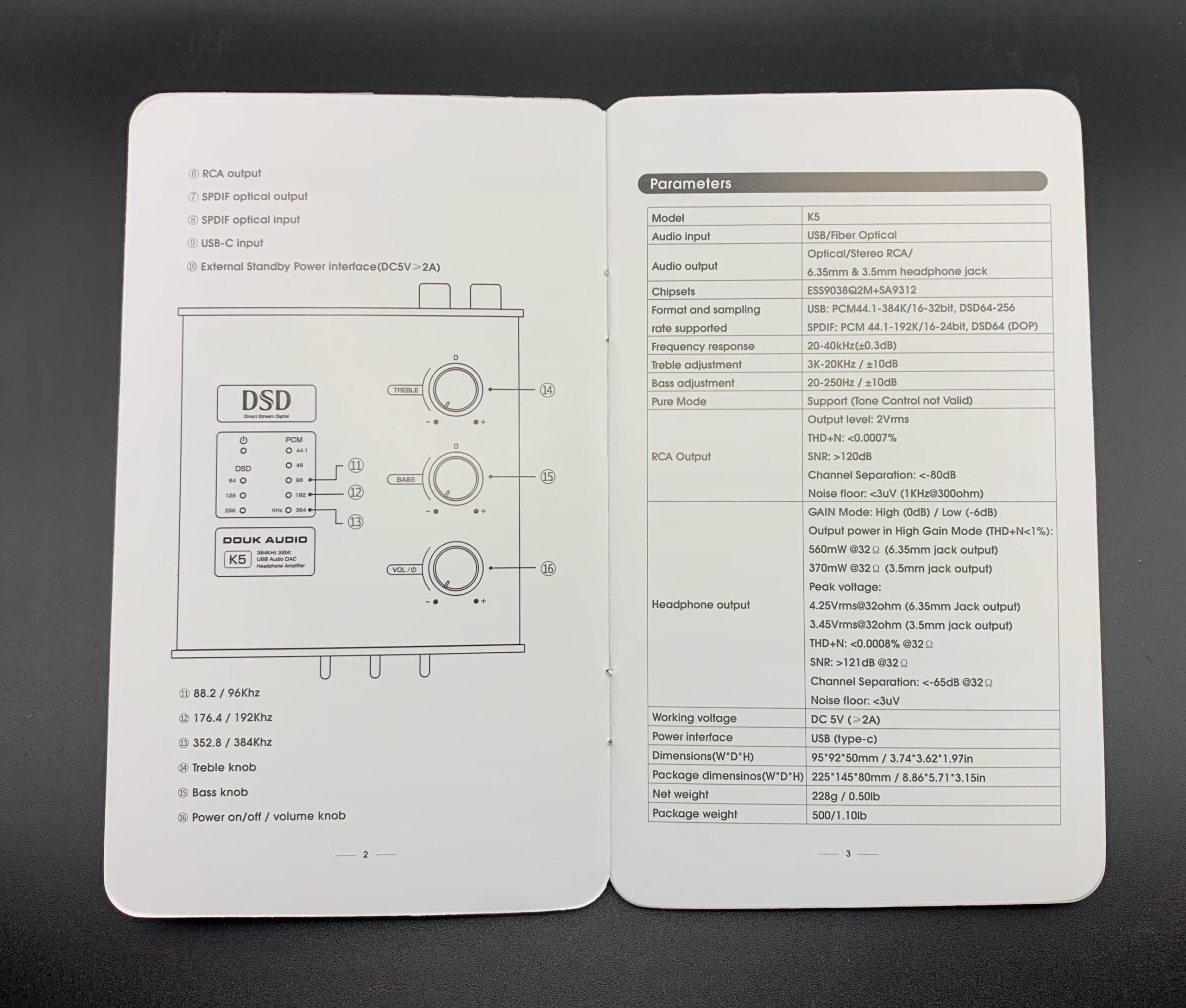
With that in mind, the K5 specifications are still quite interesting and give a clear idea of the technical structure behind the device.
| Feature | Specification |
| DAC Chip | ESS9038Q2M |
| DSP | SA9312 |
| Headphone amplification | SGM8262 |
| Analog filter | OPA1678 |
| USB resolution | PCM 32bit / 384 kHz |
| DSD support | up to DSD256 |
| Inputs | USB, optical SPDIF |
| Outputs | RCA, optical SPDIF, 6.35 mm, 3.5 mm |
| Headphone power | 560 mW @ 32Ω |
| Supported impedance | 16 to 600Ω |
| SNR | >121 dB |
| THD | <0.0007% |
| Frequency response | 10 Hz to 40 kHz |
| Power supply | 5V / 2A |
| Dimensions | 9.5 × 9.2 × 5 cm |
| Weight | approx. 228 g |
Design, ideas and choices
Looking at the K5 for a moment, the idea behind the project becomes clear quite quickly. It is not simply about putting a DAC and a headphone amplifier into a small box, but about creating a compact desktop hub able to handle multiple functions without complicating the setup.
The project revolves around three main concepts: integration, versatility, and direct control over the sound.
The first one is integration. The K5 is not designed as a simple USB DAC, nor as a dedicated headphone amplifier. The goal is to bring multiple functions into a single compact device. Alongside digital to analog conversion and headphone amplification, it can also work as a preamp to drive active speakers, or as a small digital interface within a larger audio chain.
In a desktop context, this approach makes a lot of sense. It reduces the number of components on the desk and simplifies the system in a very practical way.
Versatility and sound control
The second key idea is versatility. The presence of both USB and optical input significantly expands the range of possible use cases. The K5 works easily with a computer, but it can also be connected to a gaming console, a streamer, a TV, or other digital sources.
This makes it a very flexible device for a desktop setup or even for a small home system. There is no need to switch equipment every time the source changes.
The third design choice is the ability to adjust the sound directly. On the top panel, dedicated controls for bass and treble are available. This is not a complex equalizer, but a simple and immediate way to shape the response.
It becomes particularly useful when switching between different headphones or music genres. Instead of opening software or using digital EQ, a quick adjustment on the knobs is enough to find the desired balance.
Connections and controls
One of the most interesting aspects of the K5 is how connections and controls are managed. Despite the very compact size, the device offers a surprisingly complete set of features, allowing it to be used in different scenarios without real limitations.
Controls and connections are distributed between the top panel and the front panel. This layout works well in a desktop setup, keeping everything visible and easy to reach during everyday use.
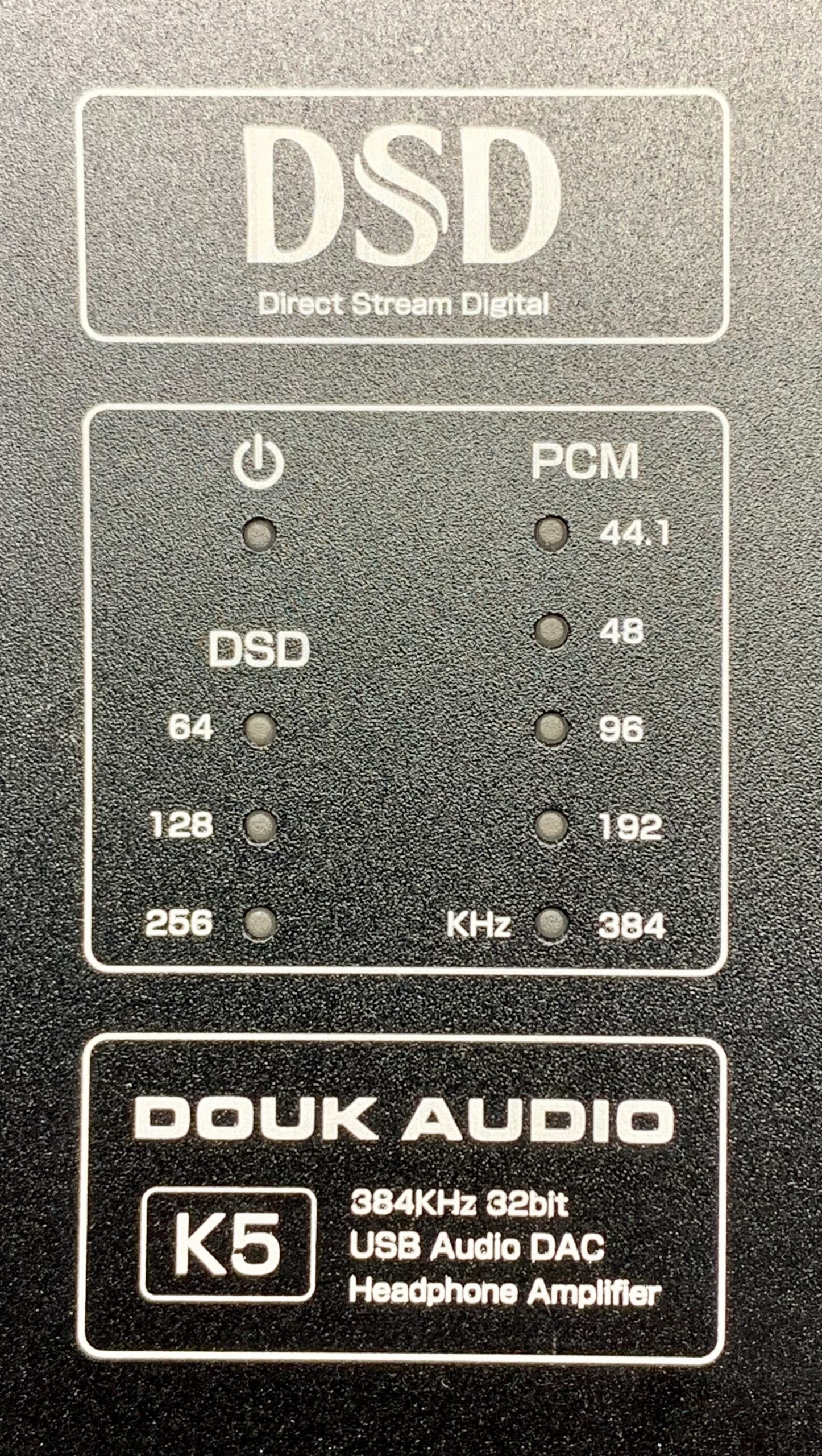
On the top panel:
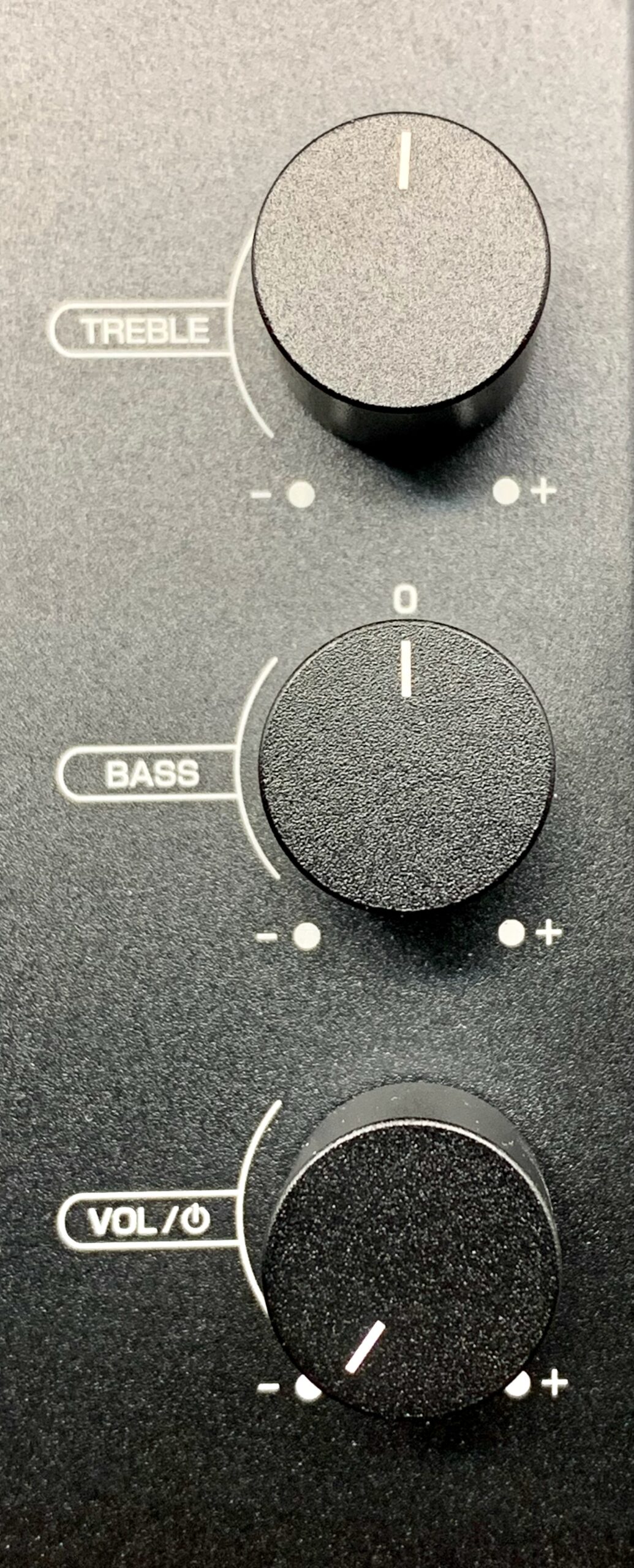
• volume knob with power function
• bass control
• treble control
• sample rate LED indicators
The top panel is clearly focused on quick sound adjustments. The volume knob also acts as the power control, keeping operation simple and immediate.
Bass and treble controls allow fast tuning of the sound without relying on software. The LED indicators provide essential information about the incoming signal, without adding unnecessary visual clutter.
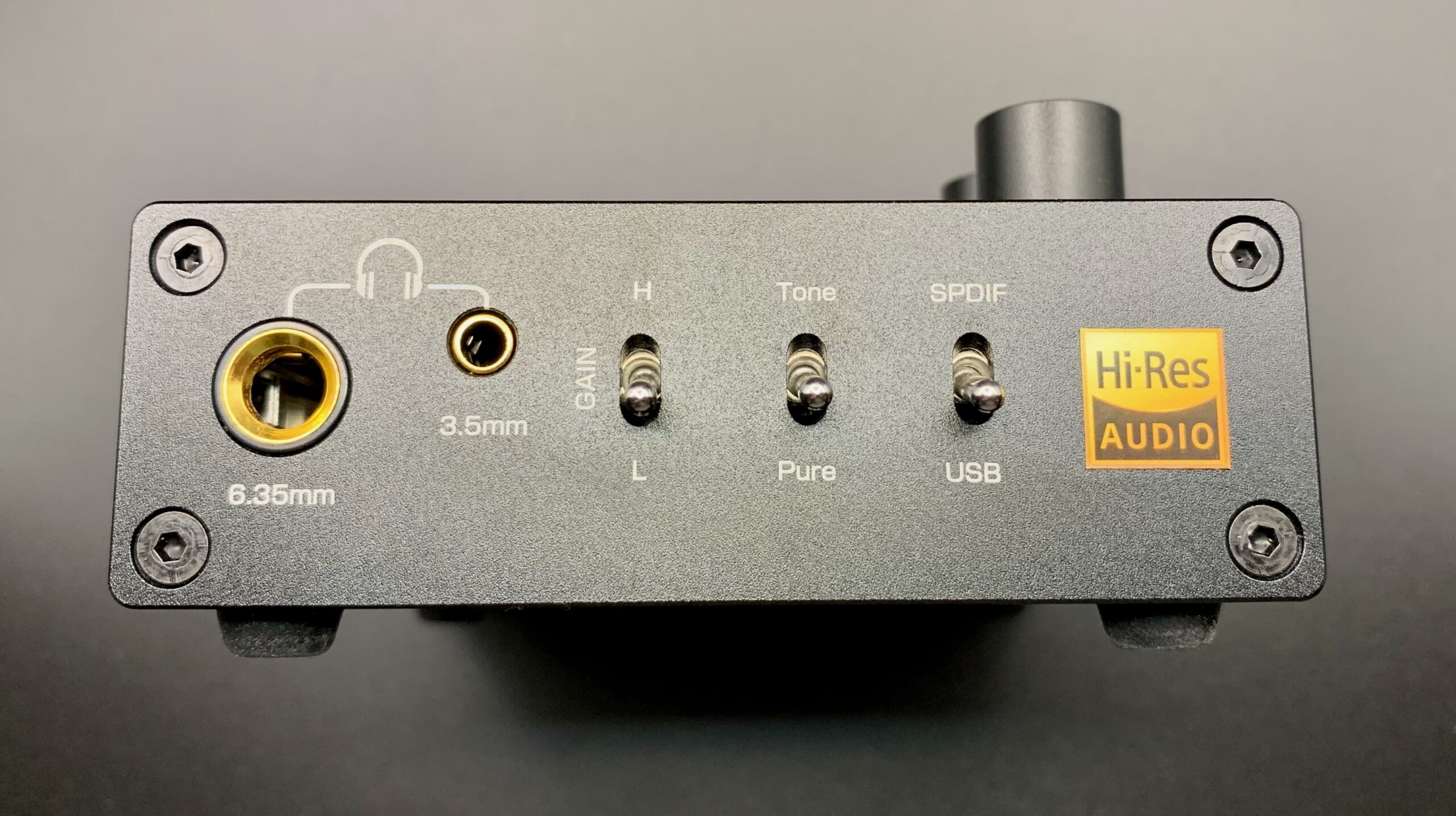
On the front panel:
• 6.35 mm headphone output
• 3.5 mm headphone output
• gain switch
• Pure mode switch
• USB / optical input selector
The front panel handles connectivity and signal management. The two headphone outputs allow direct use of both standard jack sizes without adapters, which is very convenient in daily use.
The gain switch helps match the output level to different headphones, while the Pure mode disables tone controls and keeps the signal path more direct.
The input selector allows switching between USB and optical sources, making it easy to manage different devices without reconnecting cables.
Rear connections
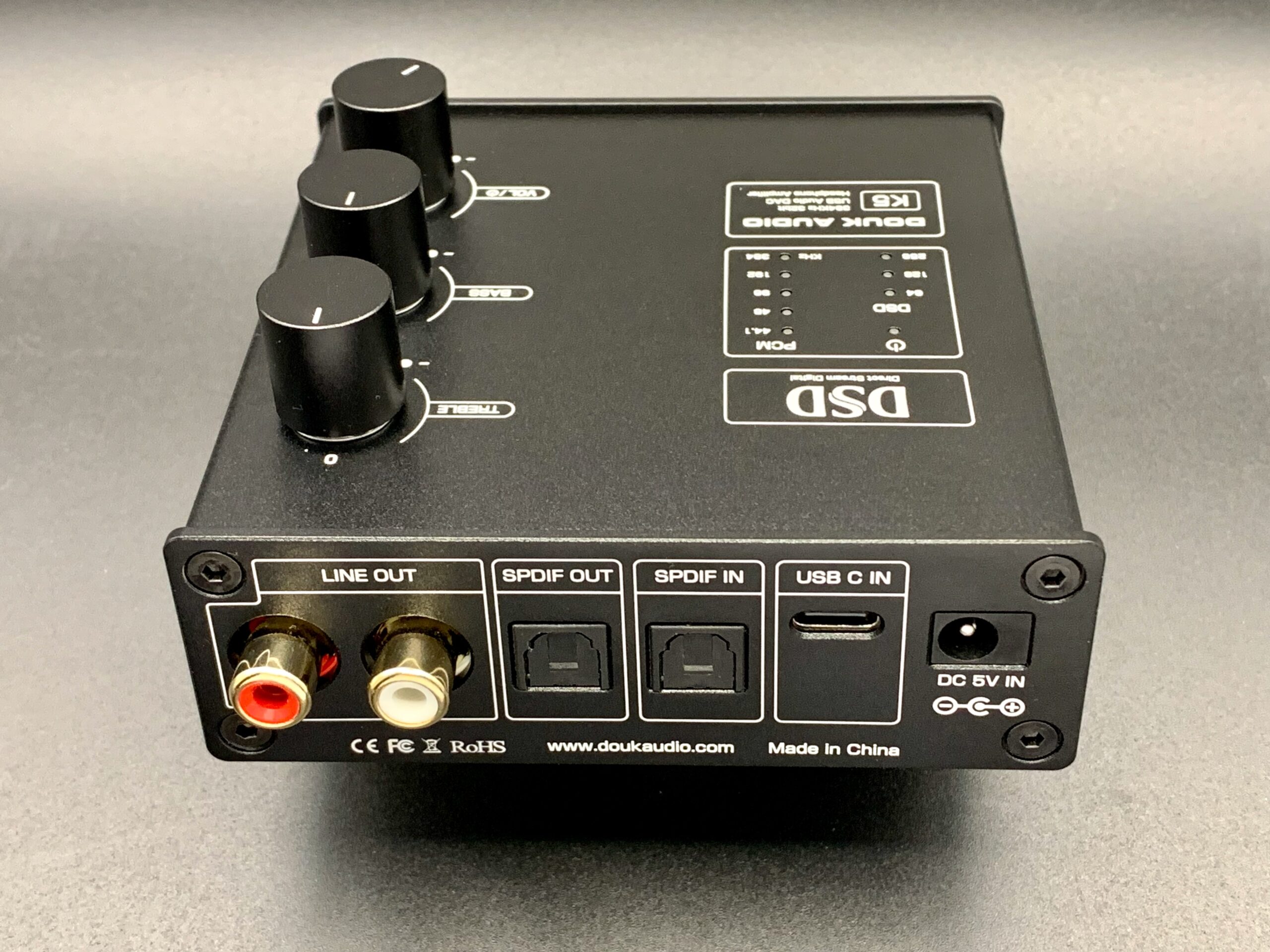
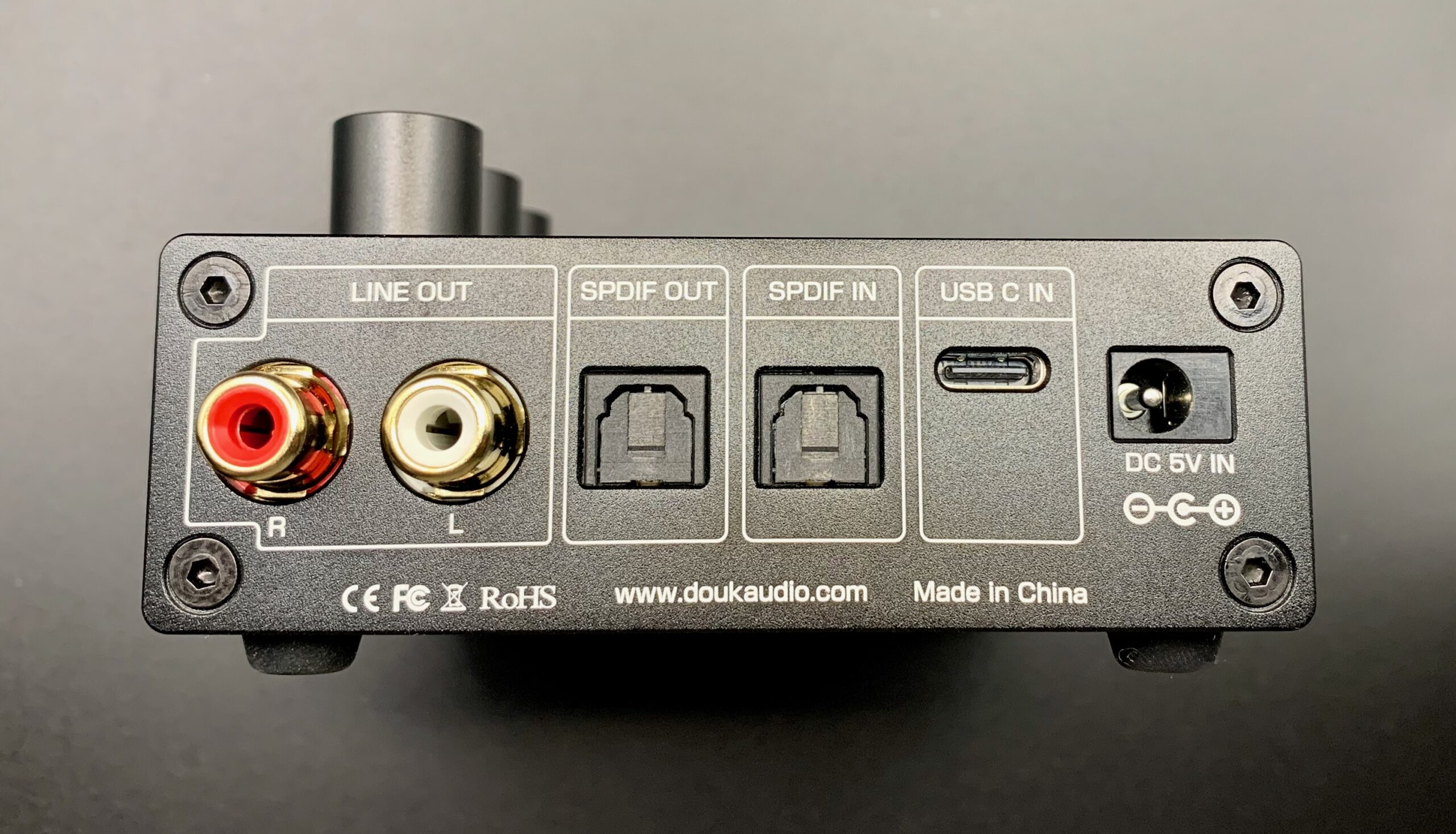
The rear panel hosts all input and output connections of the device.
Here we find:
• USB input
• optical SPDIF input
• RCA analog output
• optical digital output
• power input
The USB input allows the K5 to be used as the main DAC for a computer, while the optical input makes it easy to connect to a TV, console, or digital streamer.
The RCA output allows the device to work as a preamp, driving active speakers or an external amplifier. The optical output adds another option, allowing the K5 to be used as a digital interface within a more complex audio chain.
Considering its size, the connection layout is surprisingly complete and plays a big role in making the K5 much more versatile than expected at first glance.
Sound signature
When moving to real listening, the K5 shows its character quite clearly. It does not try to impress with an ultra analytical sound or an overly sharp presentation. The overall tuning focuses more on balance between clarity and musicality.
The result is fairly neutral, with a slight tendency toward a smoother and more relaxed presentation. Microdetail is not pushed forward, and the upper range is not used to create an artificial sense of definition. Instead, the presentation stays controlled and easy, allowing long listening sessions without fatigue.
This approach makes the K5 quite versatile. It does not favor any specific genre and handles very different recordings without issues.
Pure mode and tone controls
An interesting aspect of the K5 is how the signal can be managed through Pure mode and the tone controls.
When Pure mode is engaged, bass and treble controls are bypassed and the signal follows a more direct path. In this configuration, the K5 shows its most linear and natural behavior.
The tone controls offer a much more practical approach compared to software equalizers. They allow quick adjustments to the response, adapting the sound to different headphones or recordings without any extra steps.
This is not an extreme form of adjustment, but a gentle correction that helps shape the overall signature without altering its core character.
Bass
The low end is full and clearly present in the overall structure of the sound. The K5 does not aim for a dry or ultra tight bass, but leans toward a slightly rounded presentation that supports its musical character.
Extension is more than adequate for this category. Bass reaches down naturally and keeps a good sense of energy in rhythmic passages.
Control is not at the level of higher end DACs or amplifiers, but it remains well managed. There is no obvious loss of control and no real tendency to bleed into other frequencies.
The dedicated control allows a small boost when a fuller sound is needed, which can be useful with headphones that are lighter in the low end.
Midrange
The midrange is probably the most balanced part of the K5 presentation.
Vocals sit naturally in the mix, with a presence that does not feel pushed forward or recessed. Acoustic instruments also maintain a good tonal consistency, without noticeable coloration.
There is no artificial push to enhance detail. The presentation stays smooth and fluid, which makes listening easy and natural.
This works particularly well with genres like jazz, classic rock, and acoustic music, where tonal balance and vocal realism play an important role.
Treble
The upper range follows the same overall philosophy. It is clean but not aggressive, with a presentation that favors smoothness over sharp brilliance.
The K5 does not emphasize the top end to create a false sense of detail. Instead, the sound remains controlled and slightly softened, especially with more aggressive recordings.
This approach helps reduce listening fatigue during longer sessions. Even less refined recordings remain enjoyable.
When more openness is needed, the treble control can be used to add a bit of air without altering the overall balance too much.
Soundstage and imaging
The soundstage is consistent with the category of the device.
It is not particularly wide, but it maintains a good organization of elements within the space. Instruments are placed clearly and do not overlap in a confusing way.
Imaging remains stable, allowing a clear perception of where sounds are positioned within the mix.
Depth is more limited compared to higher end gear. The K5 leans toward a more intimate and direct presentation, which works well in a desktop listening context.
Power
One of the most interesting aspects of the K5 is its driving capability.
Despite the compact size, it has enough power to handle most dynamic headphones without difficulty. Even with models that require a bit more energy, a convincing sense of dynamics is maintained.
With low impedance headphones, control remains solid and volume can be reached easily, without effort.
With more demanding headphones, it does not reach the authority of higher end dedicated amplifiers, but stability is still good and the overall performance remains convincing for the kind of desktop use it is designed for.
Comparison with SMSL SU-1
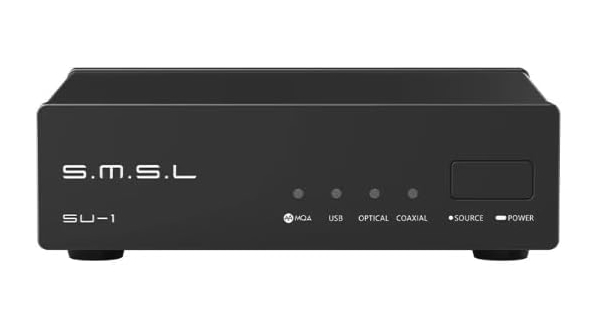
The comparison with the SMSL SU-1 is interesting because the two devices come from very different design philosophies, even if they often end up in similar desktop setups.
The SU-1 is a pure DAC. There is no headphone amplification, no tone controls, and no attempt to do anything else. Its role is simple, to convert the digital signal in the cleanest and most transparent way possible.
The K5 follows a completely different approach. It is not meant to be a pure converter, but a small control center for a desktop system. DAC, headphone amplifier, pre out for active speakers, and tone controls are all integrated into a single unit.
When listening, the difference becomes quite clear. The SU-1 delivers a more neutral and transparent sound, with a presentation that aims to stay out of the way and let detail come through.
The K5 leans toward a slightly softer and more musical presentation. The sound feels a bit rounder, less analytical, and more focused on ease of listening.
The midrange on the SU-1 comes across as a bit more defined, while the K5 feels slightly fuller and more relaxed. The same applies to the top end, the SU-1 sounds more open and precise, while the K5 smooths out harsher recordings.
In daily use, practicality becomes a key factor. The SU-1 always requires an external amplifier or preamp, while the K5 keeps everything in one place.
If the goal is maximum neutrality from an affordable DAC, the SU-1 is a strong option. If a more complete and immediate desktop solution is needed, the K5 becomes far more versatile.
Comparison with FiiO K5 Pro
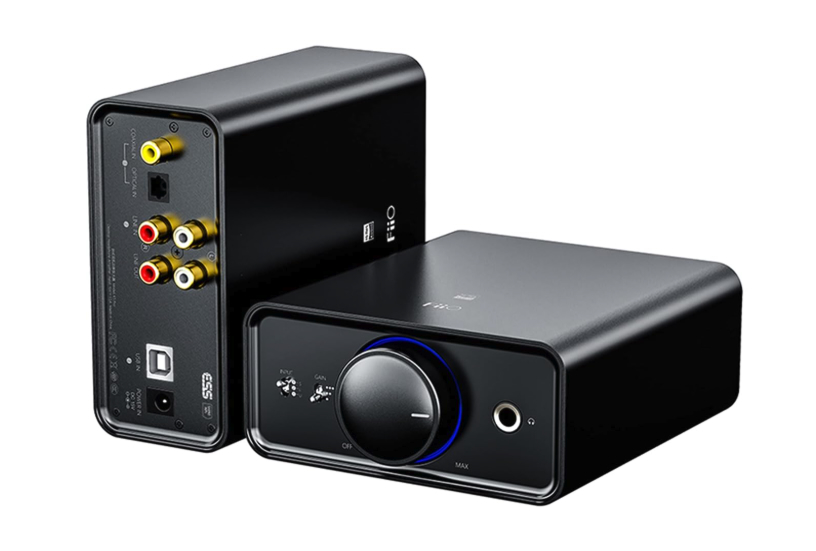
The comparison with the FiiO K5 Pro is almost inevitable, especially due to the similar name and the fact that both sit in the DAC amplifier category for desktop use. In reality, the design approach is quite different.
The FiiO K5 Pro takes a more traditional approach, built as a DAC and headphone amplifier with a structure closer to classic hi-fi design. It comes in a larger chassis, backed by a more substantial power supply, and clearly focuses on delivering higher output power. This also reflects in the price, which is usually around two to two and a half times higher than the Douk K5.
The Douk K5 follows a more compact and multifunction approach. The focus here is not pure power, but practicality. It takes very little space, combines multiple functions, and fits easily into a desktop setup without clutter.
When listening, the difference is clear. The FiiO K5 Pro delivers a more solid and authoritative presentation. The sound feels more robust, with stronger dynamics, especially with headphones that require more power.
The Douk K5 keeps a softer and more relaxed character. The presentation is slightly rounder and less focused on absolute precision. This does not make it less enjoyable, in many situations it actually makes listening easier.
Power handling reflects the same philosophy. The FiiO K5 Pro has more headroom and handles demanding headphones with greater ease. The Douk K5 remains suitable for most dynamic headphones used in desktop setups, but it is not designed as an all purpose amplifier.
In the end, the choice depends on usage. Those looking for more power and a more traditional approach will likely prefer the FiiO. Those who want a compact, versatile, and easy to integrate solution may find the Douk K5 more practical.
Final thoughts
The Douk Audio K5 is one of those devices with a very clear goal, and it tries to reach it without unnecessary complications. It is not meant to enter the world of studio DACs or compete with high end dedicated amplifiers. Its role is different, and when seen from that perspective, the project makes much more sense.
The K5 addresses a very common issue in desktop setups, too many boxes, too many cables, and not enough space. Instead of building a chain with separate DAC, headphone amplifier, and preamp, everything is brought together into a single compact unit.
This approach has an obvious advantage. The system becomes easier to manage, setup takes only a few minutes, and the desk stays much cleaner.
It does not try to do everything perfectly, but it does everything well. And in the right context, that is exactly what is needed.
A small desktop audio hub
In the right context, the K5 works almost like a compact control center. It can handle the signal from a computer, drive headphones, control active speakers, and offer some basic sound adjustments through the tone controls.
It is not a device that aims for absolute perfection in every parameter. Instead, it focuses on a balanced mix of sound quality, available power, and everyday usability.
The result is something that integrates easily into a desktop setup and remains just as easy to use on a daily basis.
Who is it really for
The Douk K5 has a fairly clear target. It is designed for those who want to improve computer audio in a practical way, without moving into more complex hi-fi chains made of multiple components and cables.
It fits very well in a desktop system, especially when paired with active speakers. At the same time, it works just as well for those who use headphones frequently, switching between work and music during the day.
An interesting aspect is the presence of both optical input and output. This expands its use beyond a simple PC connection. It can be connected to a CD or DVD player, or another digital source, to use the internal DAC. At the same time, the optical output allows it to act as a digital interface toward an external DAC, if needed.
Its strength lies in balance. Compact size, good versatility, and enough power for most dynamic headphones make it a practical and immediate solution.
It is not meant for those chasing maximum performance or a highly analytical presentation. The goal here is different, to simplify the setup and make the experience more fluid.
If the idea is to keep everything under control in a small space, with a pleasant sound and no complications, the K5 delivers.
VOTE
7,8 / 10
🟢 PRO
- extremely compact
- DAC and amplifier in one unit
- good power for the price
- useful tone controls
- wide range of connections
- balanced and easy listening
🔴 CONS
- soundstage is not very wide
- simple build
- not particularly analytical
Q/A
When using a device like the K5, a few questions tend to come up quite often, especially for those planning to include it in a desktop setup. Here are the most common ones.
Can the K5 drive high impedance headphones?
It is rated for headphones up to 600Ω. In real use, most dynamic headphones are handled without issues. With low or medium impedance models, volume and control are more than sufficient. With high impedance headphones, listening levels remain adequate, but the authority is not the same as more powerful dedicated amplifiers.
Do you need drivers on Mac?
No. On macOS the K5 is recognized immediately as a USB audio device. Just connect it and select it as the output. No additional drivers or software are required.
Can it be used as a DAC for an external amplifier?
Yes. The rear RCA output allows the K5 to work as a DAC and preamp within a larger system. It can be connected to an integrated amplifier, a power amp, or directly to active speakers.
Can it work with a TV or console?
Yes. Thanks to the optical SPDIF input, it can receive digital signal from a TV, a gaming console, or a streamer. In this way it can be used as a DAC to improve audio from those sources.
Is it only for headphones or also for speakers?
It is designed for both. Headphones can be driven directly from the front outputs, while active speakers can be controlled through the rear RCA outputs. This makes it very practical in a desktop setup where both are used.
Acknowledgements and personal note
I would like to thank Douk Audio for providing the K5 for this review. No compensation was received, no approval was requested, and there were no constraints on the content. What you have read comes entirely from time spent using the device in my own system, with headphones and music I know well.
When writing a review, the approach is always the same. First listening, then understanding what is happening, and only at the end trying to describe it. Specifications and technical details help build the context, but the starting point is always the listening experience.
The K5 has been used in different situations, with various headphones and music I am familiar with. Jazz, rock, acoustic recordings, and more modern compressed productions. The goal is always to understand how a device behaves in real everyday use.
Every review remains a personal snapshot. Headphones, system chain, listening habits, and even music choices can influence the final impression. For this reason, it is always useful to compare different opinions and, when possible, listen with your own ears.
That is my part. I listened, took notes, and tried to put everything into words as honestly as possible.
For those interested, the Douk Audio K5 is available through the official Douk Audio store and other major online retailers, including AliExpress. As always, I recommend checking current pricing and availability, as they can vary depending on the region.
From here on, it is up to you. As always, in the end, the music decides.



No Comment! Be the first one.