






























Disclaimer:
I personally purchased the iFi Go Link Max and was not compensated for reviewing it. I will try to be as objective as possible, and as an audio enthusiast, I will use simple terms and concepts that everyone can understand. My review won’t be overly technical or full of measurements: it will be more emotional, based on my ears, not my instruments.
Table Of Content
- Disclaimer
- Preface
- Unboxing: iFi Go Link Max
- Box contents
- Features
- Aesthetic and tactile evaluation of the iFi Go Link Max
- Output Power
- iFi Go Link Max keys and buttons
- Supported Audio CODECs
- Power Consumption (battery draw)
- Timbre
- Bass
- Mid-range
- Highs
- Soundstage & Imaging
- In Summary
- Filters
- So? Do I like this iFi Go Link Max?
- Comparison Test
- Comparison with the Hidizs S9 Pro Plus
- Conclusion on Questyle iFi Go Link Max
- RATING
- ⭐ 8.5 / 10
- PROS
- CONS
- Who sells it
Preface:
For some time now, there’s been talk of turning any mobile device (or PC) into an audiophile source for headphone listening. As is well known, the quality of DACs and headphone outputs on a phone, PC, or tablet/notebook is certainly not top-notch, much less hi-fi quality.
The ideal would be to be able to process the digital signal on the phone or notebook/tablet beforehand, then convert and amplify it more effectively. This is possible in most modern devices that allow the OTG output to be activated from the USB port.
All modern smartphones, among other options, allow this. Basically, the digital stream is taken from the USB output and sent to an external DAC/headphone amplifier.
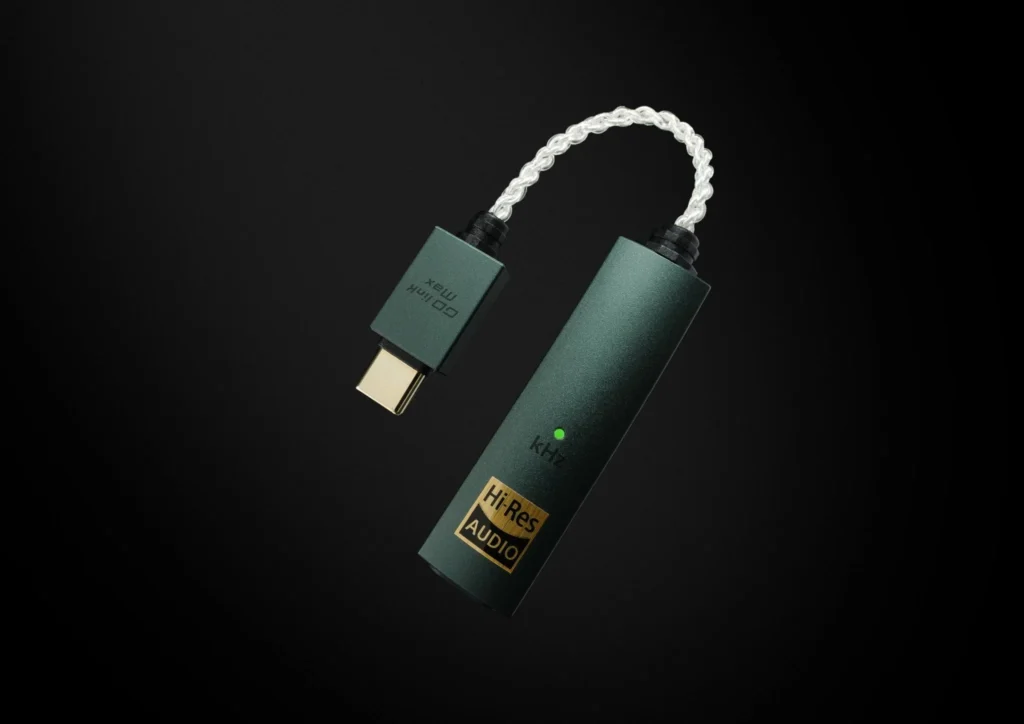
iFi GO Link Max: a brand that has always focused on headphone listening and portability (here’s the review of the iFi iDSD). This time, they’ve created a truly compact DAC/amplifier dongle. The first thing that comes to mind is: “Small… but how did they fit all these electronics in there?” And above all: is it really capable of delivering HiFi listening?


Unboxing: iFi Go Link Max
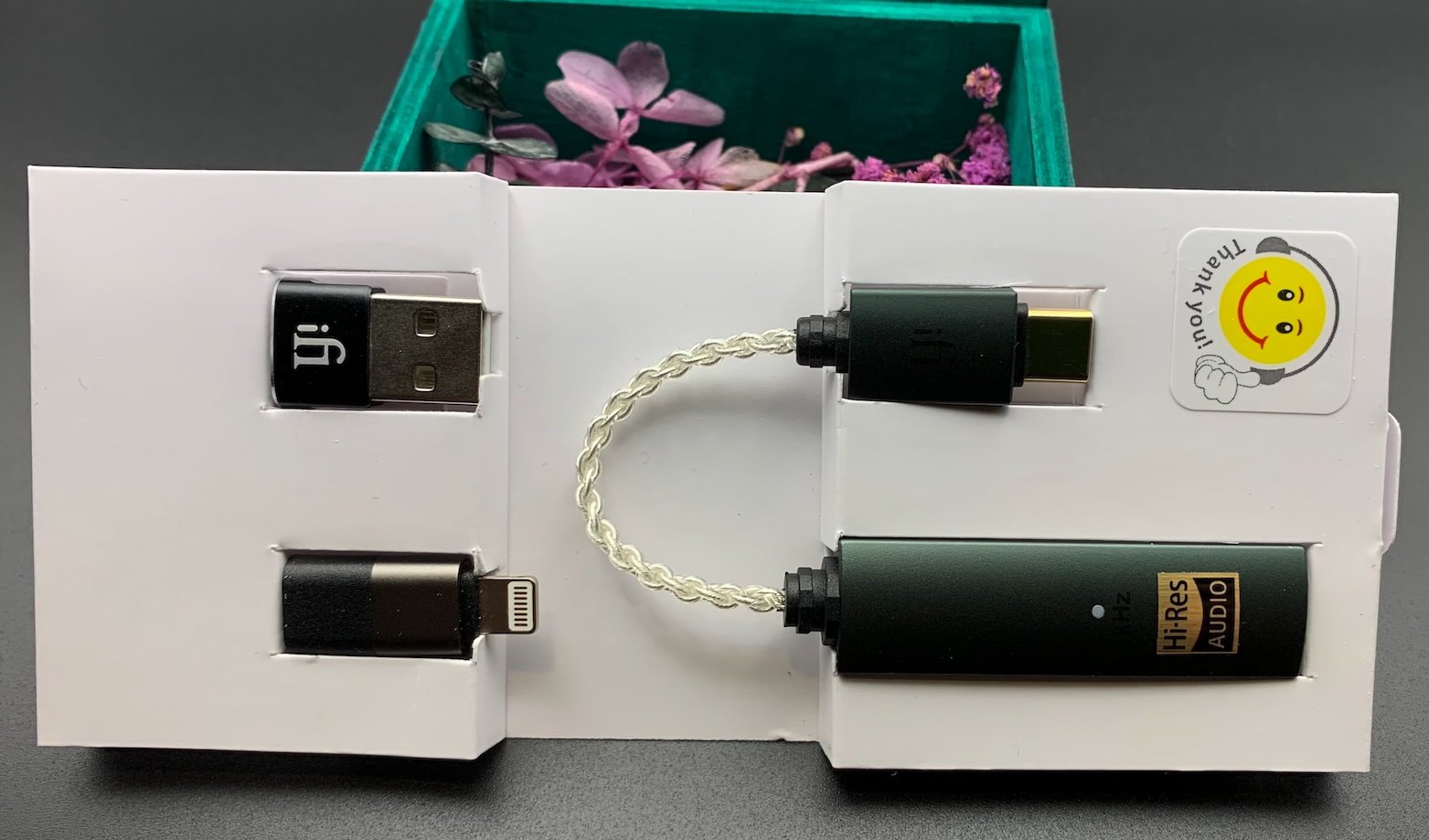
The packaging is compact, essential, and focused on functionality: a white box, clean graphics, and minimal materials.
Box contents:
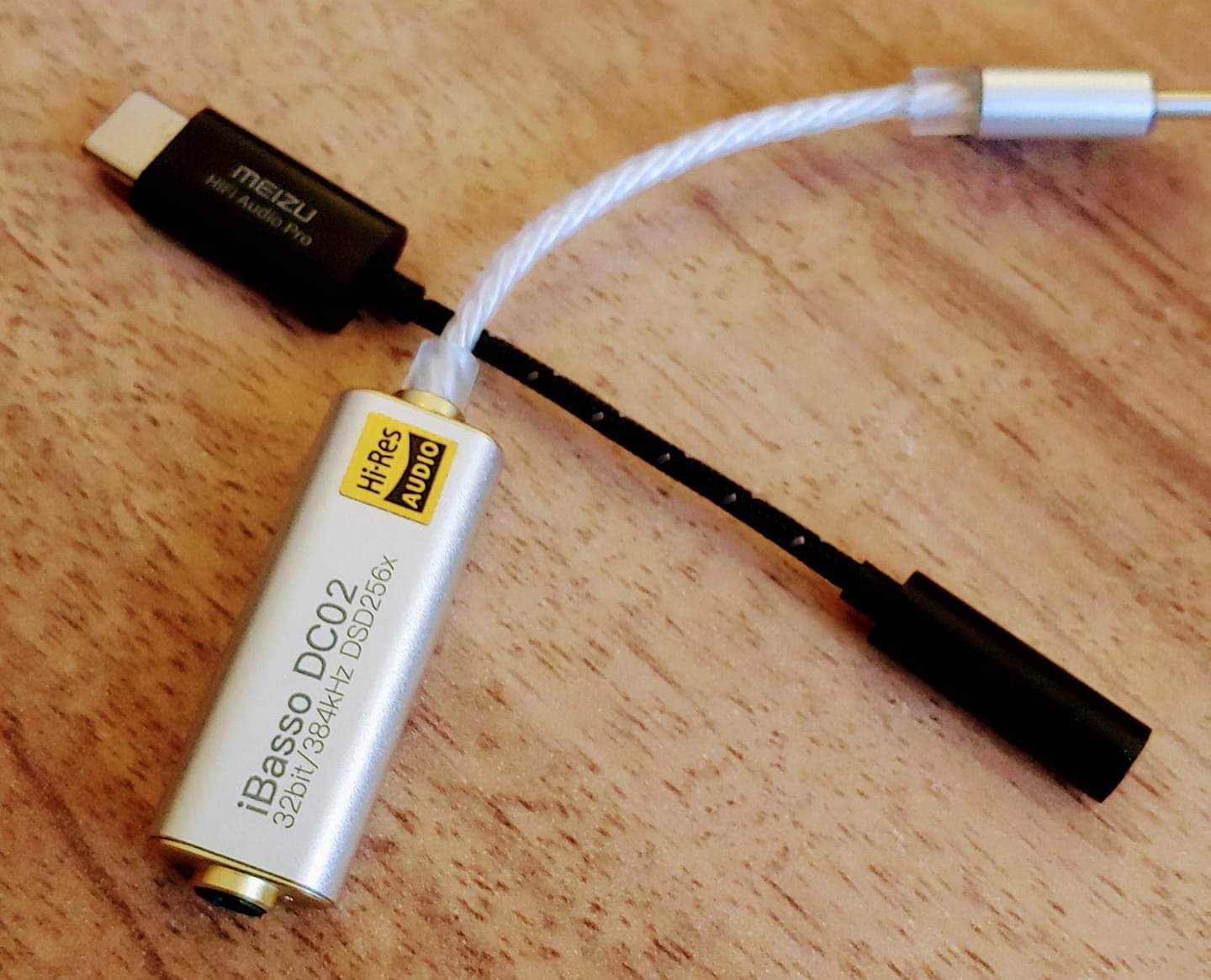
- iFi GO Link Max dongle (body + integrated USB-C cable)
- USB-C → USB-A adapter
- USB-C → Lightning adapter (not all do this for older Apple devices)
- Quick start guide + brand sticker
Missing features or notes: There are no additional cables (extension cable, dedicated case). The package is tailored to the portable/minimalist philosophy. Considering the price, the choice is consistent.
From an economic standpoint, the configuration is wired to the bare minimum, which helps keep the price down while maintaining quality.
Features:
Main manufacturer specifications:
- Type: USB-C DAC dongle + portable headphone amplifier.
- DAC: 2 x ESS Sabre ES9219 (one per channel) with DRE (Dynamic Range Enhancement) technology +6dB.
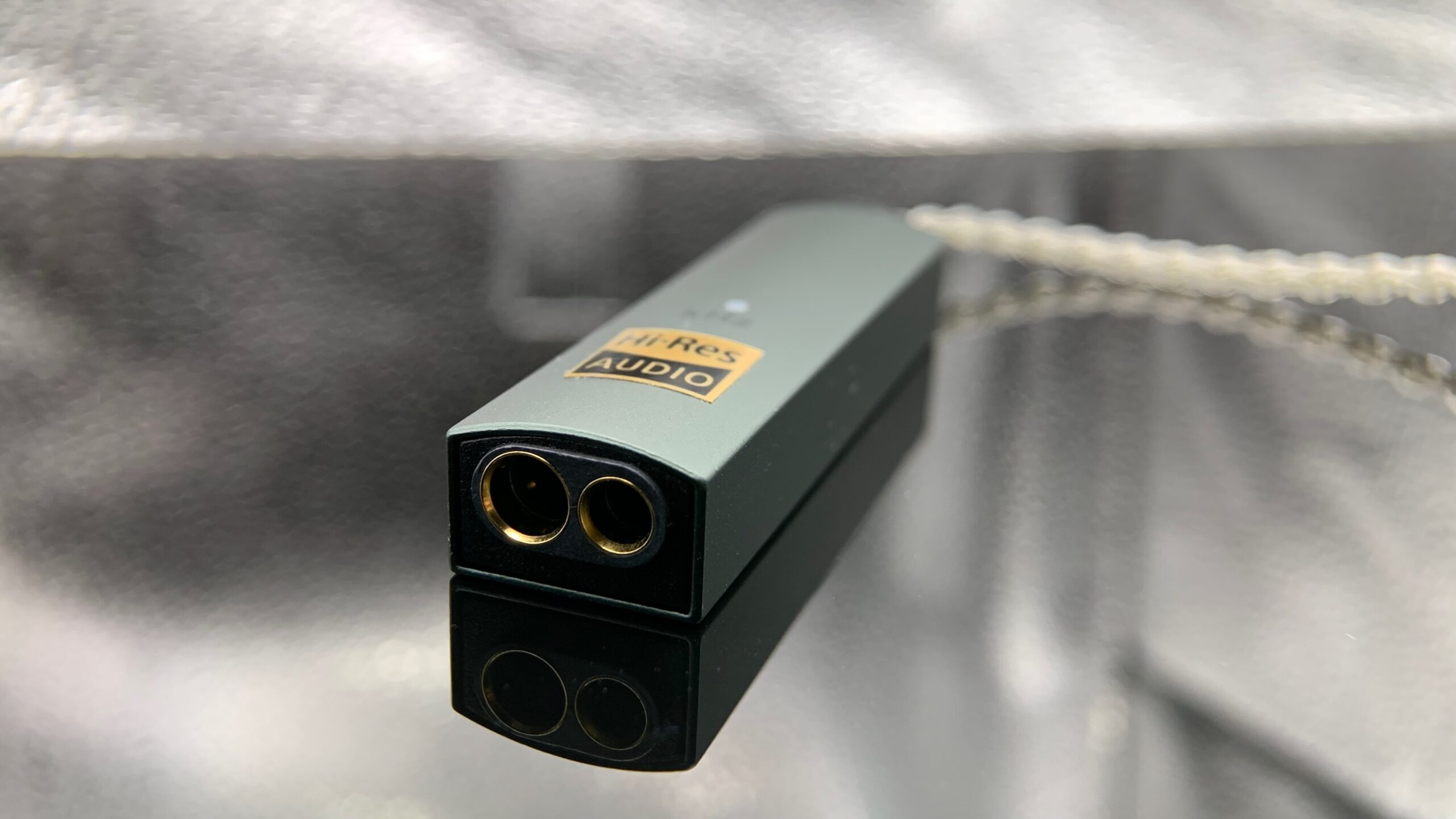
- Headphone outputs: 4.4 mm balanced (“S-Balanced”) + 3.5 mm single-ended.
- Rated power: ~241 mW @ 32 Ω (4.4 mm) / 100 mW @ 32 Ω (3.5 mm) approximately.
- Supported formats: PCM up to 32 bit / 384 kHz, DSD up to DSD256.
- Signal-to-noise ratio: ~130 dB on the balanced output.
- Output impedance: 0.35 Ω (4.4 mm) approximately.
- Good quality integrated cable, lightweight metal body (~14-15 g).
Aesthetic and tactile evaluation of the iFi Go Link Max:
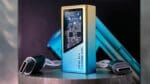
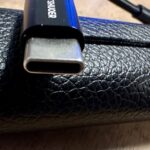
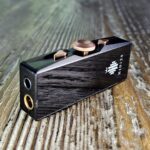
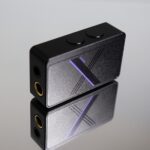
The iFi GO Link Max is extremely compact (approximately 150 x 15 x 10 mm) and very light (~14-15 g). The metal body feels high-quality, and the integrated cable terminates in USB-C with additional adapters included. Since it’s fixed, I don’t like it, there’s a risk that it will get damaged over time, but given its size, adding a USB-C port would be a miracle.
The finish is simple and elegant, with the “electronics” part feeling more like a guitar jack than a bulky accessory.
Feel: solid, with carefully selected materials, but being a portable device with an “integrated cable,” it requires a little care (it doesn’t behave like a sturdy detachable cable). When used in a pocket or with a phone, it doesn’t cause any noticeable discomfort. In fact, it’s so small it feels like carrying a piece of candy in your pocket.
Overall: the feel is “excellent.”
Output Power:
Based on the stated specifications, the 241 mW (balanced) output is more than adequate for sensitive or low-impedance headphones.
I tested the dongle with IEMs and over-ear headphones; dynamics were decidedly good with the standard phone or laptop output. For high-impedance or very difficult-to-drive headphones, it will still be an upgrade over the standard output, but I recommend using the balanced port.

Important: To get the most out of it, it’s recommended to use headphones that aren’t too demanding. The dongle isn’t a replacement for a studio amplifier, but it’s excellent for mobility or a laptop/PC setup.
iFi Go Link Max keys and buttons:
The iFi GO Link Max is minimalist: no dedicated potentiometer, no physical buttons other than the audio outputs. The volume is controlled by the source device (smartphone/laptop).
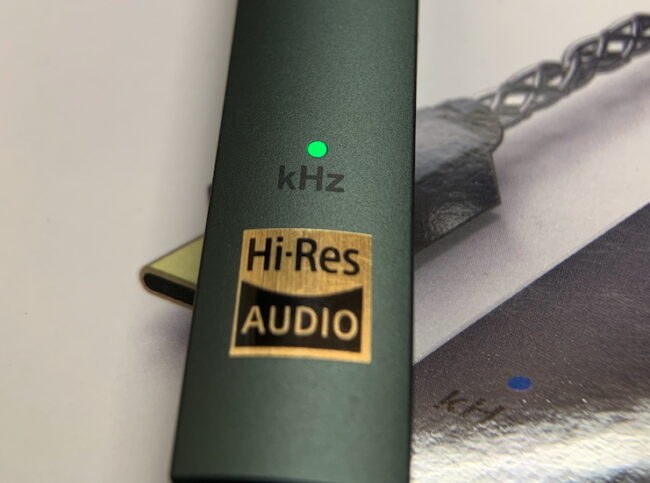
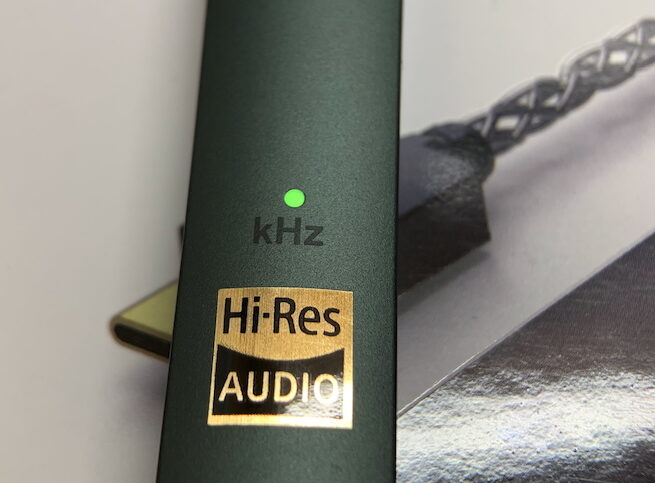
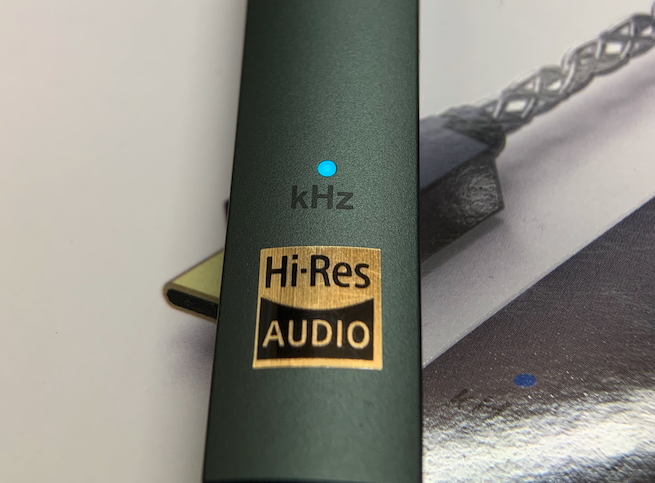
An LED indicates the digital format being played (PCM or DSD). The LED is so small that color variations are almost imperceptible.
This minimalist approach simplifies mobile use: “plug & play“. A small drawback may be the lack of different gain modes or selectable filters, but this is in line with the concept of a portable dongle.
Supported Audio CODECs:
The device natively supports:
- PCM up to 32-bit / 384 kHz
- DSD up to DSD256
- Includes “S-Balanced” technology (4.4 mm balanced)
Note: Does not include MQA support.
In practice, it fully covers the Hi-Res listening needs of a passionate, mobile user.
Power Consumption (battery draw):
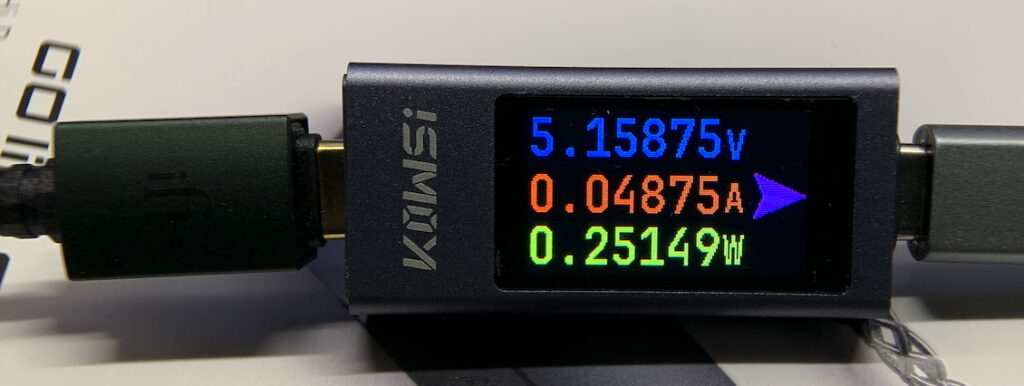
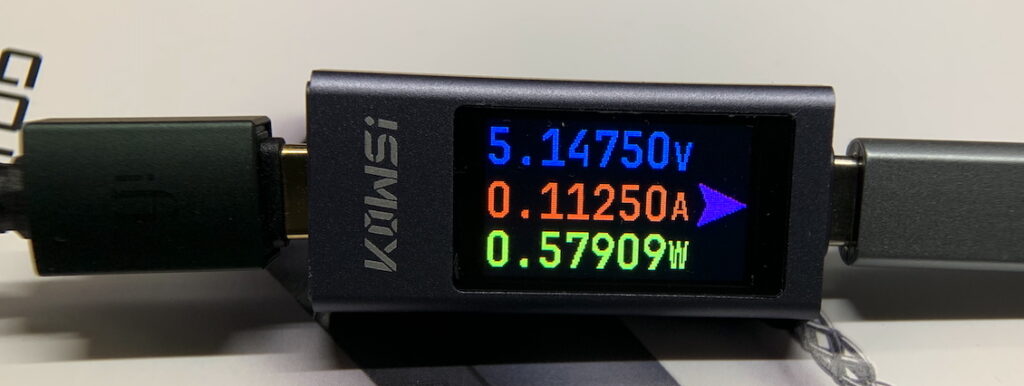
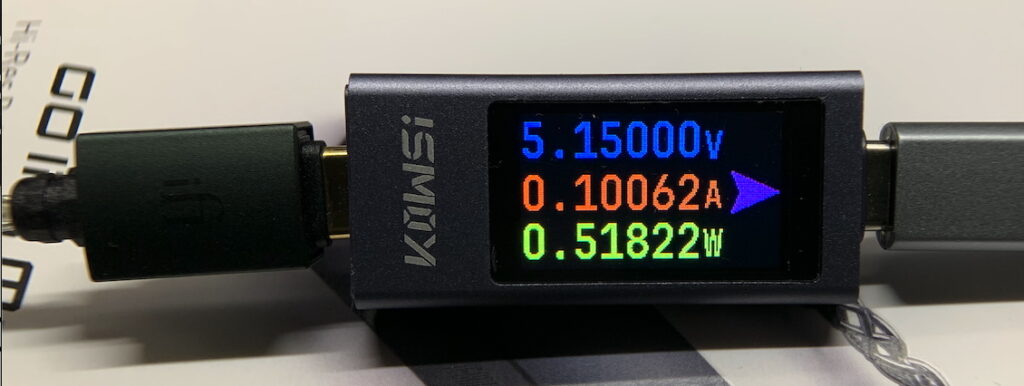
It consumes about 0.48-0.11A at various resolutions, which isn’t bad, but is average for other dongles. So it has a minimal impact on a smartphone’s battery, and even less so on a laptop.
For intense listening, the impact is minimal but still worth considering. When connected and active, it uses more power than the standard headphone output, so it consumes slightly more, but it’s absolutely acceptable.
Timbre:
The iFi GO Link Max offers a sound profile that, for my taste, is truly pleasant. One thing I’ve always appreciated about iFi products is the naturalness of their sound that I don’t often find in other devices: they never seek an artificial “wow” effect, but a mature, rich, and believable balance.
Bass:
The bass is well-controlled, with good definition and speed, without ever becoming bloated or intrusive. It doesn’t dive to stratospheric depths but has the right density that gives the music substance. It doesn’t have that “empty” or dry feeling found in some cheap dongles; on the contrary, the slightly “wet” character of the bass, that extra touch of body, gives it a pleasant tactile feel. In practice, if the recording has a punchy bass, the iFi GO Link Max follows it without smoothing it out, but without overdoing it either.
Mid-range:
Midrange The midrange is one of the strong points. Vocals are clear and present, with well-defined instruments and a very natural balance. The midrange is slightly forward but never excessive or shouty. It has a controlled brilliance that provides dynamics and presence, but without becoming fatiguing. The body of the notes isn’t heavy; it remains clean and lean, yet with enough substance to make everything credible even in the most complex vocal pieces. The iFi signature is evident here: a midrange that doesn’t compress, fade, or alter the natural timbre.
Highs:
The highs are open and airy, with good brightness but without becoming sharp. The delivery is balanced: there’s no excess energy that pushes toward artificial brightness, but neither is there a timidity that drowns out detail. It’s a high range that adds air, breadth, and a hint of sparkle, all without turning into sibilance or harshness, unless it’s already present in the recording. Overall, it slightly improves the perception of micro-details and maintains good tonal contrast even with warmer IEMs.
Soundstage & Imaging:
For a dongle, the soundstage is surprising: good separation, a decent sense of spaciousness, and a depth that exceeds the category average. It’s not at the level of a high-end desktop amplifier, and you wouldn’t expect it to be, but what matters is that the GO Link Max never sounds compressed or congested. The soundstage doesn’t collapse, flatten, or become muddy: it remains coherent and airy enough to follow complex mixes without losing instrument placement.
In Summary:
A mature, convincing, natural sound with a musicality that makes you want to keep listening. Perfect for advanced listening on the go or for compact setups where you want real quality without sacrificing practicality.
Filters:
There are no selectable digital filters or multiple gain modes. The design focuses on simplicity and direct signal quality: an advantage in terms of ” fewer frills, more music.”
This option is fine for those who want “plug & play,” but it could be limiting if you want to fully customize the EQ or handle complicated signals. In this case, you will need to do this before the Dangle.
So? Do I like this iFi Go Link Max?
I could simply say “yes, I like it a lot,” but that wouldn’t be honest.
Nowadays, we’re increasingly demanding and want more from everything, and I’m no exception.
Overall, I really appreciated the Go Link Max, much more than its smaller brother (without the MAX). I consider it a leap forward, both for the two outputs and for the more mature tone.
I’ve always appreciated IFI’s mid-range products, because they manage to deliver a very natural sound at a reasonable price, of course if we go to the high-end desktop line, then there is a lot to listen to and certainly even better.
In this mid-price range, the iFi has an edge over other dongles. Its sound has a naturally velvety quality, never fatiguing, almost silky.
When I listen to Diana Krall – Live in Paris, in the splendid rendition of “Just the Way You Are“, the voice is so real it feels like she’s right in front of the microphone. The sound is intimate, warm, with a believable presence and a breathing soundstage. Then comes that break between the tubular bells and the bass: a moment in which you perceive all the dynamics, controlled yet alive, precise, never forced. It’s one of those sensations that demonstrates how this little DAC manages to maintain a surprising musical balance.
On the rock side, however, the iFi tends to smooth out the rough edges, as if to soften the rougher character of the electric guitars. It’s not a loss of detail; rather, it’s a choice of taste.
The result is a more “human” sound, less metallic, far from the glassy coldness of certain overly analytical dongles. The most energetic recordings become more musical, more listenable, even over long sessions.
And then there’s that moment that’s never missing from my tests: “Dixie Chicken” from Little Feat’s live performance of “Waiting for Columbus“. The very beginning, with the Dixieland-flavored piano and the echoing electric guitar, puts a smile on your face. But it’s when the bass and drums come in that the piece comes to life, pulsating real. The iFi Go Link Max delivers everything with surprising vitality, and when the two trumpets and the clarinet begin to interact on stage, the scene opens up, three-dimensional. You can clearly perceive where the musicians are, and the harmony that is created is pure magic. It’s moments like this that make you stop for a moment and think, “This is why I love music“.
As you can see, I really liked it, even if it’s not analytical or hyper-powerful, but its harmony and naturalness are worth the money. I recommend at least 40-50 hours of use before making a serious evaluation.
Comparison Test:
Estimated average price: ~89 USD at the time of review.
~-30% range (~50-60 USD): very basic DAC/amp dongles, less power, no balanced outputs, less performing DACs.
Even price range (~80-90 USD): The iFi GO Link Max appears to be one of the best options: power, balanced 4.4mm output, hi-res support, dual Sabre chips.
~+30% price range (~100-120 USD or more): There are more powerful dongles or dongles with advanced features (more outputs, integrated filter, more robust amplifier stage). If you drive very demanding headphones or are looking for a “mobile desktop,” you could go up, even significantly.

Comparison with the Hidizs S9 Pro Plus:
The Hidizs S9 Pro Plus is a dongle for those seeking detail and incisiveness. It surprises with its resolution and transients, with a slightly wider soundstage and the impression of more “air” around instruments.
The iFi GO Link Max, on the other hand, aims for naturalness, a warmer and “woodier” tone, more natural vocals, and a more engaging presence, prioritizing listening pleasure over pure analysis.
On the bass, the S9 Pro Plus is more extended but controlled, at times even too “restrained,” while the iFi offers meatier and rounder mid-bass.
In short, choose the S9 Pro Plus for detail and soundstage and the iFi for musicality and naturalness.
Conclusion on Questyle iFi Go Link Max:
The iFi GO Link Max is a true upgrade for those who listen on the go or with a notebook/laptop and want sound quality that’s significantly superior to the built-in headphone output. It’s well-built, powerful, supports hi-res formats, and offers a 4.4mm balanced output, a rare plus in this price range.
If you’re looking for something serious but compact, I highly recommend it.
If, however, you have ultra-expensive headphones or want a desktop system with a dedicated amplifier, you might want to consider a higher-end solution.
I see it as perfect for on-the-go use, for laptops/PCs, or even as part of a minimal secondary home audio setup.
RATING:
⭐ 8.5 / 10
PROS:
- Balanced 4.4mm + 3.5mm single-ended output
- Excellent power for its category
- Hi-Res support (PCM 384kHz, DSD256)
- Compact construction and quality materials
- Excellent value for money
CONS:
- No digital filter or built-in gain control (not a con for my use)
- Integrated cable may be less flexible than detachable cable solutions
- For very high-impedance or ultra-demanding headphones, the resolutions. room for improvement
Who sells it:
Available through the official iFi Audio website and numerous European online retailers.
I purchased from: Murerca
I’m mentioning this company for two reasons. The first is that the promotional price is slightly lower than average. The second, and what really matters, is that I publicly thank them: I had a problem with the courier, and they were professional and extremely helpful in resolving it. For me, that means more than any discount.



No Comment! Be the first one.